

Everyone on social media is making money from option trading. Or at least that is what they want you to believe.
The glamour is real, but the graveyard is much bigger. Behind every viral trading screenshot is a story nobody is telling you. A story of margin calls, borrowed money, and sleepless nights.
Most beginners never see the hidden risks until their capital is already gone. One wrong move in a leveraged position and everything vanishes in minutes.
It sounds dramatic, but this is the reality of thousands of traders in India every single year.
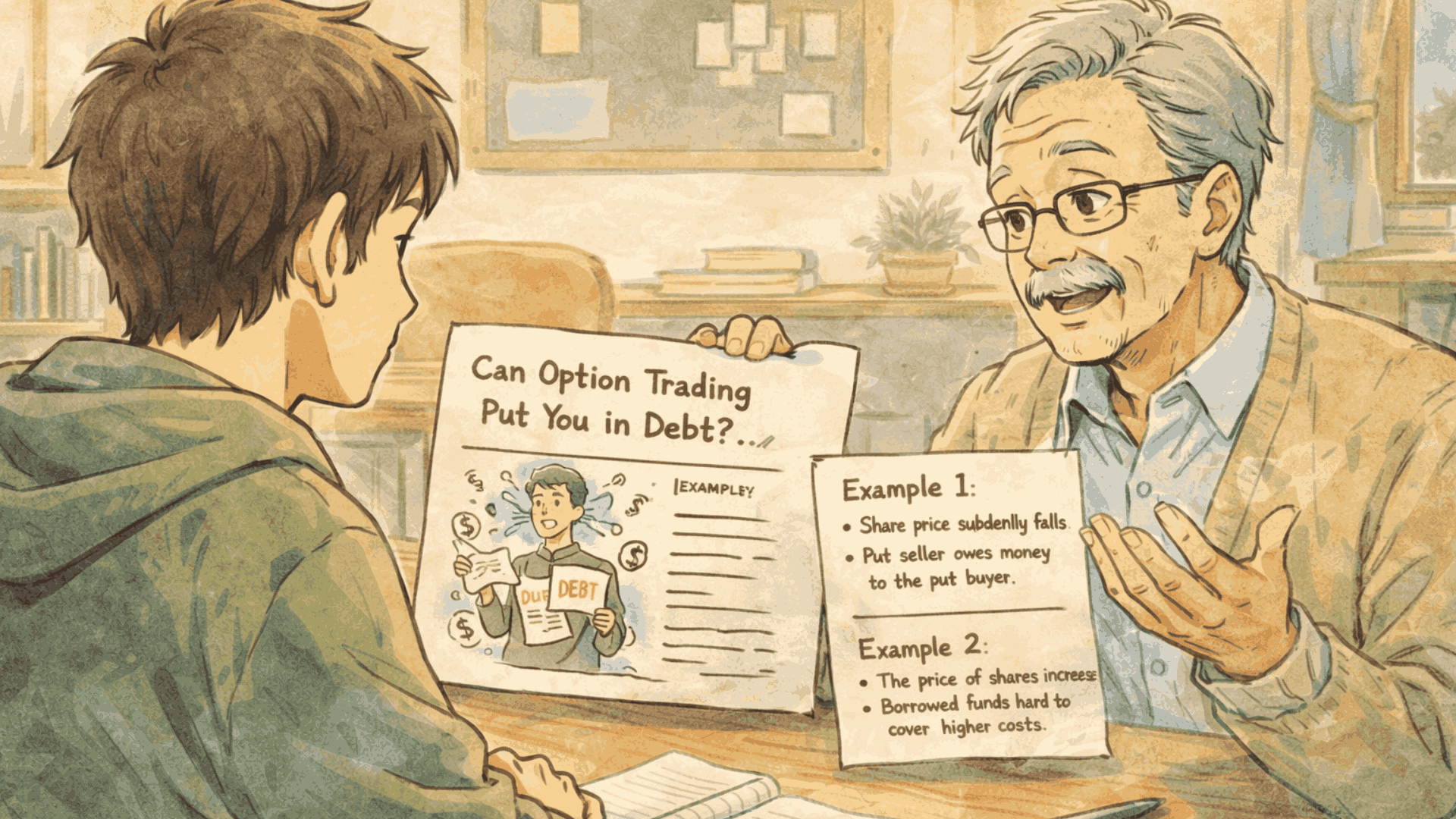
So before you place your next trade, ask yourself one question: Can option trading put you in debt?
In this blog, we kill the dark and show you exactly what nobody in those viral videos ever talks about.
Can You Go Into Debt Trading Options?
To understand how debt happens, we need to look at Option Selling (Writing). Most retail traders start by “buying” options because it requires very little money.
When you buy an option, your maximum loss is limited to the premium you paid.
However, the real danger lies in “Selling” or “Writing” options without proper hedging.
When you sell an option, you are acting like an insurance company. You collect a small premium, but you take on “unlimited risk.”
If the market moves violently against your position, such as a sudden 1,000-point gap in the Sensex due to a global event, your losses can multiply exponentially.
In such cases, your broker will issue a Margin Call.
If your option trading margin falls below the required level because the loss is greater than your capital, the broker has the right to sell your other holdings (like your long-term stocks or mutual funds) to recover the money.
If even those are not enough, you are legally obligated to pay the remaining balance to the broker.
This is the most common technical path to debt in the derivative market.
Can Options Put You in Debt?
Beyond the technicalities of margin calls, there is a “behavioral” side to the debt trap. In India, many traders are unfortunately using borrowed capital to trade options.
It includes taking personal loans, using credit card limits, or borrowing from “instant loan apps” to fund their trading accounts.
It creates a “Double Debt” scenario:
- The Trading Loss: Options are a zero-sum game where most people lose. If you lose the borrowed ₹1 lakh, that money is gone.
- The Interest Burden: You still have to pay back the loan plus the high interest rates associated with personal loans or credit cards.
Many traders fall into the trap of Revenge Trading. After losing their initial capital, they borrow more money, hoping to “win back” their losses.
Because they are trading under immense pressure to pay back a loan, they make emotional mistakes, take even higher risks, and eventually spiral into a massive debt crisis that can affect their family and future.
Why Option Trading is Profitable?
If options are so dangerous, why does everyone do it? The truth is that option trading can be profitable, but only for a very small percentage of participants (only 10% according to SEBI).
While beginners often ask can option trading make you rich, the reality is that wealth in this market is built through consistency rather than overnight luck.
When you ask can option trading be a career, the answer depends entirely on your approach; the 10% of traders who are profitable treat options as a business rather than a gamble
When you learn how to do option trading with a professional mindset, you realize it is not about “guessing” but about managing risk.
They focus on:
- Hedging: They never leave a “Sell” position open without a “Buy” position to limit the risk.
- Risk-Reward Ratio: They only take trades where the potential profit justifies the risk.
- Defined Stop Losses: They exit the market immediately when their logic is proven wrong, preventing a small loss from becoming a debt-inducing disaster.
- Using Data: They rely on Open Interest (OI) and Option Chain analysis rather than “tips” or “gut feelings.”
How Much Money Do You Need to Trade Options Safely in India?
Most beginners never ask this question. They just start trading with whatever they have.
Sometimes ₹5,000. Sometimes ₹10,000. And that is exactly where the problem begins.
Undercapitalization is one of the biggest reasons that option trading can put you in debt becomes a real nightmare.
The money you start with does not just affect your profits. It decides whether you survive in this market at all.
1. SEBI’s New Capital Rules
SEBI increased the minimum contract value for index derivatives from ₹15 lakh to ₹20 lakh in November 2024. This was not a random decision.
Too many retail traders were entering with too little money.
Too many were ending up in serious financial trouble. The regulator had to step in.
2. Stop Trading With Borrowed Life
Is your trading money paying rent next month? Is it your EMI? Then stop. Trading with essential money creates panic, panic creates bad decisions, and bad decisions create losses.
And that is how option trading puts you in debt, becomes your story too.
3. Only Risk What You Can Lose
Simple rule. If losing this money would hurt your family, it does not belong in a trading account.
No trade is worth that risk. None.
4. Build Your Safety Net First
Keep 12 months of living expenses aside. Put it in a fixed deposit. Do not touch it. Not even once. Not even for a trade that looks perfect.
Before your next trade, ask yourself one question. Is this money truly free? Because if it is not, you already know the answer to whether option trading puts you in debt.
Start safe. Start smart. Give yourself a real chance.
Conclusion
The “Dark Side” of options trading is often hidden behind the glamour of quick profits. We have answered the primary question: Can option trading put you in debt?
Yes, it can, through both unlimited-risk selling strategies and the dangerous habit of trading with borrowed money.
Options are powerful financial tools, but they are like a sharp knife; they can help you prepare a meal, or they can cut you deeply if handled carelessly.
If you are a beginner, stay away from “Naked Option Selling” and never, under any circumstances, trade with money that you have borrowed.
New to options trading? Don’t let one mistake cost you everything. Join our option trading classes and learn risk management and trading basics through real market guidance.
FAQs
Q1: Is buying options safer than selling them?
Ans: In terms of debt, buying is “safer” because you can only lose the premium you paid. However, the probability of winning as a buyer is very low (around 33%), which means you can still lose your entire capital over time.
Q2: Why Do Most People Lose Money in Options?
Ans: Most people lose money in options because they treat it like gambling, trade without a strategy, and let emotions make decisions that logic should be making.
Q3: What is a “Black Swan” event in trading?
Ans: It is an unpredictable, rare event that causes an extreme market move (like the COVID-19 crash). Such events are the primary cause of debt for option sellers who do not hedge their positions.
Q4: Can my broker sue me if my account goes into a negative balance?
Ans: Yes. When you open a trading account, you sign a “Know Your Client” (KYC) agreement. You are legally responsible for any debit balance in your account. The broker can take legal action to recover the funds.
Before investing capital, invest your time in learning Stock Market.
Fill in the basic details below and a callback will be arranged for more information: