



Every trader who follows the Indian stock market has seen sudden vertical rallies on the chart. An index like NIFTY 50 may remain flat or bearish for most of the day, and then suddenly surge upward within minutes.
For beginners, this can feel confusing and unpredictable. The key question many traders ask is: does short covering increase price and cause these explosive moves?
In simple terms, short covering happens when traders who sold earlier rush to buy back their positions as the market moves against them.
This creates a burst of buying activity that pushes prices higher quickly.
Learning how short covering increases price can help traders recognize these powerful market moments and understand the hidden forces driving price action.
How Does Short Covering Increase Price in Stock Market?
Short covering increases price because it represents “forced” buying. It is not a choice; it is a necessity for the bears to survive.
To understand why, we need to look at the pressure created by trapped sellers.
Here is a detailed breakdown of why and how this happens:
- The “Buy to Close” Requirement: In the stock market, “Shorting” involves selling a security you don’t own (in futures) or writing an option you don’t hold. To finish the trade and book a profit or loss, the trader must buy the security back. This “Buy to Close” order is the same as a regular “Buy” order in the eyes of the exchange.
- Massive Demand Spike: When a stock starts rising unexpectedly, hundreds or thousands of short sellers get nervous at the same time. When they all hit the “Buy” button simultaneously to exit their positions, it creates a massive surge in demand. Since everyone is buying and no one is willing to sell at those lower prices anymore, the price must go up to find new sellers.
- The Stop-Loss Cascade: Most professional short sellers have a “Stop-Loss” order placed above a certain resistance level. If the price touches that level, their broker automatically sends a “Buy” order to the market. When one stop-loss is hit, it pushes the price higher, which hits the next person’s stop-loss, creating a domino effect that sends the price soaring.
- Panic and Urgency: Unlike regular buyers who might wait for a “dip” to buy, short sellers who are losing money are in a state of panic. They are willing to buy at “Market Price” just to get out. This lack of price sensitivity increases the price so rapidly compared to normal buying.
- Liquidity Vacuum: Often, during a short covering rally, the “Ask” side of the order book becomes empty because sellers are afraid to stand in the way of the rising tide. This vacuum allows the price to jump large gaps in seconds.
Example of Short Covering Increasing Price
A good example can be seen in the movement of NIFTY 50 during an expiry day.
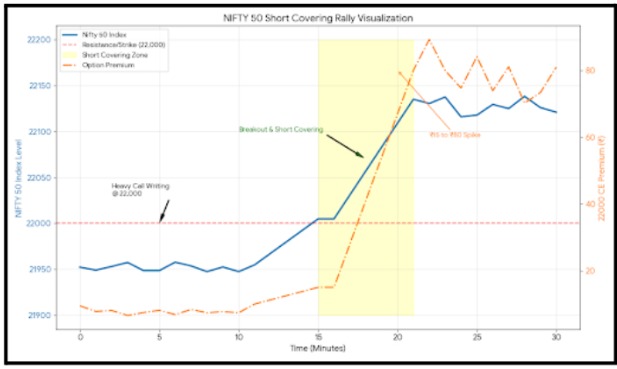
Suppose Nifty is trading around 21,950, and many traders have sold the 22,000 Call Option, expecting the market to stay below that level.
This creates huge call writing and high open interest at 22,000.
Suddenly, Nifty starts rising due to buying pressure and crosses 22,000. As the price moves above this level, call option sellers begin to panic because their losses start increasing.
To exit the trade, they rush to buy back the call options they previously sold. It creates a sudden spike in demand.
As hundreds of sellers try to buy at the same time, Nifty may quickly jump from 22,000 to 22,120 or 22,150 within minutes.
The call option premium may jump from ₹15 to ₹80 very quickly. This is where short covering increases the price rapidly in the market.
Why Short Covering Happens?
Short covering isn’t just a random price jump; it’s a reaction to pure “pain” in the market.
It happens when traders who bet on a price drop get trapped as the market moves upward. To stop their losses from spiraling, they are forced to hit the “Buy” button immediately.
Think of it as a domino effect: one trader’s stop-loss gets triggered, which pushes the price higher, hitting the next person’s stop-loss.
This “forced buying” creates a massive demand spike, especially during F&O expiry when the pressure to close positions is at its peak.
In simple terms, bears aren’t buying because they’ve turned bullish; they’re buying to survive.
Identifying this through falling Open Interest is a game-changer, helping you spot those vertical rallies before they fizzle out.
Short Covering Impact on Stock Price
Short covering has a strong and immediate impact on stock prices, often leading to sharp upward movements.
It occurs when traders who previously sold positions rush to buy them back, creating sudden buying pressure.
As more short sellers exit simultaneously, demand increases rapidly while supply remains limited, pushing prices higher.
This effect is further amplified when stop-loss levels are triggered, causing a chain reaction of buying.
Unlike normal bullish trends, such moves are fast and driven by urgency rather than fresh investment. Once the short covering phase ends, the price may stabilize or follow the broader market trend.
How Does Short Covering Affect Stock Price?
The effect of short covering on price is characterized by speed and verticality.
- Vertical Price Action: Unlike a steady uptrend that moves in a zigzag pattern, short covering moves are often straight lines. On a 5-minute chart, you will see 3 or 4 giant green candles with almost no “wicks” at the top.
- Expansion of Spreads: During intense covering, the difference between the “Bid” and “Ask” price widens. This makes the price move in larger “jumps” rather than small increments.
- Volatility Spike: Even though the price is going up, the India VIX may spike briefly during the initial panic phase. However, as short covering completes and the market stabilizes at higher levels, VIX typically begins to cool down. A sustained VIX spike alongside rising prices is unusual and generally only occurs during extreme squeeze events.
- Breakout Confirmation: Short covering often turns a “Potential Breakout” into a “Confirmed Breakout.” By pushing the price far beyond a resistance level, it forces the rest of the market to accept the new higher price.
Short Covering Meaning in Options
In the options segment, short covering is even more explosive due to a factor called “Gamma.” Short covering in options usually refers to “Shorts” in Call Options.
Market makers and institutional “Call Writers” sell calls to collect premiums, betting that the market won’t rise.
However, if Nifty starts moving up, the “Delta” of those calls increases.
- The Squeeze: As the call premium rises, naked call sellers face theoretically unlimited risk. However, call sellers who are hedged such as those running covered calls or spreads, have their risk capped. The panic buying and short covering in call option is primarily driven by naked or under-hedged call sellers.
- The Data Signal: You can identify this in the option chain by looking for Price UP + Open Interest DOWN. Learning how to predict short covering using these metrics allows a trader to anticipate the next phase of the move.
- Impact: This leads to a “Short Squeeze.” On an expiry day, a call option priced at ₹10 can jump to ₹100 in thirty minutes. This move is driven by a combination of Gamma explosion, Delta acceleration, and short covering by call sellers, not short covering alone.
Understanding the short covering meaning in options helps you realize that the “Option Chain” is not just a table of numbers; it is a map of where traders are feeling the most pain.
Conclusion
Short covering is a game-changer for any retail trader. We have answered the fundamental question: does short covering increase price?
Yes, it does, and it does so with a force that regular buying can rarely match. By recognizing that short covering means bullish or bearish depending on your timeframe, you can avoid the trap of becoming a “permanent bull” during a temporary squeeze.
In the Indian stock market, where volatility is the only constant, the ability to read the “pain” of the sellers through Open Interest and Price action is your greatest edge.
Master concepts like short covering, option chain analysis, and expiry trading with live market examples in our stock market classes.
Join today and learn how professional traders read real market moves.
FAQs
Q1: How can I confirm that a rally is happening because of short covering and not fresh buying?
Ans: Traders can confirm short covering by checking the relationship between price and open interest.
If price is rising while open interest is falling, it usually indicates that existing short sellers are exiting their positions rather than new buyers entering the market.
Q2: Why do prices move so fast during short covering rallies?
Ans: Prices move quickly because short sellers rush to buy back their positions at the same time to limit losses.
This sudden surge in buy orders creates strong demand, causing the price to spike rapidly within minutes.
Q3: Can short covering happen in both stocks and index options like Nifty or Bank Nifty?
Ans: Yes, short covering can happen in individual stocks as well as index derivatives like Nifty and Bank Nifty.
In fact, it is more common in the F&O segment where traders take leveraged short positions.
Q4: Is it safe for beginners to trade during a short covering rally?
Ans: Short covering rallies can be profitable but also highly volatile.
Beginners should be cautious because these moves can reverse quickly once the short sellers finish covering their positions.
Q5: How to identify short covering early in the market?
Ans: Traders usually watch option chain data, open interest changes, resistance breakouts, and sudden increases in volume.
A combination of price breakout and falling open interest often signals the start of short covering.
Before investing capital, invest your time in learning Stock Market.
Fill in the basic details below and a callback will be arranged for more information: