

Every trader keeps a close eye on the price movement of Nifty and Bank Nifty. When the market starts falling, fear grips the retail investors, and many rush to buy “Put Options” to profit from the decline.
But have you ever noticed a situation where the market stops falling, begins to stabilize, or even starts a minor recovery?
During such times, if you look at the derivative data, you will often see a phenomenon called long unwinding in put option.
Understanding this concept is crucial because it tells you that the “Bears” (the traders betting on a market fall) are starting to lose their conviction or are simply booking their profits.
While a “Long Build Up” in puts signifies an aggressive bet on a market crash, a long unwinding in put option signifies the end of that bearish momentum.
In this blog, we will break down exactly what this means, how to spot it in the option chain, and how you can use it to stay ahead of the curve.
What is Long Unwinding in Put Option?
To understand this, we first need to define a “Long Put.” A trader goes long on a put option when they expect the stock or index to go down.
If their prediction comes true and the market falls, the premium (price) of that put option increases, giving the trader a profit.
However, a trader cannot hold that position forever. At some point, they must “square off” or exit the trade.
When a large number of these put buyers decide to exit their positions simultaneously, it is called a long unwinding in put option.
Technically, a long unwinding in put option mean that two specific things are happening in the market data:
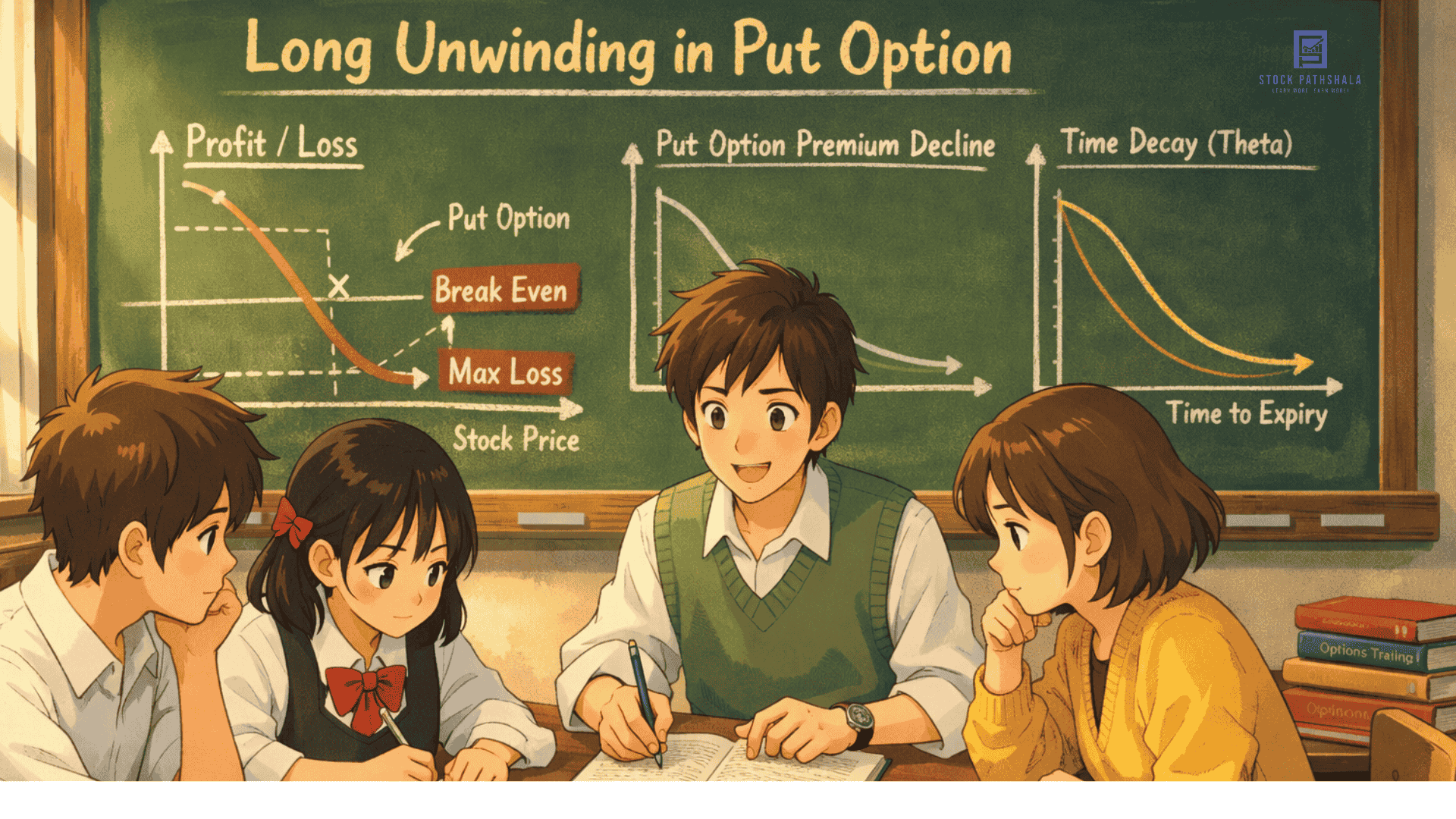
- The Price (Premium) of the Put Option is falling: Since buyers are now selling their contracts to exit, the selling pressure pushes the premium down.
- The Open Interest (OI) is decreasing: Since these are old contracts being closed rather than new ones being created, the total number of outstanding contracts in the market drops.
In simpler terms, the people who were betting that the market would crash have decided to take their money and leave.
This usually happens when the market reaches a strong support level or when positive news hits the wires.
At this stage, many traders begin to think ahead and ask a practical question: What happens after long unwinding?
In most cases, the immediate effect is a slowdown in the existing trend. The selling pressure reduces as bearish positions are closed, which often leads to consolidation or a minor bounce in the market.
Long Unwinding in Put Option vs Call Option
It is very common for beginners to get confused between the different types of unwinding. While both involve traders exiting their positions, the market implications are the exact opposite.
In a long unwinding in call option, the traders who were bullish (expecting a rise) are exiting their positions. This usually happens after a big rally when the bulls want to book profits.
The result is often a minor dip or a sideways movement in the market.
On the other hand, a long unwinding in put option vs Call Option analysis shows that in a put unwinding scenario, it is the bears who are exiting.
- Call Unwinding: Bulls are leaving. Price of Call falls + OI falls. Sentiment: Bullish momentum is ending.
- Put Unwinding: Bears are leaving. Price of Put falls + OI falls. Sentiment: Bearish momentum is ending.
Understanding this distinction helps you realize that a fall in put OI is better interpreted as a reduction in active bearish pressure rather than a direct bullish signal.
It suggests that the downward momentum is weakening, but confirmation from price action is still needed before taking a long trade.
This is because the people who were profiting from the fall are no longer interested in holding their bearish bets.
How to Identify Long Unwinding?
The option chain is the most reliable tool for identifying this movement. Whether you are using the NSE India website or a professional trading terminal like Sensibull or Quantsapp, the data is available for everyone.
Here is how to spot long unwinding in put option:
- Select the Put Side: Look at the right-hand side of the option chain (the Put side).
- Check the ‘Change in OI’ Column: Look for negative values. If you see numbers like -5,00,000 or -10,00,000, it means a large number of put contracts have been closed.
- Check the ‘LTP’ (Last Traded Price) Column: Ensure that the price of the put is also decreasing (shown in red).
- Look at the Strike Prices: You will commonly see this at ‘In-the-Money’ (ITM) or ‘At-the-Money’ (ATM) put strikes, as these holders are already in profit after a decline. However, significant unwinding can also appear at ‘Out-of-the-Money’ (OTM) strikes when a key support level holds and traders exit to cut losses. These are the traders who have already made money from a previous fall and are now liquidating.
When you see a sea of negative OI changes on the put side, it is a clear sign of a long unwinding in put option. It tells you that the floor is being established and the bears are retreating.
Why Long Unwinding Happens in Put Options?
There are four primary reasons why a long unwinding in put option occurs in the share market:
1. Profit Booking at Support Levels
Just as bulls book profit at resistance, bears book profit at support. If Nifty is falling and reaches a psychological support like 21,500, the traders who bought puts at 22,000 will see massive profits.
To realize those profits, they must sell their puts.
This mass selling results in a long unwinding put option.
2. Time Decay (Theta) Near Expiry
Options have an expiry date. As the expiry date approaches (especially on Wednesday for Bank Nifty and Thursday for Nifty on NSE), the “time value” of an option melts away.
If the market is staying sideways and not falling further, put buyers realize they are losing money due to Theta decay.
They decide to exit their positions to save whatever premium is left.
3. Change in Market Sentiment
Sometimes, a sudden positive news event like a better-than-expected inflation report or a favorable government policy, changes the outlook.
Traders who were bearish suddenly realize the market might bounce back.
To avoid losses, they rush to exit their puts.
4. Technical Reversals
If a stock forms a “Bullish Piercing” or a “Hammer” pattern on the daily chart after a downtrend, technical traders see this as a reversal signal.
These traders, who might have been holding puts, will immediately unwind their positions to switch to a bullish stance.
How to Trade Long Unwinding in Put Option?
Trading based on unwinding data requires a contrarian mindset.
Developing a solid long unwinding strategy allows you to capitalize on the moment bears start to panic-buy their positions back to book profits.
Here is a simple strategy to trade:
- Wait for the Stabilization: Don’t buy a stock just because puts are unwinding. Wait for the price to stop making “Lower Lows.”
- Look for a “Price-OI” Divergence: If the market price is still slightly falling but the Put OI is falling sharply, it’s a sign that the selling is not “fresh” anymore. It is just old bears exiting. This is often the best time to look for a “Long” entry.
- The Scalping Opportunity: When bears unwind their puts, the bullish effect on the underlying is indirect. As put buyers close positions, market makers and dealers who were holding short delta hedges in the underlying (to hedge their long put exposure) now unwind those hedges by buying back the underlying.
This delta unwinding by institutional desks is what creates the actual upward pressure on the spot price, often leading to a short-term bounce. Traders can scalp 20-30 points in Nifty during this bounce.
- Use Stop Losses: Even if puts are unwinding, the market can still fall further if a “Short Build Up” starts on the call side. Always keep a stop loss at the recent swing low.
Mistakes Made During Long Unwinding in Put Options
Despite having the data, many retail traders fail to interpret a unwinding of long positions in put options correctly.
Here are the most common mistakes:
- Confusing it with Put Writing: In “Put Writing” (Short Build Up), the price of the put falls but the OI increases. In unwinding, the OI decreases. Many traders see falling put prices and think institutions are selling puts to support the market, when in reality, it’s just retail bears booking profits.
- Trading Too Early: Just because some bears are leaving doesn’t mean the market will skyrocket. Sometimes, put option long unwinding
is followed by a period of boring, sideways consolidation. - Ignoring the Call Side: You must look at both sides of the chain. If puts are unwinding but calls are seeing a “Long Build Up,” it’s a strong bullish signal. But if both puts and calls are unwinding, it simply means traders are confused and leaving the market altogether.
- Ignoring Global Cues: If the US markets are crashing, a local put option long unwinding in the Indian market might not be enough to stop the fall. Always look at the bigger picture.
Conclusion
The long unwinding in put option is a vital piece of the puzzle for any serious derivative trader. It is a sign of relief for the bulls and a sign of profit-taking for the bears.
By monitoring the long unwinding in the option chain, you can understand when a downward trend is losing its steam.
Remember, trading is not just about following the price; it is about following the “Open Interest.” When you see a exit of long positions in puts, the market is telling you that the bears are heading for the exit.
It is a time to be cautious with your short positions and start looking for potential buying opportunities at support levels.
Stay disciplined, watch the data, and always trade with a plan!
If you are interested in learning the concept of long unwinding, you can learn it through our live stock market classes at Stock Pathshala.
FAQs
Q1: What does long unwinding in put option indicate about market direction?
Ans: Long unwinding in put option indicates that traders who were previously bearish are exiting their positions. Since put buyers profit from falling markets, their exit usually signals that downside momentum is weakening.
It often suggests market stabilization or a potential short-term bounce.
Q2: Is long unwinding in put option bullish or bearish?
Ans: Long unwinding in put option is generally considered a sign of weakening bearish momentum rather than a direct bullish signal.
It reduces downside pressure but must be confirmed with price stabilization and supportive broader market conditions before treating it as a buy signal.
Q3: How is long unwinding in put option different from put writing?
Ans: In long unwinding in put option, both the Put premium falls and Open Interest decreases, meaning existing buyers are closing positions.
In put writing (short build-up), the premium falls but Open Interest increases, indicating fresh sellers entering the market. The OI data makes the key difference.
Q4: At which strike prices does long unwinding in put option usually occur?
Ans: It commonly appears in In-the-Money (ITM) or At-the-Money (ATM) strike prices after a strong market decline.
These are the strikes where put buyers are already in profit and prefer to exit when the market reaches a support level.
Q5: Can long unwinding in put option be used for intraday trading?
Ans: Yes, intraday traders often use long unwinding in put option to identify short-term reversal or bounce opportunities. If Put OI is sharply decreasing while price stabilizes, it may signal a quick upside move.
However, traders must confirm with price action and maintain strict stop losses.
Before investing capital, invest your time in learning Stock Market.
Fill in the basic details below and a callback will be arranged for more information: