


If you observe the stock market closely, you will notice that prices sometimes fall even when there is no aggressive selling.
Many traders assume that bears are entering the market, but that is not always true. Sometimes the fall happens because earlier buyers are closing their positions. This situation is called long unwinding.
In simple terms, long unwinding occurs when traders who previously bought futures or options exit their positions, leading to a fall in both price and open interest.
Understanding this concept is important because it helps traders interpret market sentiment correctly and answer the key question: long unwinding means bullish or bearish?
Does Long Unwinding Mean Bullish or Bearish?
In derivatives trading, long unwinding occurs when traders who previously bought positions start closing them, causing both price and Open Interest to decline.
It usually happens when investors book profits after a rally.
As buyers exit the market, upward momentum weakens, and prices begin to fall gradually.
While the price decline may look bearish, it is different from aggressive selling, like a short build-up.
To understand the signal correctly, we must examine two perspectives on whether long unwinding is bullish or bearish in market behaviour.
Is Long Unwinding Bullish?
A common question among beginners is: Is long unwinding Bullish? After all, the word “Long” is right there in the name.
The short answer is: No, it is not bullish.
To be bullish, a market needs fresh buyers and rising prices. In a long unwinding scenario, the buyers are actually leaving the market. They are “squaring off” their trades.
Imagine a party where the host stops bringing in new food and the guests start leaving one by one. The party isn’t necessarily “crashing,” but it is certainly coming to an end.
If you see long unwinding, it is a signal to stop looking for immediate “Buy” opportunities. The bulls are no longer confident that the stock will go higher in the immediate future.
Therefore, Is long unwinding Bullish? Definitely not. It is the absence of bullishness.
Is Long Unwinding Bearish?
Now, let’s look at the other side. Is long unwinding bearish?
Technically, yes, it is bearish, but with a caveat. It is a “passive” form of bearishness.
When we talk about a “Bear Market,” we usually mean “Short Build Up,” where sellers are aggressively pushing the price down to make a profit from the fall. In long unwinding, the price is falling simply because the “support” from the buyers has been removed.
Think of it as a ladder.
In a short build-up, someone is actively pulling the ladder down. In Long Unwinding, the person holding the ladder simply lets go and walks away. In both cases, the person on the ladder falls, but the reason is different.
Long unwinding creates negative price action, making it bearish in the short term. However, it usually doesn’t trigger a catastrophic crash unless it evolves into a short build-up later.
Example of Long Unwinding in Stock Market
To make this concept crystal clear, let’s look at a practical long unwinding meaning in a stock market example using Nifty.
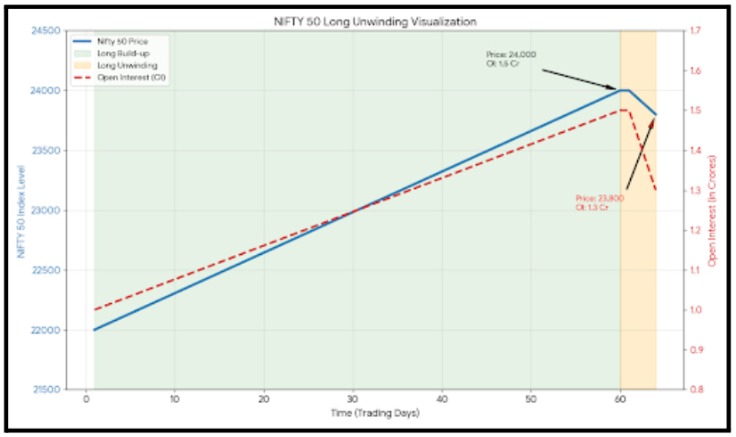
Suppose Nifty has been on a great run, moving from 22,000 to 24,000 over two months.
- At 24,000, the Open Interest is 1.5 crore contracts.
- The next day, Nifty hits a resistance level and drops to 23,800.
- You check the data and see that the Open Interest has fallen to 1.3 crore contracts.
What does this tell you?
It tells you that 20 lakh contracts were closed. The traders who bought at 22,000 or 23,000 are now happy with their 1,000-point gain and are exiting.
As they sell their futures or close their long call positions to exit, the price slips to 23,800.
This specific movement is often seen during long unwinding in call option contracts, where buyers who were bullish now decide to take their money off the table.
Note that exiting a long call means selling the call contract back; it does not mean selling the underlying directly.
The price impact from options unwinding is indirect, whereas futures unwinding directly impacts the underlying price.
Understanding this long unwinding meaning in the stock market allows you to stay calm and realise that the market isn’t necessarily “collapsing”, it’s just rebalancing.
Short Build Up vs Long Unwinding
Many traders get confused between these two because both result in a falling price. Let’s discuss the features of both in a tabular form:
| Feature | Long Unwinding | Short Build Up |
| Price Action | Decreasing | Decreasing |
| Open Interest | Decreasing | Increasing |
| Participant Type | Old buyers exiting | New sellers entering |
| Market Sentiment | Profit Booking / Weakness | Aggressive Bearishness |
| Intensity | Low to Moderate | High and Violent |
| Volume | Usually moderate | Usually very high |
The most important takeaway here is the Open Interest (OI). If the price is falling and OI is rising, you should be very scared because new bears are attacking.
But if the price is falling and OI is falling, how to identify long unwinding becomes clear; it is the signature of old buyers leaving.
This suggests the selling might stop once the profit-booking is over.
Knowing this distinction is what separates a professional trader from a retail gambler.
Long Unwinding Strategy
Now that you know about the long unwinding signal, how should you trade it? A critical part of your plan is anticipating what happens after long unwinding, so you don’t get trapped in a continuing slide.
You cannot use the same strategy for unwinding that you use for a fresh short move.
Here is a step-by-step guide:
- Don’t “Buy the Dip” Immediately: One of the biggest mistakes Indian retail traders make is buying as soon as the market drops 1%. If the data shows long unwinding, it means the buyers are still leaving.
Wait for the Open Interest to stabilise. If you buy while OI is still falling, you are catching a “falling knife.”
- Tighten Your Stop Losses: If you are already in a long position and you see the price slipping with falling OI, recognise that long unwinding means bullish or bearish for your current trade; it’s bad news.
This is the time to tighten your trailing stop loss or exit manually to protect your capital.
- Look for Support Levels: Since long unwinding is often just profit booking, the price will usually find support at a previous “base” or a moving average (like the 20-day or 50-day EMA).
Professional traders wait for the long unwinding to finish and then look for a “Long Build Up” at these support levels to re-enter the market.
- Use Option Spreads: If you still want to be in the market but see unwinding happening, switch from “Naked Calls” to “Bull Call Spreads.”
It reduces your risk from time decay and sudden price drops.
- Monitor the Put-Call Ratio (PCR): In a long unwinding phase, the PCR can move in either direction depending on which side the unwinding is occurring.
For instance, long unwinding in put option positions (bullish players exiting) will have a different impact on PCR than call buyers exiting. If call buyers are exiting (call OI falling), PCR may rise.
If put writers are closing positions (put OI falling), PCR may drop. Do not assume PCR always drops during long unwinding; always check which side of the option chain the OI is falling on.
Conclusion
Derivative data can completely change the way you interpret market movements. As we discussed throughout this guide, long unwinding means bullish or bearish depending on the context.
But, in most cases, it signals short-term bearish sentiment caused by profit booking rather than aggressive selling.
When price and Open Interest fall together, it simply means earlier buyers are exiting, and the bullish momentum is weakening.
Therefore, when traders ask if long unwinding means bullish or bearish, the correct interpretation is that it reflects a temporary pause or weakness in an uptrend, not necessarily a market crash.
If you want to learn how to analyse Open Interest, option chain data, and real market setups like professional traders, you can join our option trading classes.
In these sessions, expert mentors break down real market movements in Nifty, Bank Nifty, and stocks so you can apply these concepts confidently in your trading journey.
FAQs
Q1: Does long unwinding always indicate a bearish market?
Ans: Long unwinding generally signals short-term bearish sentiment because prices fall as existing buyers close their positions.
However, it does not always mean a strong downtrend, since the fall is caused by profit booking rather than aggressive selling.
Q2: Why does the price fall during long unwinding?
Ans: During long unwinding, traders who previously bought futures or options exit their positions to book profits.
It increases selling pressure while Open Interest declines, causing the price to move downward.
Q3: How can traders confirm long unwinding in the market?
Ans: Traders can confirm long unwinding when both price and Open Interest decrease simultaneously.
This combination indicates that existing long positions are being closed instead of new short positions being created.
Q4: What should traders do when long unwinding appears?
Ans: When long unwinding appears, traders should avoid buying immediately, monitor support levels, and wait for fresh buying signals, such as long build-up, before entering new long trades.
Q5: What is the difference between long unwinding and short build-up?
Ans: In long unwinding, price and Open Interest both fall, showing that earlier buyers are exiting the market.
In a short build-up, price falls, but Open Interest rises, indicating that new sellers are entering with strong bearish expectations.
Before investing capital, invest your time in learning Stock Market.
Fill in the basic details below and a callback will be arranged for more information: