


Most traders see a falling stock and instantly assume bears are in control, but that’s where many go wrong.
In the Futures and Options market, two stocks can fall by the same percentage yet behave completely differently afterward. The real story isn’t in the candle; it’s in the Open Interest data.
This is where Short Build Up vs Long Unwinding becomes critical to understand.
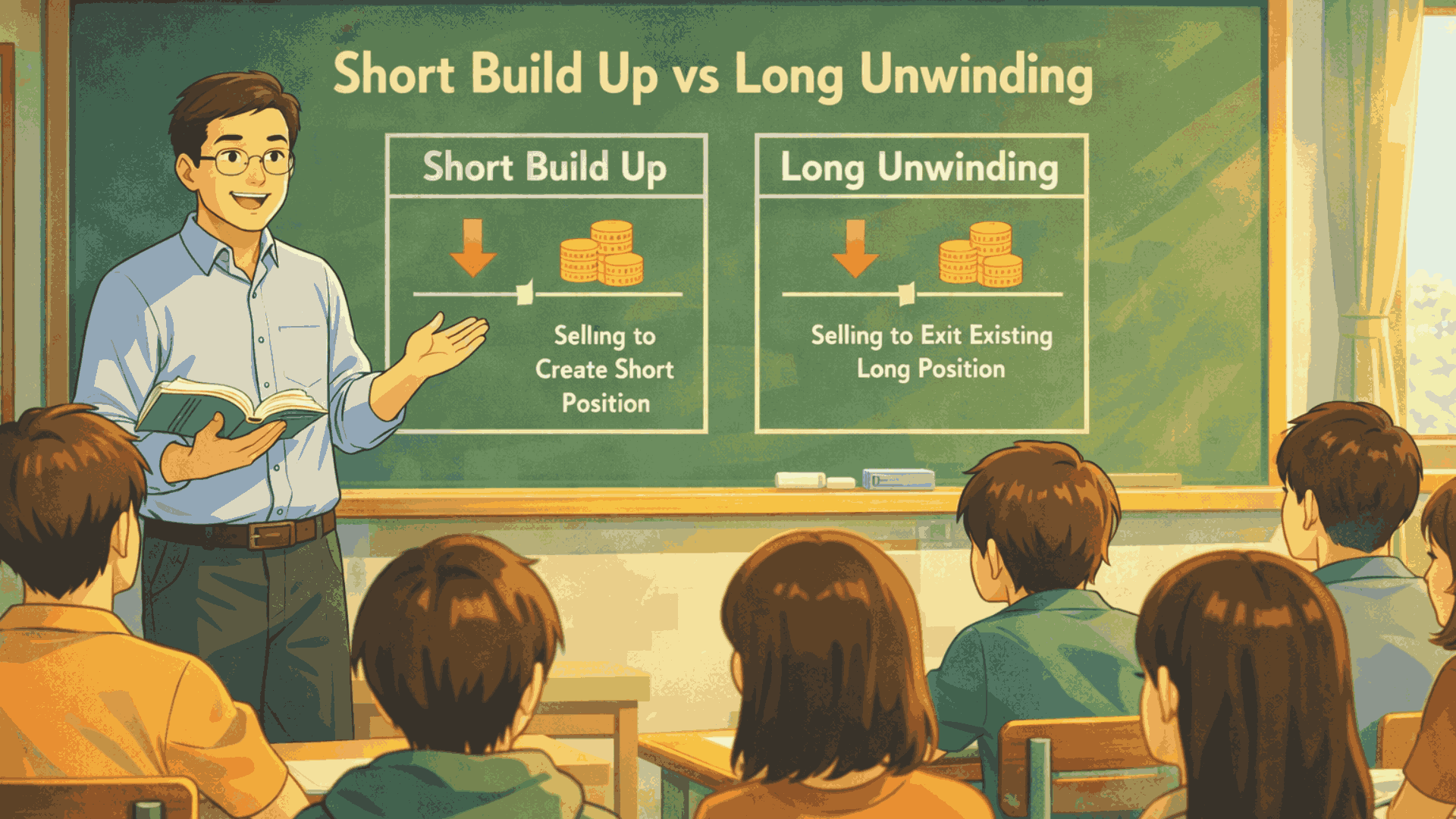
Short Build Up means fresh sellers are actively entering the market, while Long Unwinding simply means existing buyers are exiting.
Both create falling prices, both look identical on a chart, but they demand opposite responses.
So in this blog, we will break down exactly what Short Build Up and Long Unwinding mean and how to use this knowledge to make smarter, data-driven trading decisions.
What is Short Build Up And Long Unwinding?
Before we jump straight to the differentiation between Short Build Up vs Long Unwinding, let us understand the key concepts first to make the distinction clearer.
Both terms are rooted in how price and Open Interest move together, and without understanding each one individually, the comparison can get confusing.
In derivatives trading, every price movement carries a hidden layer of information about trader intent, and that intent is what separates a dangerous downtrend from a harmless one.
Are fresh sellers entering the market, or are existing buyers simply walking away? The answer to that one question changes everything about how you should respond as a trader.
So before we compare the two, let’s break them down one by one, so that when we finally put them side by side, the difference becomes completely obvious.
What Does Short Build Up Mean?
Short build-up is a derivatives market condition where traders actively create new short positions because they expect prices to fall.
It is identified when the price decreases while open interest increases, showing fresh selling pressure entering the market rather than just profit booking.
Knowing how to identify short build up early is essential for staying on the right side of a trend. You can spot this pattern by looking for these specific markers:
- Price declines due to aggressive selling
- Open Interest rises as new short contracts are added
- Indicates strong bearish sentiment
- Often appears at breakdown levels or after support is broken
- Usually signals continuation of a downward trend
In simple terms, short build-up means sellers are confident and entering the market with new bets on lower prices, so the fall is driven by fresh conviction and not merely by traders exiting existing positions.
Practical Example of Short Build-Up
Suppose a stock is trading at ₹1,000 near a major support level. Suddenly, the price breaks ₹980 and starts falling to ₹960. At the same time, Open Interest rises sharply by 12%.
This tells us that new short sellers are entering aggressively after the breakdown. The fall is not random; it is supported by fresh bearish conviction.
In such cases, the probability of further downside increases.
What Does Short Build-Up Indicate?
A short build-up indicates a structural shift in market sentiment from optimism to pessimism. It is a warning sign that the “Smart Money”, institutional investors, and high-net-worth individuals are actively positioning themselves for a downturn.
Specifically, it indicates:
- Conviction of the Sellers: Sellers are so confident that they are willing to lower their “Ask” prices to get their orders filled.
- A Supply-Heavy Market: The supply of contracts is increasing at a rate that far outpaces the demand from buyers, creating a vacuum that drags the price lower.
- Breakdown of Support: If a stock is trading near a critical support level and shows a short buildup, it indicates that the support is likely to break soon.
- Increasing Volatility: As more traders rush to short the stock, volatility typically spikes, leading to sharper and faster price drops.
Mastering the data allows you to align yourself with the dominant market force. Here is how a trader uses short build-up effectively:
- Confirming Sell Signals: When a technical indicator (like a MACD crossover or a Relative Strength Index breakdown) suggests a sell, a trader checks the OI. If it shows a short build-up, the signal is confirmed.
- Targeting Put Options: Traders look for stocks with heavy short build-up to buy Put options. The rising conviction often leads to “Gap Downs” the following day, yielding high returns for option buyers.
- Avoiding “Value Traps”: Retail investors often buy stocks that have fallen 10%, thinking they are getting a bargain. However, if the data shows a short build-up, the professional trader knows the stock is in a freefall and avoids buying until the build-up stops.
- Futures Trading: Active traders initiate fresh short positions in the futures market, using the previous day’s high as a stop-loss, riding the bearish wave created by the short build-up.
Short Build Up Means Bullish or Bearish?
If you are looking for a definitive answer, the Short Build Up means bearish.
In the four quadrants of price and OI analysis (Long Build Up, Long Unwinding, Short Build Up, and Short Covering), Short Build Up is the most negative quadrant. It represents the birth of a bear trend.
While Long Unwinding might just be a temporary dip in an uptrend, a Short Build Up is a sign of an active attack by the bears.
If you are holding a long-term investment, seeing a consistent short build-up in the futures of that stock is a signal to re-evaluate your thesis.
What Does Long Unwinding Mean?
Long unwinding is a situation in the derivatives market where traders who previously bought (held long positions) start closing their positions by selling them.
This leads to a fall in price along with a decline in open interest, showing that the market is not being pushed down by new sellers but by existing buyers exiting.
To understand how to identify long unwinding in a live market, you must look for the specific combination of a dipping price and a shrinking Open Interest (OI) column, which signals that capital is leaving the buy side rather than entering the sell side.
In a Long Unwinding in Put Option scenario, those who were betting on a market fall are now closing their trades, which causes both the put premium and the Open Interest to drop.
- Price falls because buyers are booking profits or cutting losses
- Open Interest decreases since positions are being closed, not created
- Indicates weakening bullish sentiment, not strong bearish aggression
- Often seen near resistance rejection or after a rally
- Can result in a temporary correction rather than a strong downtrend
In simple terms, long unwinding means the market is cooling off as bulls step aside.
A Long Unwinding in Call Option is the most common version of this, where the initial “fuel” of the rally is exhausted, which sometimes prepares the ground for stabilization or a future rebound instead of a crash.
Practical Example of Long Unwinding
Imagine a stock rally from ₹800 to ₹950 in two weeks. Near ₹950, the price starts slipping to ₹920 while Open Interest begins declining.
Here, traders who bought earlier are booking profits. There is no aggressive new short-selling. The decline is caused by bulls exiting, not bears attacking.
This often leads to consolidation near support rather than a full trend reversal.
What Does Long Unwinding Indicate?
Long unwinding indicates a phase of fatigue or a “cooling off” period in an ongoing uptrend. It is the market “taking a breath” after a long run. It indicates:
- Exhaustion of Buyers: At the current price levels, no new buyers are willing to step in and push the price higher.
- Profit Booking: It is often seen near psychological resistance levels (like 20,000 on the Nifty) where traders choose to take their cash off the table.
- A Non-Aggressive Fall: Unlike a short build-up, the price drop in long unwinding is often slower and less “violent,” as it is driven by exits rather than aggressive new entries.
- Testing Support: Long unwinding often pushes the stock price back to its “Mean” (average price) or a major moving average, where long-term investors might be waiting to buy again.
Knowing how traders use long unwinding can save you from making emotional decisions during a market dip.
- Waiting for the Floor: Traders watch for the point where the price stops falling, and the OI stops decreasing. This stabilization often marks the end of the profit-booking phase and the potential start of a fresh rally.
- Trailing Stop Losses: If a trader is in a long position and sees the price dipping with falling OI, they recognize it as long unwinding and tighten their stop loss to protect their existing profits.
- Distinguishing “Noise” from “Trend”: By identifying long unwinding, a trader realizes that the long-term bullish trend isn’t necessarily broken; it’s just taking a break. This prevents them from panic-selling their entire portfolio.
- Identifying the Next Entry: Professional traders often look for stocks in a long unwinding phase as potential “Buy on Dip” candidates, provided the fundamental story of the company remains strong.
Difference Between Short Build Up vs Long Unwinding
The primary difference between short build-up vs long unwinding lies in the “intent” of the traders and the flow of capital. While both result in falling prices, the behavior of Open Interest (OI) reveals the true story.
Let us have a look at the table below to understand the concept more clearly:
|
Feature |
Short Build Up |
Long Unwinding |
|
Price Action |
Falling | Falling |
| Open Interest (OI) | Increasing (New contracts added) |
Decreasing (Contracts settled/closed) |
|
Market Psychology |
Aggressive Bearishness | Profit-taking / Exhaustion |
| Money Flow | Fresh capital entering the sell side |
Capital exiting the buy side |
|
Sustainability |
High (Trend is likely to continue) | Moderate (Often a temporary correction) |
| Trader Action | Fresh Shorting |
Squaring off Longs |
While both Short Build Up and Long Unwinding result in falling prices, their underlying market dynamics are completely opposite.
Short Build Up reflects fresh bearish aggression with increasing Open Interest and new capital entering the sell side, making the downtrend more likely to sustain.
Long Unwinding, however, is simply existing buyers exiting their positions, causing Open Interest to drop.
Thus signaling exhaustion rather than conviction, and often leading to a temporary correction rather than a prolonged fall.
Conclusion
At the end of the day, a falling price is never just a falling price; it’s a question waiting to be answered.
Is the market being dragged down by aggressive bears, or are bulls quietly slipping out the back door?
Short Build Up tells you the bears are in charge and the trend has legs. Long Unwinding tells you it’s just exhaustion, and the real opportunity might be just around the corner.
The difference between a trader who panics and one who profits often comes down to this one distinction.
So the next time you see red candles, don’t just react; check the Open Interest, understand the intent, and let the data make the decision for you.
Want to master Short Build Up vs Long Unwinding and trade with confidence? Learn practical strategies with Stock Market classes and make smarter, data-driven trading decisions in the market today.
FAQs
Q1: What is the main difference between Short Build Up and Long Unwinding?
Ans: The main difference lies in the Open Interest behavior during a price decline. In a Short Build Up, price falls while Open Interest rises, indicating fresh short positions are being created and strong bearish sentiment is entering the market.
In Long Unwinding, price falls along with declining Open Interest, which shows that existing long positions are being closed rather than new short positions being added. One reflects aggressive selling, while the other reflects liquidation of previous buying.
Q2: Is Short Build Up bullish or bearish?
Ans: Short Build Up is clearly bearish because it shows that traders are actively initiating new short positions with the expectation of further downside.
The combination of falling price and rising Open Interest confirms fresh selling pressure.
It often appears near breakdown levels and usually signals continuation of a downtrend rather than a temporary dip.
Q3: Does Long Unwinding always lead to a market crash?
Ans: No, Long Unwinding does not necessarily signal a crash. It typically represents profit-booking or cautious exit by earlier buyers.
Since Open Interest declines along with price, it indicates position closure rather than aggressive new short selling.
This type of move is often corrective in nature and may result in consolidation or stabilization near support levels.
Q4: How can traders confirm Short Build Up using exchange data?
Ans: Traders monitor price and Open Interest data from the National Stock Exchange of India derivatives segment. When price declines while Open Interest increases consistently, it confirms Short Build Up.
Combining this with support breakdowns, volume expansion, or technical indicators strengthens the reliability of the bearish signal.
Q5: How should traders respond to Long Unwinding?
Ans: When traders identify Long Unwinding, they should avoid panic selling and instead analyze support zones and overall trend structure. It may be a healthy correction within a larger uptrend.
Many professional traders tighten stop-loss levels, wait for Open Interest stabilization, and look for potential re-entry opportunities once selling pressure weakens.
Before investing capital, invest your time in learning Stock Market.
Fill in the basic details below and a callback will be arranged for more information: