



Ever watched Nifty 50 suddenly spike in minutes with zero news?
No RBI announcement, no earnings report, nothing. Just green candles stacking up out of nowhere.
What you just saw was probably short covering playing out in real time.
This is one of the most powerful forces behind sudden market rallies, and most retail traders completely miss it.
All that panic buying hits at once, and prices don’t just rise, they explode.
In this guide, we’ll break down exactly what short covering means and how it happens.
What is Short Covering Meaning in Share Market?
Short covering refers to the process where traders who earlier sold a stock or index buy it back to close their trade.
In simple terms, the short covering meaning in the stock market is the act of exiting a sell position by purchasing the same asset.
But does short covering increase price in a way that creates those sudden spikes?
Usually, short covering happens when a large number of sellers are forced to exit simultaneously, creating a “Short Squeeze.”
To avoid further losses as the market moves against them, they quickly buy back the shares they previously sold.
In short covering, the buying pressure can sometimes push prices up quickly because many short sellers may try to exit their positions at the same time.
As a result, the market can witness a sudden upward move. Because these moves are so rapid, learning how to predict short covering becomes a vital skill for any trader looking to capture the momentum before the spike is over.
Short Covering Rally Meaning
A short covering rally is a sudden and sharp rise in price caused by short sellers closing their positions.
It usually happens when traders who expected the market to fall are caught on the wrong side of the move.
For example, if the market opens with a gap up after positive news or strong global cues, short sellers may face losses.
To limit those losses, they quickly buy back their positions, creating panic buying.
Short Covering Meaning in Option Trading
Option trading is where short covering becomes most explosive due to a factor called “Delta” and “Gamma.”
In the Indian context, where we have weekly expiries for almost every major index, the impact of short covering is felt most acutely on the day of expiry.
In option trading, there are “Option Buyers” and “Option Sellers” (also known as Writers). Option sellers are usually big institutions (FIIs and DIIs) with large capital.
They sell options to collect the premium, betting that the market will not move beyond a certain level.
When the market moves against these big players, the short covering that follows can be legendary.
Short Covering in Call Option
Call short covering refers to the panic-driven exit of “Call Writers.”
Imagine Bank Nifty is trading at 52,000, and big institutions have sold (written) the 52,200 Call Option, betting the market stays below that level.
If Bank Nifty suddenly surges to 52,250, these sellers face theoretically unlimited losses. To survive, they are forced to “buy back” their positions immediately.
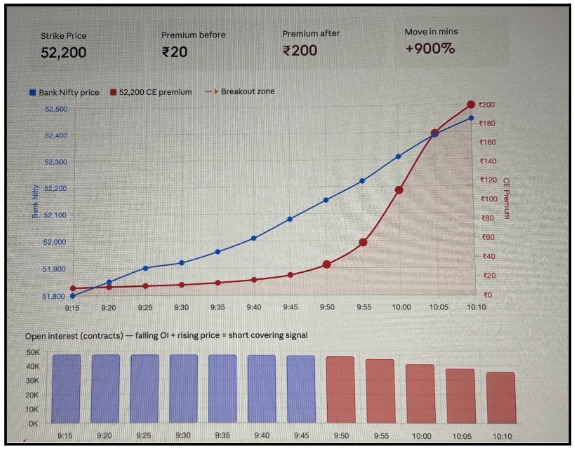
This massive wave of forced buying at the 52,200 strike causes the premium to skyrocket—sometimes jumping from ₹20 to ₹200 in minutes.
This is a classic “Call Squeeze,” where the very traders who bet against the market end up fueling its most explosive upward move.
Short Covering in Put Option
While call covering leads to a market spike, the Put short covering is slightly different and often more dangerous.
Put writers are traders who have sold put options because they are bullish; they believe the market will not fall below a certain support level.
If the market suddenly crashes and breaks that support below, the Put Writers get trapped.
To exit, they must buy back their puts. Because buying a put is a bearish action, and the market is already falling, this act of “covering” actually accelerates the crash.
The more precise mechanism for this is delta hedging by market makers.
In this scenario, the “forced buying” of put options to close short positions provides the liquidity for the market to fall even deeper.
Does Short Covering Mean Buy or Sell?
This is a point of confusion for many beginners. Does short covering mean the market participants are buying or selling?
Technically, short covering involves a “Buy” order.
To understand this, look at the lifecycle of a short trade:
- Step 1 (Entry): You sell a contract (opening a short position).
- Step 2 (Exit): You must buy the contract back (Short Covering).
Even though the trader’s original intention was bearish, their final action to close the trade is a “Buy.”
Observing these moves helps traders understand the short covering effect on stock price and anticipate sudden upward pressure in real-time.
This is why, on your trading terminal (like Zerodha or Angel One), when you want to exit a short position, you click on the “Buy” button.
When millions of such “Buy to Close” orders hit the exchange simultaneously, it creates massive upward pressure on the price.
Is Short Covering Bullish or Bearish?
Many traders often ask: Does Short covering mean bullish or bearish? In simple terms, short covering usually pushes the market up in the short term.
However, it is important to understand what this move actually means.
- Price Action: Short covering is bullish because prices move higher due to buying.
- Market Sentiment: It is often neutral, since the buying is coming from traders exiting positions rather than new investors entering the market.
For this reason, short covering is sometimes called “hollow buying.” The rally occurs because short sellers are forced to exit their trades.
Once most short positions are closed, the market may lose momentum. If fresh buyers do not enter, the price can fall again after the short covering rally ends.
Conclusion
We have explored the short covering meaning from every angle, from its impact on stock prices to its explosive nature in the options segment.
Short covering is the “fuel” that drives many of the market’s most violent upward moves. It is a process where the bears surrender, and their surrender becomes the profit of the bulls.
By recognizing that short covering means market up or down based on the exit of trapped sellers, you can refine your trading strategy and avoid being caught on the wrong side of a “Short Squeeze.”
When you learn how to find short covering stocks by analyzing these specific shifts in positioning, you gain a massive advantage over the rest of the retail crowd.
Want to truly understand short covering, option chain signals, and expiry trading?
Learn directly from market experts in our option trading classes and start reading markets like professional traders.
FAQs
Q1: How to identify short covering in the market?
Ans: Traders can identify short covering by observing a rising price while open interest is falling.
This combination usually signals that traders who previously sold positions are buying them back to exit, which creates sudden upward price momentum.
Q2: Why do option premiums rise so quickly during short covering?
Ans: During short covering, option sellers rush to buy back the contracts they sold earlier.
This sudden demand increases the option premium rapidly, especially in near-the-money strikes where liquidity and trading activity are highest.
Q3: Is short covering a good signal to enter a new long trade?
Ans: Not always. Short covering can create quick rallies, but they may not last long.
Traders should confirm whether fresh long positions are entering the market before assuming the rally will continue.
Q4: Can short covering happen even without any major news in the market?
Ans: Yes, short covering often happens without news.
Sometimes, a small breakout above resistance or a sudden increase in buying volume can trigger stop losses of short sellers, leading to a rapid price spike.
Q5: What happens to the market after a short covering rally ends?
Ans: Once most short sellers exit their positions, the buying pressure reduces.
If new buyers do not enter the market, prices may slow down, move sideways, or even reverse after the rally ends.
Before investing capital, invest your time in learning Stock Market.
Fill in the basic details below and a callback will be arranged for more information: