


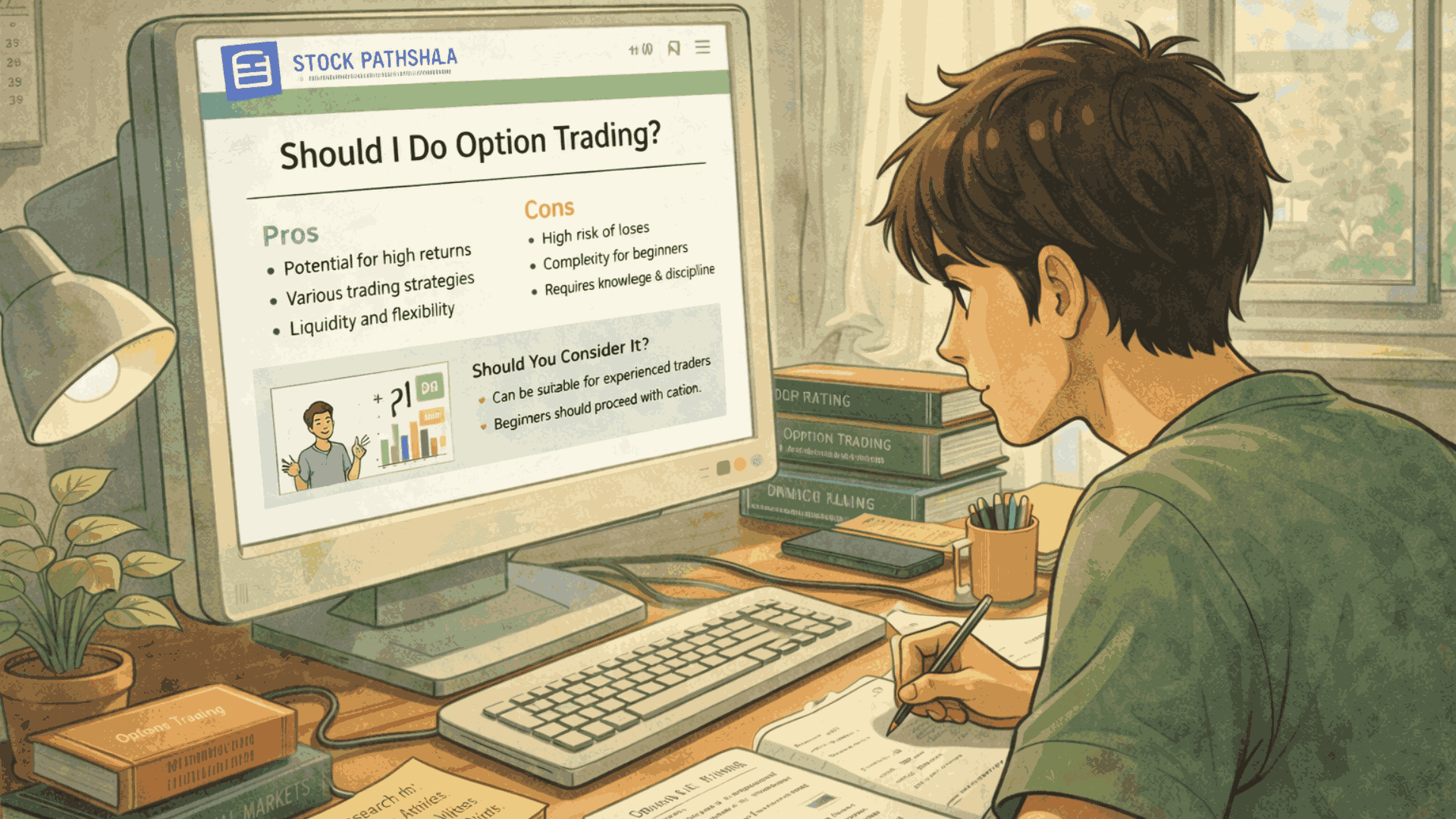
You see a profit screenshot and something inside you thinks, I could do this too.
That feeling is exactly how most people enter the world of option trading in India. And there is nothing wrong with that feeling as long as you do not stop there.
Should I do option trading? It is a question that deserves more than a yes or no because the market does not care about your excitement, your savings, or your intentions.
What separates the 10 percent who profit from the rest is preparation, not luck. The good news is that preparation is something you can actually control right now.
This guide will give you an honest answer based on where you actually stand today.
Should I Do Option Trading or Not?
Before you open your account and start buying options, pause for a moment. Most people jump straight into trading without asking themselves the most important question, which is whether they are actually ready for it.
So be honest with yourself and go through these five questions.
- Do you understand what you are buying?
If you cannot explain what a Call or Put option is in simple words, you are not ready yet. Trading something you do not understand is not investing; it is gambling.
- Can you afford to lose the money you are putting in?
Options can go to zero. Not sometimes, quite often actually. If the money you are planning to trade with is needed for rent, groceries or emergencies, please keep it away from options.
- Can you control your emotions when a trade goes against you?
This is where most beginners fail. The market will test your patience daily. Panic selling and revenge trading have destroyed more accounts than bad strategies ever have.
- Do you have at least 30 minutes daily to study the market?
Options are not a set-and-forget investment. They need attention, analysis and regular learning.
- Are you expecting quick and guaranteed profits?
If yes, options will disappoint you badly. While the potential for high returns often makes people ask if option trading make you rich, it is a skill that takes months to build, not days.
If you answered honestly and most answers were yes, you are in a much better position than 90 percent of people who start trading options.
Should Beginners Do Options Trading?
Generally, beginners should avoid jumping directly into options. In the stock market, there is a “ladder” of learning.
Most experts suggest starting with long-term investing, then moving to swing trading in stocks, and only then exploring how to do option trading safely.
The reason options are dangerous for beginners is leverage. Options allow you to control a large amount of money with a very small investment.
This feels great when you are winning, but when you lose, your entire capital can vanish in minutes.
Beginners often don’t understand “The Greeks” (like Theta decay, which eats your money every day the market stays flat).
If you are a beginner, spend at least 6 months learning technical analysis and paper trading before putting real money into options.
Who Should Do Option Trading?
Option trading suits a very specific type of person, not everyone who is curious about it or excited by screenshots on Instagram.
You are the right candidate if:
- You have financial stability: You have a dedicated risk capital of at least Rs. 50,000 to Rs. 1 lakh that you can genuinely afford to lose without affecting your lifestyle.
- You have baseline market knowledge: You understand how the stock market works, can read a basic candlestick chart, and are familiar with concepts like support, resistance, and trend.
- You have emotional discipline: You can sit through a 20 to 30% drawdown in a trade without panicking or revenge trading.
- You have time: At least 1 to 2 hours daily for learning, journaling trades, and reviewing market setups, not just watching the screen.
- You have a long-term mindset: You are prepared to spend 6 to 12 months learning before expecting consistent profits.
If most of these describe you, option trading can genuinely become a skill worth building.
Who Should Not Trade Options?
Option trading is not for everyone, and that is not a failure. It is just a fact. You should avoid option trading if:
- You are using money meant for rent, EMIs, household expenses, or your child’s school fees.
- You have never invested in stocks or mutual funds before and do not understand how markets move.
- You are looking for a way to recover past financial losses quickly.
- You get anxious or emotional when any trade moves against you, even slightly.
- You cannot commit time daily, not just when markets are exciting, but consistently.
- You are relying on tips from Telegram groups, YouTube influencers, or friends without understanding the logic behind trades.
If any of these sound familiar, start with SIP investing or index funds first. Build the foundation before building the risk.
Risks of Option Trading
Most content online focuses on the rewards of option trading. Nobody talks enough about the very real, very common risks.
Here are five you must understand before putting in a single rupee:
- 9 Out of 10 Traders Lose Money: The Securities and Exchange Board of India’s own study found that 9 out of 10 individual traders in the F&O segment reported net losses. This is not a scare tactic. It is a regulatory finding. The odds are statistically against the average retail trader, especially in the beginning.
- Theta Decay Silently Eats Your Capital: Every option has an expiry date. As time passes, the value of your option decreases even if the stock price stays exactly where it is. This is called Theta decay. Most beginners do not realise they are losing money even when they are right about the market direction. Theta works against option buyers every single day.
- Leverage Amplifies Losses, Not Just Gains: Options give you exposure to a large quantity of shares for a small premium. This sounds great until a trade goes wrong. A 5% move against you in the underlying stock can wipe out 50 to 80% of your option premium within hours. Many beginners mistake leverage for opportunity when it is actually a double-edged sword.
- Emotional Risk Is Underestimated: Panic, greed, and FOMO are responsible for more blown accounts than bad strategies. The psychological pressure of watching a trade go red in real time causes most traders to exit too early, hold on too long, or double down recklessly. Without emotional control as a skill, even a technically sound strategy will fail in execution.
- Liquidity and Impact Cost on Far OTM Options: Many beginners buy deep Out-of-The-Money (OTM) options because they are cheap, sometimes just Rs. 5 or Rs. 10. What they do not realise is that these options often have poor liquidity, wide bid-ask spreads, and an extremely low probability of success.
Capital Required for Option Trading in India
This is one of the most common questions, and most honest answers are avoided because they are not exciting enough.
Here is the practical breakdown:
|
Stage |
Recommended Capital | What You Should Do |
| Learning Phase | Rs. 0 (paper trade) |
Use some free platforms or broker simulators |
|
Beginner Live Trading |
Rs. 25,000 to Rs. 50,000 | Trade 1 lot, focus on learning, not profits |
| Consistent Buying | Rs. 50,000 to Rs. 1 lakh |
Build a track record over 3 to 6 months |
|
Option Selling (hedged) |
Rs. 3 lakh to Rs. 5 lakh+ | Option trading margin requirements for strategies like spreads |
| Full Selling Strategies | Rs. 5 lakh to Rs. 10 lakh+ |
Iron Condors, strangles, only after proven skills |
Key rule: Never allocate more than 10% of your total savings to options trading, especially in the first year.
Capital preservation matters more than profit in the beginning.
Best Way to Start Option Trading
This is the part most blogs skip: the actual actionable path.
If you are sitting there wondering what should i learn for option trading to avoid common pitfalls, here is the actual, step-by-step knowledge map:
- Step 1: Build Your Foundation First (Months 1 to 2): Before touching a single option, learn how the stock market works. Understand candlestick charts, basic technical analysis, support and resistance, and how indices like Nifty and Bank Nifty behave. Read, watch, and absorb as much as you can.
- Step 2: Learn Options Theory (Months 2 to 3): Understand what a Call and Put option is. Learn about strike prices, expiry, premiums, and the Option Greeks: Delta, Theta, Gamma, and Vega. These are not optional knowledge. They directly determine whether you make or lose money.
- Step 3: Paper Trade for at Least 30 Days (Month 3 to 4): Do not put real money in yet. Use a simulator or a paper trading account to practice your strategies without financial risk. Maintain a trading journal. Track every trade: your entry reason, exit, and what you learned.
- Step 4: Start Small with Real Money (Months 4 to 6): Once you have a consistent paper trading record, enter the live market with a small amount. One lot of Nifty weekly options is a good start. Keep position sizes small. The goal is not to make money yet. It is to manage emotions with real stakes.
- Step 5: Review, Refine, and Stay Consistent: Track your trades in a journal every week. Identify patterns in your mistakes. Adjust. This review process separates traders who grow from those who stay stuck.
- Step 6: Learn from a Structured Course: Random content gives you random results. If you are serious about option trading, invest in structured, step-by-step education.
At Stock Pathshala, the curriculum is built exactly for the Indian market, from basics to advanced strategies like spreads and hedging, with real examples from Nifty and Bank Nifty.
Learning the right things in the right order saves you from losing months and lakhs to avoidable mistakes.
Conclusion
Options trading is worth it for the top 10% of traders who have mastered the craft.
If you become a professional, the freedom and income benefits of option trading are unmatched by any 9-to-5 job.
However, for the remaining 90%, it is often not worth the mental health cost and the financial loss.
If you find yourself losing sleep over a trade or losing money that was meant for your house rent, then options trading is definitely not worth it.
It is only worth it if you can treat it as a disciplined business and manage your risks like a professional.
If you want to approach options trading with the right discipline and structure, join our online option trading classes, where we focus on practical risk management and real market understanding.
FAQs
Q1: How Much Money Is Safe to Start Option Trading?
Ans: There is no fixed amount, but a safe approach is to start with only 5–10% of your total savings as risk capital. Beginners should avoid deploying large capital initially and instead focus on learning with small position sizes.
Q2: Which Time Frame is Best for Option Trading?
Ans: The best time frame depends on your strategy. Intraday traders use 1-5 minute charts, while positional traders prefer hourly or daily charts. Beginners are usually better off with higher time frames to avoid noise and emotional decisions.
Q3: How Do Taxes Work in Option Trading in India?
Ans: Profits from option trading are treated as business income, not capital gains. You need to maintain proper records, and in some cases, a tax audit may be required. Consulting a CA is highly recommended.
Q4: How Long Does It Take to Become Profitable in Option Trading?
Ans: For most traders, it can take 1–3 years of consistent learning, practice, and discipline to become profitable. Success in option trading is a gradual process, not something that happens overnight.
Before investing capital, invest your time in learning Stock Market.
Fill in the basic details below and a callback will be arranged for more information: