


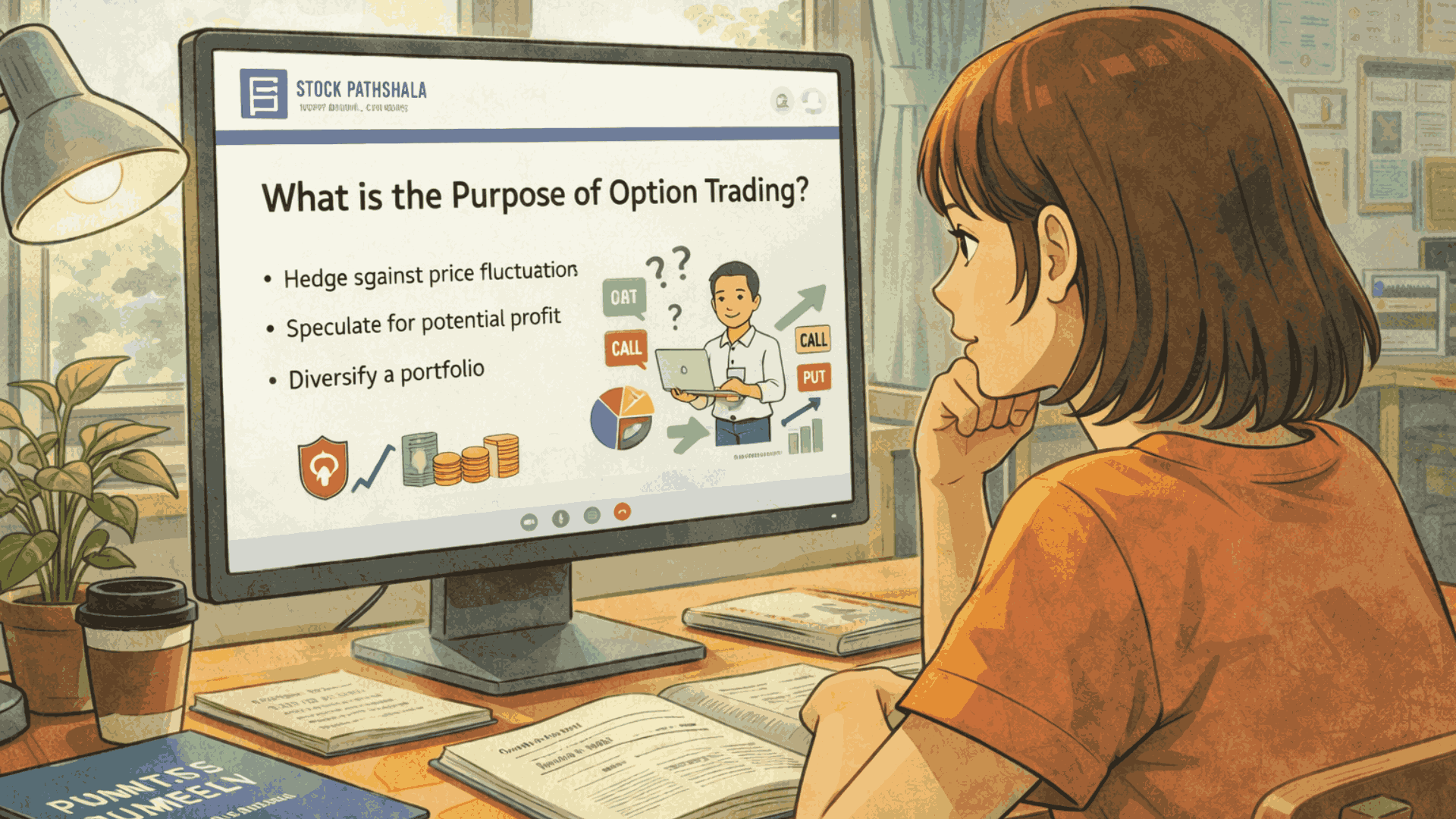
Most people enter the stock market with one simple goal, which is to make money. You buy shares, wait, and hope the price goes up.
But what happens when the market crashes, or worse, goes absolutely nowhere?
That is exactly where most retail investors feel stuck and helpless. Understanding what the purpose of option trading is can completely change how you see the market.
Options are not just for big institutions or Wall Street experts sitting behind five screens.
An everyday trader in India can use them to protect money, earn income, and profit in any market condition.
This single tool can turn a confusing, unpredictable market into something you can actually work with. So let’s understand the purpose of F&O trading.
What Is the Point of Option Trading?
An option is a type of “derivative” contract that derives its value from an underlying asset, such as a stock (e.g., SBI) or an index (e.g., Nifty 50).
Option trading gives you the right but not the obligation to buy or sell an asset at a pre-fixed price (the Strike Price) before a certain date (the Expiry).
- Call Option (CE): You buy these if you think the market will go up.
- Put Option (PE): You buy these if you think the market will go down.
Options are much more than just “gambling” on price moves. In reality, they are powerful financial tools used by both beginners and professional traders for multiple strategic purposes:
- Hedging (Protecting Your Portfolio): Think of options as insurance for your investments. Suppose you own ₹10,00,000 worth of blue-chip stocks and you are worried about a market crash due to some global news. By buying Put Options, any loss in your stock portfolio can be offset by gains in those options. This helps you limit your downside risk.
- Leverage (Big Exposure, Small Capital): This is one of the most popular reasons why traders in India use options. To buy 500 shares of a ₹2,000 stock, you need ₹10,00,000. But with options, you can control the same quantity by paying a premium of just ₹20,000-₹30,000. While many believe option trading is more profitable because of this high ROI on small capital, it is important to remember that this same leverage also increases the risk of loss. This is exactly why position sizing is important; as it ensures that a single leveraged trade doesn’t wipe out your entire account
- Income Generation (Monthly Rent): Options can also be used to generate regular income. For example, if you own 500 shares of a stock like Reliance, you can sell a Call Option against it. In return, you receive a premium. If the stock stays below a certain level, you keep that premium, just like earning monthly rent on your holdings.
- Profiting from a “Sideways” Market: In normal stock trading, if the price doesn’t move, you make no profit. But options give you an edge here. Using strategies like Short Straddles, traders can make money even when the market is moving sideways. Here, you are essentially profiting from time decay.
- Getting a Discount on Stocks (Cash-Secured Puts): Instead of buying a stock at ₹1,000, you can sell a Put Option at ₹950. You receive a premium upfront. If the stock falls to ₹950, you buy it at your desired price, but your effective cost becomes even lower due to the premium received. It’s like buying stocks at a discount.
- Trading Volatility: Sometimes, you may not know the direction of the market, but you are sure that a big move is coming (like during Budget Day or Election Results). Options allow you to trade volatility, meaning you can profit as long as the market moves sharply in either direction.
What Are the Benefits of Options Trading?
Options trading is popular because it offers flexibility, lower capital requirements, and multiple ways to profit in any market condition.
Traders can manage risk, leverage small capital for larger exposure, and use strategies to generate income or capture short-term market opportunities efficiently.
Below are some of the key benefits that make option trading attractive for both beginners and experienced traders.
- Low Capital Requirement: You can start trading Nifty options with as little as ₹5,000 to ₹10,000.
- Defined Risk: If you are an option buyer, your maximum possible loss is limited to the premium you paid. You can never lose more than that, regardless of how much the market crashes.
- Versatility: You can make money in Bullish (Up), Bearish (Down), and Neutral (Sideways) markets.
- High Returns: Because of leverage, a 1% move in Nifty can sometimes lead to a 20% or 50% profit in an option contract.
Common Option Trading Strategies
Before exploring specific strategies, it’s important to understand that option trading is not about random buying or selling.
Each strategy is designed for a particular market condition, whether bullish, bearish, or sideways.
The key is to match the right strategy with your market view, risk appetite, and capital.
Below are some of the most commonly used option trading strategies in India
- Long Call: Buying a Call (CE) when you expect a sharp rally.
- Long Put: Buying a Put (PE) when you expect a market fall.
- Bull Call Spread: A “safe” way to trade an uptrend by buying one call and selling another to reduce the cost.
- Iron Condor: A very popular strategy in India for a range-bound market (e.g., when Nifty is expected to stay between 21,500 and 22,000).
- Protective Put: Buying a Put for a stock you already own in your portfolio to “lock in” your profits.
What Are the Risks of Option Trading?
While option trading offers flexibility and high return potential, it also comes with significant risks that every trader must understand before entering the market:
- Time Decay (Theta Risk): Options are wasting assets. Even if the market does not move, the value of your option keeps decreasing daily due to time decay, especially near expiry.
- Leverage Risk: Options allow you to control large positions with small capital. While this can amplify profits, it can also wipe out your entire premium within minutes if the trade goes wrong.
- Volatility Risk (IV Crush): A sudden drop in implied volatility can reduce option prices sharply, even if your market direction is correct. This often happens after major events like results or budget announcements.
- Unlimited Loss in Option Selling: If you are selling options without proper hedging, your potential losses can be unlimited, making it extremely risky for beginners.
- Emotional & Psychological Stress: Rapid price movements can lead to panic decisions, overtrading, or revenge trading, which significantly increase the chances of losses.
- Liquidity & Slippage Risk: In some stock options, low liquidity can lead to poor execution prices, increasing your trading costs and reducing profitability.
Should I Do Option Trading?
Option trading is worth considering only if you are ready to approach it with discipline, patience, and a long-term mindset.
It is not a quick way to make money, but a skill-based activity that requires consistent learning and risk management.
If you are wondering what should I learn for option trading to get started, you must focus on mastering the “Greeks,” understanding the option chain, and developing a solid risk management plan.
If you have basic market knowledge, can control emotions, and are willing to spend time analyzing trades, then you can explore options gradually.
However, if you are looking for fast profits, relying on tips, or planning to risk essential savings, option trading is not suitable for you.
Start small, focus on learning, and treat it like a business. The right approach determines whether options become an opportunity or a costly mistake.
Conclusion
While the purpose of option trading is to provide flexibility and higher returns, it comes with high risk.
According to SEBI, 9 out of 10 individual traders in the equity F&O (Futures & Options) segment incur losses.
The key to success in the Indian market is Education. Don’t treat options as a “get rich quick” scheme.
Use them for their true purpose: to manage risk, generate consistent income, and trade with discipline.
If you want to learn this the right way, join our online option trading classes, where strategies are taught with real examples and practical guidance.
FAQs
Q1: How much money do I realistically need to start option trading in India?
Ans: While technically you can start with ₹5,000–₹10,000, a practical amount is ₹20,000–₹50,000. This allows better risk management, position sizing, and survival during losing streaks.
Q2: Which is better for beginners: buying options or selling options?
Ans: Beginners should start with option buying because the risk is limited to the premium paid. Option selling involves higher capital and carries potentially unlimited risk if not managed properly.
Q3: What are “Greeks” in option trading, and do beginners need them?
Ans: Option Greeks (Delta, Theta, Vega, Gamma) measure how option prices react to different factors. Beginners don’t need to master all of them initially, but understanding Delta and Theta can significantly improve decision-making.
Q4: Which time frame is best for option trading in India?
Ans: The first hour (9:15–10:30 AM) and the last hour (2:30–3:30 PM) are usually the most volatile and offer better opportunities. Mid-day sessions are often slow and unpredictable.
Before investing capital, invest your time in learning Stock Market.
Fill in the basic details below and a callback will be arranged for more information: