


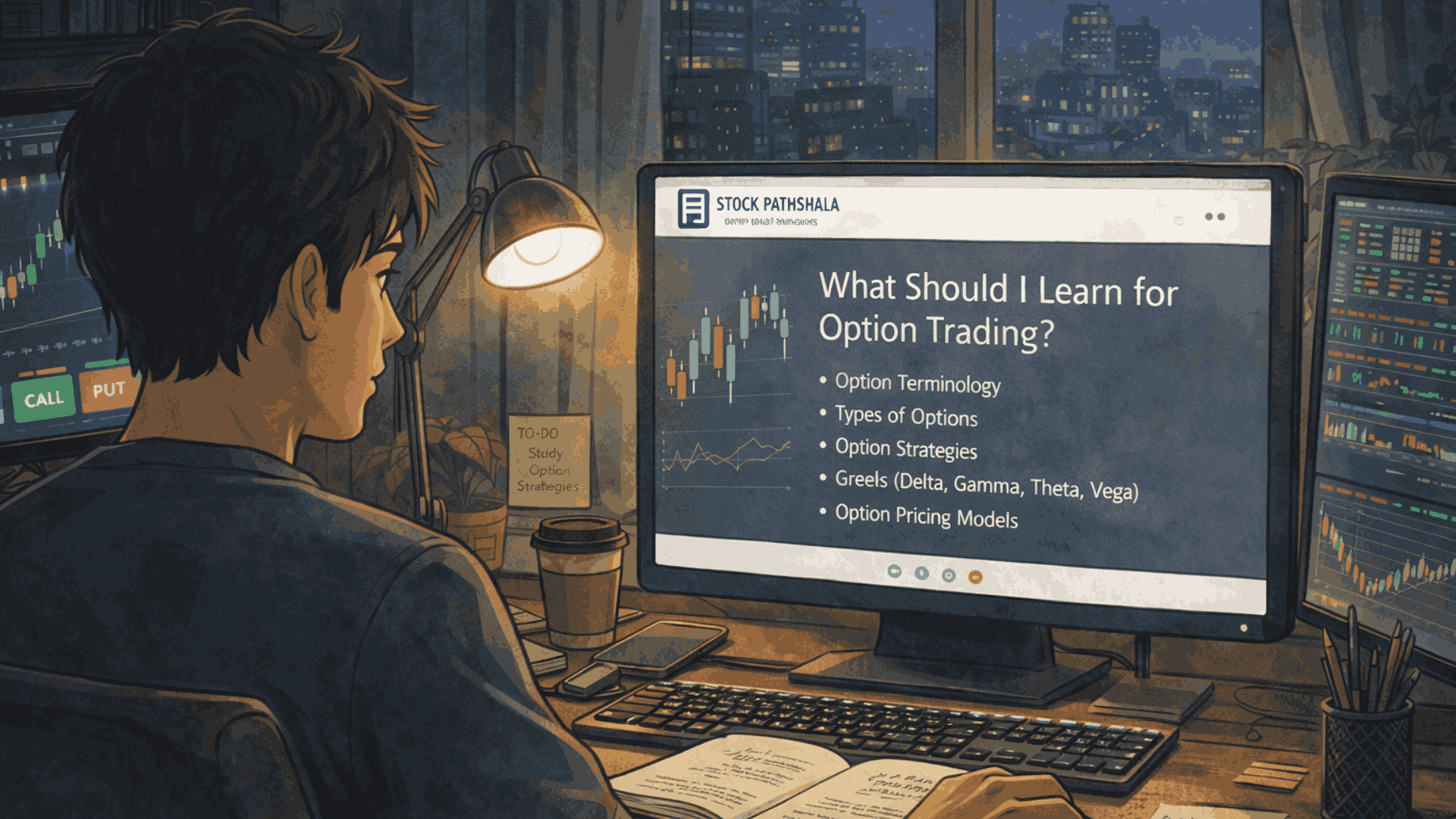
Everyone wants quick profits from options trading. Very few actually survive long enough to make them.
The social media reels make it look effortless. One good trade, a screenshot, and suddenly everyone is a market genius.
Many beginners are lured in by the question of whether can option trading make you rich overnight, but behind those highlights is a graveyard of blown accounts, missed entries, and panic exits that nobody posts about.
The problem is rarely the market. It is the noise.
So, traders are often asking this one question: “What should I learn for option trading?”
This is a valid question for someone who is keen to learn about how options move and how one can actually manage risk and earn profits.
Before diving into the technicals, most people find themselves at a crossroads, debating should I do option trading at all given the risks involved.
This guide gives you the exact knowledge map, no shortcut promises, just the foundations that actually move the needle.
What to Learn For Option Trading?
Option trading rewards those who prepare and punishes those who skip the basics.
Many beginners jump straight into trades because they believe option trading is more profitable than cash or futures, but they fail to realize that this higher potential for gain comes from understanding the complex forces driving price movement.
Before you think of any contract, here is exactly what you need to learn.
1. Learn About Call and Put Options
Before touching the “Greeks,” you must understand what an option actually is.
- Call Options (CE): The right to buy. You buy these when you are bullish.
- Put Options (PE): The right to sell. You buy these when you are bearish.
- Strike Price: The specific price at which the contract is set.
- Premium: The “token amount” you pay to buy the option.
2. Learn Options Greeks
This is where most beginners fail. You must learn how these four factors affect your profit and loss:
- Delta: How much your option price moves for every 1-point move in Nifty/Bank Nifty.
- Theta (Time Decay): The most important Greek letter for Indian traders. It is like an ice cube melting; every day you hold an option, it loses value.
- Vega: How changes in market volatility affect your premium.
- Gamma: The rate of change in Delta (this is what causes explosive moves on expiry days).
3. Learn Option Chain Analysis
In India, the NSE Option Chain is a goldmine of information. You must learn to read Open Interest (OI). OI tells you where the “Big Players” (Institutions) have sold options.
- High Call OI acts as a Resistance (ceiling).
- High Put OI acts as a Support (floor).
- PCR (Put-Call Ratio): A simple ratio that helps you identify if the market is “Overbought” or “Oversold.”
4. Technical Analysis Lessons
You don’t need to be a chart genius, but you must know:
- Support and Resistance: Where the price usually bounces or falls.
- Candlestick Patterns: Signals like “Hammer” or “Shooting Star” that show buyer/seller exhaustion.
- Moving Averages: Specifically, the 20 EMA and 200 EMA to identify the trend.
5. Risk Management in the Stock Market
This is the only thing that will keep you alive in the market.
- Stop Loss (SL): Knowing exactly where to exit if you are wrong.
- Position Sizing: Understanding why position sizing is important is the difference between a minor loss and a blown account; never put more than 5-10% of your total capital into a single trade.
- Risk-Reward Ratio: Aiming for at least ₹2 profit for every ₹1 you risk.
How to do Option Trading in India?
Learning the theory is easy; getting “good” is the hard part.
Many traders eventually wonder can option trading be a career in the long run; the reality is that it only becomes a sustainable profession when you stop gambling and start building a repeatable edge.
Some advanced traders also explore whether option trading be automated using algo-based systems, but even automation requires a solid manual foundation before it can be trusted.
Here is how professional traders build that edge:
- Master One Strategy: Don’t be a “jack of all trades.” Whether it is Scalping, Swing Trading, or Option Selling, pick one style and practice it for 3 months.
- Keep a Trading Journal: Write down every trade you take. Why did you enter? Why did you exit? How did you feel? Your journal is your best teacher.
- Focus on Process, Not Profit: If you follow your rules and lose money, it was a “good trade.” If you break your rules and make money, it was a “bad trade” because it built a bad habit.
- Control Your Emotions: Fear and Greed are the two biggest killers in options. Getting “good” means becoming a robot that follows a pre-set plan regardless of the P&L fluctuations.
How to Learn Options Trading?
If you are starting from zero, follow this 4-step roadmap to avoid blowing up your account:
- Step 1: Theory (The Foundation): Spend at least 2 weeks watching quality YouTube channels or reading books like “Options, Futures, and Other Derivatives” by John C. Hull. Learn the jargon so you aren’t confused during market hours. If you want a more structured approach instead of random learning, platforms like Stock Pathshala can help you build a strong foundation with guided lessons.
- Step 2: Paper Trading (The Simulator): Use apps like FrontPage or Neostox to trade with virtual money. It allows you to practice entering and exiting orders without the emotional stress of losing real cash. Do this until you are profitable for 2 consecutive weeks.
- Step 3: Small Capital (The Testing Phase): Start with a very small amount, perhaps ₹10,000 to ₹15,000. Trade only 1 lot. The goal here is not to buy an iPhone; the goal is to see if you can keep your emotions in check when real money is on the line.
- Step 4: Scale Up (The Business Phase): Once you have proven that you can protect your ₹10,000 capital for 3 months, you can gradually increase your capital. At this stage, start focusing on Option Hedging or Option Spreads to reduce your risk.
Learning these advanced strategies with expert guidance from Stock Pathshala can significantly improve your consistency and risk management.
Conclusion
Option trading is not a lottery. It is a skill you build one lesson at a time.
By now, you would have been able to understand the answer to this question: ‘What should I learn for option trading?’ and know where to begin. The roadmap is in front of you; the next move is entirely yours.
Most traders fail because they skip the foundation and chase the profits. Do not be that trader. Learn the Greeks, respect the risk, and trust the process every single day.
The market will always be there. Make sure you are prepared when your moment arrives.
Want to turn learning into real execution? Join our online option trading classes and start building your edge with practical, real-market guidance.
FAQs
Q1: How long does it take to learn options trading?
Ans: To understand the theory, it takes about 1 month. To become consistently profitable, it usually takes 1 to 2 years of active market experience.
Q2: Can I learn options trading for free?
Ans: Yes. There is enough high-quality content on YouTube and the NSE website (NSE Academy) to learn everything you need. You don’t need to buy expensive “Millionaire” courses.
Q3: What is the minimum capital required?
Ans: You can start with ₹10,000, but that is mostly for learning. To trade professionally using hedging or selling strategies, a capital of ₹2 lakh to ₹5 lakh is recommended.
Q4: Is technical analysis enough for options?
Ans: No. Technical analysis tells you “Direction,” but in options, you also need to manage “Time” (Theta) and “Volatility” (Vega). You must combine charts with Option Greeks.
Q5: Which is better for beginners: Nifty or Bank Nifty?
Ans: Nifty is generally better for beginners as it is less volatile than Bank Nifty. Bank Nifty moves very fast, which can be psychologically overwhelming for a new trader.
Before investing capital, invest your time in learning Stock Market.
Fill in the basic details below and a callback will be arranged for more information: