

You’ve just spotted what looks like a perfect Supertrend buy signal on your 5-minute chart. The line flipped green, price is surging, and you enter the trade with confidence.
Twenty minutes later, you’re staring at a loss, the trend reversed before you could react.
Sound familiar? The culprit often isn’t the Supertrend indicator itself. It’s the timeframe you’re using.
The Supertrend indicator remains one of the most popular trend-following tools among Indian traders, particularly for trading Nifty, Bank Nifty, and individual stocks.
Its simplicity, a single line that flips between green (bullish) and red (bearish),makes it visually intuitive. But that simplicity can be deceptive.
The same indicator can generate wildly different signals depending on whether you’re looking at a 5-minute chart or a daily chart.
So which timeframe is best?
The honest answer: there is no universal ‘best’ timeframe.
The right choice depends entirely on your trading style, risk tolerance, and the amount of time you can dedicate to monitoring your trades.
What Is the Supertrend Indicator?
The Supertrend indicator, developed by Olivier Seban, is a trend-following overlay that plots directly on your price chart.
Unlike oscillators such as RSI or MACD that appear in separate panels, Supertrend draws a single continuous line that sits either above or below the candlesticks.
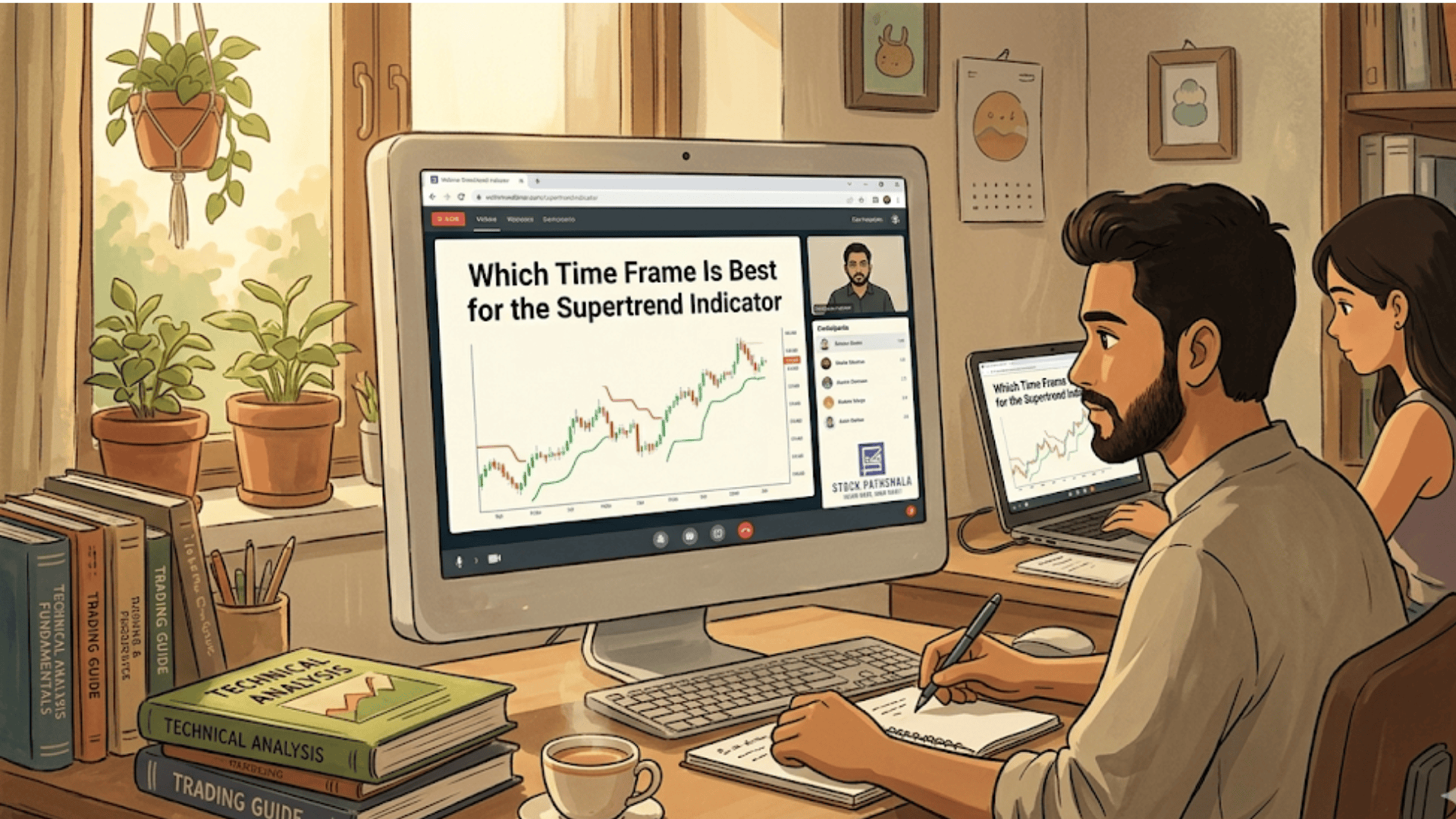
When price trades above the Supertrend line, the line turns green and acts as dynamic support, signalling a bullish trend.
When price drops below the line, it turns red and acts as dynamic resistance,signalling a bearish trend. The flip from one colour to another generates the buy or sell signal.
Why Time Frame Matters in Supertrend Trading?
The timeframe you choose fundamentally changes what the Supertrend indicator tells you. On a 1-minute chart, the indicator responds to every minor price fluctuation.
As a result, you’ll see frequent colour flips, potentially dozens in a single trading session.
Some will be genuine short-term trend changes; many will be noise that leads to false signals and whipsaws.
In contrast, on a daily chart, the same indicator filters out intraday noise entirely. Colour flips become rare, sometimes occurring only a few times per month.
Each signal carries more weight, but you’ll enter trends later and exit later, potentially missing significant portions of the move.
This creates an inherent trade-off, and understanding it before you pick a timeframe will save you a lot of losing trades:
| Shorter Timeframes | Longer Timeframes |
| More signals | Fewer signals |
| Earlier entries | Later entries |
| More false signals/whipsaws | Fewer false signals |
| Requires constant monitoring | Requires less screen time |
| Smaller profit targets | Larger profit targets |
| Tighter stop losses | Wider stop losses |
The volatility of Indian markets amplifies this dynamic. Nifty and Bank Nifty can experience sharp intraday swings driven by global cues, FII/DII activity, or economic announcements.
A 5-minute Supertrend might flip multiple times during such volatility, while a 15-minute or hourly Supertrend might show a consistent trend throughout.
Best Time Frames for Supertrend Indicator
Choosing the right timeframe for the Supertrend indicator depends on your trading style, risk tolerance, and how frequently you want to trade.
Each timeframe offers a different balance between signal accuracy and market noise, so understanding their strengths is key to consistent results. Here is how each one plays out in practice.
1. For Scalping (1-Minute to 5-Minute Charts)
Scalpers aim to capture small price movements multiple times throughout the day, and understanding which time frame is best for scalping becomes crucial for consistency.
For this style, 1-minute and 5-minute charts provide the responsiveness needed.
However, these timeframes generate significant noise. The default Supertrend settings (10 period, 3 multiplier) often produce too many false signals on such short intervals. Scalpers typically need to:
- Accept a lower win rate but maintain strict risk management
- Use additional confirmation indicators (discussed later)
- Focus on high-liquidity instruments like Nifty and Bank Nifty where spreads are tight
Best suited for: Full-time traders who can monitor charts continuously throughout market hours.
2. For Intraday Trading (5-Minute to 15-Minute Charts)
If scalping feels too fast-paced, the 15-minute timeframe is where most Indian intraday traders land.
It has emerged as arguably the most popular choice among those using Supertrend.
It strikes a balance between responsiveness and reliability, generating enough signals to find opportunities while filtering out much of the minute-to-minute noise.
The 5-minute chart remains useful for timing entries after a 15-minute signal confirms the trend direction.
Typical approach:
- Use 15-minute Supertrend for trend direction
- Use 5-minute chart for precise entry timing
- Exit before market close or when Supertrend flips on the 15-minute chart
Best suited for: Traders who can dedicate 2-4 hours during market hours but don’t want to watch every tick.
3. For Swing Trading (1-Hour to Daily Charts)
Not everyone can sit at a screen during market hours and that is where swing trading with Supertrend makes a strong case for itself, especially if you are exploring how to learn swing trading effectively.
Swing traders hold positions for multiple days to weeks, aiming to capture larger price swings.
The hourly and daily timeframes work best for this approach, forming the foundation of swing trading time frames used by experienced traders.
On a daily chart, Supertrend signals become high-conviction setups.
When the indicator flips green on a daily timeframe, it often marks the beginning of a trend that can last weeks or even months.
The trade-off is that you’ll enter after the trend is already established, missing the initial move but with significantly higher confidence that the signal is genuine rather than intraday noise.
While the Supertrend line acts as a dynamic stop loss, managing your capital is equally vital.
This is why position sizing is important, as it ensures that even if the indicator gives a false signal on a shorter time frame, your account remains protected from significant drawdowns
Typical approach:
- Use the daily Supertrend for the overall trend direction.
- Use an hourly chart for entry timing and position management.
- Hold until the daily Supertrend flips or reaches the target.
Best suited for: Working professionals who can check charts once or twice daily but cannot monitor throughout market hours.
4. For Positional/Long-Term Trading (Daily to Weekly Charts)
Positional traders think in weeks and months, which directly connects to understanding which time frame is best for long term trading.
The daily and weekly timeframes provide the perspective needed.
Weekly Supertrend signals are rare, the exact frequency depends on the stock’s volatility and your multiplier setting, but flips are infrequent enough that each one warrants serious attention rather than routine reaction.
Best suited for: Investors with a medium-term horizon who want to ride major trends without daily monitoring.
While these settings provide a great starting point, they work best when used as part of a broader EMA and supertrend strategy.
This helps in staying with the dominant trend even if the Supertrend gives a brief exit signal during minor pullbacks
Multi-Timeframe Supertrend Strategy
Now that you know which single timeframe suits your style, here is how to make Supertrend significantly more accurate by stacking timeframes.
One of the most effective ways to use Supertrend is to combine multiple timeframes.
This approach significantly reduces false signals while improving entry timing.
The core principle: Use a higher timeframe to determine trend direction, then use a lower timeframe for entry signals.
1. Practical Implementation for Intraday Traders
- Check the hourly chart first. Only consider long trades if the hourly Supertrend is green. Only consider short trades if it’s red.
- Move to the 15-minute chart for signals. Wait for the 15-minute Supertrend to flip in the direction of the hourly trend.
- Optional: Use the 5-minute chart for precise entry. Once the 15-minute signal confirms, enter when the 5-minute Supertrend also aligns.
This layered approach means you’re trading with the larger trend while using smaller timeframes for timing.
A long signal on a 5-minute chart that conflicts with a bearish hourly trend should be ignored, it’s likely a pullback rather than a trend reversal.
2. Practical Implementation for Swing Traders
- Check the weekly chart for the primary trend direction.
- Use the daily chart for entry signals that align with the weekly trend.
- Monitor hourly charts for fine-tuning entries and managing positions.
Supertrend Settings for Different Time Frames
The default settings of 10 periods and 3 multiplier work reasonably well across most scenarios, but optimising settings for your chosen timeframe can improve results.
1. Understanding the Parameters
- Period (ATR length): Higher values average volatility over more candles, diluting recent spikes and producing a wider, slower-moving band.
Lower values weigh recent price action more heavily, tightening the band and triggering signals sooner but with more noise. - Multiplier: This value scales directly against the ATR, a higher multiplier widens the band around price, allowing more price movement before a flip occurs.
This reduces total signals and filters out noise. A lower multiplier narrows the band, generating earlier but less reliable signals.
2. Recommended Settings by Timeframe
The table below maps each timeframe to settings that balance signal frequency with reliability, giving you a tested starting point before you backtest.
| Timeframe | Suggested Period | Suggested Multiplier | Behaviour |
| 1-5 minutes | 7-10 | 2-2.5 | More responsive, suits scalping |
| 15 minutes | 10-12 | 2.5-3 | Balanced for intraday |
| 1 hour | 10-14 | 3-3.5 | Smoother signals for swing entries |
| Daily | 10-14 | 3-4 | Filters noise, higher conviction signals |
| Weekly | 10-14 | 3.5-4 | Long-term trend identification |
These are starting points, not definitive answers. Backtest different combinations on the specific instruments you trade. Bank Nifty’s higher volatility might warrant a higher multiplier than Nifty, for instance.
Best Indicator Combinations with Supertrend
The Supertrend indicator works best when combined with complementary tools that confirm signals or filter out false ones.
1. RSI (Relative Strength Index)
RSI helps identify overbought and oversold conditions. When Supertrend flips green, check if RSI is below 70, this confirms the trend has room to run without being overbought.
If RSI is already above 70 and rising steeply, the move may be overextended, increasing the risk of a pullback shortly after entry.
2. Moving Averages (EMA 20, 50, 200)
Moving averages work as an additional trend filter. A buy signal above the 50 EMA carries more weight than one below it.
Beyond that, the 200 EMA on daily charts tells you whether you’re trading in a broader bull or bear environment, context that Supertrend alone cannot give you.
3. Volume
Volume is where Indian markets require extra attention.
A signal with above-average volume behind it suggests institutional participation. Without that volume, especially in mid-caps, treat the signal with scepticism.
4. VWAP
For intraday traders, VWAP (Volume Weighted Average Price) adds one more layer. A Supertrend buy above VWAP points to genuine bullish momentum.
Below VWAP, even a green Supertrend flip warrants caution, price sitting under VWAP means the average intraday buyer is at a loss, creating overhead supply pressure that can cap upside and invalidate the signal.
5. Support and Resistance Levels
Always check where key support and resistance levels lie before acting on a Supertrend signal.
A buy signal just below major resistance might lead to a failed breakout.
Conversely, a buy signal at support with confluence from Supertrend can be a high-probability setup.
Conclusion
Ultimately, which time frame is best for the Supertrend indicator comes down to one question: how much of your day can you give to the screen? Scalpers need the responsiveness of 1–5 minute charts despite the noise.
Intraday traders often find the 15-minute timeframe hits the sweet spot between signal quality and opportunity frequency.
Swing and positional traders should rely on hourly to weekly charts for higher-conviction setups.
Regardless of which timeframe you choose, combining multiple timeframes significantly improves accuracy.
Trade in the direction of the higher timeframe trend, use lower timeframes for entry timing, and always confirm signals with complementary indicators like RSI, moving averages, or volume.
Most importantly, backtest your chosen settings on historical data before trading live.
The Indian markets have their own rhythm, what works perfectly on US indices might need adjustment for Nifty and Bank Nifty.
Ready to master technical analysis beyond just the Supertrend indicator? Join our stock market classes where experienced market practitioners break down advanced strategies for Indian markets.
Learn how to combine multiple indicators, manage risk effectively, and build a complete trading system that works in both trending and ranging conditions.
FAQs
Q1: What is the best timeframe for Supertrend for intraday trading in India?
Ans: The 15-minute timeframe is widely considered optimal for intraday trading in Nifty and Bank Nifty.
It balances signal reliability with sufficient trading opportunities. Many traders use it alongside a 5-minute chart for precise entries.
Q2: Which Supertrend settings work best for Bank Nifty?
Ans: Given Bank Nifty’s higher volatility, settings of 10 periods with a 3 to 3.5 multiplier on a 15-minute chart tend to work well.
Higher multipliers help filter out whipsaws caused by Bank Nifty’s sharper price swings.
Q3: Can I use Supertrend on a 1-minute chart?
Ans: You can, but expect more false signals and whipsaws.
A 1-minute Supertrend requires constant monitoring, quick execution, and strict stop losses. Most traders find better risk-adjusted returns on 5-minute or higher timeframes.
Q4: Should I change Supertrend settings for different stocks?
Ans: Yes, highly volatile stocks benefit from higher multiplier values (3.5-4) while steadier large-caps can work with lower multipliers (2.5-3).
Backtest specific settings on each instrument you trade regularly.
Q5: How do I avoid false signals with Supertrend?
Ans: Combine Supertrend with a higher timeframe trend filter, confirm signals with RSI or moving averages, check volume for institutional participation, and avoid trading during the first 15-30 minutes when volatility is erratic.
Before investing capital, invest your time in learning Stock Market.
Fill in the basic details below and a callback will be arranged for more information: