


Every trader enters the market with one goal, which is to make money.
But most spend years buying and selling stocks, watching profits crawl at a slow pace, wondering why their returns never match their efforts.
Then they discover options.
Options trading is not just another way to invest. It is a completely different way to think about the market.
While a stock trader waits for prices to rise, an options trader can profit from prices going up, going down, or even staying exactly where they are.
But the statistics paint a different picture, as 90% of options traders are at a loss according to SEBI, but still, people choose to trade options.
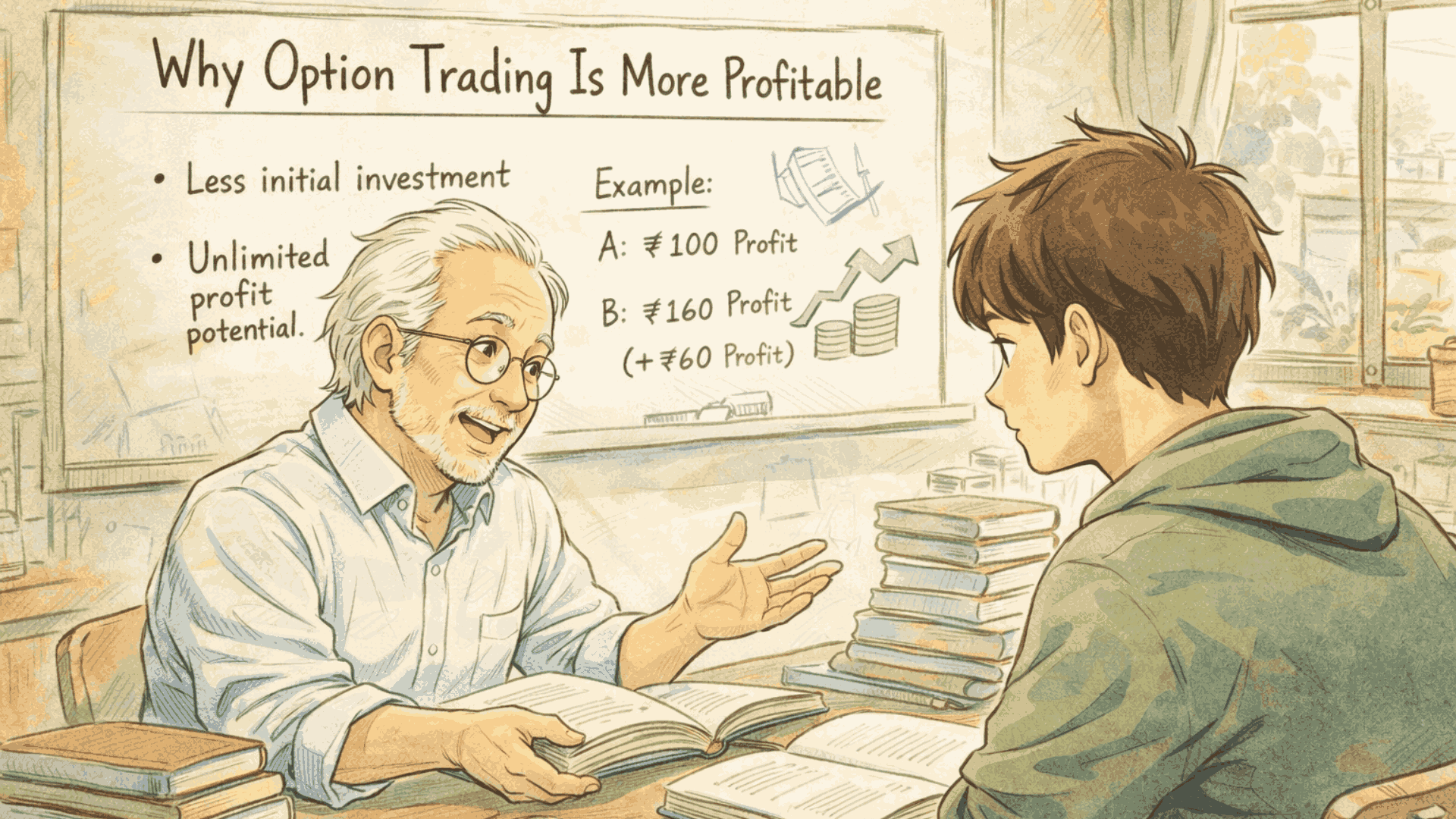
This is why many traders ask: Why is option trading more profitable?
This guide breaks it all down in simple language. Let us get into it.
Why Is Options Trading So Profitable?
The core reason options trading is so profitable is simple: leverage.
With a small amount of capital, you can control a large position in any stock or index. You do not need to buy 100 shares of a company at Rs. 5,000 each.
You can simply buy an option contract that gives you exposure to those 100 shares at a fraction of the cost.
This leverage multiplies your gains dramatically. If a stock moves 5%, a stockholder earns 5%.
But an options buyer, depending on how the contract is structured, can earn 50%, 100%, or even more from that same 5% move.
That kind of return is simply not possible with direct stock ownership.
Beyond leverage, options offer something stocks do not: flexibility. You can profit when the market goes up, when it goes down, or even when it goes nowhere at all.
This three-dimensional ability to make money in any market condition is what sets options apart from virtually every other financial instrument.
Options also allow you to define your risk upfront. When you buy an option, the maximum you can lose is the premium you paid and nothing more.
This built-in risk control is a major reason why sophisticated investors prefer options over other instruments.
Why Option Selling Is More Profitable?
This is where professional traders truly excel. Option selling involves collecting premiums from buyers and profiting when the market stays within a predicted range.
Essentially, how option selling works is that the seller takes on the obligation to fulfill the contract in exchange for an upfront fee, acting much like an insurance provider.
It is the equivalent of being the casino rather than the gambler.
While buyers only pay a small premium, the option trading margin required for selling is much higher, acting as a security deposit for the broker.
Statistically, the majority of options expire worthless. That means option sellers win most of the time simply because the big price moves that buyers bet on never actually happen.
The market tends to stay calmer than people expect, and that is a natural advantage for sellers.
- Time Decay Works For You: As an option seller, theta is your best friend. Every day that passes without a dramatic market move means more profit for you. While buyers need the market to move sharply and quickly, sellers simply need the market to stay in a comfortable zone, which it does most of the time.
- The Probability Advantage: An out-of-the-money option might have only a 20% chance of becoming profitable for the buyer. That means the seller has an 80% probability of keeping the premium. Selling options is simply playing better odds, and in trading, consistently better odds lead to better long-term outcomes.
- Consistent Monthly Income: Option sellers can create steady monthly income through strategies like covered calls and cash-secured puts. These approaches generate regular premium income regardless of whether the market is trending up or down, similar to collecting rent from a property every month.
Why Are Options More Profitable Than Stocks?
When you buy a stock, you have one hope: the price goes up. That is it. You wait, hold, and hope. Options give you a complete toolkit.
You can use them to generate income, hedge losses, speculate on direction, or bet on volatility, all using the same underlying instrument.
1. Capital Efficiency
To buy 100 shares of a Rs. 2,000 stock, you need Rs. 2,00,000. To gain equivalent exposure through an at-the-money call option, you might pay just Rs. 8,000 to Rs. 15,000 in premium.
That is a 90% reduction in capital deployed with similar upside potential in the short term.
2. Profit From Falling Markets
Stock investors suffer when the market crashes. Options traders can actually profit from it. By buying put options, which are contracts that gain value when prices fall, options traders benefit from downturns that destroy wealth for traditional investors.
3. Premium Decay as a Weapon
Every option has an expiry date, and its value erodes daily due to time decay, also called theta. For stock buyers, time is neutral. For smart option sellers, time is literally money.
They earn profits every day just by holding their position while time ticks away. This is an advantage that stock trading simply cannot offer.
Is Option Trading Profitable in India?
Options trading in India has grown explosively over the last few years, and for good reason.
For traders who understand the mechanics, this liquidity translates directly into opportunity.
- The Indian Market Advantage: India’s options market is uniquely suited for retail participation. Weekly expiries on Nifty and Bank Nifty mean traders do not have to wait an entire month for a trade to play out.
Positions can be opened and closed within days, giving active traders far more opportunities to generate returns compared to monthly-expiry markets abroad.
- Defined Risk in a Volatile Market: Indian markets can move sharply around events like RBI policy announcements, Union Budgets, election results, and global cues. Options allow traders to take positions around these events while knowing exactly how much they stand to lose.
No other instrument offers that combination of event-based opportunity and capped downside.
- Income Generation for Indian Traders: Strategies like selling covered calls on holdings or running iron condors on index options have become increasingly popular among Indian traders looking for consistent monthly income.
These approaches work particularly well in the range-bound phases that Indian indices frequently go through between major economic events.
- The Reality Check: SEBI data has repeatedly shown that 9 out of 10 options traders in India lose money. Profitability is absolutely possible, but it demands education, a tested strategy, and strict risk management.
Why Option Buying Is Risky?
While option buying offers explosive profit potential, it comes with a critical challenge: the odds are structurally against you.
Three forces work against the buyer at the same time, and all three must align for a trade to profit.
- Direction risk: The market must move the way you predicted.
- Timing risk: It must move before your option expires, which could be days or weeks away.
- Magnitude risk: The move must be large enough to overcome the premium paid.
Even if you correctly predict that a stock will go up, if it rises too slowly or too little, your option can still expire worthless. Time decay eats into the value of every bought option every single day.
It makes option buying a race against the clock.
Beginners often underestimate this decay. They buy an option, the stock barely moves, and they watch their investment shrink daily, even without any negative news.
This is theta working against them, an invisible daily cost that does not exist when you simply hold a stock.
It is not always because traders are wrong about direction. It is because time, premium costs, and volatility crush even correct predictions when the timing is off.
That said, option buying is not inherently bad. When used with discipline, tight stop-losses, clear targets, and small position sizes, it remains a powerful tool.
The danger lies in using it recklessly in the hope of overnight riches.
Conclusion
Options trading is more profitable not because it is easy, but because it gives you tools no other instrument provides. Leverage, flexibility, income generation, hedging, and defined risk all come in one package.
Understanding the difference between buying and selling options, and knowing when to use which approach, is what separates consistent winners from the crowd.
When you learn options trading with a focus on these mechanics, you start to see the market as a professional business rather than a game of luck.
Start small, learn the mechanics, paper-trade your first few strategies, and always treat risk management as the foundation. Used wisely, options do not just beat stocks.
They transform the way you think about markets entirely.
If you want to truly understand how options work in real market conditions, join our option trading classes and learn directly through practical, live examples.
Frequently Asked Questions (FAQs)
Q1: Can a beginner make money from options trading?
Ans: Yes, but only with education and discipline. Beginners should start with simple strategies, use small capital, and paper trade before going live. Jumping into complex strategies without understanding the basics leads to quick losses.
Q2: Is option selling safer than option buying?
Ans: Option selling has a higher probability of profit on individual trades, but it carries serious risk if not managed properly. Sellers must use stop losses and avoid selling naked options without sufficient capital or hedges in place.
Q3: How much capital do I need to start options trading in India?
Ans: You can begin buying options with as little as Rs. 5,000 to Rs. 10,000. Option selling requires a higher margin, typically Rs. 1 to 2 lakh per lot, depending on the underlying. Always ensure your capital can survive 5 to 10 losing trades in a row.
Q4: What is the best options strategy for consistent income?
Ans: Strategies like the Iron Condor, Short Strangle, and Covered Call are popular for consistent income. They work best in low-volatility, sideways markets and are favoured by professional traders for generating regular monthly returns.
Q5: Can option trading make you rich?
Ans: Yes, it can, but not in the way most people expect. Options trading offers high return potential due to leverage, but consistent profitability comes from disciplined risk management, strategy, and experience, not quick wins.
Before investing capital, invest your time in learning Stock Market.
Fill in the basic details below and a callback will be arranged for more information: