



Markets can look quiet and bearish for hours, then explode upward with massive green candles.
Many traders assume strong buyers have entered the market, but that is not always the real reason.
Often, these sharp rallies are driven by short covering, when sellers rush to exit losing positions.
Understanding why short covering happens can help traders read market psychology, spot sudden momentum moves, and avoid getting trapped on the wrong side of a powerful “bear squeeze”.
Let’s try to understand this concept of short covering in simple terms:
Why Does Short Covering Happen in the Stock Market?
Short covering occurs when traders who previously sold a stock, future, or option buy it back to close their short position. This buying happens to book profits or avoid losses when prices start rising.
But a common question among new traders is: does short covering increase price even without new investors?
The answer lies in the mechanics of the trade.
The sudden demand from these buy orders can quickly push prices higher and trigger sharp rallies.
Short covering doesn’t just happen by accident. It is usually a reaction to “pain” or “panic” among the bears.
Here are the primary reasons why it occurs:
1. Market Moves Against Short Sellers
The most basic reason is price action. If a trader shorts Bank Nifty at 52,000, expecting it to fall to 51,500, but instead, it starts moving toward 52,200, the trader starts losing money.
To prevent further losses, they must buy back their position. When the market moves against the collective view of the sellers, the “short covering rally” begins.
2. Stop Loss Triggered
Most professional traders and institutional “algos” have fixed stop-loss orders. For a short seller, a stop-loss is a “Buy” order placed above the current price.
The same logic applies in options trading, especially in Short Covering in Put Option, where traders who sold puts are forced to buy them back as prices move unexpectedly.
When the price hits these levels, hundreds of “Buy” orders are triggered automatically.
This creates a domino effect; one stop-loss hit pushes the price higher, which hits the next stop-loss, leading to a vertical spike.
3. Positive News or Change in Market Sentiment
In India, global cues play a huge role. If the US markets (NASDAQ or Dow Jones) rally overnight, or if there is a sudden positive announcement from the RBI or the government, the sentiment shifts.
Sellers who were holding bearish positions overnight realize they are on the wrong side of the trend and rush to cover their shorts as soon as the market opens at 9:15 AM.
4. F&O Expiry Pressure
In India, we have experiences almost every day (Nifty on Tuesday, Sensex on Thursday, etc.). On expiry day, traders must either settle their positions or roll them over.
If the market moves even slightly against the “Call Writers” (sellers) in the afternoon, they panic.
In the final hour of trading on expiry days, short covering activity often intensifies as traders rush to close positions before settlement. This can lead to sharp price moves.
5. Breakout Above Important Resistance
Short sellers usually build their “fortresses” at round numbers or major resistance levels (like Nifty 25,000).
They believe the market won’t cross that level.
However, if the price breaks and stays above that resistance, the sellers realize their “fortress” has fallen.
Their exit creates a “Short Squeeze.”
Short Covering Effect On Stock Price
Short covering has a direct and often sharp impact on stock prices. It occurs when traders who previously sold shares (short positions) start buying them back to exit their positions.
This sudden buying demand increases the stock’s price, sometimes leading to a rapid upward movement.
Unlike regular bullish trends driven by fresh investments, short-covering rallies are typically fast and short-lived. They are often triggered by unexpected positive news, strong support levels, or a change in market sentiment.
As more short sellers rush to cover their positions, the buying pressure intensifies, creating a temporary price spike.
However, once the short covering ends, the price may stabilize or reverse depending on overall market conditions.
Real World Example of How Short Covering Affects Stock Price
Imagine a stock “ABC Ltd” is consistently falling and currently trading at ₹500. Many traders expect the price to drop further, so they take short positions by selling the stock at this level.
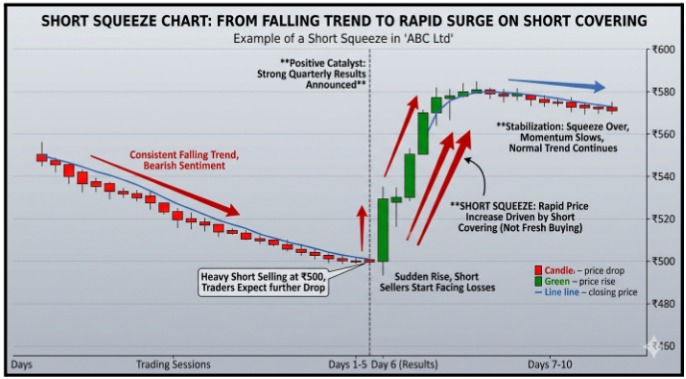
Suddenly, the company announces strong quarterly results, which changes market sentiment. The stock begins to rise from ₹500 to ₹530. As the price moves up, short sellers start facing losses.
To exit their positions and limit further losses, they begin buying back the stock.
This creates additional buying pressure, pushing the price even higher, say to ₹560 or ₹580 in a short period.
This rapid price increase is driven by short covering, not fresh buying interest.
Once most short positions are closed, the momentum may slow down, and the stock price stabilizes or follows its natural trend.
How to Find Short Covering Stocks?
Short covering can be identified by observing a combination of price and open interest data.
Typically, when a stock’s price rises sharply while open interest declines, it signals that short sellers are exiting their positions.
This indicates short covering rather than fresh buying.
Additionally, such moves are often fast and occur after a downtrend.
You may also notice sudden spikes in volume, confirming aggressive buying activity. Technical indicators like support levels holding strong can further support this view.
Monitoring derivatives data, especially in the futures segment, helps traders confirm whether the rally is driven by short covering or genuine bullish momentum.
Conclusion
Understanding why short covering happens is a game-changer for any trader.
It allows you to understand that not every price rise is a sign of long-term strength. Often, it is just the bears feeling the pain and rushing for the exit.
If you can identify a short-covering move early by looking at the falling Open Interest, you can ride the momentum for a quick profit.
However, always remember that these rallies can fizzle out as quickly as they started.
Want to understand why short covering happens and how to trade it?
Learn with real market examples in stock market live classes and improve your trading decisions.
FAQs
Q1: How can I identify short covering in the option chain?
Ans: You can identify short covering by observing price rising while open interest falls.
This indicates that traders who previously sold positions are buying them back to exit, which often leads to a quick upward price movement.
Q2: Does short covering always lead to a strong bullish trend?
Ans: No, short covering does not always indicate a long-term bullish trend.
It often causes a temporary price spike because sellers are exiting their trades, and once the covering ends, the market may move sideways or even fall again.
Q3: Why do short covering rallies usually happen very quickly?
Ans: Short covering rallies happen quickly because many short sellers try to exit at the same time to avoid bigger losses.
This sudden rush of buy orders creates strong demand, pushing prices sharply higher in a short period.
Q4: Can short covering happen even when the overall market trend is bearish?
Ans: Yes, short covering can occur during a bearish market.
Even in a downtrend, sudden positive news or resistance breakouts can force short sellers to exit, causing temporary upward spikes in price.
Q5: What is the biggest risk for traders during a short covering rally?
Ans: The biggest risk is entering the market too late.
Many traders mistake short covering for a new bullish trend and buy at the top, only to see prices fall once the short sellers finish covering their positions.
Before investing capital, invest your time in learning Stock Market.
Fill in the basic details below and a callback will be arranged for more information: