


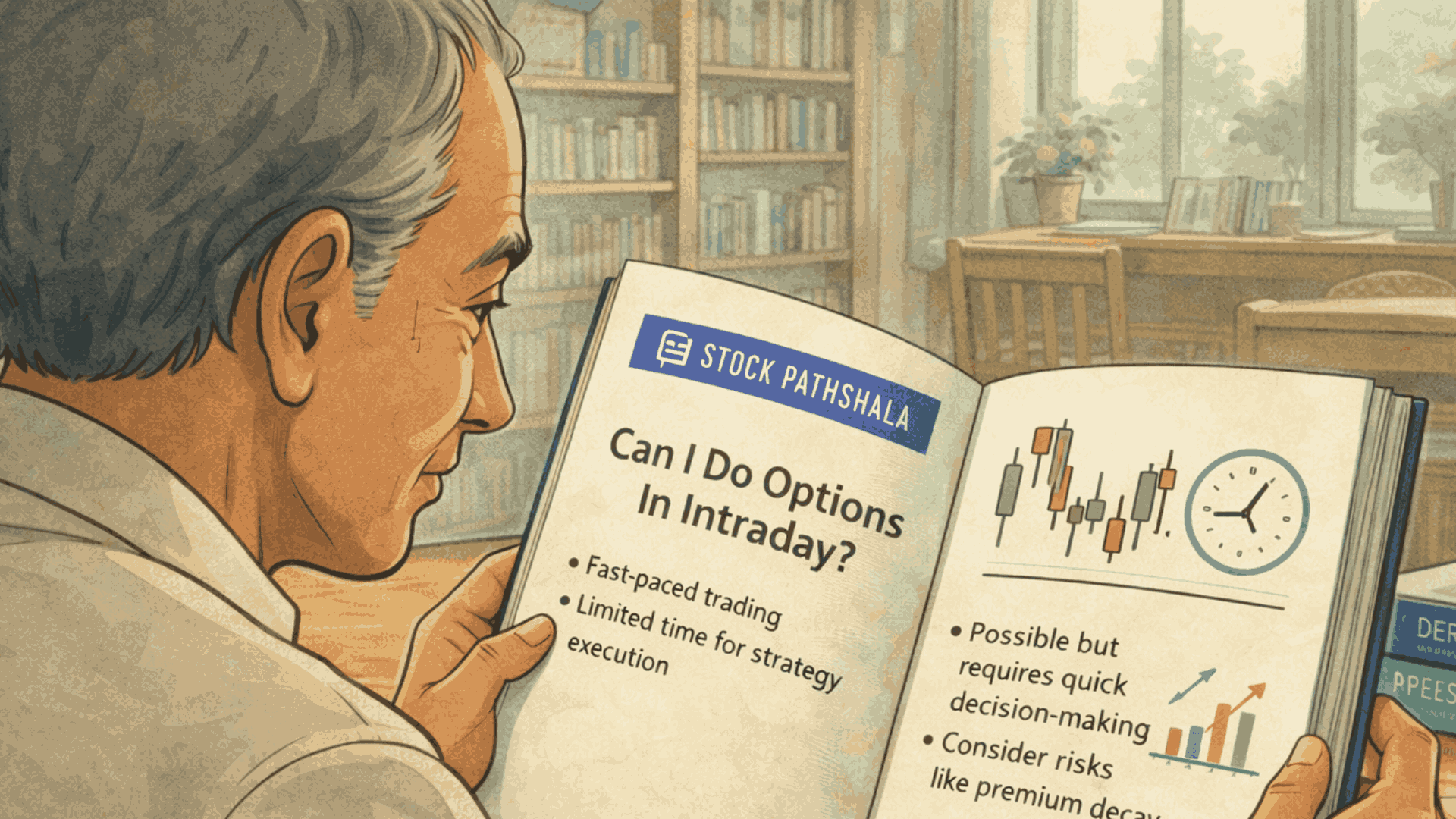
If you are getting into trading and know the basics of the stock market, chances are you have asked yourself this at some point – can I do options in intraday?
It is a very common question, especially when you start exploring options trading and see how quickly prices move.
The simple answer is yes, you can trade options intraday. But there is a bit more to it than just that.
Options trading already has its own learning curve. When you combine it with intraday trading, where everything happens within a single day, it becomes faster.
Plus, it becomes more reactive and sometimes overwhelming for beginners.
That is why it is important to understand how it actually works before you start.
In this guide, we will walk through everything in a simple way. We will explore what intraday options trading means, how people use it, and what you should keep in mind before trying it yourself.
What Is Intraday Options Trading?
Before jumping in, you must understand the basic mechanics of the day trade. How intraday trading works is simple: you buy and sell a financial instrument within the same business day to profit from short-term price movements.
Intraday options trading is a specific version of this, where you buy or sell “Call” or “Put” contracts instead of actual shares.
You are required to close them out before your broker’s auto square-off window, which for most brokers falls between 3:15 PM and 3:20 PM.
Unlike long-term investing, you are not buying a piece of a company to hold for years.
Instead, you are trading a contract that derives its value from an underlying index, like the Nifty 50, or a specific stock. These contracts come with an expiry date.
Their value fluctuations happen by the second. This high-speed environment makes them incredibly volatile and a favorite for active day traders.
Can You Do Options in Intraday the Same Way as Equity?
While both involve buying and selling on the same day, the main factor driving the price is completely different for each.
|
Factor |
Equity Trading | Options Trading |
| Asset vs contract | You buy actual shares of a company, and you own a piece of it |
You buy a contract giving you the right to buy/sell shares at a set price |
|
Price movement |
Linear: if the stock rises 1%, your position gains 1% |
Non-linear, a 1% stock move can trigger a 20–50% change in the option’s premium |
|
Time decay |
Shares hold their value indefinitely; time does not erode them | Every hour that passes reduces the option’s value, even if the stock price stays flat |
| Capital & leverage | Brokers offer margin-based leverage on your actual capital |
No broker leverage for buying, but contracts are naturally leveraged; you control a large stock value with a small premium |
Can You Do Options in Intraday?
Yes, you absolutely can, and it is currently the most common way retail traders in India try to grow their capital.
Many who start here eventually ask can option trading be a career; while the answer is yes, doing it right requires a total change in how you view the market and a shift from a hobbyist to a professional mindset.
Joining structured intraday option trading classes can accelerate this transition.
When you trade options intraday, your primary opponent is not just the price; it is time. Options lose value as the clock ticks (a phenomenon known as “Theta Decay”).
Thus, you have to be right about both the direction and the timing of the move.
If the market stays sideways for a few hours, an equity trader loses nothing, but an options buyer will likely see their capital slowly evaporate.
Most professionals prefer Nifty or Bank Nifty for this because they are “highly liquid.” This ensures there are always enough buyers and sellers.
So, you can jump in and out of trades in a split second without getting stuck by wide price gaps.
Is It Safe To Do Options Intraday?
Safety in the options market is a relative term. It mostly depends on which side of the trade you are on.
- Option Buying: This is the big draw for beginners because it requires very little money. You can start with as little as ₹5,000.
However, while your “math” says your loss is limited to what you paid, the statistical chance of losing 100% of that capital is actually quite high. Many traders enroll in Option Buying classes to better understand these risks before committing real capital.
- Option Selling: Pro traders often consider this “safer” because you win if the market stays flat or moves in your favor.
To understand how option selling works, you must realize you are acting as the “insurance provider,” collecting premiums from buyers while betting that the price will not reach a certain level.
But the thing is, you need significant capital. Usually, over ₹1.5 Lakh per lot is needed for options selling. And you face the risk of huge losses if the market makes a violent move against you.
For anyone just starting out, intraday options are not safe without a disciplined stop-loss. The market moves so fast that it can wipe out a trading account in a very short time.
But if you learn how it works, make a proper strategy, and follow it, the chances of earning profit can increase significantly.
Key SEBI Rules for Options Trading
Before you place your first trade, make sure you understand the latest regulations that govern your money.
- The 50:50 Margin Rule: If you plan on selling options, SEBI requires 50% of your margin to be in cash. The other 50% can come from the value of shares you have “pledged” from your existing portfolio.
- No Intraday Leverage for Buying: You have to pay 100% of the option premium upfront. You cannot borrow money from a broker to buy options the way you can with regular stocks.
- Auto Square-off: If you forget to close your position by around 3:20 PM, your broker will do it for you automatically. Also, you need to be cautious about auto square off as brokers usually charge an extra fee of about ₹50 for this “service.”
Common Strategies for Intraday Options
Profitable traders do not rely on luck. They use structured plans to navigate the chaos.
1. Momentum Trading
This is the go-to strategy for buyers. You wait for a clear, strong move in the market and “ride the wave” to catch a quick price spike.
Because time decay is always working against you, the goal is to be in and out as fast as possible.
The best momentum setups usually appear after a clear market-moving event, such as an RBI policy announcement or a strong gap-up open on Nifty.
Avoid chasing moves that are already 70–80% complete. Entering late on a momentum trade is one of the fastest ways to get caught in a reversal.
2. Scalping
Scalpers are like bees; they move fast and take small sips. They might make 20 trades a day, aiming for tiny gains of ₹2 or ₹3 per unit of premium movement.
Multiplied across a lot size, which for Nifty is 75 units, even a ₹3 move adds up to ₹225 per lot, and those small wins stack up quickly across multiple trades.
This works best in high-volume indices like Bank Nifty.
If that’s your preferred instrument specifically, our Bank Nifty option trading classes go deeper into how that contract’s own volatility behaves.
Scalping demands strict discipline on exits; many beginners turn a small winning scalp into a loss by waiting for “just a little more.”
Set a fixed target in rupees before entering the trade and exit the moment it is hit, regardless of what the market looks like at that second.
3. Selling Spreads
Instead of just selling one option, smart traders sell one and buy another further away to act as protection. This is called a “Spread.”
It caps your risk, lowers the capital you need, and is a much more professional way to handle volatility.
Risks You Must Manage
Intraday options have “hidden” risks that do not exist in regular stocks. Many beginners ask, what if i lose in intraday trading?
The answer lies in understanding these three critical factors: Time Decay, Volatility, and Liquidity Risk
- Time Decay in options (Theta): Even if the market goes nowhere, your option loses value every hour. This is the biggest silent killer for buyers.
- Volatility (Vega): A sudden news break or a global event can cause option prices to explode or crash, even if the stock price itself has not moved yet.
- Liquidity Risk: If you trade “Out of the Money” options, you might find it impossible to sell them. You could be “right” about the move but find no one willing to buy your contract when you want to exit.
Conclusion
Can you do options in intraday? Yes, you can. Should you? Only if you are prepared for the wild swings and have a strict risk management plan in place.
Intraday options offer some of the highest potential returns in the financial world. But, they also come with a very real risk of losing your entire investment.
Start small, use virtual “paper trading” to find your feet, and only use real money once you have proven you can protect your capital first.
Master options trading with us!
Stop leaving your trades to chance! Join our option trading classes on the StockPathshala app and learn how to handle real market moves with confidence.
FAQs
Q1: How much capital do I need for intraday options?
Ans: You can start buying options with as little as ₹5,000. However, for selling options, you will generally need at least ₹1.5 Lakhs to handle margin requirements.
Q2: Which is better: Nifty or Bank Nifty for intraday?
Ans: Nifty is usually “smoother” and easier for beginners to track. Bank Nifty is far more aggressive and moves faster. This can lead to bigger profits, but it can also drain your account much quicker.
Q3: Can I carry my intraday option to the next day?
Ans: Yes, you can convert an “Intraday” (MIS) position to “Overnight” (NRML) if you have the required cash. But be careful – the market often opens with a “gap,” which could result in a massive loss before you can even react.
Q4: Which time frame is best for option trading?
Ans: Most action happens in the first hour -9:15 to 10:30 AM, and the final hour, 2:30 to 3:15 PM. This is when the volume is highest, and the price moves are most predictable.
Q5: Are options profits taxed differently?
Ans: In India, options profits are treated as “Business Income.” This is actually a perk because you can deduct expenses like your internet, books, or software, and even use trading losses to reduce the tax you owe on other income.
Before investing capital, invest your time in learning Stock Market.
Fill in the basic details below and a callback will be arranged for more information: