


An Elliott Wave Leading Diagonal is a special type of price pattern that appears at the beginning of a new trend.
It looks like a weak or overlapping move, not a strong and clean impulse wave pattern.
In simple terms, it is the market’s way of slowly shifting direction. Buyers and sellers are still unsure, so price moves forward but with hesitation.
If you have looked at a chart and felt that the move up or down looks messy, not sharp or powerful, you might have been looking at a leading diagonal.
Let’s break it down clearly for you to understand.
What Is Elliott Wave Leading Diagonal?
This is the problem. A unique kind of motive wave that emerges at the start of a new trend is called a leading diagonal.
It appears as either Wave A of a zigzag corrective pattern or Wave 1 of an impulse.
Unlike a typical impulse wave, it looks compressed. Price overlaps. Momentum feels hesitant. It almost looks wrong.
But it’s not wrong.
An Elliott wave leading diagonal is a 5-wave structure with the name 1 2 3 4 5. But within it is a corrective internal structure, ordinarily 5 3 5 3 5 or occasionally 3 3 3 3 3.
Waves 1 overlapping Wave 4? That’s allowed here. And that is what makes it different.
Elliott Wave Leading Diagonal Rules
Now let’s get precise. The Elliott wave leading diagonal rules are strict.
Core Structural Rules:
- It must have five waves.
- Waves 1, 3, and 5 are again divided into zigzags or correctional structures.
- Wave 4 and Wave 1 share price space. (Unlike standard Elliott wave 4 rules, where overlap is strictly forbidden)
- Wave 3 can not be the shortest.
- Waves 1 and 3, and Waves 2 and 4 have trendlines that converge to give a wedge shape.
Yes, here, Wave 4 overlap is permitted. That’s the twist. In a normal impulse, the count is invalidated with overlap. Overlaps should be anticipated in a leading diagonal.
Elliott Wave Leading Diagonal Example
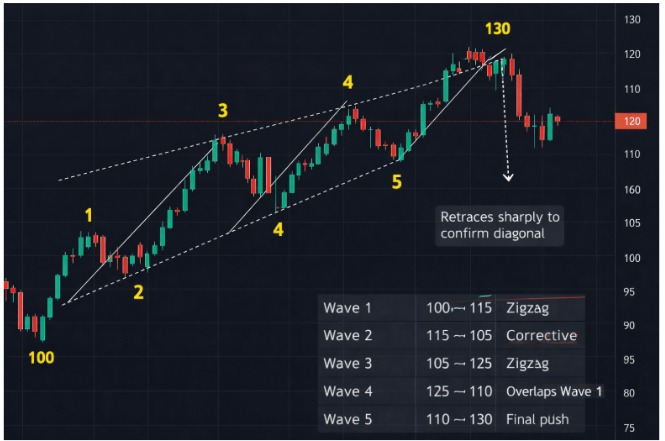
Let’s make this practical. This is often how traders spot Elliott Wave 1 in a brand new trend:
| Wave | Price Move | Structure |
| Wave 1 | 100 → 115 | Zigzag |
| Wave 2 | 115 → 105 | Corrective |
| Wave 3 | 105 → 125 | Zigzag |
| Wave 4 | 125 → 110 | Overlaps Wave 1 |
| Wave 5 | 110 → 130 | Final push |
Notice Wave 4 drops into Wave 1 territory. That’s valid here.
After Wave 5 completes at 130, the price often sharply retraces back toward 110 or even 105. That retracement confirms the diagonal.
You see the rhythm?
Push. Pull. Push. Pull. Final push. Then snap back.
That snap back is important.
It typically follows the Elliott Wave ABC correction rules, providing a structured way to measure how deep the pullback will go before the trend resumes.
Just as you measure the Elliott wave 5 length to find the end of a mature trend, observing the leading diagonal helps you identify the very birth of a trend.
Once this hesitant start and the subsequent pullback finish, the market usually accelerates into the “Power Wave.”
This is where understanding what is wave 3 of Elliott wave cycle becomes crucial, as it is the most explosive part of the move that follows a diagonal.
Why Does The Elliott Wave Leading Diagonal Form?
Turning point markets are unpredictable. Buyers intervene, yet confidence remains on the rise. Sellers are not fully gone. So price drives ahead, then slows, then drives on.
It is similar to a car taking off on a hill. It jerks and pulls, then accelerates.
That hesitation creates the wedge shape. And once Wave 5 completes, the market usually makes a sharp pullback, retracing much of the diagonal.
If you trade on TradingView or MetaTrader, you’ll notice these often appear after long downtrends or major corrections.
You’ll often see an Elliott wave leading diagonal:
- At the beginning of a new bull market
- At the start of Wave A in a correction
- After prolonged exhaustion trends
- Near major support or resistance levels
It’s common in indices like NIFTY 50 or S and P 500 after strong corrections.
Seasonal volatility periods, like pre-budget rallies or earnings cycles, often show this hesitant start behavior.
Common Mistakes Traders Make While Analyzing Leading Diagonal
Let’s be honest.
Most confusion happens because:
- Traders forget that the Wave 4 overlap is allowed.
- They assume all five wave structures are impulses.
- They ignore the wedge shape.
- They fail to anticipate a sharp retracement after completion.
And that retracement?
It’s not small. It’s usually aggressive.
That’s why confirmation matters.
Leading Diagonal Vs Standard Impulse
This comparison clears the confusion fast.
| Feature | Leading Diagonal | Standard Impulse |
| Wave 4 Overlap | Allowed | Not Allowed |
| Internal Structure | Corrective | Impulsive |
| Shape | Wedge | Clean upward channel |
| Momentum | Moderate | Strong |
Many traders mislabel diagonals as weak impulses. That mistake can cost money.
If you expect explosive continuation but you’re actually in a diagonal, you may get caught in the sharp retracement after Wave 5.
Conclusion
The Elliott wave leading diagonal is not a messy pattern. It’s structured hesitation. It signals that a new trend is forming, but conviction is still building.
It contradicts the idea of clean impulse waves. Yet it works within the Elliott framework perfectly.
Want to master Elliott Wave Leading Diagonal with real market examples?
Join our stock market classes for detailed sessions and practical learning.
FAQs
Q1: Why is the phenomenon of Elliott Wave Diagonal identifiable?
Ans: It is a five-wave wedge formation that can be seen at the beginning of a trend where Wave 4 can overlap Wave 1.
Q2: What are nature of the rules related to Elliott Wave Leading Diagonal?
Ans: Five waves, corrective internal structure, Wave 4 overlap allowed, Wave 3 not the shortest, converging trendlines.
Q3: How do you confirm a leading diagonal?
Ans: A sharp retracement after Wave 5 completion usually confirms the pattern.
Before investing capital, invest your time in learning Stock Market.
Fill in the basic details below and a callback will be arranged for more information: