


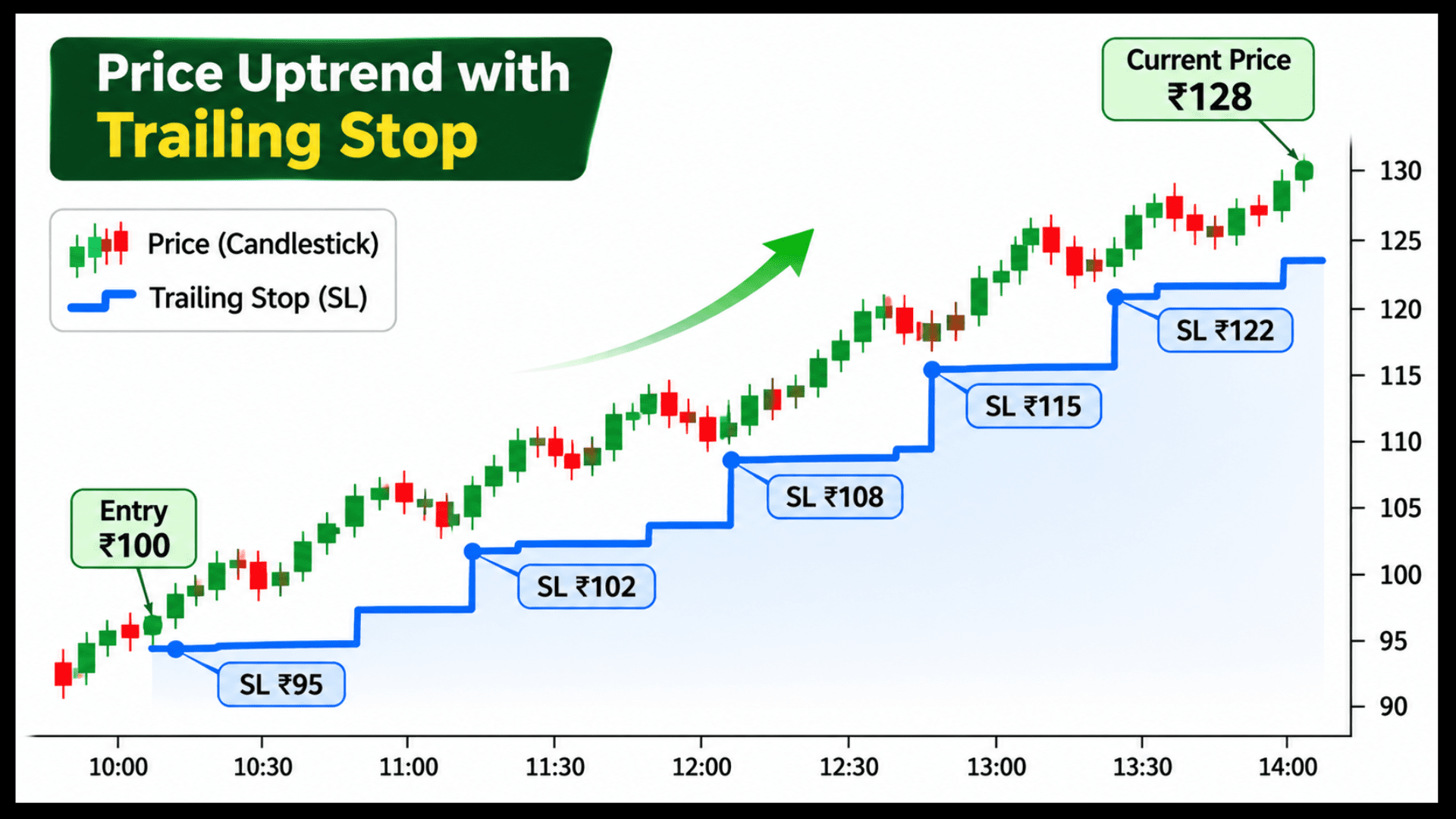
You are in a trade, the price is moving in your favour, and you do not want to give back your profits.
But is trailing stop loss a good idea, or can it close your position too early?
The answer depends on market conditions, your trading style, and how you manage risk. Let’s understand when it works, when it fails, and how to use it effectively.
When Should You Use a Trailing Stop Loss in Trading?
A trailing stop can help you protect profits while allowing a winning trade to continue.
However, it works best when you understand the market movement and have a clear exit plan.
A trailing stop loss strategy is particularly useful in these situations:
- When the market is trending in one direction for hours or days.
- When you want to hold a winning trade without monitoring every candle.
- When you struggle to book profits and often let your gains disappear.
In a steady trend, a trailing stop allows profits to grow while keeping downside risk limited.
Before trailing your stop, first understand what the stop loss for intraday trading should be.
When Can a Trailing Stop Loss Go Wrong?
A trailing stop is not suitable for every market condition. Sometimes, it can close your position before the actual price movement begins.
Watch out for these situations:
- Choppy markets: Frequent price movements can trigger your stop before the actual trend begins.
- Very tight stops: Normal market fluctuations can close your position too early.
- Price gaps: If a stock opens below your stop level, your actual exit price may be worse.
- Early exits: You might book a small profit and then watch the stock move much higher.
Many beginners struggle with these mistakes. इसलिए, understand why people lose money in intraday trading and learn how poor stop-loss decisions affect trading results.
Difference between Trailing Stop Loss And Fixed Stop Loss
Neither method works best in every situation. A fixed stop loss stays at your selected price, whereas a trailing stop moves as the market moves in your favour.
Here is a quick comparison to understand their differences:
| Point | Fixed Stop Loss | Trailing Stop Loss |
|---|---|---|
| Price level | Stays at the set price | Moves up as price rises |
| Best market | Sideways or uncertain | Strong, steady trends |
| Main risk | Gives back open profits | Exits early on small pullbacks |
| Effort | Set once | Requires a clear trailing rule |
| Suitable for | Target-based trades | Trend-following trades |
The real question is which method suits your trading plan. If you have a predefined target, a fixed stop can be easier to manage.
साथ ही, your potential profit matters as much as your possible loss. Understand the risk reward ratio in intraday trading before deciding your exit strategy.
Fixed vs Trailing Stop Loss: Example With Real Rupee Calculations
Let’s understand how both methods can produce different results under different market conditions.
These are hypothetical examples for illustration only. Brokerage, taxes, and slippage are not included.
Assume you buy 200 shares at ₹500, with an initial stop at ₹490. Your starting risk is ₹2,000.
Your fixed target is ₹520, while your trailing stop stays ₹10 below the highest price.
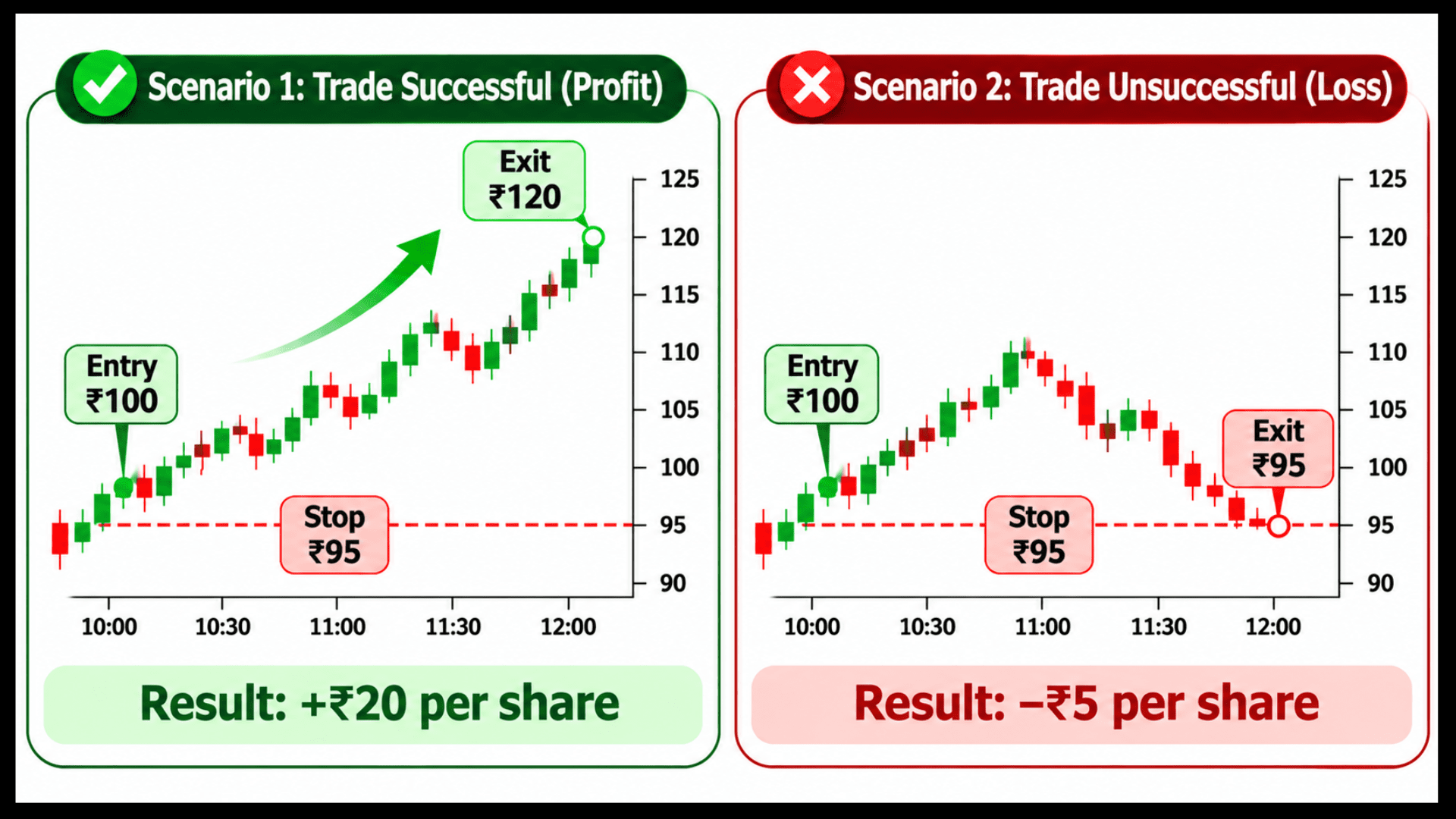
Consider these two scenarios:
Scenario 1: Strong market trend
The price moves from ₹500 to ₹540 and then falls to ₹525.
Scenario 2: Choppy market
The price moves from ₹500 to ₹512, drops to ₹502, then rises to ₹530 and closes at ₹528.
| Scenario | Fixed Stop With ₹520 Target | Fixed Stop, Exit at Close | Trailing Stop (₹10 Behind) |
|---|---|---|---|
| Clean trend | +₹4,000 | +₹5,000 | +₹6,000 |
| Choppy day | +₹4,000 | +₹5,600 | +₹400 |
In the trending market, the trailing stop performs best because it captures more of the upward movement.
However, in the choppy market, it exits at ₹502 before the actual recovery.
Therefore, market conditions matter more than the stop-loss method itself.
Trailing Stop Loss vs Partial Profit Booking: What Should You Choose?
Some traders prefer booking a portion of their profits while keeping the remaining position open.
This approach combines profit protection with the opportunity to benefit from further price movements.
- Trailing only: You can capture a larger trend, but a sudden reversal may reduce your open profits.
- Partial booking only: You secure some profits, but might miss additional gains.
- Combining both: You book part of your position at the first target and trail the remaining quantity.
For beginners, combining both approaches can make trade management easier because some profits are already secured.
How to Set the Right Trailing Stop Loss Distance?
Choosing the right distance is one of the most important parts of a trailing stop strategy.
A stop placed too close can trigger during normal price movements, while a wider stop may give back more profits.
There are two common ways to decide the trailing distance:
| Method | How It Works | Example |
|---|---|---|
| Percentage-based | Trail a fixed percentage below the highest price | 2% of ₹500 = ₹10 |
| ATR-based | Trail using a multiple of the recent average price range | ATR of ₹8 × 1.5 = ₹12 |
A percentage-based method is simple, but it does not consider how much a particular stock moves.
On the other hand, ATR (Average True Range) adjusts to market volatility, giving volatile stocks more room and quieter stocks less.
You can also understand how to use ATR for position sizing to learn how volatility can influence your risk management decisions.
Does Trailing Stop Loss Work for Intraday Trading?
Many traders use trailing stop loss for intraday trading because prices can move quickly during market hours.
It can work, but your trailing distance must account for normal intraday fluctuations.
The first hour is often volatile, so a tight trailing stop may get triggered unnecessarily.
Many traders wait for the market to settle or start trailing after the first profit target is reached.
For options, the approach can be different because premiums move quickly and are also affected by time decay. Therefore, understand the risks before applying an equity-based stop-loss strategy to options.
Who Should Use a Trailing Stop Loss Strategy?
A trailing stop loss is more suitable for certain trading styles than others.
Here is who can consider using it:
- Trend followers and swing traders: They hold positions for larger price movements, making trailing stops useful.
- Intraday traders: Those with fixed targets may prefer a predefined exit strategy.
- Scalpers: Since they exit within minutes, trailing stops may offer limited benefits.
- Beginners: They can start with fixed stops and gradually learn trailing techniques.
If you are planning to hold trades for several days, first understand is swing trading profitable and whether this trading style suits your risk tolerance.
Remember, wider trailing distances also require an appropriate risk budget.
Before Using a Trailing Stop Loss: 5 Things to Verify
Before adjusting your stop-loss level, consider these questions:
- Is the market trending or moving sideways?
- Is my trailing distance wider than normal price fluctuations?
- Do I understand the risks of price gaps?
- Does my total trade risk match my trading plan?
- Do I have a clear exit strategy?
If you cannot answer most of these questions confidently, a fixed stop loss may be a better choice for that particular trade.
Wondering how to choose between a fixed and a trailing stop when real money is on the line?
In our live intraday trading classes, you learn on real charts in sessions of 1 to 1.5 hours. You can ask doubts, get personalised mentorship, and there is no fixed batch, but we do not guarantee profit.
Conclusion
Yes, a trailing stop loss can be useful in a strong trend when you maintain a sensible trailing distance.
However, it may cause early exits in choppy markets or when the stop is too tight.
Test it on historical charts, compare it with fixed stops and partial booking, and always calculate your risk before entering a trade.
Disclaimer: This blog is for educational purposes only and is not investment advice. Trading involves financial risk. Verify applicable rules and order types through official exchange and SEBI resources.
Frequently Asked Questions
Before investing capital, invest your time in learning Stock Market.
Fill in the basic details below and a callback will be arranged for more information: