


Can I learn intraday trading in 1 month? Many beginners ask this and expect either a big yes or a scary no. The real answer sits in the middle, and it depends on what you mean by “learn”.
Here you will see what one month can give you, what it cannot, and a weekly plan you can follow.
Is 1 Month Enough to Learn Intraday Trading?
Yes, you can learn the basics and a simple process in one month. No, you cannot become a consistently profitable trader in one month.
Think of it like learning to drive. In 30 days you learn the controls and the rules. You will not yet handle every road, weather and traffic jam.
Before you start, it also helps to be sure that intraday is the right style for your life. A quick look at how intraday and delivery trading differ can save you weeks of effort in the wrong direction.
What Can You Learn in 1 Month of Intraday Trading?
One month is enough to build a solid base if you study with focus. Here is what a serious beginner can expect to finish.
- Understanding of order types, market hours, margin and charges.
- Ability to read candles, support, resistance and volume on a chart.
- One simple setup written down with entry, stop loss and exit rules.
- A basic risk rule, such as a fixed rupee loss per trade.
- Ten or more paper trades recorded in a journal.
What Can You Not Learn in 1 Month?
Some things only come with time and many market days. No plan can shortcut them, so it is better to know this early.
- Consistent results, because 20 or 30 trades prove very little.
- Experience of different market phases, such as trending, sideways and sharply volatile days.
- Emotional control with real money, which is very different from practice mode.
- A tested edge, which needs hundreds of trades to judge honestly.
Intraday also stays risky by nature, as is intraday trading speculative shows with SEBI data, so expect some losses.
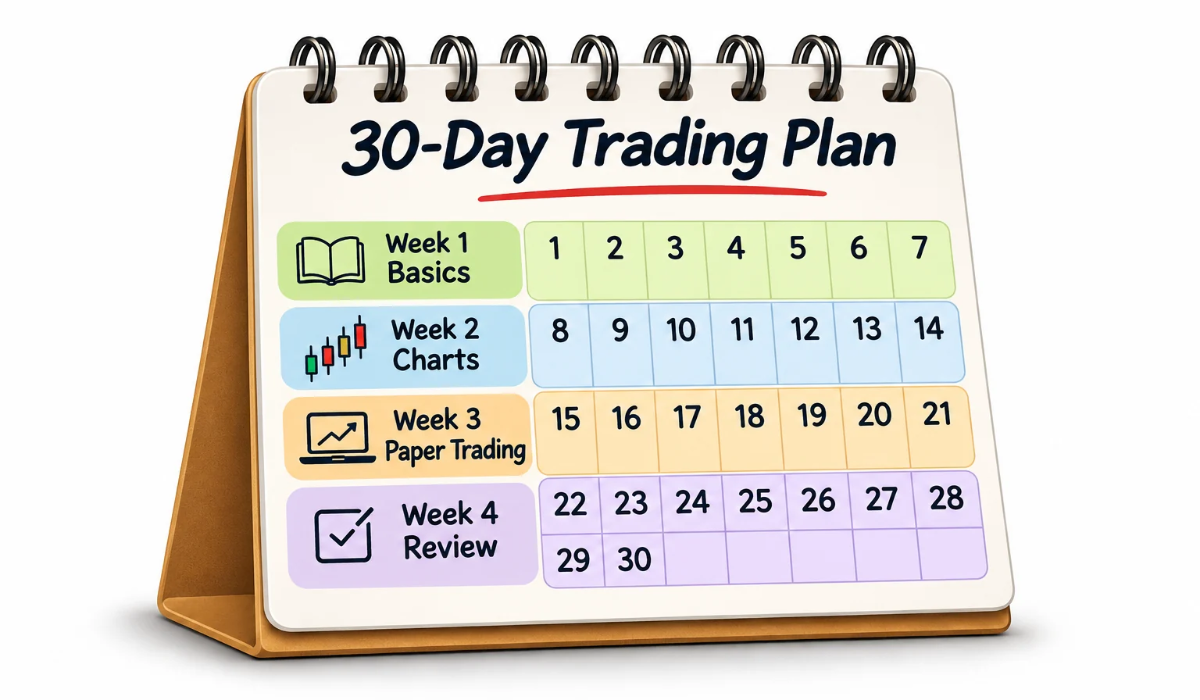
30-Day Intraday Trading Learning Plan for Beginners
A good plan keeps you from jumping between videos, tips and tools. Each week below has one clear job and one clear output.
Many learners first ask about safety, and is it safe to do intraday trading weighs benefits against risks.
The table gives you the full picture first, and the sections after it explain each week.
| Week | Main focus | What you do | You finish with |
|---|---|---|---|
| Week 1 | Basics and market structure | Learn order types, margin, charges and how a trading day flows | A one-page notes sheet in your own words |
| Week 2 | Charts and one setup | Read candles, levels and volume, then choose one setup | Written entry, stop loss and exit rules |
| Week 3 | Paper trading with risk rules | Practise the setup in practice mode with a fixed risk per trade | A journal with at least 10 sessions |
| Week 4 | Review and tiny-size decision | Study your journal, count mistakes, and decide the next step | A written decision: continue practice or try tiny size |
If a week is not complete, repeat it instead of moving ahead.
Week 1: Learn Intraday Trading Basics and Market Structure
Start with how the market works before you look at any chart. Learn what happens in a day, what orders do, and which costs eat into every trade.
Spend time on price terms too. For example, read what is LTP in share market so you can read the screen correctly from day one.
Week 2: Learn Charts and Pick Only One Intraday Setup
Now move to the chart. Learn candles, support and resistance, volume and trend, then pick one setup and stay with it.
A simple moving average idea is enough to test, and the 9 EMA strategy is one such example to study. Do not add three more indicators in the same week.
Week 3: Paper Trading With Risk Rules
This is the most important week. Take your written setup and practise it in practice mode, with a fixed rupee risk on every trade.
Remember that practice fills often look cleaner than real ones. Real orders meet a gap between buyers and sellers, so it helps to understand bid price and ask price before going live.
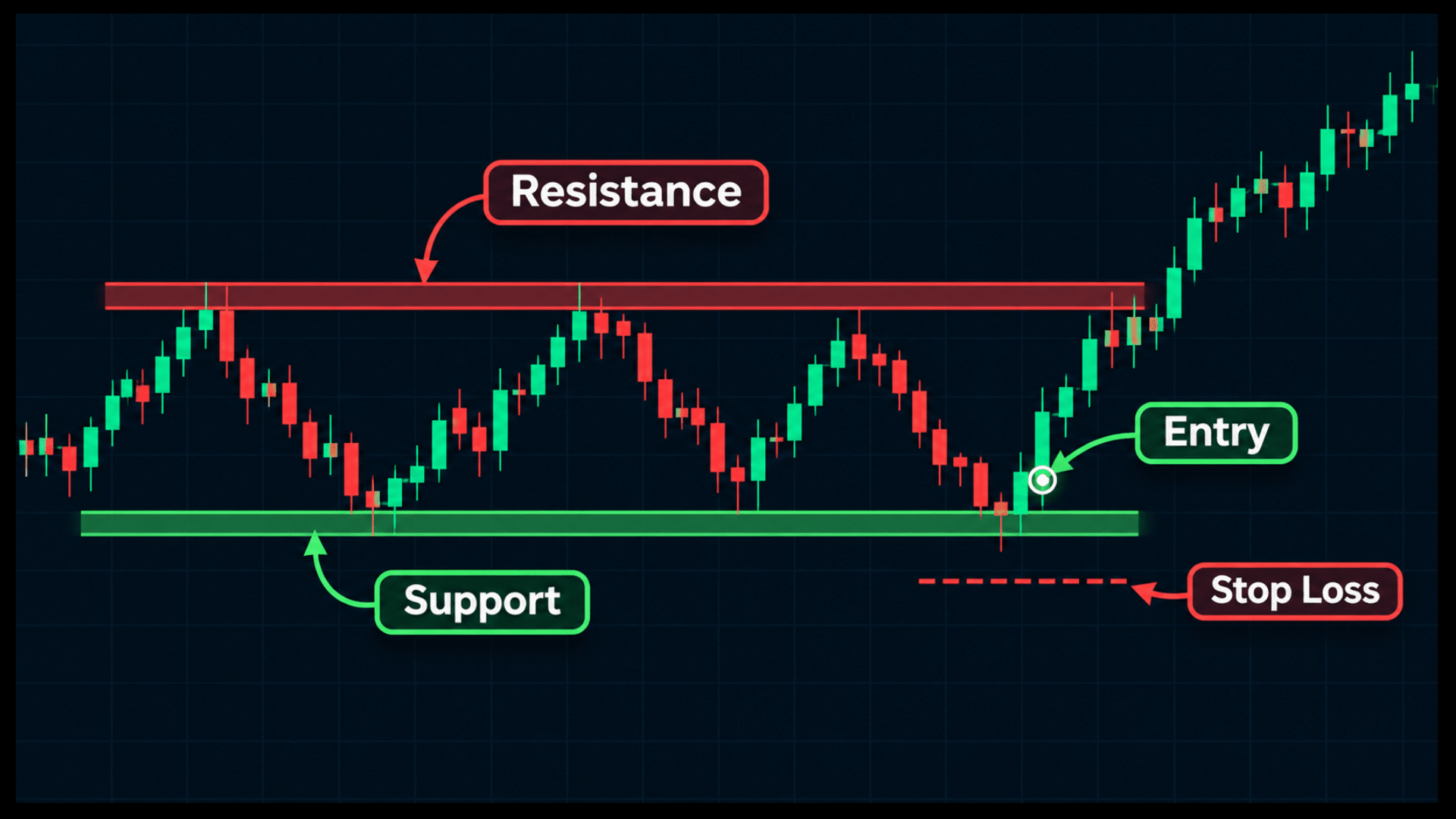
Here is a hypothetical example, for illustration only. Suppose your practice capital is Rs 20,000 and you risk 1% per trade, which is Rs 200.
If your stop loss is Rs 2 away from entry, the quantity works out to 100 shares. Now see why this rule matters in a bad streak.
- Ten losses in a row at 1% risk would reduce Rs 20,000 to about Rs 18,088, a fall of around 9.6%.
- Ten losses in a row at 5% risk would reduce it to about Rs 11,975, a fall of around 40%.
The rule is not about winning more. It is about staying in the game long enough to learn.
Week 4: Review Your Journal and Decide the Next Step
Now read your journal like a teacher checking an exam copy. Count how many mistakes came from the setup and how many came from not following your own rules.
If you decide to go live, keep the size tiny. Seeing how to start intraday with a very small amount shows how small size can work as a learning step.
Also remember that a small sample can fool you, and this is another hypothetical example. Say you took 20 paper trades with a risk of Rs 200 each, and winners paid 1.5 times the risk.
With 9 wins and 11 losses, the net result is Rs 500. With just one fewer win, it becomes Rs 0, so one trade changed the whole story.
How Many Hours a Day Do You Need to Learn Intraday Trading?
Time is where most plans break. A job, a family and a market that runs at fixed hours all compete for your attention.
The table below compares two types of learners with hypothetical but realistic study schedules, for illustration only.
| Learner type | Daily time | Weekly time | Total in 4 weeks |
|---|---|---|---|
| Working professional | 1.5 hours on weekdays, 3 hours on weekend days | 13.5 hours | 54 hours |
| Full-time learner | 5 hours, 6 days a week | 30 hours | 120 hours |
A working professional can still finish the plan, but it may need a slower pace. A full-time learner finishes faster, though the lessons from live market days still cannot be rushed.
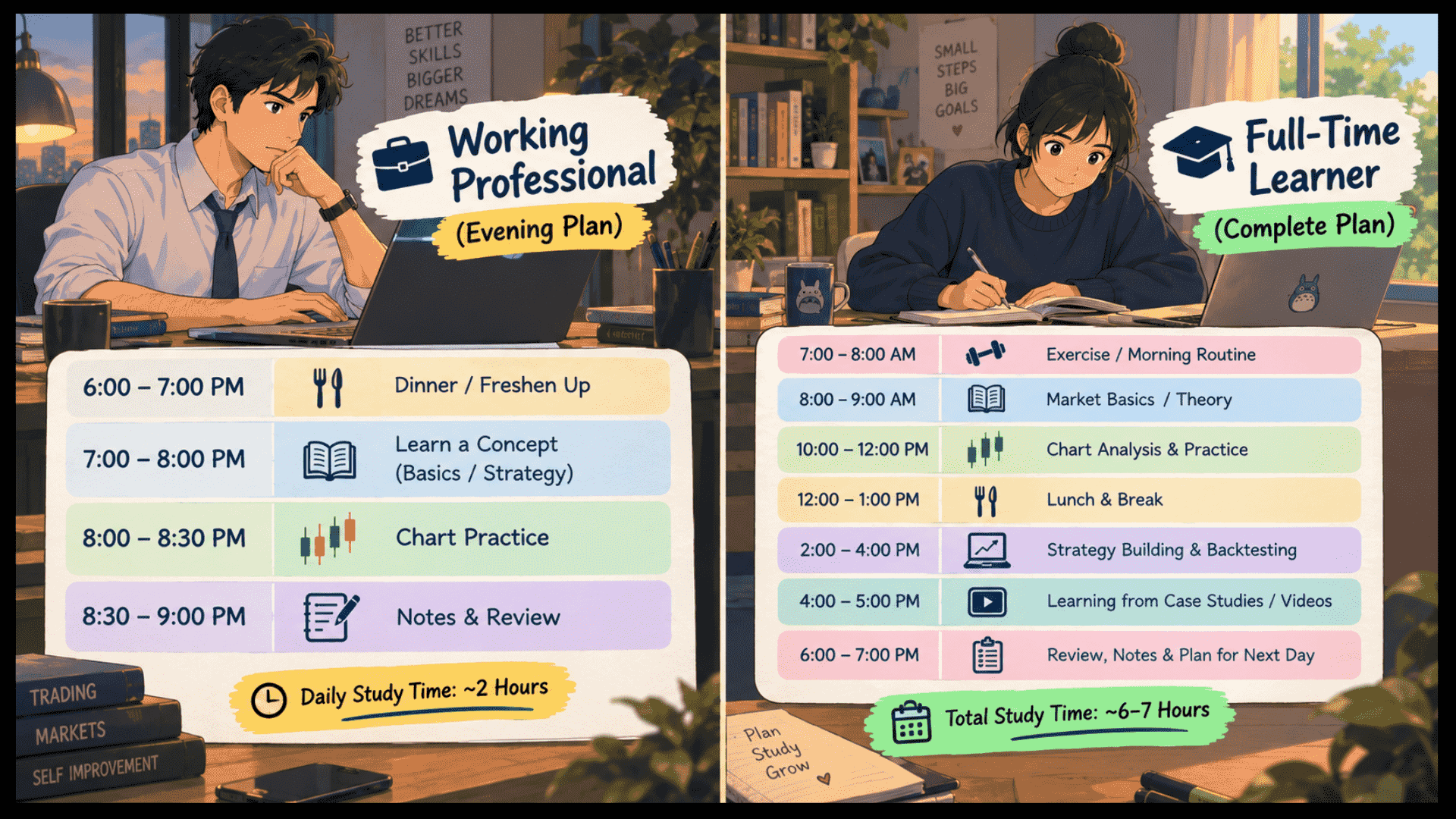
If you work a regular job, plan your weekday sessions around what you can observe. Knowing the best intraday trading time helps you decide which part of the day deserves your attention.
For your weekends, use the time to review charts, update your journal and plan next week. Do not try to cram all learning into one weekend.
Common Mistakes Beginners Make When Learning Intraday Trading in a Hurry
Speed makes people skip the boring parts, and the boring parts are usually the safest. Here are the mistakes that show up most often in a hurry.
- Going live with real money in week 2 because paper trading feels slow.
- Changing the setup after every loss.
- Trading without a stop loss, or moving it further away when price turns.
- Using borrowed money or money meant for household needs.
- Chasing a loss with a bigger next trade.
- Copying tips from social media instead of testing your own rules.
Another common mistake is trading at random times of the day. Understanding the best time to buy stocks for intraday can help you avoid entering when you have no plan.
Notice that none of these mistakes need more knowledge to fix. They need patience and discipline.
Are You Ready for Live Intraday Trading?
At the end of the month, be honest with yourself. The goal is not to prove that you are ready, but to find out.
Use the table below as a simple checklist after week 4.
| Area | Ready sign | Not ready yet |
|---|---|---|
| Rules | You can write your setup in five lines | You change the setup every day |
| Stop loss | You set it before entry, every time | You move or remove it when price goes against you |
| Journal | You record every trade with the reason | You remember only the good trades |
| Emotions | You treat a loss as a planned cost | You want to recover a loss quickly |
| Money | You use only money you can afford to lose | You depend on trading profits for monthly needs |
If most answers fall in the “not ready yet” column, that is fine. Simply repeat weeks 3 and 4 for another month.
A first loss will come, and what if I lose in intraday trading explains how to handle it calmly.
Do you want a mentor to help you learn intraday trading step by step on real charts?
In our live classes of 1 to 1.5 hours, you can join from your mobile, ask doubts live and get personalised mentorship. There is no fixed batch to wait for, and we never promise profits.
Conclusion
So, can I learn intraday trading in 1 month? You can learn the basics, one simple setup and a risk rule, but you cannot expect consistent results in 30 days.
Treat the first month as your foundation. Study, practise on paper, review honestly, and then decide calmly whether to continue.
Disclaimer: This blog is for educational purposes only and is not investment advice. Please verify rules on the official exchange and SEBI websites.
Frequently Asked Questions
Before investing capital, invest your time in learning Stock Market.
Fill in the basic details below and a callback will be arranged for more information: