


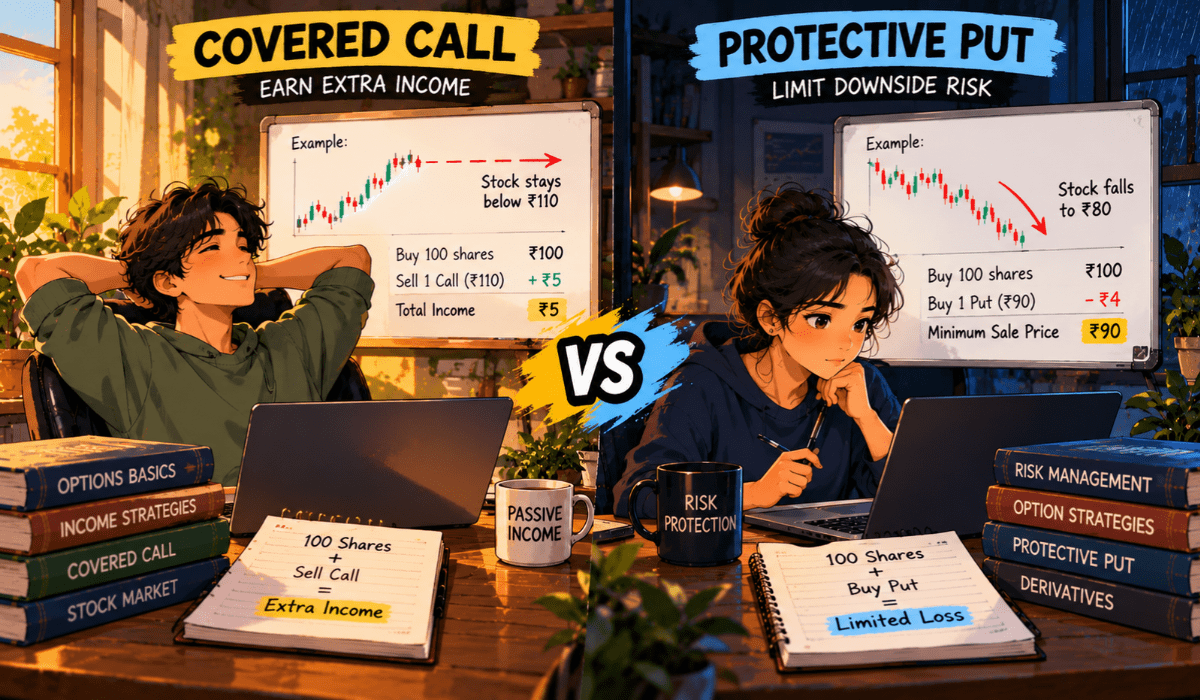
You own a stock, and you are a little nervous about it. Covered call vs protective put is the choice most people face at exactly this point.
One option earns you some extra money. The other costs you money but helps you sleep.
Neither one is free of trade-offs.
Covered Call vs Protective Put: Main Difference in Simple Words
Most investors hold shares for months and still feel uneasy when the market turns shaky. Covered calls and protective puts are two popular ways to handle that feeling, but they solve different problems.
Here is the one-line difference:
- A covered call says: “I am happy to sell at a higher price, and I want to be paid while I wait.”
- A protective put says: “I do not want to lose more than a fixed amount, and I will pay for that comfort.”
If you want the full story of the first strategy, we have it in our guide on how a covered call strategy works. Here we stay with the comparison.
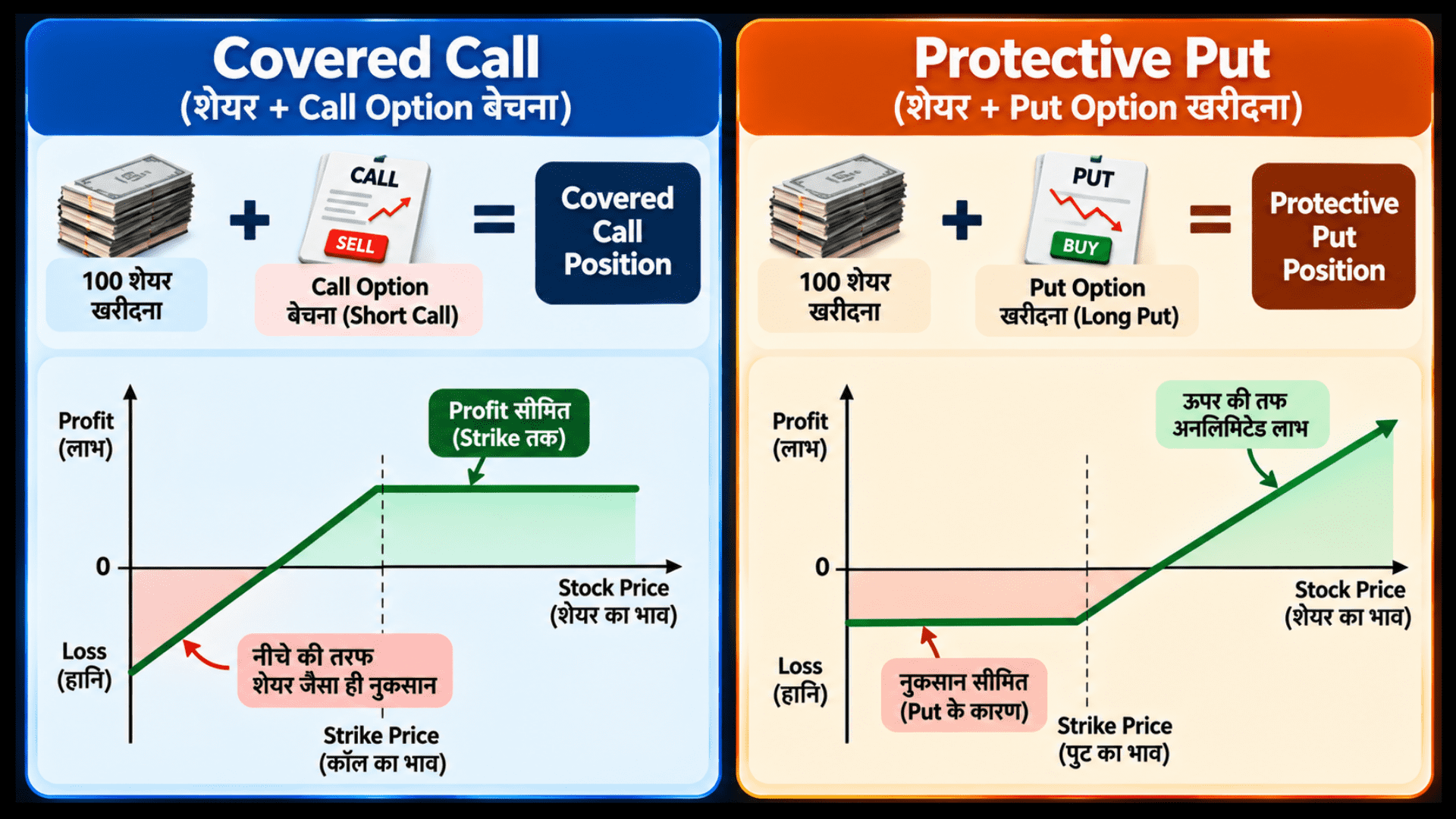
ADD IMAGE: add a side-by-side payoff diagram of a covered call and a protective put on the same stock
What Is a Covered Call?
A covered call is the simpler of the two to picture. Imagine you own a flat and rent it out.
You earn rent every month, but you agree not to sell it above a fixed price.
A covered call works the same way. You own the shares, and you sell someone the right to buy them from you at a fixed price.
The money you get for this is called the premium. You keep it no matter what happens next.
Before going further, it helps to know what it means to sell a call option and why a buyer pays you for it.
Here are the key numbers, per share:
- Max profit: (strike minus purchase price) plus premium received
- Break-even: purchase price minus premium
- Max loss: purchase price minus premium, if the stock falls to zero
What Is a Protective Put?
A protective put is insurance for your shares. Think of how you insure your car.
You pay a small amount every year, and you hope you never use it.
Here you own the shares and buy a put option. A put gives you the right to sell at a fixed price, even if the market price falls much lower.
You pay a premium for this. If the stock drops below the strike, the put gains value and covers part of your loss.
Here are the key numbers, per share:
- Max loss: (purchase price minus strike) plus premium paid
- Break-even: purchase price plus premium
- Max profit: unlimited in theory, because the stock can keep rising, less the premium
Your worst case is known from day one. The price you pay is the premium, and it is gone if the stock never falls.
Covered Call vs Protective Put: Side-by-Side Comparison
The table below puts the two on the same page, so you can see where each one helps and where it hurts.
| Feature | Covered call | Protective put |
|---|---|---|
| View | Neutral to mildly bullish | Bullish, but worried about a fall |
| Cost vs income | You receive premium (income) | You pay premium (cost) |
| Max profit | Limited: (strike minus purchase price) plus premium | Unlimited in theory, less the premium |
| Max loss | Purchase price minus premium (stock to zero) | (Purchase price minus strike) plus premium |
| Break-even | Purchase price minus premium | Purchase price plus premium |
| Best market | Sideways or slow uptrend | Uncertain, event-heavy or fall-prone |
| IV preference | Prefers high IV when selling | Prefers low IV when buying |
| Time decay | Works in your favour | Works against you |
| Position type | Credit, with an obligation to sell | Debit, with a right to sell |
Implied volatility (IV) is just the market’s guess of how much a stock may move. When it is high, options cost more.
So you would like to sell when implied volatility in the option chain is high, and buy protection when it is low.
Keep two things in mind about IV:
- High IV pays you more for a covered call, but it also warns that the stock may move sharply.
- Low IV makes puts cheaper, but cheap cover can feel unnecessary until the day you need it.
Covered Call vs Protective Put Example With Payoff Table
Let us use one made-up stock so the comparison is fair. All numbers are hypothetical and per share.
The setup:
- You buy the stock at Rs 100.
- Covered call: you sell a 110 call and receive Rs 4.
- Protective put: you buy a 95 put and pay Rs 3.
- Both options have the same expiry, one month away.
Now see what each position earns or loses at expiry for different stock prices.
| Stock price at expiry | Shares only | Covered call | Protective put |
|---|---|---|---|
| 80 | -20 | -16 | -8 |
| 90 | -10 | -6 | -8 |
| 95 | -5 | -1 | -8 |
| 100 | 0 | +4 | -3 |
| 105 | +5 | +9 | +2 |
| 110 | +10 | +14 | +7 |
| 120 | +20 | +14 | +17 |
| 130 | +30 | +14 | +27 |
Figures are in Rs per share, before charges and taxes.
Here is what the table tells you:
- In a flat market near 100, the covered call earns Rs 4 while the put costs Rs 3.
- In a sharp fall to 80, the covered call loses Rs 16 and the put loses only Rs 8.
- Above about 117, the protective put overtakes the covered call, because the call caps your gain at Rs 14.
So in this setup, the covered call comes out ahead between roughly 88 and 117. The protective put wins in bigger falls and bigger rallies.
Can You Use a Covered Call and Protective Put Together?
Yes, you can. You do not always have to pick one.
Many investors sell a call to help pay for the put.
Collar Strategy: Covered Call and Protective Put Together
A collar means holding the shares, buying a protective put and selling a covered call, usually in the same expiry.
The call premium pays for some or all of the put. So your protection becomes cheaper, sometimes close to free.
In our example, you buy the 95 put for Rs 3 and sell the 110 call for Rs 4. The net credit is Rs 1.
The collar then works out like this:
- Max loss: Rs 4 per share (a fall to 95 costs Rs 5, less the Rs 1 credit)
- Max profit: Rs 11 per share (a rise to 110 gains Rs 10, plus the Rs 1 credit)
- Cost: close to nothing, but you give up every gain above 110
You are trading big upside for a small, known downside. It suits someone who wants to hold through an uncertain event without staring at the screen all day.
The catch is that you now manage two options, pay two sets of charges, and face margin rules on the short call.
What Is a Synthetic Covered Call Strategy?
A synthetic covered call is a position that pays off the same way as a covered call, without holding the shares directly. The classic version is a short put.
This sounds odd at first, so here is the idea. Put-call parity is a rule that links calls, puts and the stock at the same strike and expiry.
In plain terms, long stock plus a short call gives the same shape of payoff as a short put, plus a fixed amount of cash.
Compare the two payoffs:
- Covered call: you gain as the stock rises up to the strike, then the profit flattens.
- Short put: you keep the premium if the stock stays above the strike, and you lose as it falls below.
- Both: capped profit, and heavy losses if the stock crashes.
So a covered call and a short put at the same strike are cousins. Both are neutral to bullish, with limited reward and a large downside.
A short put is an income trade, and it follows the same logic as how option selling works: you collect premium and accept an obligation.
In India, a short put on a stock that finishes in the money at expiry is settled by delivery. You would have to buy the shares at the strike, so keep the funds ready.
Poor Man’s Covered Call: Is It Good for Beginners?
A poor man’s covered call replaces the shares with a long-dated call that is deep in the money. You then sell a near-month call against it.
It needs less money than buying the stock, which is why it looks attractive to beginners. Use it with caution.
In India, long-dated stock options are often thinly traded. Spreads can be wide, and exiting can be hard.
The long call also loses time value, and a falling stock can eat a big share of what you paid.
How to Choose Between a Covered Call and a Protective Put
Start with an honest answer to one question: what are you trying to avoid?
Use this as a rough guide:
- Choose a covered call if you expect the stock to stay flat or rise slowly, and you would happily sell at the strike.
- Choose a protective put if you fear a sharp fall, such as around results or global news, and want a known worst case.
- Consider a collar if you want protection without paying much, and can live with capped gains.
Then check four things before placing the trade:
- Do you really want to sell at the strike? A covered call can take your shares away in a strong rally.
- Can you afford the premium? A protective put bought every month adds up.
- Is implied volatility high or low right now?
- Do you have enough margin and unpledged shares for the covered call?
If you want someone to check your strike and expiry choices before you trade, our live classes and personalised option trading mentorship are built for exactly that.
Covered Call vs Protective Put in India: What Changes
The strategies are the same everywhere. The plumbing is different in India.
Settlement and margin rules affect which one is easier to run.
Covered Call vs Protective Put in India: Physical Settlement Rules
Here is how settlement works for stock options and why it matters before you place your first trade.
Stock options on NSE F&O stocks are physically settled. Only options that finish in the money at expiry go to delivery.
SEBI phased in physical settlement from 2018, and it has applied to all stock F&O since the October 2019 expiry. Index options like Nifty are cash-settled.
For a covered call, a short call that ends in the money means you must hand over the shares at the strike.
So the shares must be free in your demat. If they are pledged, they cannot be delivered until you unpledge them.
A protective put that ends in the money also goes to delivery, so you would deliver shares at the strike. You can close the position before expiry if you do not want that.
It pays to understand how expiry works in the share market before your first trade.
Margin Required for Covered Call vs Protective Put in India
Margin confuses almost everyone at first. It is the money your broker blocks as a safety deposit when you sell an option.
The basic split:
- Protective put: a debit trade with defined risk. You pay the premium upfront, and no margin is needed to hold the long put.
- Covered call: you are selling a call, so margin applies.
Here is the surprise for many people. Shares in your demat sit in the equity segment, while margin is computed in the derivatives segment.
So your shares do not automatically cut the margin on a short call.
Pledged shares can count as collateral after a haircut. Brokers usually need at least 50% of the margin in cash or cash equivalents, so check your broker’s rule.
Margin can rise near expiry and when the price rises, and brokers can charge more than the exchange minimum.
For the wider picture, read up on how margin works in option trading. Verify current figures on NSE and with your broker.
Covered Call vs Protective Put: Which Is Easier to Run in India?
Both strategies are simple on paper. The real difference shows up in cash flow and planning.
The protective put is simpler: pay, hold, done. The covered call needs more planning around margin and delivery.
F&O profit or loss is generally treated as non-speculative business income, and STT applies on option sales. Please confirm your own treatment with a CA.
If steady income is what you want, first check whether the covered call strategy is really profitable over time, with its risks.
Common Mistakes With a Covered Call or Protective Put
These mistakes come up again and again:
- Selling a call too close to the price, so a small rally takes your shares away.
- Buying a very cheap, far out-of-the-money put that only helps after a crash.
- Rolling puts every month without counting the total cost of cover.
- Forgetting that margin on the short call can rise.
Strike choice matters more than most beginners expect, so spend time choosing the strike price before every trade.
Join Option Trading Classes and Learn the Covered Call Strategy from Experts
Confused about covered call vs protective put and which one suits your stock?
In our live classes of 1 to 1.5 hours, you can ask questions, get a plan set around you, and learn without a fixed batch to chase.
Conclusion
A covered call pays you to wait, but it caps your gains. A protective put limits your loss, but the premium is a cost.
Pick based on the risk you want to avoid, and consider a collar if you want both. Check margin and delivery rules before every trade.
We cannot promise profits, but we can help you understand the risk before you trade.
Frequently Asked Questions
Before investing capital, invest your time in learning Stock Market.
Fill in the basic details below and a callback will be arranged for more information: