


Ever watched a market rally and thought, “This can’t possibly go higher,” and then it does? The final burst of enthusiasm usually belongs to Wave 5.
And knowledge of Elliott Wave 5 Length can be the difference between being able to ride the trend and leaving.
Let’s understand it practically.
What Is Elliott Wave 5 Length?
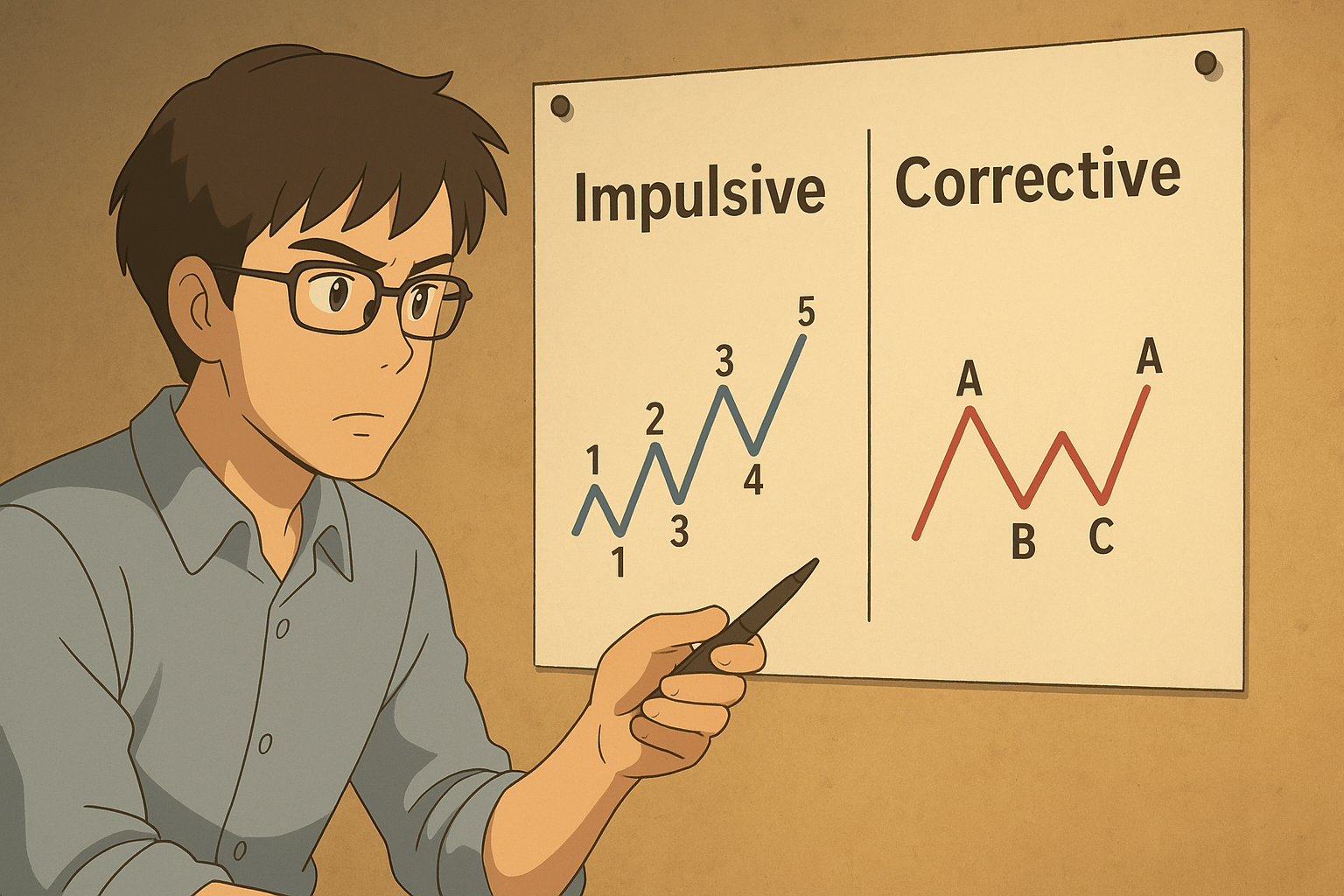
The Elliott Wave theory has five waves in a complete impulse move. Waves 1, 3, and 5 run with the direction of the trend.
Wave 5 is the final leg of a standard Elliott impulse wave pattern.
But here’s the thing. Wave 5 is not random. Its length often follows measurable Fibonacci relationships relative to Waves 1 and 3.
When traders talk about Elliott wave theory 5 length, they’re usually asking:
- How far will Wave 5 travel?
- Will it extend?
- Will it truncate?
- Is it equal to Wave 1?
These are not philosophical questions. They affect entries, exits, and risk management.
Elliott Wave 5 Length & Fibonacci Ratios
Wave relationships are built on Fibonacci ratios. That’s the backbone of the model.
These are the most recent projections of the Elliott wave 5th wave length:
- Wave 5 = 61.8 percent of Wave 1
- Wave 5 = 100 percent of Wave 1
- Wave 5 = 161.8 percent of Wave 1
- Wave 5 = 61.8 percent of Waves 1 through 3 combined
By combining Elliott wave with Fibonacci, you create a high-probability zone for trend exhaustion.
However, when Elliott Wave 3 extends or is excessively long, say 161.8 percent or above Wave 1, then Wave 5 is likely to be small. This balance keeps the structure proportional.
Elliott Wave theory is deeply rooted in symmetry.
In many cases:
- Wave 5 equals Wave 1
- Or Wave 5 measures 61.8 percent of Wave 1
This balance keeps the structure proportional. Elliott Wave theory is deeply rooted in symmetry.
Measuring Elliott Wave 5 Length Step By Step
Let us simplify it into a usable checklist.
- Identify clear Wave 1, 2, 3, 4.
- Measure Wave 1.
- Check if Wave 3 is extended.
- Apply Fibonacci projections from Wave 4.
- If Wave 4 was a sideways Elliott wave triangle pattern, project the thrust from the breakout point.
- Look for confluence with:
- Previous resistance
- Channel boundaries
- RSI divergence
- Volume shifts
You’re not guessing. You’re stacking probabilities.
Note: Wave 5 is the final push of the trend, and because it often runs on fading momentum, it carries a higher risk of sudden reversal.
Wave 5 Length Measurement Example
Let’s say:
- Wave 1 = 100 points
- Wave 3 = 200 points
Wave 3 clearly extended.
Now project Wave 5:
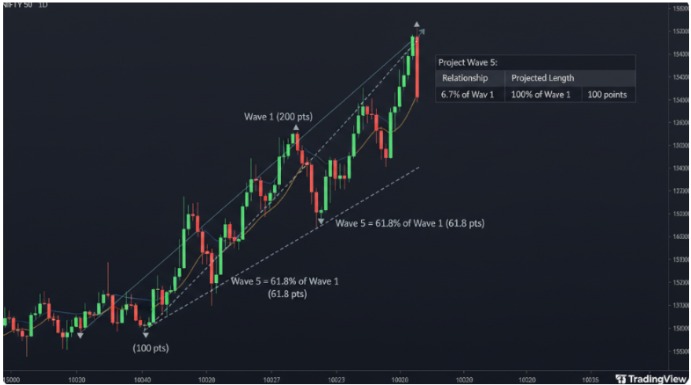
| Relationship | Projected Length |
| 61.8% of Wave 1 | 61.8 points |
| 100% of Wave 1 | 100 points |
Most traders will project from the end of Wave 4 using Fibonacci extension tools in platforms like TradingView.
If Wave 5 approaches equality with Wave 1, that’s often your high probability target zone.
Common Mistakes Traders Make While Measuring Wave 5
Let’s be honest.
Most miscalculate Wave 5 because they:
- Forcing the Wave Count: Trying to make the market fit a specific bias rather than letting the price action dictate the structure.
- Ignoring the Elliott Wave 4 Rules and Guidelines: Forgetting that in a standard impulse, Wave 4 cannot overlap with the price territory of Wave 1. If you see an overlap but the trend is still clearly beginning, you might actually be looking at an Elliott wave leading diagonal rather than a standard Wave 1.
- Disregarding Wave 3 Extension Rules: Failing to recognize that Wave 3 cannot be the shortest of the three impulse waves (1, 3, and 5). This rule alone saves many traders from invalid counts.
- Projecting from the Wrong Pivot: Placing Fibonacci extension tools on the wrong start or end points, which leads to inaccurate length targets.
- Overlooking the Rule of Alternation: Forgetting the guidelines between Waves 2 and 4; if Wave 2 was a sharp zigzag, Wave 4 is likely to be a sideways Elliott wave flat correction.
Elliott Wave requires discipline. If Wave 3 is the shortest impulse wave, your count is invalid. That rule alone saves many traders.
When Wave 5 Becomes the Extended Wave?
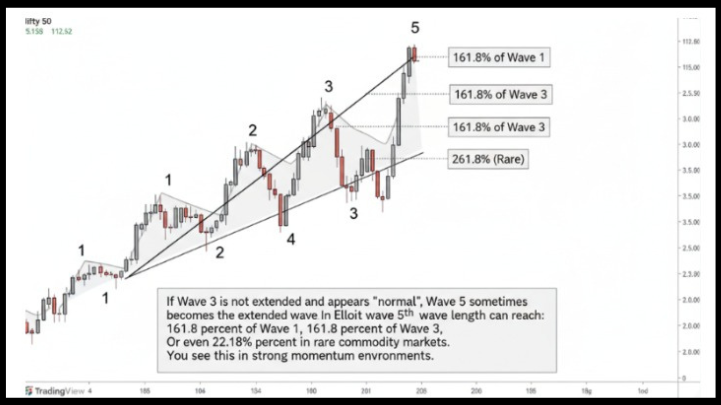
Now let’s flip it.
If Wave 3 is not extended and appears “normal,” Wave 5 sometimes becomes the extended wave.
In this case, the Elliott wave 5th wave length can reach:
- 161.8 percent of Wave 1
- 161.8 percent of Wave 3
- Or even 261.8 percent in rare commodity markets
You see this in strong momentum environments. Think of crypto rallies or breakout phases in small-cap stocks.
Emotion drives price. Wave 5 reflects late participation. Retail traders rush in. Volume spikes. Headlines get loud.
But structure still applies.
When Elliott Wave 5 Length Falls Short?
Here’s where it gets interesting.
Sometimes Wave 5 fails to exceed the high of Wave 3. This is called a truncation.
Why does it happen?
- Momentum divergence
- Weak buying pressure
- Exhausted trend
- Broader market resistance
Technically, the wave still counts as Wave 5. But its length is smaller than expected. Truncations are common near major cycle tops.
If RSI shows bearish divergence while price barely pushes above Wave 3, that’s often a warning.
And yes, this is part of understanding Elliott Wave 5 Length. Not every fifth wave explodes higher.
Conclusion
Wave 5 is the final push. It can be dramatic or disappointing. Long or short. Extended or truncated.
But it is rarely random.
By analyzing:
- Wave 1 length
- Wave 3 behavior
- Fibonacci ratios
- Channel resistance
- Momentum divergence
You gain a structured expectation for Elliott Wave 5 Length.
And when you have structure, you trade with clarity.
Not certainty. But clarity.
FAQs
Q1: What is the Formula to Compute Elliott Wave 5 Length?
Ans: Measure Wave 1, verify whether Wave 3 has extended, and project the Fibonacci ratios of the end of Wave 4. Typical targets include 61.8 percent or 100 percent of Wave 1.
Q2: Can Wave 5 Be The Longest Wave?
Ans: Yes. Wave 5 can extend to 161.8 percent or higher of Wave 1 or Wave 3, unless Wave 3 is extended.
Q3: What if Wave 5 Is Smaller Than it should be?
Ans: It might be a fifth wave that has been shortened, commonly reflecting trend exhaustion or the loss of momentum before a more significant correction.
Master Elliott Wave 5 Length like a pro and turn market moves into confident trades. Join our stock market classes today, and start trading with clarity.
Before investing capital, invest your time in learning Stock Market.
Fill in the basic details below and a callback will be arranged for more information: