


Every seasoned trader knows this feeling: you see a pattern on the chart that looks like it should work, but somehow the market laughs and takes you out.
The reason?
Pattern recognition without rules is guesswork.
That’s where neo-wave rules come in, a structured way to read market waves with more precision than the traditional Elliott Wave Theory.
In this blog, we’ll break down what these rules are, how time and price come into play, and how real traders use them in everyday market decisions.
What Is Neo Wave Theory?
Neo Wave Theory is an advanced development of the original Elliott Wave Theory, which was created by Ralph Nelson Elliott but refined and structured by Glenn Neely.
It employs a more accurate and straightforward count of the wave numbering system for traders.
In contrast to the classical Elliott waves, the Neo Wave applies systematic rules in the calculation of whether a pattern is valid and tradable.
Key elements include:
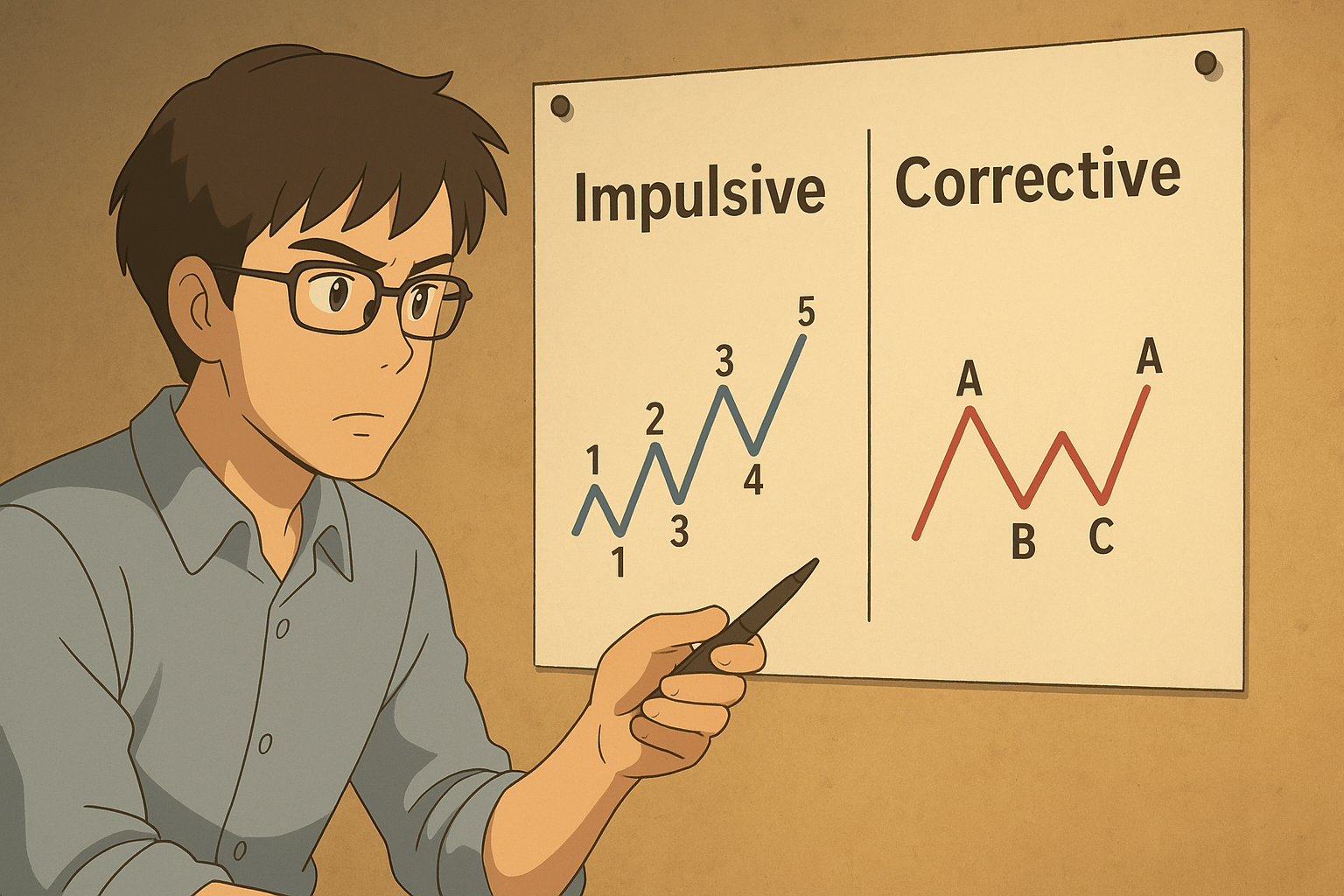
- Basic Neo Wave Rules: Clear guidelines for identifying impulse and corrective waves.
- Time Rules: Ensures waves unfold in realistic durations.
- Price Rules: Confirms valid retracements and extensions.
- Monowave & Polywave: Breaks trends into small single-wave movements (monowaves) and linked wave sequences (polywaves) for accurate pattern recognition and trade setups.
This approach reduces guesswork and increases trading reliability.
Understanding The Core Neo Wave Rules
Before you hunt for a wave, you’ve got to know what makes a valid one.
Neo Wave Rules are stricter and more detailed than traditional Elliott waves. They help you avoid mislabeling patterns and losing money on fake signals.
What The Rules Look Like:
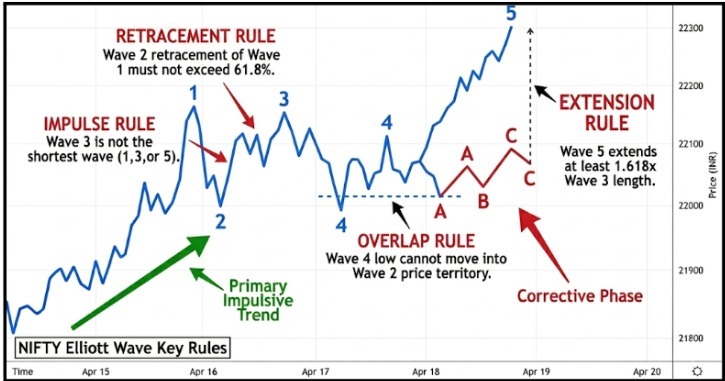
| Rule Category | Key Rule Example |
| Retracement Rule | Wave 2 should not retrace more than 61.8% of Wave 1 |
| Impulse Rule | Wave 3 cannot be the shortest of Waves 1, 3, and 5 |
| Overlap Rule | Wave 4 must not move into Wave 2’s price space |
| Extension Rule | One directional wave must extend at least 1.618 times another if the pattern is impulsive |
These aren’t random.
Each rule has a purpose: cut out the subjectivity that plagues Elliott Wave counting.
Traders using only classic waves often argue endlessly over whether a pattern is valid or not. Neo wave theory rules force a more discipline-based count.
Neo Wave Structure Label System Explained
Before applying any rule, Neo Wave requires you to label each wave segment with a structure tag.
These aren’t just cosmetic; they determine which rules apply next.
- :5 — Marks an impulse wave (5-segment, trend-following move). When you tag a wave:5, it must comply with all impulse rules, no overlap, Wave 3 not shortest, etc.
- :3 — Marks a corrective wave (3-segment counter-trend move). Zigzags, flats, and triangles all fall under this label family.
- :F3 — A flat correction specifically, where Wave B retraces close to or beyond Wave A’s origin, followed by a Wave C of similar length.
- :L5 — A trending impulse with extension, typically where Wave 3 stretches beyond 1.618x.
These are a few of the most common labels.
Think of structure labels as your chart’s grammar. Without them, you’re stringing waves together randomly.
With them, every label carries a ruleset, making your wave count auditable, not just intuitive.
Neo Wave Retracement Rules
Most traders treat retracement as a simple Fibonacci check: Did it bounce at 61.8%?
Good enough, but Neo Wave disagrees.
Retracement in Neo Wave isn’t just a level; it’s a decision tree.
Depending on how far a wave pulls back, the rules change entirely, what the next wave must do, how long it should take, and whether your current wave label even survives.
There are 7 distinct Retracement Rules in Neo Wave, each with its own conditions, and together they form the most objective wave-validation system available to retail traders.
- Rule 1 — Less than 38.2% retracement: The next wave must be longer and take more time than the current wave. This signals a strong trending market.
- Rule 2 — Between 38.2% and 61.8%: The most common healthy retracement zone. The following wave should be similar in time and price to the wave before it.
- Rule 3 — Between 61.8% and 100%: The market is showing weakness. The next segment must be carefully watched; it needs to confirm continuation or signal a corrective structure.
- Rule 4 — Exactly 100% retracement: Rare but significant. Usually signals the prior wave was corrective, not impulsive.
- Rule 5 — Between 100% and 138.2%: A strong reversal signal; the prior wave label likely needs reassignment.
- Rule 6 — Between 138.2% and 161.8%: Extensions are in play, the pattern may be part of a larger corrective structure.
- Rule 7 — Beyond 161.8%: The original wave count is invalid. Start the labeling process again.
Each rule changes how you label the next wave, which directly affects where you place your stop-loss and target.
Neo Wave Time Rules
It’s not only about how high or low the market moves. Neo wave time rules help with two things:
- Confirming pattern validity
- Avoiding false wave counts
Unlike classic theory, Neo Wave doesn’t ignore time.
For example:
- Wave 2 needs to take longer than Wave 1 before it can be validated as a correction (the same with Wave 4 and Wave 3). The time is one confirmatory factor, not a hard requirement.
Imagine a race: some athletes are not as fast as others. When a corrective wave flies by at too high a rate, it must likely not be an authentic corrective.
So, in practice:
- If Wave 2 looks shallow in time and price, you may wait for a longer pullback.
- If Wave 4 happens too quickly, you question whether the pattern is unfolding at all.
This helps avoid counting random price swings as meaningful waves.
Neo Wave Price Rules
As a trader, you’ve probably used Fibonacci levels like 38.2% or 61.8%. Neo Wave price rules bring similar numeric discipline to wave counts.
Price Rule Nuggets:
- Wave 2 should not ever take back above 61.8 percent of the distance covered by Wave 1.
- Wave 3 is not allowed to be the shortest motive wave.
- Wave 4 must not move into Wave 2’s price territory.
Add to that the idea of extension:
- One of the impulsive waves (typically Wave 3) has to be stretched by a substantial amount relative to others, which is usually by a factor of about 1.618x.
These price rules give your entry and exit levels meaning:
- If you see a potential impulse, but Wave 2 retraces 80% of Wave 1, that’s a red flag.
- If Wave 3 is shorter than Wave 1 on price, you may be facing a corrective move, not a trend.
How Traders Use Neo Wave Rules In Real Markets?
If you’re thinking: Okay, cool theory, but how do people trade with this?
Here’s a practical take:
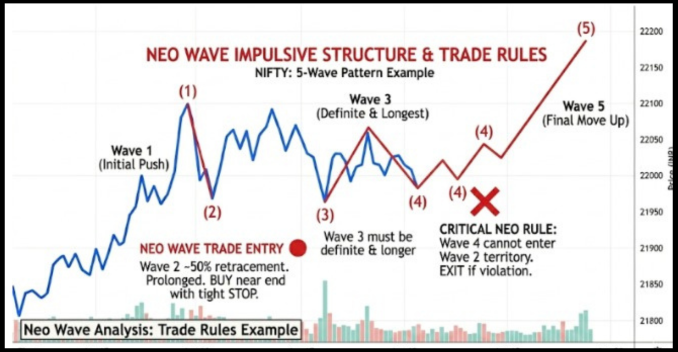
- Mark monowaves on your chart (small segments of movement).
- Check price and time compliance with the rules.
- Look for confirmation in volume or candlestick closes.
- Set trades only when multiple rules align.
Let’s say you spot an uptrend forming:
- Wave 1 pushes up.
- Wave 2 retreats to approximately 50%, and it is more prolonged than Wave 1.
- Wave 3 is much more definite and longer.
Perfect; rules aligned. You might enter near the end of Wave 2 with a stop just below. If Wave 4 then dips into Wave 2’s price zone, you know your count is off, and you exit.
In real markets, this discipline can save a lot of capital that would otherwise be squandered on guesswork.
Common Pitfalls And How Rules Help
Here are common mistakes and how strict wave rules save you:
- Counting random swings as waves: price/time rules filter these out.
- Assuming every retracement is a correction: strict retracement limits prevent that.
- Entering too early: time rules make you wait for pattern development.
In fact, many traders build rules into scripts or indicators on TradingView to automate these checks before taking a trade.
A Simple Neo Wave Chart Example
Let us understand this with the help of a chart:
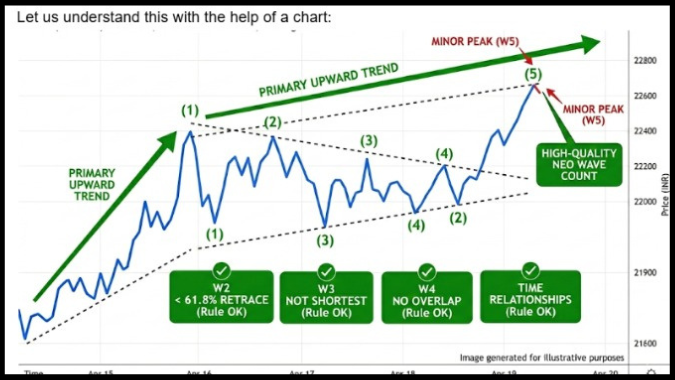
The above given cart clearly explains the following:
| Wave | Pattern | Rule Check |
| 1 | Uptrend | Baseline |
| 2 | Pullback | ~55% retrace, took longer than Wave 1 |
| 3 | Strong push | Longest motive wave |
| 4 | Mild retrace | Doesn’t touch Wave 2’s zone |
| 5 | Peak | Price rule and structure match |
If all boxes are green, you’ve got a high-quality wave count that fits neo wave price rules and time rules.
Conclusion
The Neo Wave rules give traders an orderly system to be able to trade waves in the market with precision and accuracy.
Using a combination of time rules and price rules, you can determine which ones are actual trends and which are random fluctuations.
Therefore, you can minimize some guesses and enhance trade decisions.
Regardless of the trading asset types, be it stocks, forex, or crypto, these systematic rules can assist in ensuring consistency, risk management, and high-probability arrangements.
They are mastered, and leveling the analysis of waves becomes an art, a strong tool.
If you want to master these technical patterns, then join our professional stock market classes today to build a solid trading foundation.
FAQs
Q1: What makes the neo wave rules different from traditional Elliott rules?
Ans: The primary distinction in the Neo wave vs Elliott wave comparison is that Neo Wave adds significantly more structure, including time measurements and stricter price retracements, making the patterns more objective.
Q2: Can the neo wave rules be used in any market?
Ans: Yes, traders apply them in stocks, forex, and crypto to improve wave counts and trade quality.
Q3: Do price rules and time rules always match perfectly in real charts?
Ans: No, that’s why traders require multiple rule confirmations before acting, not just one.
Before investing capital, invest your time in learning Stock Market.
Fill in the basic details below and a callback will be arranged for more information: