


Two traders looking at the same chart can see completely different opportunities.
Why?
Because the tools they use to analyze price movements shape their decisions. The debate of the neo wave vs Elliott wave is all about clarity, precision, and profitability in trading.
Let’s break it down in a way that professional traders actually use on real charts.
What Is Elliott Wave Theory?
Elliott Wave Theory is an instrument of technical analysis that has existed the longest and is also highly utilized.
It assists traders in determining recurrent price patterns, owing to human behavior and psychology.
When you look at a chart to draw Elliott wave structures, you are essentially mapping out the collective sentiment of the market participants.
Key Features:
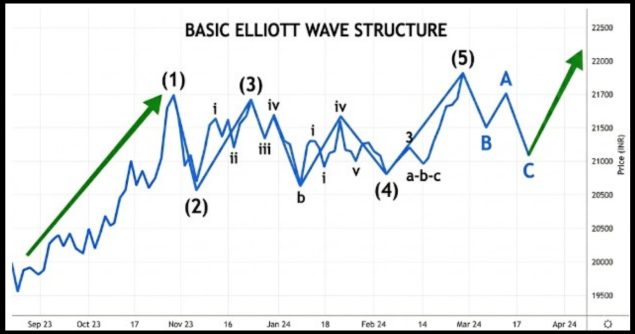
At its core, Elliott Wave is based on a five-wave trend movement followed by a three-wave correction.
The market typically advances in five waves in the direction of the trend and then retraces through a three-wave corrective phase before the next cycle begins.
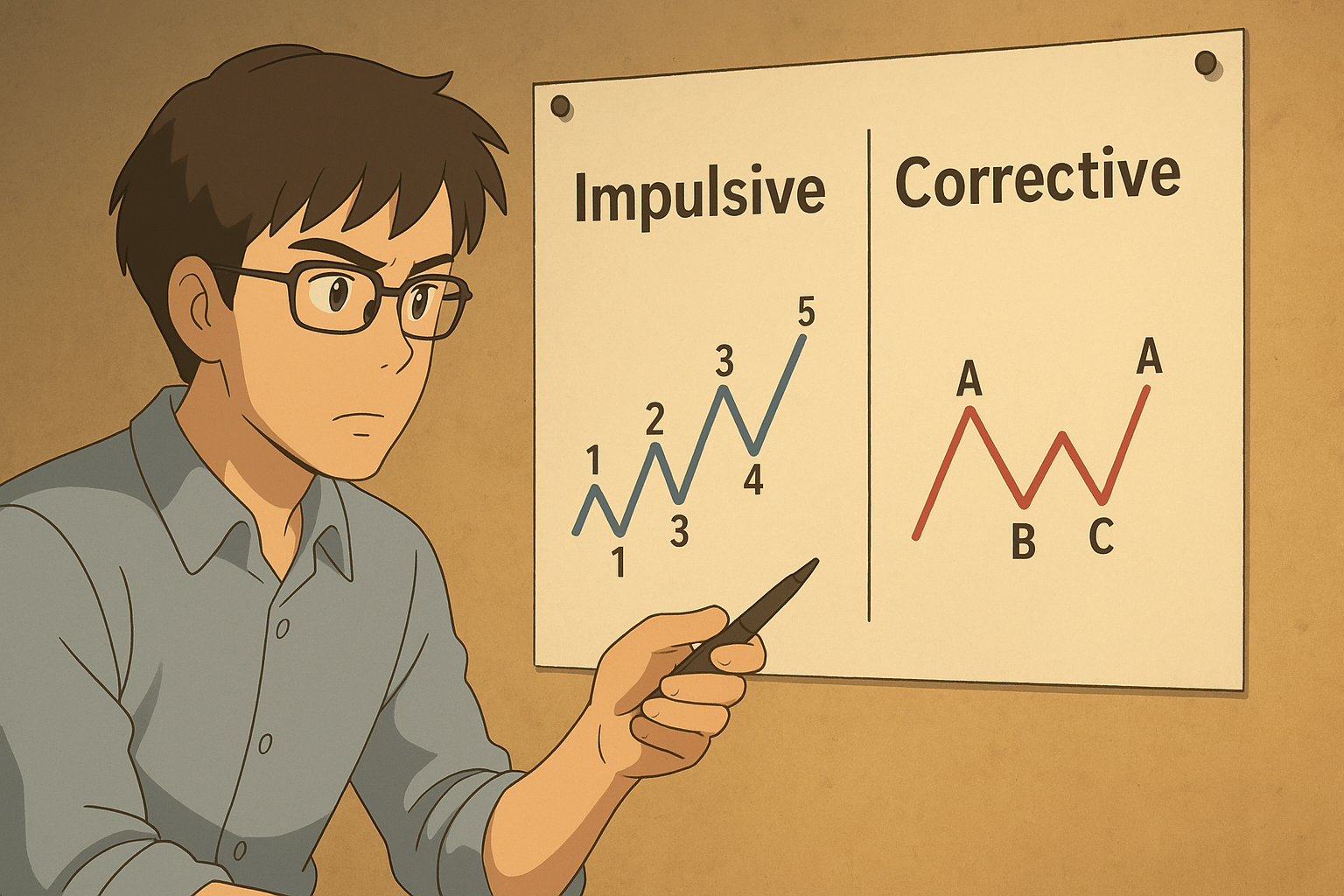
- Impulse Waves (5-wave moves) push the trend forward.
- Corrective Waves (3-wave retracements) move against the trend.
- Elliott wave theory with Fibonacci ratios helps determine price targets and retracement levels.
- The approach is used across stocks, forex, and crypto markets.
However, Elliott Wave analysis is not only about counting waves.
It also relies on three cardinal rules that every valid wave structure must follow.
Elliott Wave Rules
These rules act as guardrails for wave analysis.
If any rule is broken, the wave count is considered invalid.
- Rule 1: Wave 2 can never retrace more than 100 percent of Wave 1.
- Rule 2: Wave 3 can never be the shortest among Waves 1, 3, and 5.
- Rule 3: Wave 4 can never enter the price territory of Wave 1.
These simple rules help traders eliminate incorrect wave counts when analyzing charts.
Corrective Wave Structures In Elliott Wave
After the five-wave impulse move, markets enter a corrective phase.
Elliott Wave identifies several correction patterns that appear frequently:
- Zigzag: A sharp three-wave correction that moves strongly against the previous trend
- Flat: A sideways correction where the price retraces gradually before the next trend move
- Triangle: A consolidation pattern where price forms converging trendlines before a breakout
These corrective structures are important because Neo Wave later expands and refines them with additional patterns.
What Is Neo Wave Theory?
Neo Wave was developed to reduce the subjectivity and guesswork often found in classic Elliott Wave analysis.
Neely rebuilt the foundation entirely by introducing the Monowave as the base unit, reclassifying corrective patterns, and replacing subjective labeling with a logic-driven, self-confirming process.
The structure presents some distinct and enforced Neo wave rules on pattern recognition whereby waves are subjected to certain time, price, and pattern conditions before a trading decision.
Key Principles:
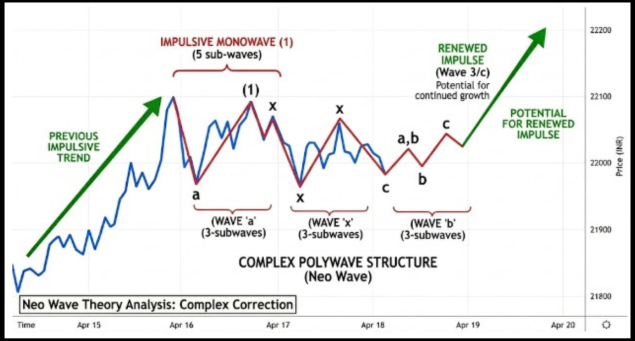
The structure presents some distinct and enforced rules on pattern recognition whereby waves are subjected to certain time, price, and pattern conditions before a trading decision.
Key principles include:
- Precise Wavelength and Time Ratio Tests: There is a test of each wave based not only on price but also upon the duration required to develop it, which offers a verification dimension absent in conventional Elliott Wave.
- Pattern Validation Rules: Patterns that satisfy all of the Neo Wave conditions are only valid; this removes unclear counts and pseudo-indicators.
- Patterns of the Neo Wave: Unlike the Elliott Wave, the Neo Wave identifies more advanced patterns like the Diametric pattern and the Neutral Triangle that are more effective at describing the behavior of the market.
- Monowave Concept: Single-wave moves that determine the trends or reversals of their own, enabling the trader to identify what is known as unique market behaviour that could be outside the usual wave patterns.
- Three Core Neo Wave Elements:
- Logic: Patterns must follow defined logical structures.
- Self-Defining: The wave pattern reveals its own boundaries; no guessing required.
- Self-Confirming: Each wave confirms itself regarding timing and price relationships.
- Time-Based Validation Rules: Neo Wave would incorporate the attribute of time, where patterns will follow a particular order of time, and this will bring a degree of reliability to trade arrangements.
To traders, it means fewer false signals, more predictive of the entry and exit strategy, and a systematic construct that can be successful in difficult markets or volatile adverse environments.
Difference Between Neo Wave & Elliott Wave
The question arises for traders: which is the method that provides the best signals and minimizes errors? To simplify things, here is a straightforward comparison of the two:
| Aspect | Elliott Wave | Neo Wave |
| Origin | Developed in the 1930s by Ralph Nelson Elliott after studying repetitive market cycles. | Developed later by Glenn Neely as an advanced extension that adds strict analytical rules. |
| Core Structure | Uses the classic 5-wave impulse and 3-wave correction model to describe market trends. | Uses the same basic structure but expands it with additional rules and pattern classifications. |
| Rules | Only a few core rules guide wave counting, leaving room for interpretation. | Includes some strict rules that define wavelength, time, and structure before confirming a pattern. |
| Subjectivity | High. Different traders can label the same chart with different wave counts. | Much lower because patterns must meet specific structural and timing criteria. |
| Fibonacci Role | Fibonacci ratios are widely used as guidelines. Traders often project targets such as: Wave 3 extending Wave 1 by 1.618, Wave 2 retracing 50 to 61.8 percent, or Wave 4 retracing 23.6 to 38.2 percent of Wave 3. | Fibonacci relationships are often built into confirmation rules. Ratios are not just guidelines; they help validate whether a wave structure is acceptable. |
| Predictive Clarity | Flexible interpretation allows early forecasts but sometimes creates multiple possible counts. | Emphasizes confirmation before forecasting, which reduces conflicting interpretations. |
| Pattern Variety | Focuses mainly on impulse waves, zigzags, flats, and triangles. | Adds advanced patterns such as Diametric formations and Neutral Triangles to describe complex market movements. |
| Learning Curve | Easier for beginners because the rules are simpler. | More challenging due to strict validation rules and additional pattern types. |
| Profit Focus | Often used to forecast overall market direction and long-term cycles. | Designed to support clearer trade entries and exits through rule-based validation. |
Which Is Better: Neo Wave Vs Elliott Wave?
A one-size-fits-all solution does not exist since each strategy suits various trading types and market situations.
The decision between the two should be based on the trading objectives and experience.
Elliott Wave Strengths
- Easier for beginners to grasp
- Useful for broad market direction
- Good for spotting major trend reversals
Neo Wave Strengths
- Clearer trade signals with strict confirmation.
- Reduces ambiguous wave counts.
- Better for complex price action or volatile markets.
In short, Neo Wave is usually used by professionals looking to make scarce accuracy in trade implementation, whereas Elliott Wave can be utilized to comprehend the market rhythm.
Elliott Wave Vs. Neo Wave: Which Is More Profitable?
Making money is not about the theory, but more about the implementation. It is all about application with discipline, timing, and correct risk management, and not merely copying patterns.
When traders ask Elliott wave vs. Neo wave, which is more profitable, the real answer often depends on signal quality, trade frequency, and the type of market being traded.
Trading Example:
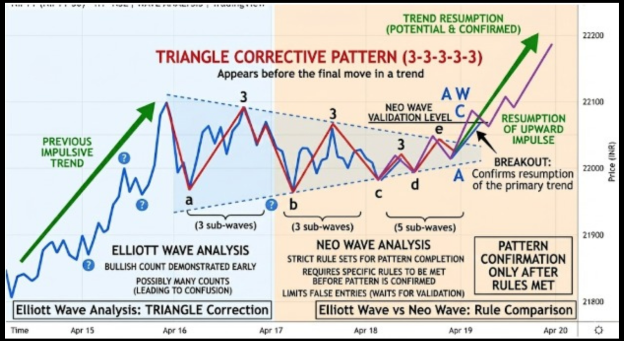
- Elliott Wave can demonstrate a bullish count early on; there are possibly many counts in total, and this confuses.
- Neo Wave does not enter the pattern until all the strict rules are met, which limits false entries.
This difference naturally suits different trading styles.
| Factor | Elliott Wave | Neo Wave |
| Trade Frequency | Higher | Lower |
| Signal Confirmation | Early but flexible | Late but strict |
| False Signals | More common | Less frequent |
| Ideal Trader Type | Active traders | Patient traders |
Another factor is the type of market being traded.
- Equities and indices often move in more structured trends. Neo Wave’s strict pattern validation works well here because price movements develop gradually and respect structural rules.
- Crypto and highly volatile forex pairs move quickly. Many Elliott Wave traders prefer the classic approach here because waiting for full Neo Wave confirmation could mean missing large impulsive moves.
So profitability can vary depending on where the strategy is applied.
Difference Between Neo Wave & Elliott Wave Using Chart
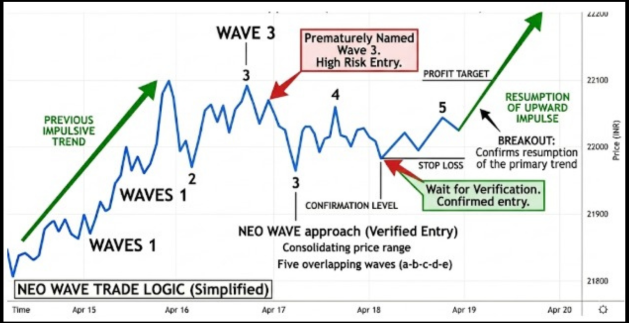
Consider the above Nifty chart: a five-wave bullish impulse develops over several days.
- The Elliott Wave traders can name the Wave 3 prematurely and position themselves on the prediction.
- Neo Wave traders wait until all the rules are verified and proceed with specified profit and stop levels.
You will need patience to avoid false entries in a fast-moving or noisy market such as crypto or forex.
Practical Risk Explanation
Even the most precise wave analysis can fail if risk management is ignored. No trading method guarantees profits. Even Neo Wave, with its structured framework, cannot remove market uncertainty.
Neo Wave introduces strict analytical elements such as exclusive patterns like Diametric and Neutral Triangle, along with a structured wave hierarchy that includes Monowaves, Polywaves, and Multiwaves.
These elements help traders analyze price movement in smaller building blocks, combine them into larger structures, and validate patterns through time and price relationships.
Smart traders manage risk by combining wave theory with disciplined strategies:
- Use stop losses below invalidation points to protect against sudden reversals.
- Limit position sizes until patterns confirm, even when a Neo Wave structure appears perfect.
- Combine wave counts with volume and momentum indicators to validate entries and exits.
While Neo Wave gives structure, logic, and precise pattern validation, risk management is what separates theory from actual trading success.
A confirmed Diametric or Neutral Triangle is strong yet with no stops, and making position sizes properly, it can result in losses even under the most strict wave count.
Conclusions
Still unsure which method suits you?
The answer lies less in the theory and more in where you are as a trader.
If you’re just starting, Elliott Wave gives you the clearest window into how markets move and why. Master the structure first, as everything else builds on it.
Once you’re comfortable reading price action, Neo Wave adds the precision layer:
- stricter rules
- fewer false signals
- cleaner trade setups that remove the guesswork
And if you’re the type who needs to see the logic before trusting a signal, Neo Wave was practically built for you.
At the end of the day, neither method is a shortcut.
What separates consistent traders from the rest isn’t which framework they use but the discipline to follow it, the patience to wait for confirmation, and the experience to know when the market simply isn’t setting up at all.
The waves are always talking. The real skill is learning when to listen and when to wait.
Want to master wave trading like a pro?
Join our stock market classes today and trade with confidence.
FAQs
Q1: Is Neo Wave merely Elliott Wave with additional rules?
Ans: Yes, Neo Wave is the continuation of Elliott Wave that includes more rules to make it less ambiguous and more consistent.
Q2: Is Neo Wave applicable in crypto markets?
Ans: Neo Wave can be applied to crypto on higher timeframes where structure is more reliable. Risk management and patience are very important.
Q3: Do the two theories ensure profits?
Ans: No, both are to be conducted with discipline and prudent risk-taking; neither is certain to succeed.
Before investing capital, invest your time in learning Stock Market.
Fill in the basic details below and a callback will be arranged for more information: