


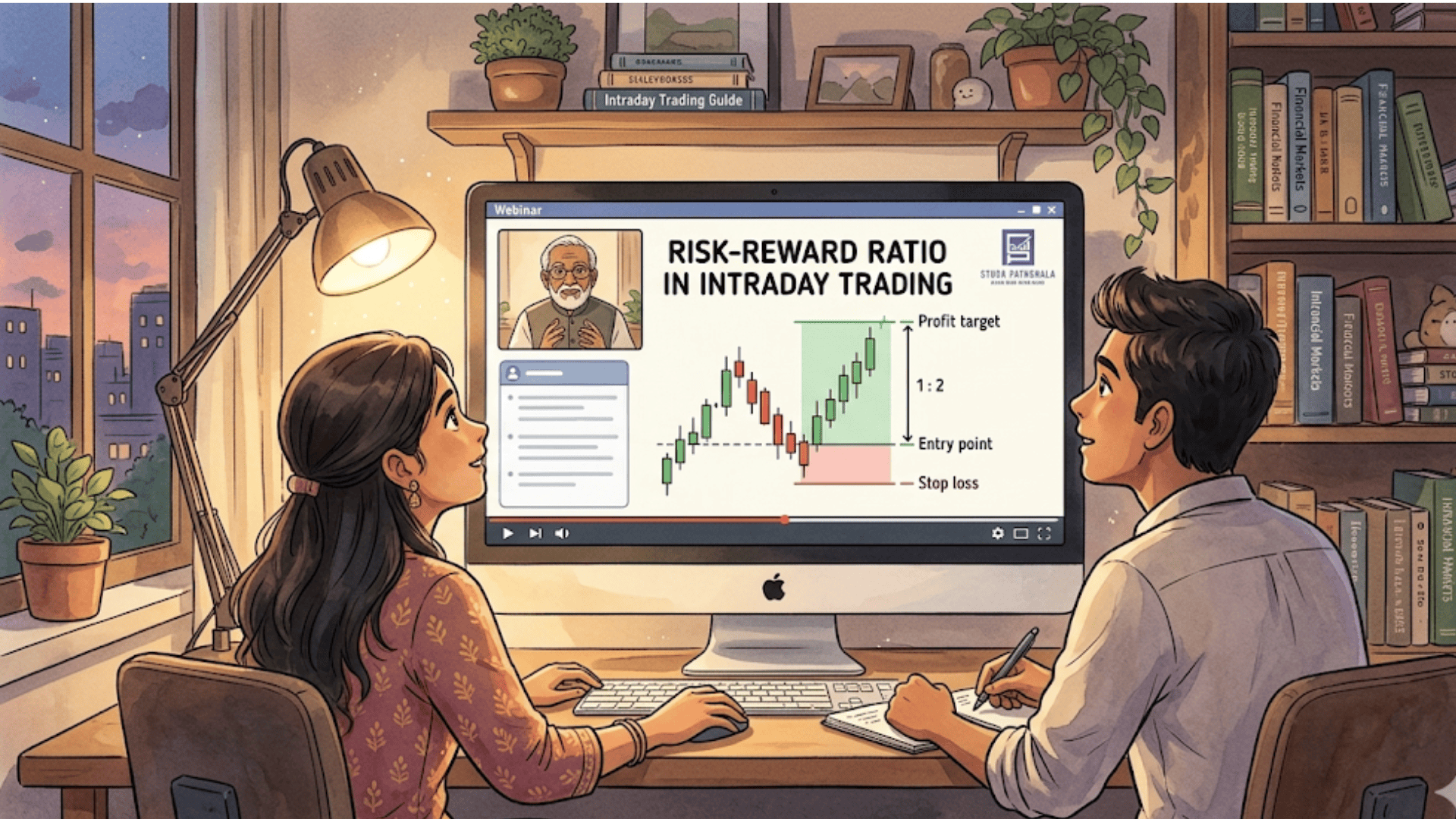
Every successful intraday trader knows a secret that beginners often overlook: it’s not about how many trades you win, but how much you make when you win versus how much you lose when you’re wrong.
In the fast-paced world of intraday trading, where positions open and close within the same session, price movements can be brutal.
One poorly managed trade can wipe out days of careful profits. This is where the risk-reward ratio becomes your most powerful tool.
Many beginners who start with questions like how to invest in share market often ignore this concept, which later becomes the biggest reason for losses.
Whether you’re trading Nifty, Bank Nifty, or individual stocks, understanding and applying the risk-reward ratio separates profitable traders from those who blow up their accounts.
What Is the Risk-Reward Ratio in Intraday Trading?
The risk-reward ratio compares how much you stand to lose on a trade versus how much you could gain if the trade works out.
In simple terms,
- Risk = The amount you’re willing to lose (your stop-loss distance)
- Reward = The amount you expect to gain (your target distance)
Quick Example:
Let’s say you’re trading Reliance Industries intraday:
- Entry price: ₹2,500
- Stop-loss: ₹2,480 (risk of ₹20 per share)
- Target: ₹2,560 (reward of ₹60 per share)
Risk-Reward Ratio: ₹20 ÷ ₹60 = 1:3
This means for every ₹1 you risk, you stand to gain ₹3.
This is considered a strong setup, but it often leaves beginners wondering which risk reward ratio is good for their specific trading style
Why Every Intraday Trader Must Understand This First?
Before you chase the next “sure-shot” indicator or trading tip, understand this: the risk-reward ratio is the foundation of profitable trading.
It forces you to think in probabilities rather than predictions, and that shift in mindset is what separates amateurs from professionals.
Which also answers a deeper question many traders have: is intraday trading speculative, or can it be approached with logic and discipline?
Why the Risk-Reward Ratio is More Important Than Win Rate?
Here’s a myth that traps most beginners: ‘I need to be right 80-90% of the time to make money.’
This is completely wrong.
This myth is often believed by traders who ask can intraday trading make you rich without understanding the importance of risk management.
You can be wrong more often than you’re right and still be consistently profitable if your risk-reward ratio is favourable.
The Math That Changes Everything
To truly understand how you can be profitable even without being ‘right’ all the time, we need to look at the risk reward ratio vs win rate dynamic.
While many beginners chase a 90% accuracy, professionals focus on the math that allows them to win big even with fewer successful trades
Let’s compare two traders over 10 trades:
| Trader | Win Rate | Risk-Reward | Wins | Losses | Net Result |
| Trader A | 80% | 1:1 | 8 × ₹1,000 = ₹8,000 | 2 × ₹1,000 = ₹2,000 | +₹6,000 |
| Trader B | 40% | 1:3 | 4 × ₹3,000 = ₹12,000 | 6 × ₹1,000 = ₹6,000 | +₹6,000 |
Both traders end up with the same profit, but Trader B was wrong 60% of the time!
Now imagine Trader A has a bad week and the win rate drops to 50%. They’re suddenly losing money. Even with a 40% win rate, Trader B remains profitable.
A strong risk-reward ratio gives you room to be wrong.
This is especially important if you’ve ever asked yourself what if I lose in intraday trading, because losses are part of the game, but controlled losses keep you in the game.
Risk-reward ratio removes the pressure of needing to ‘predict’ the market perfectly and lets you focus on executing your strategy with discipline.
What is the Best Risk-Reward Ratio for Intraday Trading?
There’s no single ‘perfect’ ratio; it depends on your strategy and trading style. However, here are the general guidelines:
Common Ratios Explained
| Ratio | Best for | Notes |
| 1:1 | Scalping | Requires very high accuracy (60%+); not sustainable for most traders |
| 1:2 | Minimum recommended | Gives breathing room; profitable even at 40-50% accuracy |
| 1:3 | Professional standard | Sweet spot for intraday momentum and breakout trades |
| 1:4 or higher | Swing/positional | Fewer setups, but highly favourable when they hit |
What Works Best in Indian Markets?
For Nifty and Bank Nifty intraday trading:
- Scalping: 1:1 to 1:1.5 (due to tight spreads and fast moves)
- Breakout/momentum trades: 1:2 to 1:3
- Trend-following: 1:3 or better
Most experienced traders recommend never taking a trade with a risk-reward below 1:2 unless you have a very specific edge with proven high accuracy.
So if you’re still confused and thinking should I do intraday trading, the answer depends on whether you can follow disciplined risk management like this.
How To Calculate Risk-Reward Ratio?
One of the biggest mindset shifts in intraday trading is understanding that more trades do not equal more profits.
In fact, professional traders often take fewer trades per day, but only when the risk-to-reward ratio is clearly in their favor :
Step 1: Identify Your Entry Price
Wait for a confirmed setup, don’t rush. Your entry should align with your strategy, whether that’s a breakout, pullback, or reversal.
Example: You identify a breakout opportunity in Tata Motors at ₹750.
Step 2: Set Your Stop-Loss
For long trades, place your stop just below the support level, not at it, but 1-2 points below to account for wick penetration.
For short trades, place it 1-2 points above resistance. This buffer prevents normal price probing of levels from triggering your stop before the move plays out.
Example: Support is at ₹745, so you set a stop-loss at ₹744. Risk per share: ₹750 – ₹744 = ₹6
Step 3: Define Your Target
Based on resistance levels, previous price action, or a multiple of your risk, set a realistic target.
Example: Next resistance is at ₹768. Reward per share: ₹768 – ₹750 = ₹18
Step 4: Calculate the Ratio
Risk-Reward Ratio=₹6/ ₹18=1/ 3=1:3
Risk-Reward Ratio= ₹18/ ₹6 = 3/ 1=3:1
This is a solid setup worth taking.
Manual vs. Automatic Calculation
Platforms like Zerodha Kite, Fyers, and Dhan have built-in chart tools where you can drag a trade line to instantly see risk, reward, and ratio.
Use these before the market opens during your pre-trade planning, not while the trade is live.
Calculating manually under pressure during a fast-moving Nifty session increases the chance of entry errors.
How To Set Stop-Loss and Target Like a Pro?
Your risk-reward ratio is only as good as your stop-loss and target placement. Poorly defined levels often lead to premature stop-outs or unrealistic expectations, which can quickly damage your consistency.
To trade like a professional, you need logical, rule-based placement rather than guesswork.
1. Using Support and Resistance
Support and resistance are the most reliable anchors for your stop-loss and target. For long trades, place your stop just below support. For shorts, place it just above the resistance.
This cushions you from normal price noise without exposing you to unnecessary risk.
Set your target at the next key resistance (longs) or support (shorts), a price level that has already been respected before.
2. Using Technical Indicators
Technical indicators help refine your stop-loss and target placement by adding confirmation to your analysis.
Tools like VWAP act as dynamic support and resistance, while moving averages such as the 20 EMA and 50 EMA help identify trend direction and safe stop levels.
Fibonacci retracement levels at 38.2%, 50%, and 61.8% are widely watched by traders, which creates self-fulfilling reactions at these zones.
Use them as areas of interest to watch for price behaviour, confluence with a support/resistance level or volume spike makes a Fib zone meaningful.
Alone, they are not reliable enough for stop placement.
3. Common Beginner Mistakes to Avoid
Many beginners set their stop-loss too tight, which causes them to get stopped out by normal market volatility.
Others aim for unrealistic targets, resulting in trades that never reach profit and eventually turn into losses.
A common emotional mistake is moving the stop-loss further away, hoping the trade will recover, instead of accepting a planned loss.
Rule of Thumb
If you cannot clearly define your stop-loss and target before entering a trade, it is better to skip the trade altogether.
Professional traders always plan their risk-reward ratio in advance and only take trades where the setup meets their criteria.
This discipline is what separates consistent traders from those who struggle.
Best Intraday Trading Strategies Based on Risk-Reward
Different strategies suit different risk-reward profiles. Choose one that matches your personality and risk tolerance.
1. Scalping (Low RR, High Frequency)
This approach focuses on exploiting very short-term inefficiencies in price movement within seconds or minutes. It demands constant screen time and quick decision-making under pressure.
- Typical RR: 1:1 to 1:1.5
- Trades per day: 10-30
- Requires: Fast execution, tight spreads, high accuracy
- Best for: Experienced traders with discipline
Small spreads and low brokerage costs play a critical role in maintaining profitability in this strategy. Overtrading or hesitation can quickly turn a profitable setup into a loss.
2. Breakout Strategy (High RR Potential)
The idea is to enter only when price confirms strength beyond a key level, rather than predicting moves in advance. False breakouts are common, so confirmation and volume play a crucial role.
- Typical RR: 1:2 to 1:4
- Trades per day: 2-5
- Requires: Patience to wait for confirmed breakouts
- Best for: Traders who prefer fewer, high-conviction trades
Successful breakout trading often depends on identifying strong zones where multiple traders are likely to act. Entering too early or without confirmation can result in getting trapped in sideways moves.
3. Trend Trading (Consistent RR)
Instead of trying to time exact tops or bottoms, this strategy aligns trades with the broader market direction. It allows traders to stay in positions longer and benefit from sustained momentum.
- Typical RR: 1:2 to 1:3
- Trades per day: 3-6
- Requires: Ability to identify and follow established trends
- Best for: Beginners and intermediate traders
Pullbacks within a trend offer better entry opportunities compared to chasing price at extremes.
Consistency in this strategy comes from following rules rather than reacting to short-term noise.
4. Reversal Trading (High Risk, High Reward)
This method attempts to catch shifts in market sentiment before a new trend begins. It often involves going against the prevailing trend, which increases both opportunity and risk.
- Typical RR: 1:3 to 1:5
- Trades per day: 1-3
- Requires: Strong technical analysis skills, tight stops
- Best for: Experienced traders only
Indicators like divergence and overbought or oversold conditions are often used to support reversal setups. Since the market can stay irrational longer than expected, risk control becomes critical.
Conclusion
The risk-reward ratio isn’t just another metric; it is the backbone of sustainable trading and long-term profitability.
It is also the foundation for answering bigger questions like is it safe to do intraday trading and whether trading suits your personality.
Instead of focusing only on accuracy, traders should understand that even a 40% win rate can be highly profitable when combined with a strong 1:3 risk-reward ratio, whereas a high win rate with poor risk management often leads to losses.
Before entering any trade, it is essential to calculate your stop-loss, target, and overall risk-reward ratio in advance.
This ensures that every trade is planned logically rather than executed impulsively based on emotions or market noise.
Setting proper levels is equally important, and traders should rely on support, resistance, and technical indicators to define their exits instead of making random decisions.
A well-structured approach helps in maintaining discipline and consistency over time.
Want to master intraday trading with professional-grade tools and strategies?
Join our intraday trading classes now and access expert insights, real-time analysis, and risk management tools designed for Indian traders. Start trading smarter today.
FAQs
Q1: What is a good risk-reward ratio for beginners?
Ans: Start with a minimum of 1:2. This gives you enough margin for error while learning. As you gain experience, aim for 1:3 or better.
Q2: Can I be profitable with a 1:1 risk-reward ratio?
Ans: Yes, but only if your accuracy is consistently above 55-60%. For most traders, this is difficult to maintain, making 1:2 or higher more sustainable.
Q3: How do I know if my target is realistic?
Ans: Use technical levels, previous resistance/support, Fibonacci levels, or VWAP zones.
If your target requires a move larger than the stock’s average daily range, reconsider.
Q4: Should I adjust my risk-reward ratio during volatile markets?
Ans: Yes. In highly volatile conditions, widen your stop-loss to account for larger price swings but reduce your position size proportionally so your total rupee risk stays the same.
If your stop widens from ₹20 to ₹40, halve your lot size. Then extend your target to maintain the ratio. Wider stop, smaller size, never a wider stop at the same size.
Q5: What’s the biggest mistake traders make with risk-reward?
Ans: Ignoring it entirely. Many traders enter based on ‘gut feeling’ without calculating whether the potential reward justifies the risk.
Always calculate before you trade.
Before investing capital, invest your time in learning Stock Market.
Fill in the basic details below and a callback will be arranged for more information: