



Should I apply for option trading? Many beginners ask this after seeing a friend or a reel talk about quick money. The honest answer is: not until you can answer a few uncomfortable questions.
This page helps you decide to start, or to wait.
What Is Option Trading Activation?
When people say “apply”, they usually mean getting the F&O segment activated on their account. Here is what that involves, in simple terms.
To trade options, you need a demat and trading account first. Then you request your broker to activate the Futures and Options (F&O) segment.
Brokers commonly ask for income proof for this. It may be a bank statement, salary slip, or tax return. Rules and documents differ, so verify the exact list with your broker.
You will also see a risk disclosure before activation. Please read it properly. It exists because options can lose value very fast.
Activation is easy, and that is the problem. A form takes minutes, but readiness takes months.
Before You Start F&O: 6 Essential Readiness Questions to Ask Yourself
Think of this as a gate. If you cannot say yes to most of these, waiting is the smarter move.
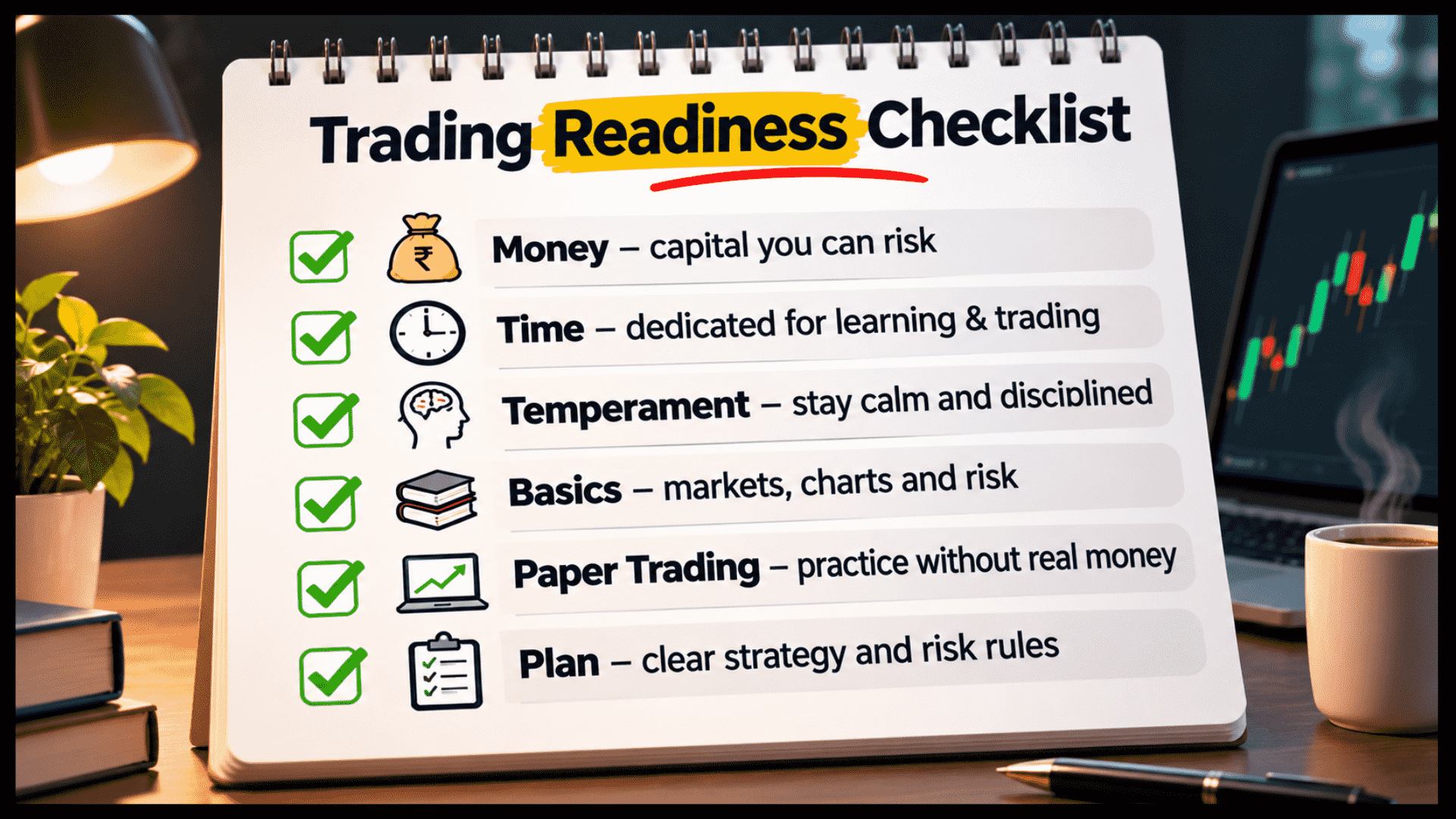
Here are the six questions.
- Money you can afford to lose: Is this amount truly extra, with no EMI, rent, or emergency fund tied to it?
- Time: Can you watch the market and review your trades every day?
- Risk temperament: Can you take a full loss on a trade without revenge trading?
- Basics known: Do you understand call, put, premium, strike price, and expiry?
- Paper trading done: Have you practised without real money for a few months?
- A written plan: Do you know your entry, exit, and maximum loss before every trade?
If even one answer is no, that is useful information. It does not mean never. It means not yet.
How Much Money Do You Need to Start Option Trading Safely?
There is no magic number. The right amount is one that will not change your life if it goes to zero.
Many people think they can begin with tiny money and grow it fast. That thinking is risky in itself. Curious about very small starting amounts? This explainer on can I start trading with 100 rupees shows what is realistic, and why small does not mean safe.
Here is a simple illustration, for illustration only. Say a lot has 100 units and the premium is ₹30. Buying one lot costs ₹3,000, and all of it can vanish if the trade goes wrong.
Ten such full losses in a row would mean ₹30,000 gone. On a ₹50,000 account, that is a deep hole. Many traders limit risk per trade to a small share of capital, such as 2%, which would be ₹1,000 here.
Who Should Not Start Option Trading Yet?
Waiting is not weakness. It is often the best first trade. You should probably wait if any of these describe you.
- You plan to use borrowed money, or money meant for fees, rent, or family needs.
- You are hoping to recover an earlier loss quickly.
- You cannot explain the difference between buying and selling an option.
- You get anxious or angry after losing a small amount.
- You are only following tips from social media or messaging groups.
If you are unsure whether you think like a long-term investor or a short-term trader, it helps to understand where you fit. This breakdown of investor vs trader vs speculator can make your choice clearer.
Who Can Start Option Trading?
Option trading is not for everyone, but some people can reasonably explore it. Read the points below as conditions, not as a push to trade.
- You already invest regularly and have an emergency fund.
- You have learned the basics and practised on paper.
- You treat it as a skill to build, not a shortcut to income.
- You accept that losses are normal, even with good decisions.
- You have time to learn risk control before chasing returns.
Even then, begin with small size and a written plan. Nobody can promise profits in options, and no class or mentor can either.
Before you place any order near expiry, learn how to trade on expiry day.
How Many Option Traders Lose Money? What SEBI Studies Say
SEBI has published studies on individual traders in the F&O segment. In general terms, they found that a large majority of individual traders made net losses, and that many of them kept trading despite repeated losses.
Please do not rely on a number from a video or a post. Read the latest SEBI study on the official SEBI website, and verify the figures yourself.
The takeaway is not “never trade”. It is that most beginners underestimate how hard consistent results are. Costs like brokerage and taxes also eat into outcomes, so check current rules on the official sites.
Common Beginner Mistakes in Option Trading
Most early losses follow a few repeating patterns. Knowing them in advance helps you avoid them.
- Buying cheap options on expiry day. They look affordable, but time decay works against the buyer. This is explained clearly in why not buy options on expiry, and it is worth reading before your first trade.
- Not knowing how contracts end. Many learners trade without understanding settlement and timing, so a surprise costs them.
- Over-sizing. Taking too many lots because one trade felt “sure” is a classic mistake.
- Revenge trading. Trading again immediately to win back a loss usually makes the loss bigger.
- Selling options without understanding the risk. Selling can carry very high risk. Beginners should not touch it until they fully understand margin and loss limits.
- Following tips blindly. Someone else’s trade does not know your capital or your risk limit.
Should You Start or Wait? Option Trading Decision Table
Use the table below as a quick filter. It is a thinking tool, not a rule, so be honest while reading it.
| Your situation | Better decision |
|---|---|
| Money is borrowed or needed for bills | Wait |
| No emergency fund yet | Wait |
| Cannot explain call, put, premium, expiry | Wait and learn basics |
| Basics known, no paper trading yet | Wait and practise first |
| Basics known, paper trading done, spare money available | May consider very small size |
| Want guaranteed or fast income | Wait, and rethink expectations |
If you land in the “wait” rows, use that time well. The next section shows what to do while you wait.
Learning Path Before Your First Real Option Trade
You do not need to learn everything. You do need a minimum base before real money goes in, and that base includes knowing what expiry means in the share market. Follow these stages in order.
| Stage | What to do | Why it matters |
|---|---|---|
| 1. Basics | Learn call, put, premium, strike, expiry, lot | You will know what you are buying |
| 2. Risk | Learn position sizing and maximum loss per trade | Protects your capital |
| 3. Paper trading | Practise for a few months without real money | Tests your plan and patience |
| 4. Small size | Start with a very small lot and strict limits | Keeps mistakes affordable |
| 5. Review | Keep a journal and review weekly | Turns losses into lessons |
Notice that the real-money step comes fourth, not first. Skipping stages is how most beginners get hurt.
Which Option Strategies Should Beginners Learn First?
Once your basics are solid, defined-risk ideas are easier to study than naked positions. Here are two worth learning about, only for education.
Protective Put Strategy: How Does It Limit Downside?
A protective put strategy shows how people think about limiting downside on shares they already hold. It is a good way to see how risk can be capped.
Even a “safe” strategy has costs and limits, so read the fine print on every idea you study.
Covered Call Strategy: How Does It Work With Shares?
Options can also interact with shares you own in a different way. Learn the trade-offs before trying anything.
Similarly, a covered call strategy helps you see how options interact with shares you own.
Not sure if you are ready for option trading, and want someone to check your basics with you?
In our live classes of 1 to 1.5 hours, you can join from your mobile, ask doubts as they come up and learn step by step. There is no fixed batch, so you can start when you are ready.
Conclusion
So, should you apply for option trading? If you have spare money, basic knowledge, paper trading practice, and a calm temperament, you may consider a small start. If not, waiting and learning is the better choice.
Applying takes minutes, but readiness takes time. Protect your capital first, because you cannot learn if your money is gone.
Disclaimer: This content is for educational purposes only and is not investment advice. Please verify rules and contract details on the official SEBI and exchange websites before trading.
Frequently Asked Questions
Before investing capital, invest your time in learning Stock Market.
Fill in the basic details below and a callback will be arranged for more information: