


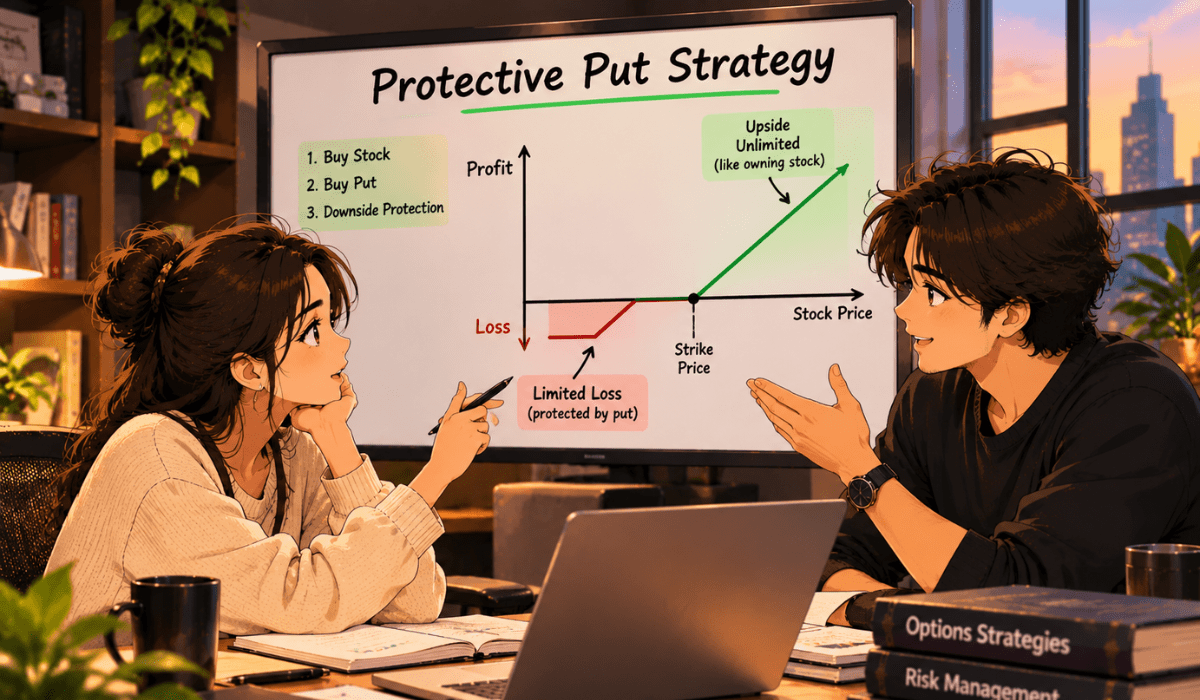
The protective put strategy means holding shares and buying a put option on them as insurance.
If the price falls sharply, the put limits your loss.
Meanwhile, if the price rises, you keep the upside after paying the premium.
Many beginners ask one question when markets turn shaky: how do I stay invested without fearing a big fall?
If that sounds like you, you are not alone.
So, we will take this one strategy step by step, with a simple example.
What Is a Protective Put Strategy?
First, let us settle the meaning.
In fact, everything else on this page rests on it.
A protective put strategy combines two positions.
You own the underlying (for example shares), and you also buy a put option on the same underlying.
A put option gives you the right, not the obligation, to sell at the strike price until expiry.
So, the put works like an insurance policy with a fixed deductible.
The premium is the price of that insurance.
In other words, if the price never falls, the premium is simply a cost you paid for peace of mind.
For instance, think of it like car insurance.
You hope never to claim, but you are glad it exists when something goes wrong.
Protective Put Strategy Legs: What You Buy and Why
Next, look at the structure.
In fact, it has only two legs, and each one is simple.
- Leg 1: Buy (or already hold) the underlying, such as 1 lot of shares.
- Leg 2: Buy 1 put option on the same underlying, same quantity.
- Strike choice: At the money (ATM) or out of the money (OTM), below the current price.
- Expiry choice: Usually chosen to cover the period you are worried about.
Only the put is bought, so there is no short option leg.
As a result, there is no extra margin for a short position.
However, margin rules still apply to the shares or futures leg, so check with your broker.
When to Use the Protective Put Strategy: Which Market View Fits?
Now for the view behind the trade.
This helps you decide whether the strategy suits you at all.
The view is bullish with caution.
Overall, you believe the price may rise over time, but you fear a sudden drop.
It often fits in a few situations:
- You hold shares for the long term and want protection through an uncertain event.
- You do not want to sell your shares, for tax or conviction reasons.
- You want a known worst case before a result, policy decision or global event.
However, it does not suit someone who expects a quiet, sideways market.
In that case, the premium keeps leaking away through time decay.
A range-bound view is better served by a seller’s setup such as the Iron Condor Strategy, which collects that decay instead of paying it.
Protective Put Strategy Example With Payoff Table
First, let us build a simple example.
Here, the numbers show exactly what the put does at each price.
All numbers are hypothetical and for illustration only.
Also, real prices, lot sizes and premiums differ, and the exchange revises lot sizes, so always verify them.
Assumptions: Company A shares are bought at 22,000.
One lot is 50 units (illustration only).
You buy a put with a strike of 21,500 that expires in 30 days.
The put premium comes from the Black-Scholes model, computed in code with 15% volatility and a 0% interest rate.
As a result, that gives 175.18 per unit, or 8,759 for the lot.
Protective Put Payoff Table at Expiry
Here is the payoff at expiry, using intrinsic value only.
Net per unit = (expiry price minus 22,000) + max(21,500 minus expiry price, 0) minus 175.18.
| Price at expiry | Shares P&L per unit | Put value per unit | Premium paid | Net per unit | Net for 1 lot (50 units) |
|---|---|---|---|---|---|
| 20,500 | -1,500 | 1,000 | 175.18 | -675.18 | -33,759 |
| 21,000 | -1,000 | 500 | 175.18 | -675.18 | -33,759 |
| 21,500 | -500 | 0 | 175.18 | -675.18 | -33,759 |
| 22,000 | 0 | 0 | 175.18 | -175.18 | -8,759 |
| 22,175.18 | 175.18 | 0 | 175.18 | 0 | 0 |
| 22,500 | 500 | 0 | 175.18 | 324.82 | 16,241 |
| 23,000 | 1,000 | 0 | 175.18 | 824.82 | 41,241 |
| 23,500 | 1,500 | 0 | 175.18 | 1,324.82 | 66,241 |
Notice how the net result stops falling once the price is at or below 21,500.
In fact, below that level, every rupee lost on the shares is earned back by the put.
The fall from 22,000 to 20,500 would have cost 75,000 on the lot without the put.
With the put, however, the loss is capped at 33,759.
Protective Put Max Profit, Max Loss and Breakeven Formulas
These are the formulas at expiry, per unit.
Then multiply by the lot size for the full position.
- Max profit: Unlimited in theory, because the shares can keep rising. Profit = (expiry price minus purchase price) minus premium.
- Max loss: (purchase price minus strike) plus premium.
- Breakeven: purchase price plus premium.
In our example, max loss = (22,000 minus 21,500) plus 175.18.
Thus, the loss is 675.18 per unit, or 33,759 for the lot.
Similarly, breakeven = 22,000 plus 175.18 = 22,175.18.
So, the shares must rise above the breakeven before you show a profit.
That is the price of the protection, and it is why this strategy is not free.
The put can lose value before expiry even when the price stays flat.
The reason is how time value and intrinsic value of options combine.
How to Choose the Strike and Expiry for a Protective Put?
A closer strike gives more protection but costs more.
However, a farther strike is cheaper but leaves you with a bigger loss before the cover starts.
Protective Put Strike Price Comparison
The table compares three strikes for the same position.
Values use the same model assumptions and are for illustration only.
| Put strike | Premium per unit | Max loss per unit | Max loss for 1 lot | Breakeven |
|---|---|---|---|---|
| 21,500 | 175.18 | 675.18 | 33,759 | 22,175.18 |
| 21,800 | 284.13 | 484.13 | 24,206.50 | 22,284.13 |
| 22,000 | 377.40 | 377.40 | 18,870.00 | 22,377.40 |
There is a clear trade-off here.
The 22,000 strike gives the tightest floor but the highest cost.
In contrast, the 21,500 strike costs less and accepts a deeper fall first.
On expiry, a longer-dated put costs more but gives more time.
On the other hand, a shorter one is cheaper but needs renewing, and each renewal is a fresh cost.
Meanwhile, the sensitivity of the put to price moves is measured by delta.
For a closer look, see how delta in options trading works.
In our example, the 21,500 put has a delta of about -0.29.
So, it gains little at first and more as the price falls.
Protective Put Margin and Costs Explained
Next, let us look at what the strategy actually costs.
This is the part beginners often skip.
Buying a put needs the full premium paid upfront.
However, there is no margin for the bought option itself.
Still, your shares or futures leg may need delivery holding or margin, depending on how you hold it.
Besides, brokerage, exchange charges and taxes apply on each leg.
Rules and charges vary and change, so verify them with your broker and the exchange.
For example, a hedge that is renewed every month can quietly add up.
Protective Put Risks: When the Strategy Fails
The strategy limits the downside, but it does not remove risk.
Here is where it can go wrong.
- Premium loss: If the price rises or stays flat, the premium expires worthless.
- Time decay: The put loses value each day, even when nothing happens.
- Volatility drop: A fall in implied volatility can reduce the put price.
- Gap risk below the strike: You still lose up to the max loss, which can be large.
- Mismatch: A put on an index does not perfectly protect a single stock.
- Repeated cost: Renewing the hedge again and again lowers long-term returns.
In fact, it works least well in a slow, steady, sideways market.
As a result, you pay for insurance and never use it.
That daily decay is also why option buyers lose money so often.
How to Exit or Adjust a Protective Put?
Also, you do not have to hold the put until expiry.
These are general ideas, not instructions.
- Sell the put early if the scare passes and it still has some value left.
- Roll the put to a later expiry or a different strike if the worry continues.
- Raise the strike after a price rise to lock in more of the gain.
- Drop the hedge if your reason for fearing a fall no longer exists.
Therefore, plan each action in advance, because each one has costs.
Likewise, deciding the exit rule before you enter helps you avoid emotional choices during a fall.
Common Protective Put Mistakes to Avoid
Generally, most mistakes come from treating the put as free or as a guarantee.
Here are the ones to watch for.
- Buying protection only after the market has already fallen, when premiums are higher.
- Choosing the cheapest strike without checking the loss before cover begins.
- Mismatching the quantity, so the put covers fewer shares than you hold.
- Ignoring the lot size, so the hedge does not match the share count.
- Holding a put that expires before the event you worried about.
- Expecting the strategy to make money rather than cap loss.
A simple check helps: write the max loss and breakeven on paper before you place the trade.
Also, if you want to see how it fits among others, learn option strategies step by step first.
Protective Put vs Covered Call: Which One Fits You?
Both strategies start with owning shares, but they behave very differently.
Next, the table gives a short comparison.
| Point | Protective put | Covered call |
|---|---|---|
| Option leg | Buy a put | Sell a call |
| Cash flow | Pay premium | Receive premium |
| Downside | Limited by the put | Only cushioned by premium |
| Upside | Unlimited, less premium | Capped at the strike |
| Best for | Fear of a sharp fall | Flat or mildly rising view |
The protective put costs money to insure against a fall.
In contrast, the covered call earns money but gives up the upside.
You can study the other side through the covered call strategy.
How to Practise the Protective Put Strategy Safely?
Because every payoff depends on timing and volatility, reading alone is not enough.
So, beginners should practise virtually first, on a simulator with no real money.
Besides, track the premium paid, the breakeven and what happens at expiry.
A mentor review of your practice trades also helps, because someone can point out mistakes you cannot see yourself.
Once you are comfortable, test ideas on past data too.
A look at backtesting options trading strategies shows how to do that without risking capital.
Do you also read about hedging and still hesitate to place your first protective put?
Videos alone won’t build that skill; real option chain practice and a mentor’s answers make the difference.
Join our live classes from your mobile, ask your doubts and learn step by step.
Conclusion
In short, a protective put means holding shares and buying a put as insurance.
It caps your loss at (purchase price minus strike) plus premium, while the upside stays open.
However, the premium is a real cost, and it hurts most in flat markets.
Finally, practise virtually first, and remember that this is learning, not a buy or sell call.
Disclaimer: This page is for education only and is not investment advice. All numbers are hypothetical, and no profit is guaranteed.
Options carry risk, so verify lot sizes, margins and charges with your broker and the exchange.
Frequently Asked Questions
Before investing capital, invest your time in learning Stock Market.
Fill in the basic details below and a callback will be arranged for more information: