



Value investing vs growth investing is the first choice many new investors face. Both aim to build wealth over years, but they look at a business in very different ways.
First, let us keep it simple and honest. Neither style is “safe”, and neither is a shortcut.
Next, in this article, you will see how each style works, where each can fail, and which one may suit you.
Value Investing vs Growth Investing: What Is the Core Difference?
Before comparing numbers, it helps to see the basic question each style asks. In fact, that one question shapes everything else.
A value investor asks, “Is this business selling for less than it is worth?” The hope is to buy at a discount and wait for the price to catch up.
A growth investor asks, “Will this business grow much faster than others?” The hope is that rising earnings will lift the price over time.
So one style hunts for a low price, and the other hunts for fast growth. The thinking behind value investing rests on buying below worth and being patient.
Also, many investors feel pulled by fear and tips. Picking a style gives you a method, so you are not guessing every time the market moves.
How Does a Value Investor Pick Stocks?
A value investor studies price against what the business actually earns and owns. The questions are usually practical.
- Is the P/E ratio low compared with similar businesses?
- Is the price low compared with the book value?
- Does the business earn steady profits and carry manageable debt?
- Is there a gap between estimated intrinsic value and market price?
In fact, that last gap is the heart of the style.
To see how investors think about it, read about the margin of safety and why a cushion matters when your estimate can be wrong.
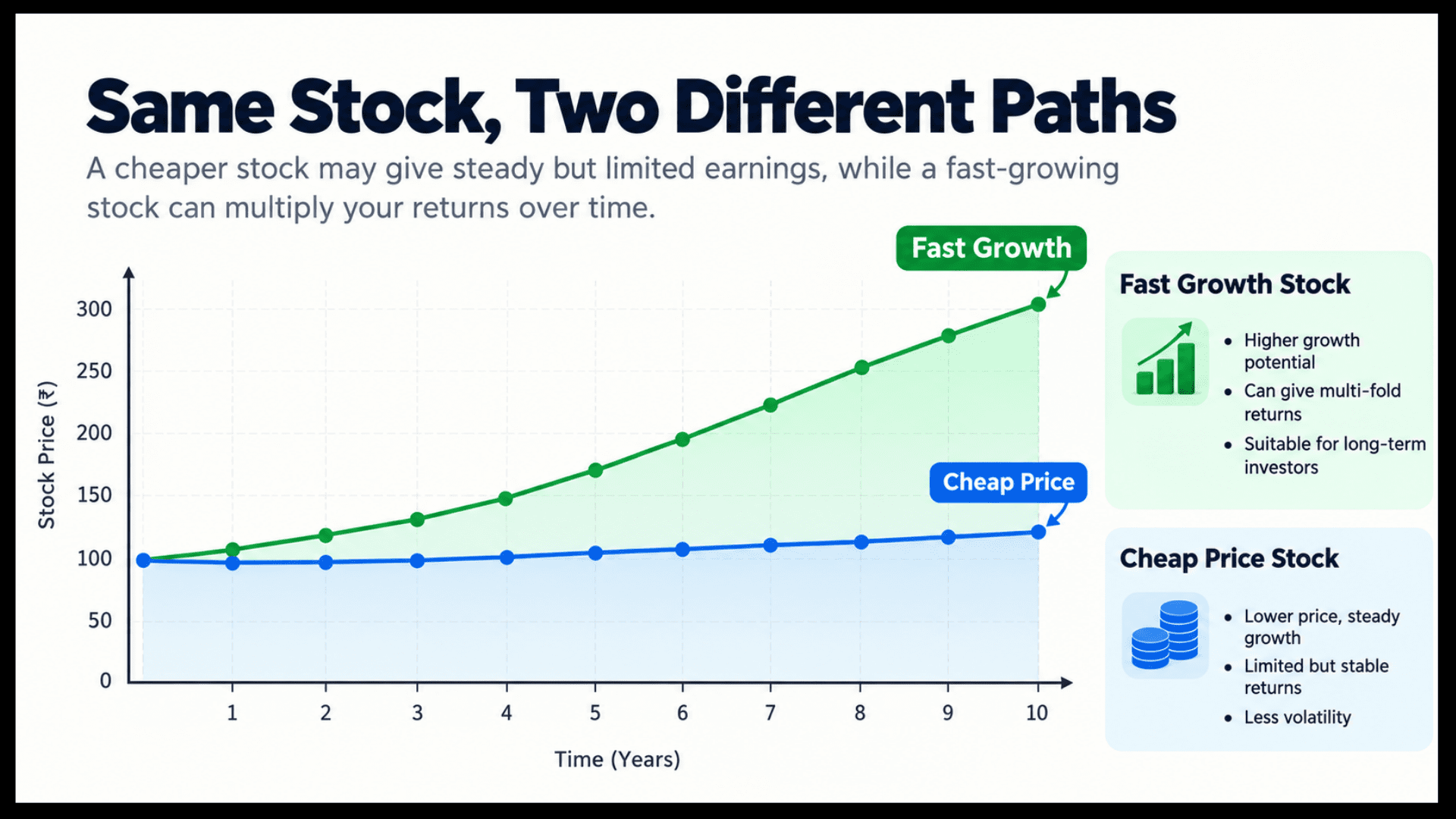
Value investors are comfortable being early and being bored. However, the wait can be long.
How Does a Growth Investor Pick Stocks?
A growth investor studies how fast sales and profits can rise. So, today’s price matters less than tomorrow’s earnings.
- How quickly are revenue and profit growing?
- Is the market large enough for years of expansion?
- Can the business keep its edge as it gets bigger?
- Is it reinvesting profits instead of paying them out?
Growth stocks often look expensive on simple ratios. Still, investors accept that because they expect earnings to grow into the price.
However, the risk is paying for a story that does not come true.
Value Stocks vs Growth Stocks: Side-by-Side Comparison
Here is a side-by-side view so you can compare the two styles quickly. Use it as a quick reference while you read the rest.
| Point | Value investing | Growth investing |
|---|---|---|
| Main question | Is the price below worth? | Will earnings grow fast? |
| Typical look | Low P/E, low price to book | High P/E, high growth |
| Profit source | Price catching up to value | Earnings rising over time |
| Patience needed | Waiting for recognition | Waiting for growth to deliver |
| Biggest risk | Value trap | Paying too much for growth |
| Mood it tests | Boredom, doubt | Fear when prices swing |
In short, the two styles are not enemies. They are different answers to the same question: where does the return come from?
Value vs Growth Investing Example With Simple Numbers
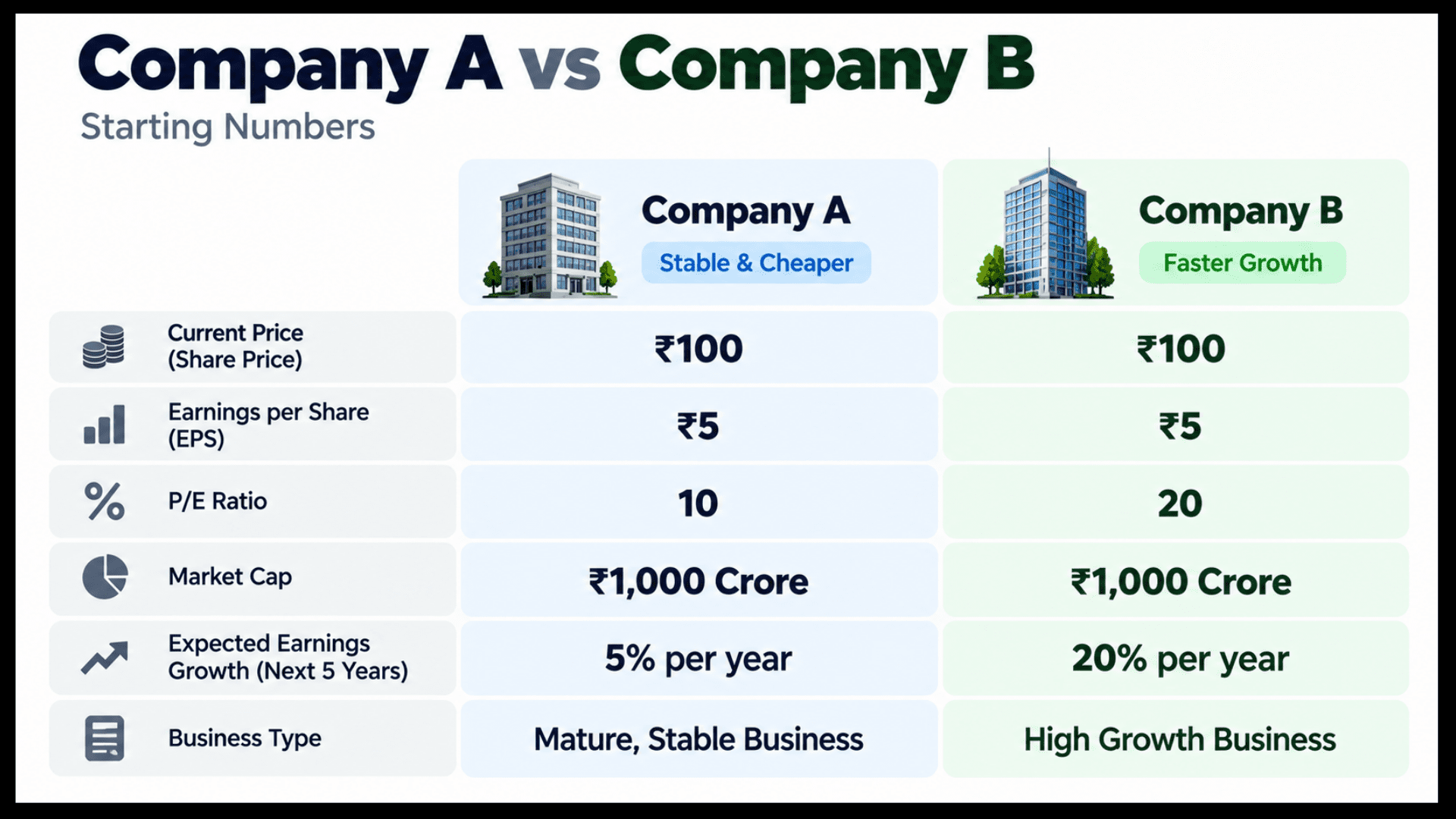
Numbers make the difference easier to see. So let us use two imaginary businesses, Company A and Company B.
All numbers are for illustration only and are not predictions.
First, both start with a price of 100. Company A earns 10 per share and grows 5% a year.
However, Company B earns 2 per share and is assumed to grow faster.
Next, the formula is: price in five years = earnings per share after five years x the P/E investors pay then.
Also, Company A has a starting P/E of 10 and Company B has a starting P/E of 50. Company B is assumed to grow 20% a year.
Notice how Company B costs 50 times its earnings, while Company A costs 10 times. That is what “cheap” and “expensive” mean here.
What Is a Value Trap? Value Trap vs Paying Too Much for Growth
Now let us see what happens when things go well and when they do not. Each row shows the earnings after five years and the price that results.
| Scenario | EPS after 5 years | P/E then | Price | Change |
|---|---|---|---|---|
| A: plan holds (growth 5%) | 12.76 | 10 | 127.6 | +27.6% |
| A: value trap (earnings fall 5% a year) | 7.74 | 10 | 77.4 | -22.6% |
| B: plan holds (growth 20%) | 4.98 | 50 | 248.8 | +148.8% |
| B: growth slows (8% a year) | 2.94 | 25 | 73.5 | -26.5% |
First, look at Company A’s second row. The business looked cheap, but its earnings kept shrinking, so the low price was a warning, not a bargain.
In short, this is a value trap.
Now look at Company B’s last row. Growth did continue, just slower, and the P/E fell.
As a result, the investor lost money even though the business still grew.
That is the lesson: cheap can stay cheap, and growth can be overpriced.
Value Investing vs Growth Investing Risks: What Can Go Wrong?
Each style has its own way of hurting you. So, knowing them in advance helps you stay calm.
- Value trap: a low price that is low for a good reason.
- Overpaying for growth: a high P/E that leaves no room for disappointment.
- Estimate errors: both styles depend on guesses about the future.
- Impatience: selling at the first drawdown, before your idea has time.
In fact, reading helps here, and a few value investing books can build your thinking step by step.
Also, a mentor reviewing your reasoning can catch weak assumptions early. Fresh eyes help most when you are emotionally attached to a pick.
Value or Growth Investing for Beginners: Which Style Suits You?
Choose by temperament and time, not by what feels fashionable. Here is a rough self-check.
| If you are… | You may lean towards |
|---|---|
| Comfortable waiting through dull years | Value investing |
| Okay with big price swings for higher potential | Growth investing |
| Uneasy about high P/E ratios | Value investing |
| Uneasy about businesses with no growth | Growth investing |
| Still unsure | A mix, starting small |
So, if you are brand new, start by learning how to judge a business. A good place is how to learn value investing, since its habits of checking price and quality apply to both styles.
Can You Combine Value and Growth Investing?
Yes, many investors do. The idea is to look for reasonable growth at a reasonable price, instead of picking a side.
In practice, that means asking two questions together. Is growth real, and is the price sensible for that growth?
For example, using the same hypothetical numbers, suppose you put 100 in each company.
If A holds and B slows, the combined result is +0.6%. However, if both go badly, it is -24.5%.
So blending does not remove risk. Instead, it only spreads your bets across two different kinds of mistakes.
Think of it as a general idea, not advice. Instead, your own goals, time horizon and risk comfort decide the mix.
Value and Growth Investing Mistakes to Avoid
A few habits cause most of the damage. So, check yourself against this list.
- Judging a stock only by a low or high P/E.
- Copying someone’s pick without understanding why.
- Calling every beaten-down price a “bargain”.
- Believing growth stories without checking earnings.
- Switching styles every time one does badly for a few months.
Where to Learn Value and Growth Investing Properly
Wherever you are on your investing journey, the right learning path saves you from many costly lessons.
Also, structured learning can shorten the trial and error. If you prefer a taught format, compare the options in value investing courses and see what fits your pace.
Do you also want to find out which investing style truly fits you, with a mentor beside you? In our live classes, you can join from your mobile, ask your doubts, and learn step by step.
Watching videos alone rarely builds conviction. Instead, real examples, personalised mentorship and honest feedback make the real difference.
Conclusion
Value investing vs growth investing is not about which is better. Instead, it is about which one you can hold through doubt, with an honest view of the risks.
So, learn how to judge a business first, then decide how much growth you want in your mix.
Finally, take your time, keep your numbers realistic, and never invest money you cannot afford to lose.
Disclaimer: This content is for education only and is not investment advice. All numbers are hypothetical and used for illustration only. Investments carry risk, including loss of capital. Please consult a SEBI-registered adviser before investing.
Frequently Asked Questions
Before investing capital, invest your time in learning Stock Market.
Fill in the basic details below and a callback will be arranged for more information: