

Most traders enter a trend too late and exit too early every single time. What if there were a simple way to time your entries with more confidence?
That is exactly what the EMA crossover for swing trading helps you do. It does not predict the market, but it tells you when momentum is shifting.
Thousands of traders use this one setup to catch multi-day moves with clarity. The best part is that you do not need ten indicators to make it work.
In this blog, you will learn exactly how to use it the right way.
What Is EMA Crossover For Swing Trading?
Most traders use EMA crossover without fully understanding what the signal is actually telling them. It is not a complex idea, but it is certainly a powerful one.
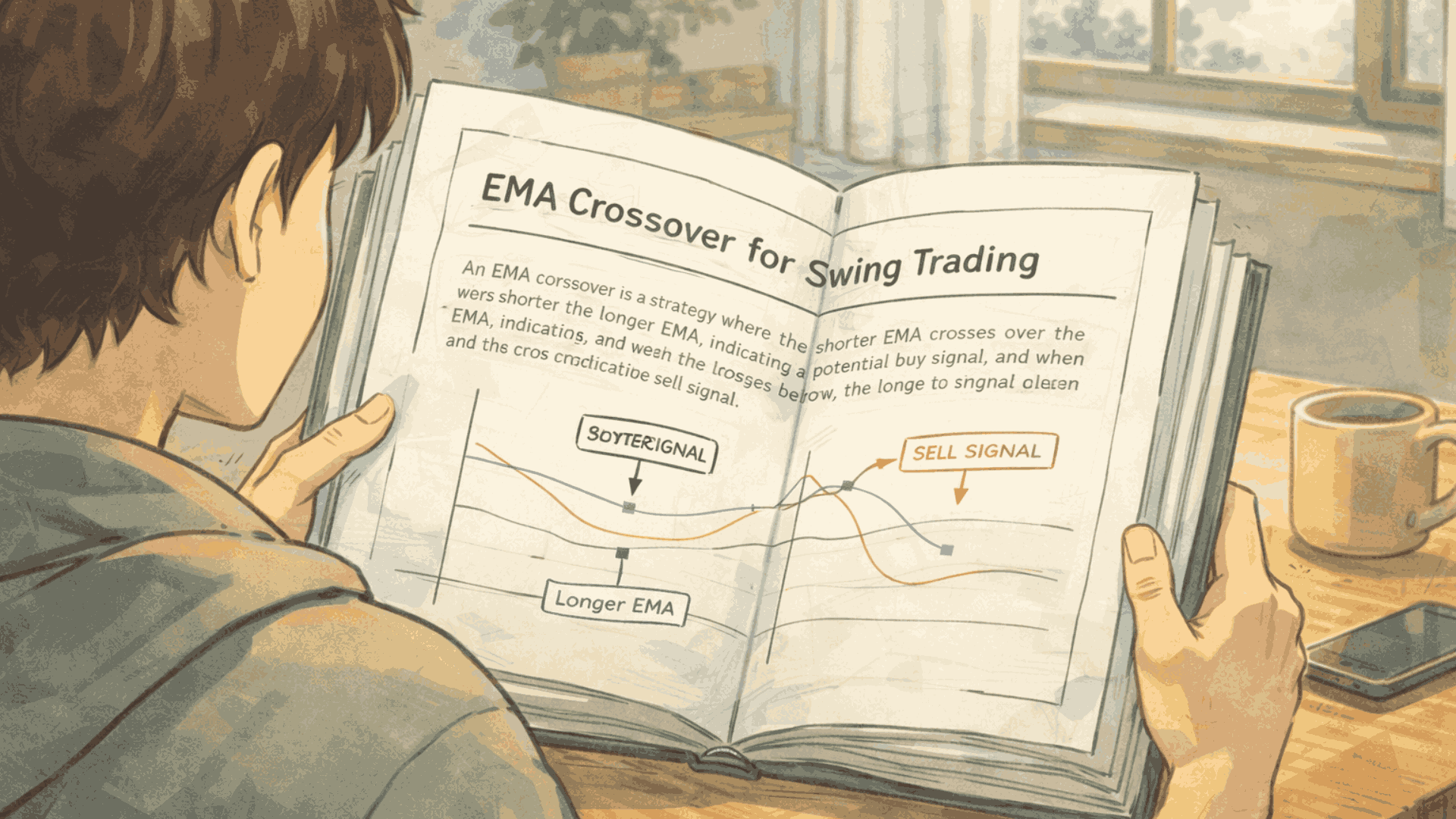
An EMA crossover happens when a short-term EMA crosses over a long-term EMA, signaling a possible shift in the direction of the trend.
The weight given to recent price data in the moving average calculation is what makes the Exponential Moving Average (EMA) react faster to price changes than a Simple Moving Average (SMA).
This increased sensitivity is used in swing trading to capture price moves that last more than a few days rather than quick intraday spikes.
Here is how it works in simple terms:
- When the short EMA crosses above the long EMA, it gives a bullish signal, indicating upward momentum
- When the short EMA crosses below the long EMA, it gives a bearish signal, indicating downward pressure
- When the price sustains above or below both EMAs, it confirms trend continuation
For example:
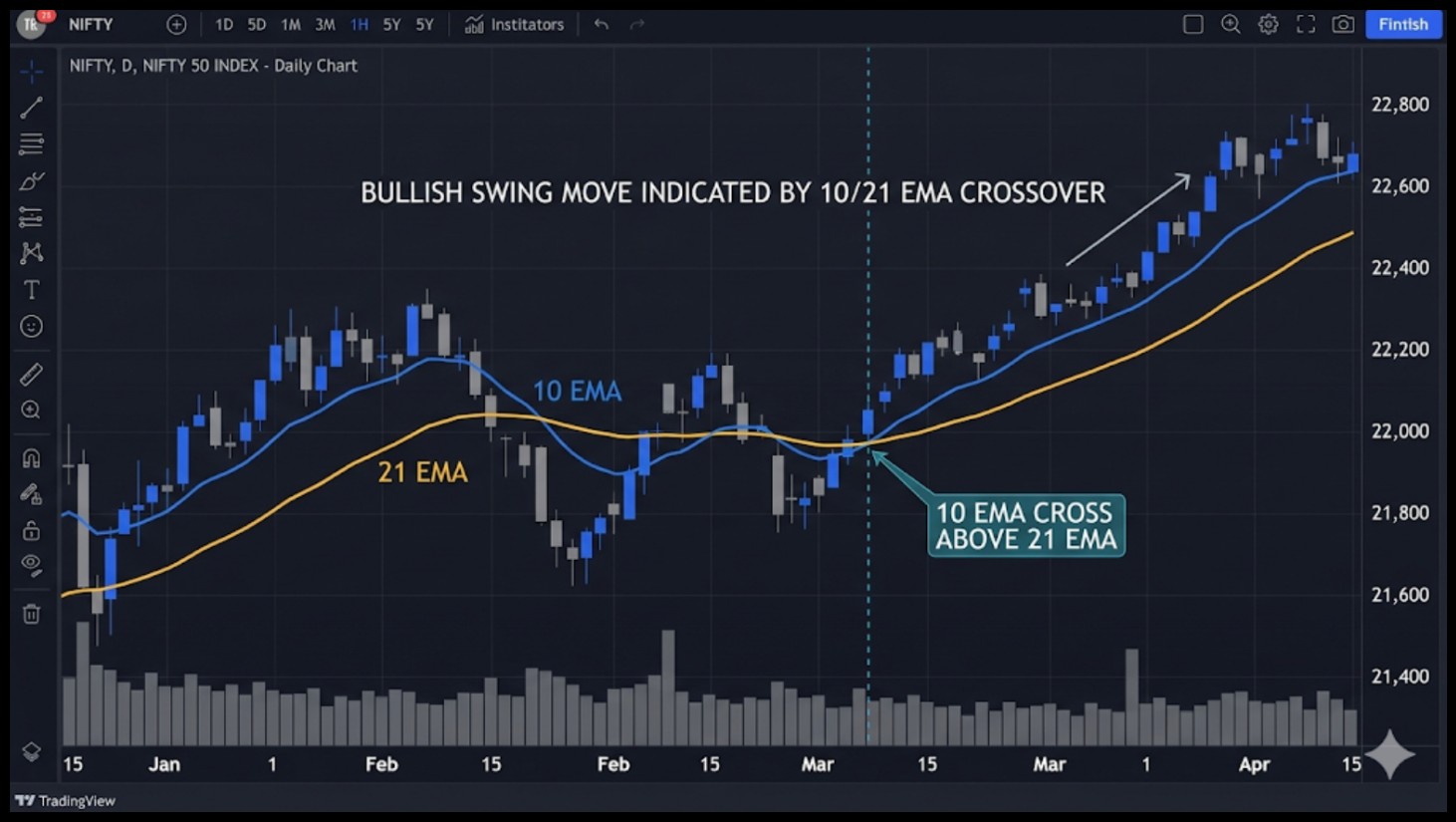
Here, Infosys shows a 10 EMA crossing above the 21 EMA on a daily chart. It often indicates the beginning of a fresh swing move.
This is where the moving average crossover for swing trading becomes practically useful. It is not about reacting fast; it is about staying in the move long enough to capture meaningful gains.
Which EMA To Use For Swing Trading?
Choosing the right EMAs is critical. Different combinations suit different trading styles. The right pair helps you balance early entry with reliable confirmation, which directly impacts your results.
Common EMA Combinations:
|
Strategy Type |
EMA Pair | Use Case |
| Most Popular Swing | 9 EMA and 20/21 EMA |
Fast enough for early entries, filters noise for daily swing trades |
|
Short Swing |
8 EMA and 21 EMA | Quick momentum trades with slightly higher sensitivity |
| Medium Swing | 10 EMA and 20 EMA |
Balanced setup for steady multi-day moves |
|
Trend-Based Swing |
20 EMA and 50 EMA |
Slower signals, ideal for strong trend confirmation |
Best EMA For Swing Trading:
- 20 EMA captures short-term trend
- 50 EMA defines medium-term direction
- 200 EMA shows overall market bias
A common approach is to use 20 and 50 EMA crossover together. It balances speed and reliability, making it the best EMA crossover for a swing trading setup.
Best EMA Crossover Strategy For Swing Trading
Now let’s connect the dots. A proper EMA Crossover Swing Trading Strategy requires clear rules. Without defined rules, even the best setup can lead to inconsistent results and unnecessary losses.
Entry Rules:
- Wait for the EMA crossover on the daily chart
- Confirm price is holding above EMAs
- Enter on a pullback toward the shorter EMA
After the EMA crossover, avoid entering blindly on a pullback. Wait for the price to break above the most recent swing high, which confirms that a new trend is actually starting, not just reacting.
Either enter on the breakout candle close or the next candle open, with a stop-loss set below the recent swing low.
This simple rule removes all guesswork and turns your entry into a clear and confident decision.
Exit Rules:
- Exit near resistance levels
- Trail stop using 20 EMA
- Exit if crossover reverses
Note: Trail your stop loss just below the 20 EMA and update it at the end of each trading day as the EMA moves upward. As the trend progresses, you can also shift your stop below each new swing low to lock in profits.
Exit the trade only when the price gives a daily close below the 20 EMA or breaks the most recent swing low.
Example Setup:
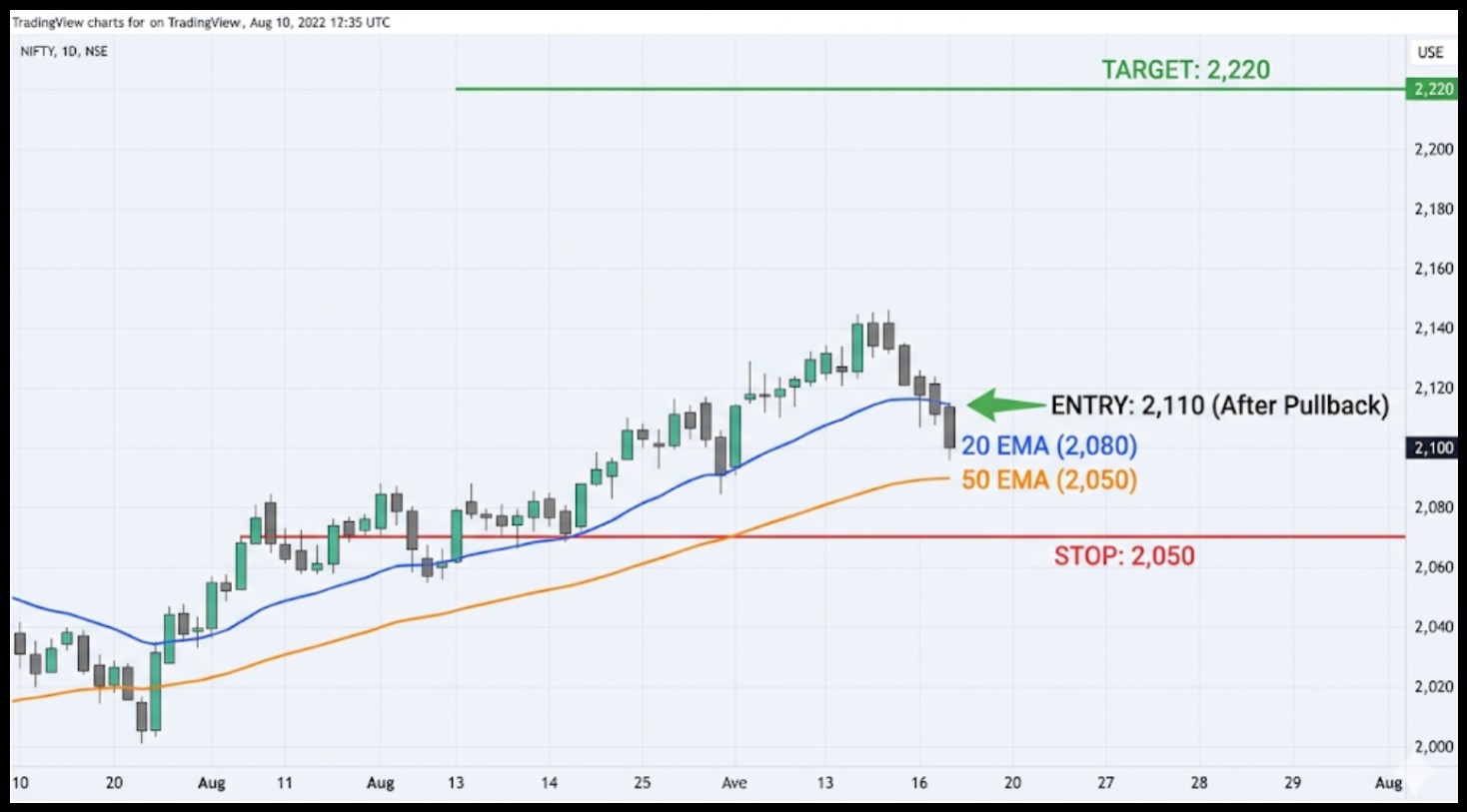
- Stock price: 2,100
- 20 EMA: 2,080
- 50 EMA: 2,050
- Entry: 2,110 after pullback
- Stop: 2,050
- Target: 2,220
This structured approach helps traders avoid emotional decisions. It ensures every trade is planned, not driven by fear or greed.
1. Using The 200 EMA As Your Swing Trade Filter
The 200 EMA acts as a higher timeframe trend filter and should guide every swing trade decision.
When the price is above the 200 EMA, only take bullish 20/50 EMA crossover signals, as the broader trend supports upward moves.
When the price is below the 200 EMA, focus only on short trades, since bullish crossovers tend to fail in a bearish environment.
For example, in the Reliance setup, if the price is above the 200 EMA along with a 20/50 bullish crossover, the probability of a successful swing trade increases significantly.
2. EMA Cross Settings For Swing Trading
Settings play a bigger role than most traders realize. Using the wrong EMAs can delay signals or create noise.
Even a small change in EMA periods can shift your entry timing and impact overall trade accuracy.
Recommended Settings:
- Fast EMA: 8, 10, or 20
- Slow EMA: 21, 50, or 100
Multi-Timeframe Confirmation: The Missing Edge
A strong EMA Crossover for Swing Trading setup starts with the right trend context. Many traders rely only on the daily chart, but that often leads to false signals.
To solve this, you must first determine which time frame is best for trend analysis to ensure your swing trade is moving in the same direction as the “big picture” market flow.
The professional approach uses a three-timeframe workflow to stay aligned with the bigger trend.
Let’s look at how the workflow works:
Weekly chart: identify the primary trend
- If the price is above the 20-week EMA, the overall bias is bullish
- If the price is below the 20-week EMA, the overall bias is bearish
Daily chart: look for the EMA crossover signal
- 20 EMA crossing above 50 EMA gives a buy signal
- 20 EMA crossing below 50 EMA gives a sell signal
- Only act on signals that match the direction identified on the weekly chart
Intraday chart (15 min or 1 hour): fine-tune your entry
- Enter on a pullback toward the shorter EMA
- Wait for a breakout candle to confirm the move before entering
This simple filter avoids taking trades against the broader trend, which is one of the most common reasons swing trades fail.
Faster signals feel exciting, but slower ones tend to be more reliable. This is a trade-off every trader must consciously accept before choosing their EMA settings.
Real Trade Example
Let’s walk through a practical scenario using the EMA Crossover for Swing Trading.
This example shows how a clear setup, defined risk, and patience come together in a real trade.
Trade Setup:
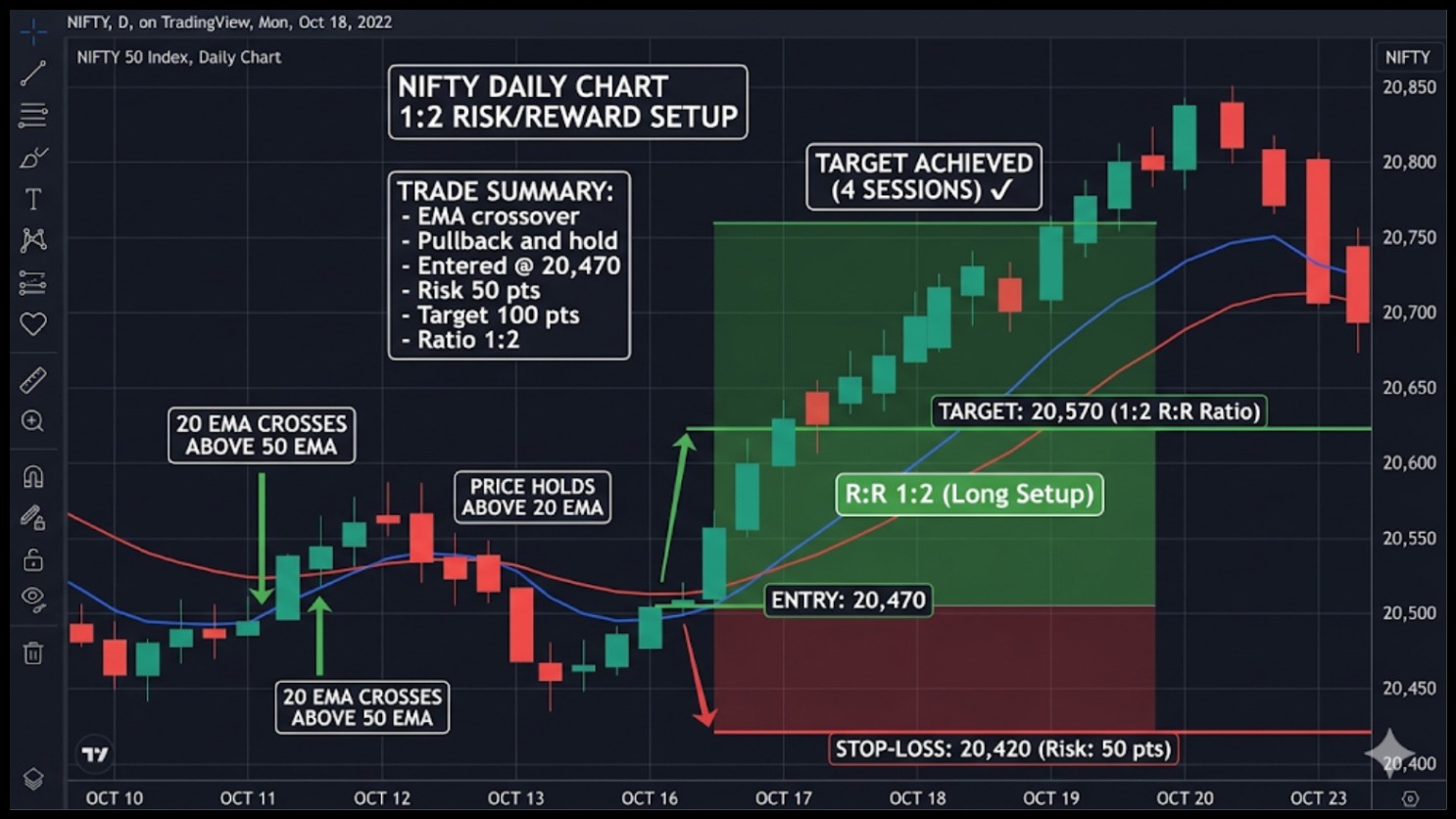
- Stock: Reliance Industries
- Timeframe: Daily
- 20 EMA: 2,450
- 50 EMA: 2,420
- Price: 2,460
Entry Conditions:
- 20 EMA crosses above 50 EMA
- Price pulls back and holds above 20 EMA
- Entry: 2,470
Risk And Target:
- Stop-loss: 2,420
- Risk: 50 points
- Target: 2,570 (1:2 ratio)
Outcome:
- Price continues upward trend
- Target achieved in 4 trading sessions
This is how swing traders apply the system with patience and clarity. They focus less on frequent trades and more on capturing clean, high-quality moves.
Best EMA Crossover For 5 Min Chart Vs Swing Trading
It’s worth comparing short-term and swing approaches. Many traders mix them up. Using the wrong time frame setup can lead to poor entries and unnecessary losses.
Key Differences:
|
Aspect |
5 Min Chart | Swing Trading |
| Timeframe | Intraday |
Daily |
|
EMAs |
9 and 21 | 20 and 50 |
| Trade Duration | Minutes |
Days |
|
Noise Level |
High |
Lower |
The best EMA crossover for a 5-minute chart focuses on speed, while swing trading focuses on stability. Trying to use intraday EMAs for swing trades often leads to confusion and poor entries.
Best EMA Crossover Strategy For Day Trading Vs Swing
There’s a subtle but important difference between these strategies. The choice depends on how quickly you want results and how much market noise you can handle.
Day traders rely on faster EMAs to catch quick intraday moves.
Here is what that looks like in practice:
- Uses faster EMAs like 9 and 21 for quicker and more sensitive signals
- Entries and exits happen within minutes or hours of each other
- Requires high trade frequency and constant screen time throughout the day
Swing traders, on the other hand, use slower EMAs, which produce fewer but much stronger signals.
Here is how it differs:
- Uses slower EMAs like 20 and 50 for more reliable and confirmed signals
- Trades last multiple days, giving you time to plan without constant monitoring
- Offers a better risk-to-reward ratio with significantly less daily stress
This contrast helps traders choose what suits their personality. Not every trader enjoys holding positions overnight.
Common Mistakes In EMA Crossover Swing Trading
Even a solid system can fail if used incorrectly. Small lapses in patience or ignoring market structure can quickly turn a high-probability setup into a losing trade.
Here are the mistakes one should avoid:
- Never trade EMA crossover signals in a sideways market, as the frequent false crossovers will only lead to unnecessary losses.
- Avoid entering a trade too late after the crossover has already happened, as the best part of the move is likely already over.
- Always check the higher timeframe trend before acting on any crossover signal because trading against the bigger trend rarely works in your favor.
- Never skip your stop loss on any trade because one unprotected loss can wipe out multiple winning trades in a single session.
Another common issue is impatience. Swing trading requires waiting, and that’s often harder than executing the trade itself.
Practical Tips To Improve Results
Small changes in how you enter and manage your trades can make a big difference over time. Even getting your entry timing slightly right or placing your stop loss more carefully can improve your overall results noticeably.
- Always combine the EMA crossover with key support and resistance levels for stronger confirmation before entering any trade.
- Avoid stocks with low trading volume as they tend to produce unreliable crossover signals that can mislead your entries.
- Focus on stocks from sectors that are currently trending as they respond better to EMA crossover signals.
- Stick to one EMA setup consistently instead of switching between combinations every time a trade does not work out.
Consistency builds confidence. Constant changes create confusion. Sticking to one clear system helps you read the market faster and act without hesitation.
Conclusion
The EMA crossover for swing trading is not about being fast; it is about being right. Most traders lose money because they chase prices instead of waiting for clear signals.
This strategy gives you a simple and rule-based way to stay on the right side.
The crossover tells you when momentum is shifting, and the trend is ready to move. You do not need to predict the market when you have a system that reads it.
Patience and consistency with this one setup can completely change how you trade over time.
Take the next step in understanding setups like this through our technical analysis classes, where real charts and practical strategies are explained in a simple, structured way.
FAQs
Q1: How do I avoid false signals in EMA crossover for swing trading?
Ans: The best way to avoid false signals is to combine the EMA crossover with a higher timeframe trend filter like the 200 EMA.
Only take bullish crossover signals when the price is already above the 200 EMA and bearish signals when it is below. This one filter alone can significantly improve your trade accuracy.
Q2: Does EMA crossover work better on some stocks than others?
Ans: Yes, EMA crossover for swing trading works best on stocks that trend clearly and have good trading volume. Low volume and highly volatile stocks tend to give more false crossover signals, making the strategy unreliable.
Stick to large-cap or sector-leading stocks for the most consistent results.
Q3: What timeframe is best for EMA crossover swing trading?
Ans: The daily timeframe is the most effective for swing trading using EMA crossovers as it filters out intraday noise. Weekly charts can be used to confirm the bigger trend, while the daily chart is used for the actual entry signal.
Avoid using timeframes below one hour as they produce too many false crossovers.
Q4: Can a beginner use EMA crossover for swing trading?
Ans: Yes, EMA crossover is one of the most beginner-friendly strategies in swing trading because the rules are simple and clear. A beginner can start with just the 20 and 50 EMA on a daily chart without needing any complex indicators.
The key is to practice on paper trades first before risking real capital.
Before investing capital, invest your time in learning Stock Market.
Fill in the basic details below and a callback will be arranged for more information: