



You have probably heard that a covered call gives “steady monthly income” from shares you already own. So is covered call strategy profitable, or is that just good marketing?
The honest answer: sometimes yes, sometimes no, and it depends on the market you are in.
Here we look at where the money comes from, where it can go wrong and how you can test it yourself.
Is Covered Call Strategy Profitable? The Short Answer
A covered call can make money, but it is not free money.
It works best when the stock stays flat or rises slowly. It disappoints when the stock rallies hard or falls sharply.
Think of renting out a flat you own. You earn rent every month, but you agree not to sell it above a fixed price.
The rent is steady, and the big price jump is not yours. No one can promise you a return from it.
If you want the basics first, this covered call strategy guide explains the structure in plain language.
Covered Call Strategy Returns: Where Does the Profit Come From?
Every rupee a covered call earns comes from a few clear sources. Once you see them, the strategy stops feeling like a mystery.
Covered Call Premium Income
When you sell a call, the buyer pays you a premium (the price of the option) upfront.
That money is yours whatever happens next, even if the stock later falls.
It is your payment for agreeing to sell your shares at the strike, the fixed price you chose.
Time Decay in a Covered Call Strategy
An option loses value as expiry gets closer. As the seller, that works in your favour.
The call you sold gets cheaper to buy back every day.
Read how time decay behaves in options before you rely on it.
Covered Call Dividends (Only on Shares You Hold)
If you own the shares, you get the dividend like any other shareholder. That is a real extra return in a stock covered call.
An index covered call does not give you this, because you cannot hold the index itself.
Covered Call Maximum Profit, Break-Even and Maximum Loss
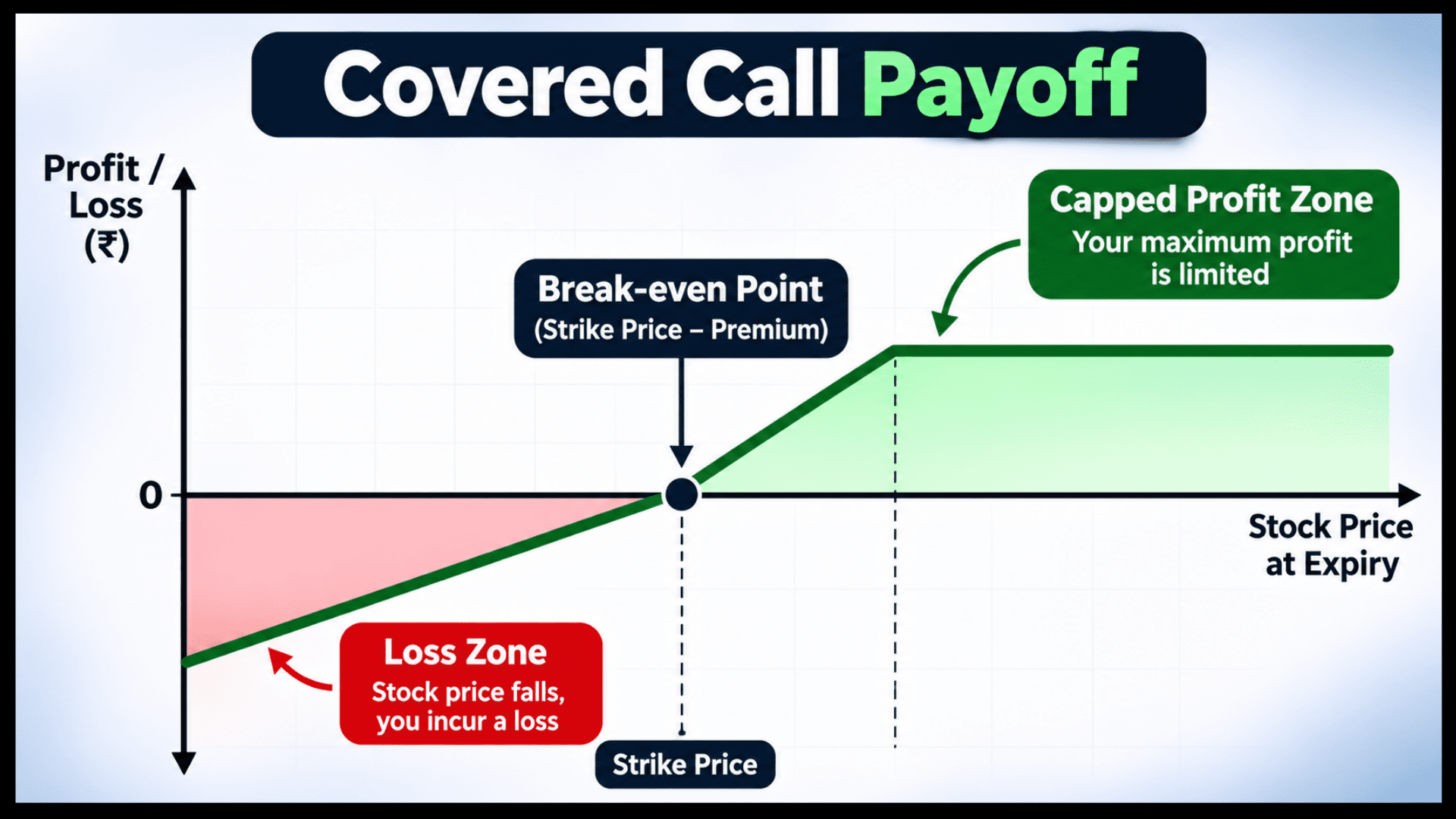
You also keep the rise in the stock up to the strike. Your total gain is the move up to the strike plus the premium, and nothing beyond that.
A quick formula to remember, per share:
- Maximum profit = (strike price minus purchase price) plus premium
- Break-even = purchase price minus premium
- Maximum loss = purchase price minus premium, if the stock went to zero
Covered Call Profit and Loss Example in Different Markets
Numbers explain this better than words. Take a hypothetical example: you buy a stock at 1,000, sell a one-month call at the 1,050 strike and collect a premium of 20 per share.
The table shows the result per share at expiry, next to simply holding the stock. It ignores costs, tax and slippage, so the idea stays clean.
| Market scenario | Stock price at expiry | Covered call result | Just holding the stock |
|---|---|---|---|
| Rising strongly | 1,100 | +70 (capped) | +100 |
| Rising slowly | 1,040 | +60 | +40 |
| Flat | 1,000 | +20 | 0 |
| Falling | 950 | -30 | -50 |
| Crash | 700 | -280 | -300 |
In the flat and falling rows, the covered call beat holding, but only by the premium.
In the strong rally you gave up 30 per share. In the crash you lost almost as much as the person who just held.
When Does a Covered Call Underperform?
A covered call trades away big gains for a small, fixed premium. That makes it lag in some markets more than others.
Here are the three situations where this happens most often.
- A sharp rally past your strike. You sell at the strike and miss the rest.
- A steady fall. The premium is too small to make up for the loss on the shares.
- A choppy market where you keep rolling the call at a loss to avoid delivery.
Strike choice changes how often the first one happens.
Our guide on how to choose a strike price walks through that thinking step by step.
Is Covered Call Strategy Safe? What Is Capped and What Is Not
It sounds like the calm, conservative option strategy, so many people ask if it is safe.
It is less risky than selling a naked call, but it is not safe the way a fixed deposit is safe.
The table splits what the strategy limits from what it leaves open.
| What the strategy does | Capped or not |
|---|---|
| Your upside on the shares | Capped at the strike plus premium |
| Your downside if the stock falls | Not capped, only cushioned by the premium |
| Your income per cycle | Capped at the premium you collected |
| Your obligation to deliver shares | Fixed if the call ends in the money |
| Your ability to profit from a big rally | Lost above the strike |
The premium is a small cushion, not a shield. If the stock drops 20 percent, a premium of 2 percent will not save you.
The strategy changes the shape of your risk. It does not take the risk away.
Is Covered Call Strategy Risky? The Risks Beginners Overlook
Most people only worry about the stock falling. The quieter risks are the ones that surprise beginners.
Covered Call Stock Risk Stays With You
You still own the shares. A bad result, a regulatory problem or a sector sell-off hurts you in full, minus that small premium.
Never sell a call on a stock you would not hold for months.
Size matters too, and why position sizing matters is worth reading before you put a big share of your money in one stock.
Covered Call Delivery Risk on NSE Stock Options
Stock options on NSE are physically settled, which means real shares change hands. If your short call ends in the money at expiry, you must deliver the shares at the strike.
That is fine when the shares sit free in your demat account. It becomes a problem if they are pledged, because pledged shares cannot be delivered until you unpledge them.
Index options like Nifty and Bank Nifty are cash-settled, so no shares move. But then there is also no share holding behind the call.
Verify the current settlement rules on NSE before you trade.
Covered Call Margin Requirement
This one surprises almost everyone. Your shares sit in the equity segment, while the margin for a short call is worked out in the derivatives segment.
So holding the shares does not automatically cut the margin. Pledged shares can count as collateral after a haircut, and brokers usually want part of the margin in cash, so check your broker’s rule.
Margin can also rise near expiry and when the price moves up. Brokers may charge more than the exchange minimum, so it helps to understand how option trading margin works in advance.
Covered Call Assignment and Rolling Traps
If the stock jumps, the urge to roll the call higher and further out, just to “save the shares”, is strong. We have all felt it.
But rolling again and again at a loss can turn a small, known cost into a much bigger one.
Common Ways People Lose Money With Covered Calls
Most losses come from how the strategy is used, not from the strategy itself. These are the patterns we see most often.
- Chasing premium: selling very close strikes or very risky stocks because the premium looks big.
- Selling calls on weak stocks: the premium is high for a reason, usually because the market expects a fall.
- Ignoring costs: brokerage, STT on the option sale and slippage can eat a thin premium.
- Over-sizing: putting most of your money in one stock, so one bad result hurts badly.
- Closing winners early, holding losers: you book the premium but sit on falling shares for months.
- Skipping the exit plan: no rule for what to do if the stock falls 10 percent or rallies through the strike.
The last one costs the most. Write down how you will exit a trade before you enter, so emotion does not decide in a stressful moment.
Already taken a loss? Take a breath. A calm review helps more than trying to win it back at once.
How to Backtest Covered Call Strategy Before Using Real Money
Before you put real money in, you want proof, not a story. The best way to answer “is covered call strategy profitable” for your own stock or index is to test it on past data.
A backtest cannot predict the future. It shows how your rules behave in good and bad markets.
We quote no results here, because they depend on the stock, the period and your rules.
Data You Need to Backtest Covered Call Strategy
Bad data gives confident but wrong answers, so start clean.
- Daily or intraday prices, adjusted for splits, bonus issues and dividends
- Historical option prices for the strikes and expiries you would really trade, not just theoretical values
- Dividend and ex-dividend dates, if you test a stock covered call
- Lot sizes as they were at each point in time, since they change
If you are new to the process, this walkthrough on backtesting option trading strategies covers the basics.
Covered Call Backtest Rules to Write First
Decide the rules first, and do not change them after you see the numbers.
- Which stock or index, and which expiry (weekly or monthly) you will sell
- How you pick the strike, for example a fixed percent above the price or a chosen delta
- When you enter and exit, such as holding to expiry or closing at a set share of the premium
- What you do if the call goes in the money: let it be delivered, roll or close
- How much capital you assume per trade
Include Every Cost in a Covered Call Backtest
A strategy that looks great before costs can look ordinary after them. Add these to every trade in your test:
- Brokerage on both the share and option legs
- STT on the option sale and other charges, using current rates from your broker’s charge sheet
- Bid-ask spread and slippage, especially in less liquid stock options
- Tax effects, which you should confirm with a CA
Covered Call Backtest Metrics That Matter
Total return alone can mislead you. The table lists what to track, with plain buy-and-hold of the same stock or index as the yardstick.
| Metric | What it tells you |
|---|---|
| Return vs buy-and-hold | Whether selling calls actually added anything |
| Maximum drawdown | The deepest fall from a peak, which you must be able to sit through |
| Worst month and worst year | How bad a bad stretch felt |
| Percentage of cycles called away | How often you gave up upside |
| Return after all costs | The only return you actually keep |
| Return in different market phases | Whether it only worked in one kind of market |
Common Mistakes When You Backtest Covered Call Strategy
Watch out for these.
- Overfitting: tuning strikes and dates until the past looks perfect, then failing on new data.
- Using only a bull market: a rising period flatters almost any long strategy.
- Ignoring liquidity: assuming you can sell at the last traded price in a thin contract.
- Survivorship bias: testing only stocks that are still around today.
- Too few trades: a handful of cycles proves nothing.
When the test is done, ask yourself one hard question: would I still follow these rules after three losing cycles in a row? If not, the strategy does not fit you, whatever the numbers say.
If you want someone to review your rules and test setup, our live option trading classes include personalised guidance on exactly this.
Who Should Use a Covered Call Strategy
Covered calls suit a certain kind of investor and a certain kind of stock. Check yourself against the points below before you sell your first call.
It may suit you if:
- You already own shares you are happy to hold for the long term
- You are comfortable selling those shares at the strike price
- You want a modest extra income and can live with missing big rallies
- You understand margin, lot sizes and settlement for your stock
Who Should Avoid a Covered Call Strategy
Some investors end up frustrated with covered calls, mostly because the strategy does not match what they want from the stock.
It may not suit you if:
- You expect a big rally and want every rupee of it
- You are buying a stock only to sell calls on it for premium
- You cannot afford a fall in the shares
- You do not hold shares in lot-size multiples, or they are pledged and cannot be delivered
If your main worry is a fall in price, another structure may fit better. Our comparison of a covered call vs a protective put shows how the two handle risk differently.
Learn Covered Call Strategy in Live Option Trading Classes
Recorded videos only show you the theory, while live practice and mentor answers help you take your first trade with confidence.
In our live classes you can join from your mobile, ask questions and learn step by step, with no fixed batch to keep up with.
Conclusion
A covered call is a reasonable, income-oriented strategy for the right stock and the right temperament.
It is not a shortcut to wealth, and it is not a safe place to hide.
People who do well with it pick stocks they are happy to own, size positions sensibly and test their rules instead of trusting a story.
A good next read is how to manage risk in trading.
Frequently Asked Questions
Before investing capital, invest your time in learning Stock Market.
Fill in the basic details below and a callback will be arranged for more information: