


Most beginner option buyers pick a strike because it’s cheap. Not because they understand what they’re actually buying. Learning how to use delta for option buying fixes that problem. Delta fixes that problem.
How to use delta for option buying comes down to one habit
Check delta before you check price. Price tells you what you’re paying. Delta tells you what you’re actually getting.
How to Use Delta for Option Buying: Why Strike Selection Beats Price?
A cheap, far out-of-the-money option often has a low delta. Sometimes under 0.20.
The stock has to move a lot just for your option to gain meaningfully.
A closer, at-the-money option typically carries a delta near 0.50. It reacts faster to the stock, and it also costs more upfront.
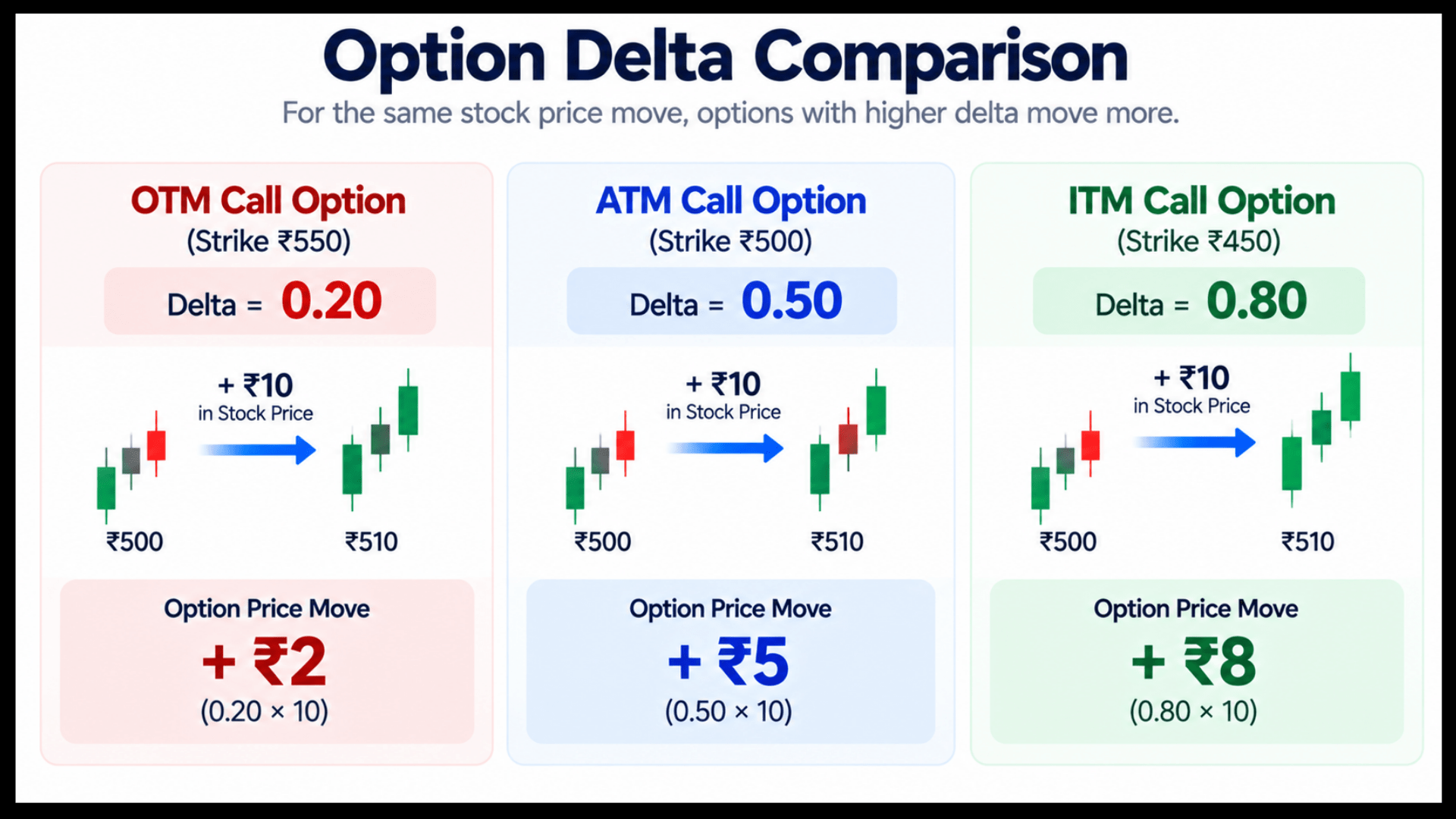
Neither is automatically right. The choice depends on your view.
Make that choice knowingly, not by accident. If delta itself is still unclear, our post on delta meaning in options trading covers the basics first.
Use Delta for Option Buying: Why Strike Selection Beats Price?
Think of delta as a dial for how directional your bet is.
Before you set that dial, be clear on what the purpose of option trading is for you in this particular trade.
High delta, closer to 0.70 or above, behaves almost like owning the stock. It suits a strong, confident view.
You pay more for less leverage, but you get a higher chance of profit.
Lower delta, closer to 0.20 to 0.30, behaves more like a lottery ticket. It costs less.
It needs a bigger move to pay off. The chance of actually working is smaller too.
A Practical Framework for Choosing the Right Delta
Match delta to your actual view instead of picking a strike at random.
Here’s a simple way to do that:
- Strong conviction, moderate move expected: look at options with delta around 0.50 to 0.65.
- Strong conviction, big move expected: delta around 0.30 to 0.45 can offer better leverage. This works if you’re confident in the size of the move.
- Lower conviction, speculative view: keep position size small regardless of delta. Lower delta options need a larger move to profit.
This isn’t a rigid rule. It’s a starting point.
Use it to stop choosing strikes purely by premium price.
Same Option Cost, Completely Different Position Risk
Two options at the same premium can carry very different real exposure. Purely because of delta.
A position’s total delta tells you roughly how much you’d gain or lose for a given move in the stock. Sum it across however many contracts you hold.
This is a far more honest risk measure than looking at premium alone.
It’s the same idea behind a delta-neutral trading strategy, just applied in reverse by traders who want zero directional exposure.
To complement your understanding of these directional Greeks, our guide on how to use gamma for option selling provides valuable context on managing position acceleration and risk.
Additionally, mastering advanced concepts like gamma scalping explained can help you navigate rapid market shifts and price volatility more effectively.
Use Delta for Option Buying: Two Real Worked Examples
A framework only makes sense once you see it on real numbers. The two examples below apply it to an actual trade view.
The first compares two strikes on the same move. The second shows where delta alone falls short.
Example 1: A 0.55 Delta Option vs a 0.25 Delta Option
You’re bullish on a stock trading at ₹1,200. You expect a move to ₹1,260 over the next two weeks. These figures are illustrative.
An option with delta 0.55 and premium ₹18 would be expected to gain roughly ₹33 on that ₹60 move.
That’s based on delta alone, before gamma acceleration along the way.
A further out-of-the-money option with delta 0.25 and premium ₹6 might only gain around ₹15 on the same move.
But your capital at risk per lot is far smaller too.
Neither is wrong. The decision should match your conviction and risk appetite. Not just which premium looked cheaper on the screen.
Example 2: When Is Delta Alone Not Enough?
Suppose you buy two different options with the same delta of 0.50. One has three days to expiry.
The other has three weeks. Understanding the option gamma meaning helps clarify why the three-day option will react faster to the stock, because gamma is higher closer to expiry.
It will also lose time value faster if the stock doesn’t move soon.
The three-week option gives the trade more room to play out. Delta alone doesn’t tell you this.
Time to expiry matters just as much as the delta number itself.
Volatility matters too, which is where vega in options trading comes in.
Why Buying Low Delta Options Can Ruin Your Win Rate?
Very low delta options, often under 0.15, behave unpredictably.
They lose value fast from time decay if the move doesn’t happen quickly.
Beginners should be especially cautious here. These options can look cheap and tempting.
They also carry a genuinely low probability of working out.
Want to Practise Delta-Based Strike Selection Live?
Reading a framework is one thing. Applying it under real market pressure, with real strikes on a live chain, is what actually builds the skill.
Our option trading classes online cover this live, on real Indian stocks.online
Conclusion
Delta turns strike selection from guesswork into a real decision. Check it before you buy, and you know exactly how much exposure you’re taking on. Not just how much you’re paying.
Match delta to your conviction, size your position by total delta rather than premium, and keep time to expiry in view. Stay cautious with very low delta options that look cheap on the screen but rarely work out.
That single habit alone fixes one of the most common beginner mistakes in options trading.
Frequently Asked Questions
Before investing capital, invest your time in learning Stock Market.
Fill in the basic details below and a callback will be arranged for more information: