



The iron condor strategy is a four-leg options setup. It earns a small credit when the market stays inside a range.
It also has a fixed, limited loss if the market breaks out. Many beginners hear “limited risk, regular income” and stop reading there.
Let us look at the full picture, including the part that hurts.
What Is the Iron Condor Strategy?
First, let us settle the meaning. In fact, every number later on this page rests on it.
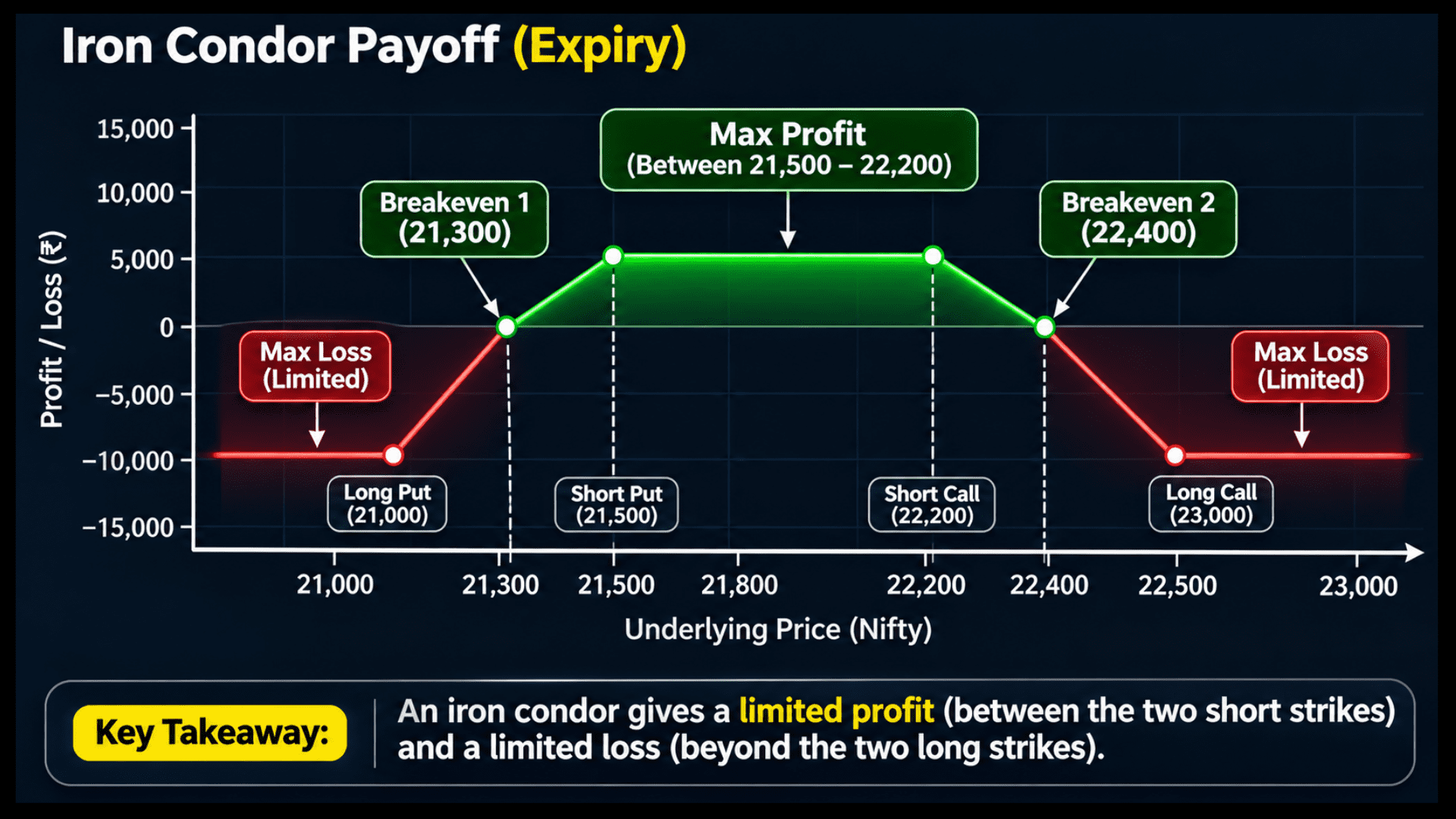
An iron condor combines two credit spreads on the same underlying and the same expiry. One spread sits above the market (a call spread), while the other sits below it (a put spread).
You sell an out-of-the-money call and an out-of-the-money put. Then you buy a further out-of-the-money call and put as protection, and the bought options are called the wings.
Think of it as a short strangle with seat belts. The wings cap your loss, but they also cost money, so the credit you keep is smaller.
A long strangle does the opposite job, because it pays when the market moves a lot. If you want a big-move idea instead, see how to create a long straddle. Then compare the two ideas side by side.
Iron Condor Strategy Example
Next, let us build a real example. Every iron condor has the same four legs, and the strikes follow one simple rule.
The rule is this: long put below short put, short put below short call, short call below long call. Here is the example we will use for the rest of this page.
All numbers are hypothetical and for illustration only. The index is at 22,000 with 30 days to expiry, and 1 lot = 50 units. Real lot sizes are revised by the exchange, so verify.
The table below lists all four legs with their premiums.
| Leg | Action | Strike | Premium (points) |
|---|---|---|---|
| Lower wing | Buy put | 21,300 | 103.4 |
| Lower body | Sell put | 21,500 | 153.8 |
| Upper body | Sell call | 22,500 | 160.7 |
| Upper wing | Buy call | 22,700 | 111.6 |
Premiums come from the Black-Scholes model with 0% interest rate and 14% volatility, rounded to one decimal. Of course, real market prices will differ.
Net credit = 153.8 + 160.7 – 103.4 – 111.6 = 99.5 points. For one lot, that is 99.5 x 50 = ₹4,975 before costs.
If you are still building your base, learn the basic option strategies first. They show how spreads fit into the bigger picture.
When to Use an Iron Condor Strategy
Before any trade, match the strategy with your view. Here we see which market the iron condor likes and which one hurts it.
The iron condor suits a neutral, range-bound view. You expect the index to stay between your two short strikes until expiry.
In our example, that range is 21,500 to 22,500. The market can wander inside it, and you still keep the full credit.
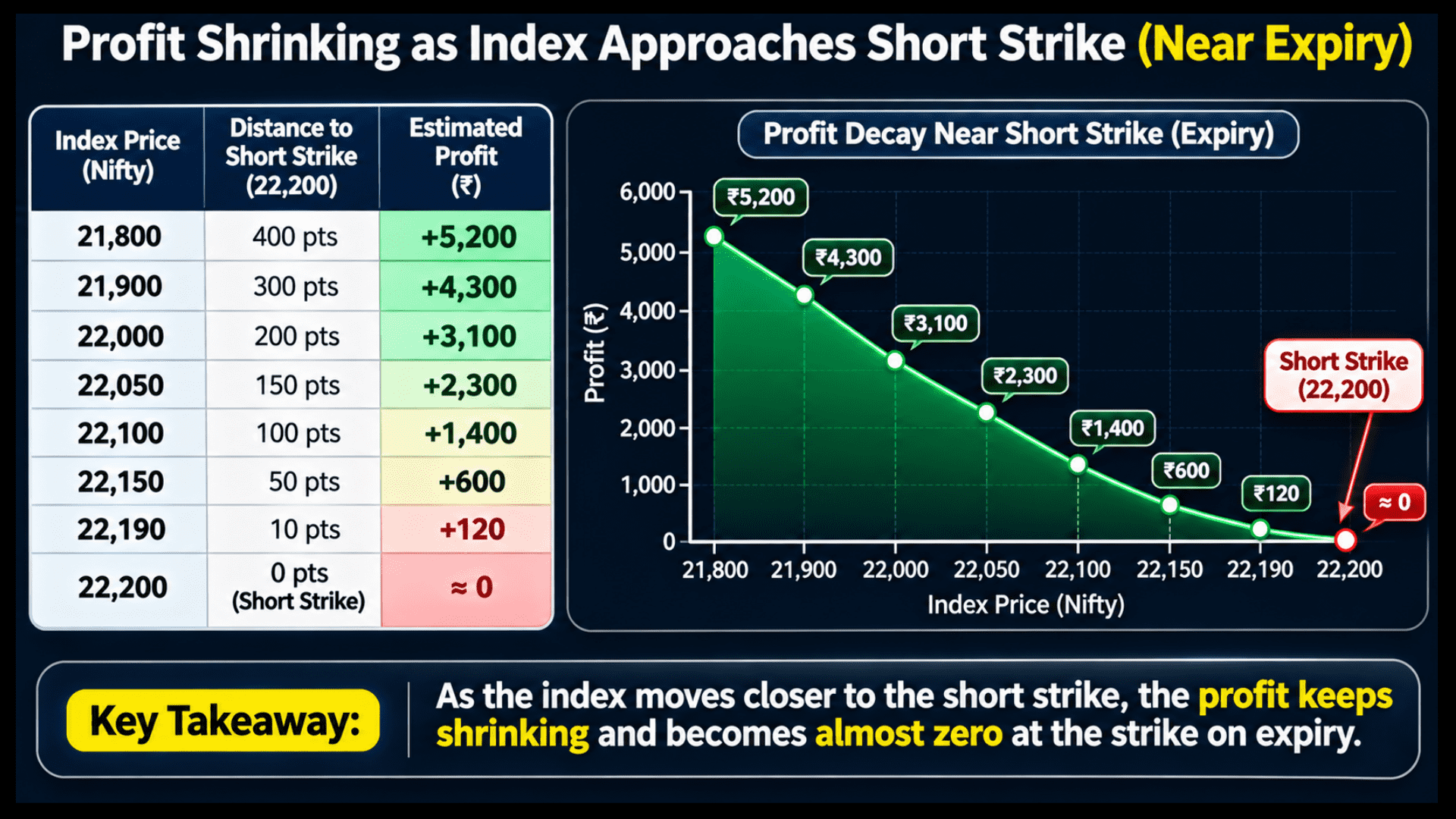
Time passing helps the seller, because option premiums shrink as expiry nears. Likewise, a fall in volatility also helps, since the options you sold lose value.
However, a sudden jump in volatility hurts. That is why traders watch how vega works before putting on any selling strategy.
How to Read the Iron Condor Expiry Payoff Table?
Now, let us see what each leg is worth on expiry day. At that point, only intrinsic value matters, so the maths stays simple.
At expiry, only intrinsic value matters. Each leg is worth the amount it is in the money, or zero.
The formula, per unit, is below.
Payoff = max(0, 21,300 – S) – max(0, 21,500 – S) – max(0, S – 22,500) + max(0, S – 22,700) + 99.5.
Here S is the index level at expiry, and costs and taxes are ignored.
You can revisit intrinsic value at expiry if this formula looks heavy. After all, it only asks how far each option is in the money.
The table below shows the result at different index levels.
| Index at expiry (S) | Profit/loss per unit (points) | Profit/loss per lot (₹) |
|---|---|---|
| 21,000 | -100.5 | -5,025.0 |
| 21,300 | -100.5 | -5,025.0 |
| 21,350 | -50.5 | -2,525.0 |
| 21,400.5 | 0.0 | 0.0 |
| 21,450 | 49.5 | 2,475.0 |
| 21,500 | 99.5 | 4,975.0 |
| 22,000 | 99.5 | 4,975.0 |
| 22,500 | 99.5 | 4,975.0 |
| 22,550 | 49.5 | 2,475.0 |
| 22,599.5 | 0.0 | 0.0 |
| 22,650 | -50.5 | -2,525.0 |
| 22,700 | -100.5 | -5,025.0 |
| 23,000 | -100.5 | -5,025.0 |
Notice the shape. Profit is flat inside the body and slopes down between the short and long strikes. Beyond the wings, it stays flat at the maximum loss.
Iron Condor Max Profit, Max Loss and Breakeven Formulas
These numbers define the whole trade. So, learn them before you place a single order.
- Max profit = net credit. Here: 99.5 points, or ₹4,975 per lot.
- Max loss = wing width – net credit. Here: 200 – 99.5 = 100.5 points, or ₹5,025 per lot.
- Lower breakeven = short put strike – net credit = 21,500 – 99.5 = 21,400.5.
- Upper breakeven = short call strike + net credit = 22,500 + 99.5 = 22,599.5.
The wing width is the gap between the short and long strike on one side. Both sides are 200 points here.
Notice that the maximum loss is slightly bigger than the maximum profit. Your reward is not larger than your risk.
So, you need the range to hold often enough to make up for the occasional full loss.
Besides, only one side can lose at expiry, because the index cannot finish above and below at once. That is why the max loss uses one wing, not two.
Narrow vs. Wide Iron Condor Wings: Which Is Better?
Wing width is a choice, and every choice has a price. Here is how it changes your credit and your loss.
We kept the short strikes at 21,500 and 22,500 and changed only the wings. The model and assumptions stay the same as above.
With 100-point wings, the net credit is 53.3 points. Max profit is ₹2,665 and max loss is ₹2,335 per lot.
With 200-point wings, the credit is 99.5 points, with ₹4,975 profit and ₹5,025 loss. With 300-point wings, the credit is 139.1 points, with ₹6,955 profit and ₹8,045 loss.
In short, wider wings collect more credit but expose you to a bigger loss. Narrow wings cut the loss but also cut the credit, and costs eat a larger share of it.
Iron Condor Margin and Costs: What to Expect
A credit received is not free money. Margin gets blocked, and four legs add costs.
Because you sell two options, the position needs margin. The exact amount depends on broker and exchange rules, which change, so verify before trading.
Since the wings cap the loss, margin is usually lower than for a naked short strangle. Still, it is real money that stays blocked until you exit or the options expire.
To see how it is worked out, read how option trading margin is calculated before you size a trade.
Moreover, four legs mean four orders. Brokerage, exchange charges, taxes and slippage apply to each leg.
Together, they can take a big bite out of a small credit. Check your own contract note to see the real cost of one full round trip.
What Can Go Wrong When Trading Iron Condors?
Limited loss does not mean small loss. Here are the risks that beginners usually miss.
The loss is limited, but it is not small. In our example, one full loss wipes out the credit from about one full win.
A sharp move also hurts faster than many expect. Near expiry, the short options react quickly, which is the gamma risk for option sellers in action.
Other Iron Condor Risks to Keep in Mind
These risks are easy to miss on a calm day. They show up exactly when the market gets noisy.
- Gap risk: an overnight event can push the index through a short strike before you can act.
- Volatility spike: premiums of the short options can jump even before the index moves much.
- Assignment and settlement: rules differ by contract type, so verify them for your product.
- Execution risk: four legs may not fill at the prices you expected.
Overall, selling legs carry margin and larger risk than buying options. Beginners should treat this as an advanced setup.
How to Exit or Adjust an Iron Condor Strategy?
Exit rules matter as much as entry. Therefore, decide them before you place the trade.
You do not have to hold an iron condor until expiry. Many traders set rules in advance, such as closing the trade after keeping part of the credit.
Another common idea is a loss limit. For example, you might exit if the loss reaches a fixed fraction of the maximum loss. The numbers here are your choice, not a rule.
However, adjustments, such as rolling one side to new strikes, add cost and complexity. They can also turn a planned small loss into a bigger one.
Whatever you choose, write the rules before entry. Then test them by backtesting options strategies on past data instead of trusting a few lucky trades.
A mentor review of your trades can also show you where you break your own rules.
Common Iron Condor Mistakes to Avoid
Most mistakes come from treating the trade as easy income. Watch for these six.
- Choosing strikes only because the premium looks attractive.
- Selling just before a major event, when volatility can jump.
- Ignoring the cost of four legs.
- Trading too many lots because the loss is “limited”.
- Closing the winning side early and leaving the losing side open.
- Having no exit plan before entry.
When the Iron Condor Strategy Fails
Every strategy has a weak spot. Here is where this one breaks.
The iron condor fails in trending or event-driven markets. If the index runs past a short strike and keeps going, you move toward maximum loss.
It also struggles when volatility rises after entry, even if the index stays inside the range. In that case, the mark-to-market loss can force you out early.
A series of small wins followed by one big loss is the classic pattern. This is why position size matters more than the strategy name.
Iron Condor vs Long Strangle vs Butterfly Spread: Quick Comparison
The iron condor is close to a few other setups. The table gives a quick, general comparison for the same neutral view.
| Feature | Iron condor | Long strangle | Butterfly spread |
|---|---|---|---|
| Legs | 4 (two credit spreads) | 2 (buy call and put) | 3 or 4 strikes |
| Net position | Credit | Debit | Usually debit |
| Best view | Range-bound | Big move | Pin near one strike |
| Max loss | Limited | Premium paid | Limited |
| Profit zone | Wide range | Beyond two breakevens | Narrow zone |
In short, a Butterfly Spread gives a narrower profit zone but a different risk balance.
Compare the rows above to see which trade-off fits your view.
How to Practise the Iron Condor Strategy Before Real Money
Do not start with real capital. Instead, follow this simple practice routine.
Practise with virtual money and track every leg, fill and exit. Write down your strikes, wing width, credit, maximum loss and exit rules before each trade.
Then compare your plan with what actually happened. Only after many practice trades should you think about real money.
Even then, use a size you can afford to lose.
Four legs, two spreads, and your hand still freezes before the first sell order?
Reading about payoff won’t fix that; practice on a live option chain and a mentor’s answers will. Join our live classes from your mobile, ask your doubts and learn the iron condor step by step.
Conclusion
In short, an iron condor sells a call spread and a put spread. It earns a limited credit in a range-bound market, and the wings cap the loss.
Still, the maximum loss is slightly bigger than the maximum profit. However, a volatility spike, an overnight gap or four-leg costs can quickly turn a quiet trade into a loss.
Finally, practise virtually first, and remember that this is learning, not a buy or sell call.
Disclaimer: This page is for education only and is not investment advice. All prices, strikes, premiums and lot sizes are hypothetical.
Option selling carries risk of loss, so verify lot sizes, margins and rules with your broker and the exchange. There is no profit guarantee.
Frequently Asked Questions
Before investing capital, invest your time in learning Stock Market.
Fill in the basic details below and a callback will be arranged for more information: