



Many homemakers ask, “Can a housewife invest in share market, or is it only for people with a salary?”
The honest answer is yes. If you are an adult Indian resident with a PAN card and valid KYC, you can open your own account and invest from home.
Can a Housewife Invest in Share Market Without a Salary?
Yes. The share market has no separate rulebook for women or homemakers.
The rules depend on you as an investor, not on whether you earn a salary.
Homemaker investing simply means putting your own savings to work in your own name.
What Does a Housewife Need to Open a Demat Account?
A demat account for housewife is the same account everyone else opens. It holds your shares in electronic form.
You also need a linked bank account to put money in and take money out.
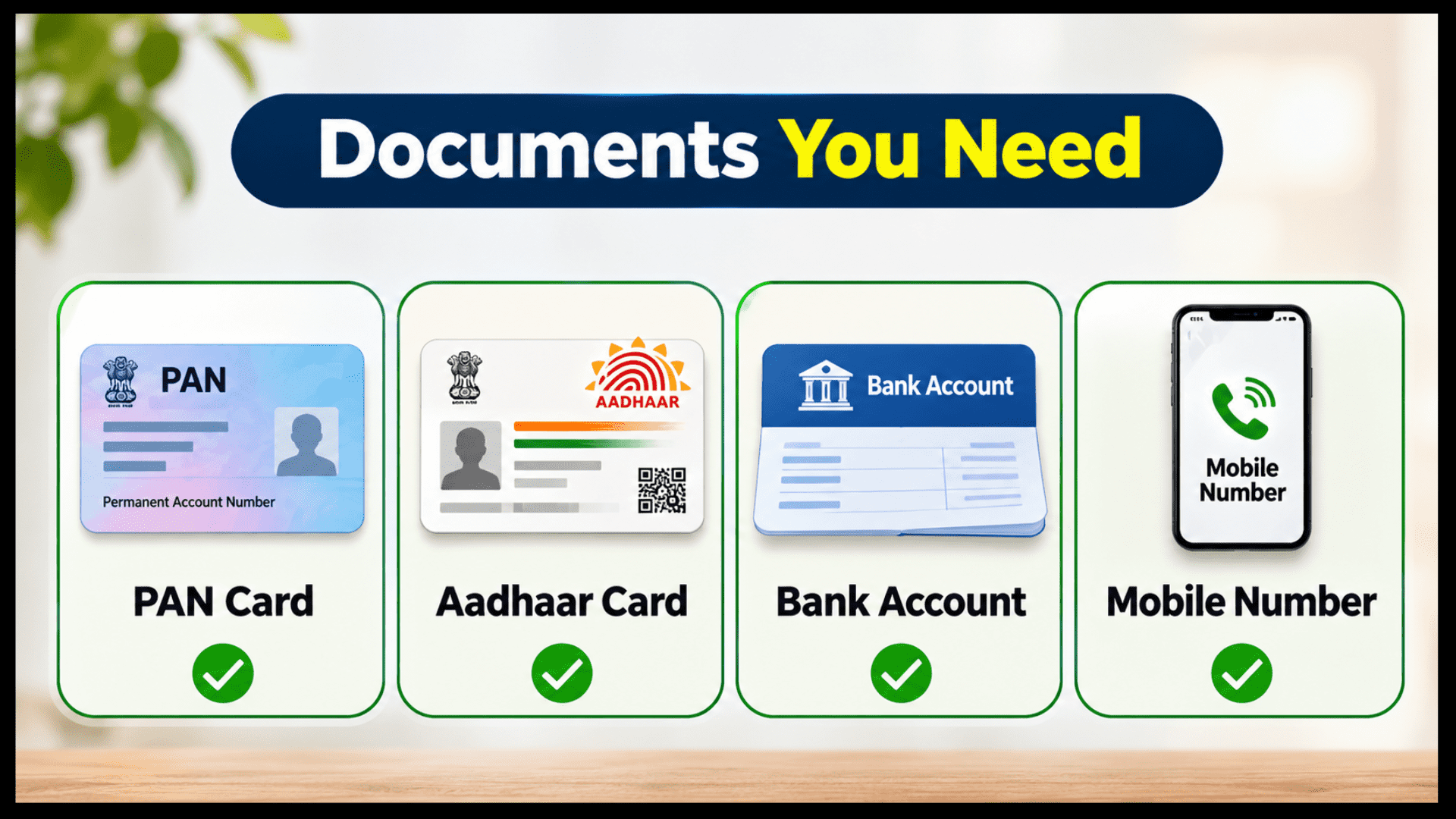
Here is a quick checklist of what is generally required, although you should confirm the exact list with your chosen broker.
| What You Need | Why It Is Needed |
|---|---|
| PAN card in your name | Identity and tax record for every market transaction |
| Aadhaar and address proof | KYC verification |
| Bank account in your own name | To move money in and out |
| Mobile number and email | OTPs, statements and alerts |
| Photo and signature | Account opening forms |
Account charges differ from one provider to another, so it helps to understand how zero brokerage demat account charges actually work before you pick one.
Always check the latest charges on the broker’s official website.
Do You Need Income Proof to Open a Demat Account?
In general, a basic demat and trading account for investing in shares does not need salary proof.
However, rules can change, so verify the requirements with your broker and on the official SEBI website.
Investing Or Trading Which Is Better for a Homemaker?
Choosing between investing and trading can be confusing, especially when you are just starting your financial journey.
Understanding the difference can help you choose an approach that fits your time, savings and comfort with risk.
Investing means buying and holding for years, so your money grows with the business and with time.
Trading means buying and selling quickly, sometimes within the same day, and it needs time, screen watching and a strong stomach for losses.
For most beginners, especially those managing a home full-time, investing is the gentler first step.
If you want to see the difference clearly, an explainer on intraday vs delivery trading shows how the two styles work in real life.
So, can a housewife do trading? Yes, there is no rule against it. But trading is a skill, and it should come only after you have learnt the basics and practised without risking real money.
Which Investment Is Best for a Housewife: Mutual Funds or Direct Shares?
There is no single best investment for everyone. It depends on your comfort, your time and how much risk you can take.
Here is a simple comparison of two common starting points.
| Point | Mutual Funds | Direct Shares |
|---|---|---|
| Who picks the shares | A professional fund manager | You do |
| Time needed | Low | Medium to high |
| Starting amount | Can be very small, monthly | Depends on the share price |
| Risk | Spread across many companies | More concentrated |
| Best for | First-time investors | Those who have learnt basic analysis |
A lot of beginners start with mutual funds through a small monthly amount. Once they understand how markets move, they add a few direct shares slowly.

If you are curious about which style fits you, read about the types of investors in the stock market and see where you fall.
Can a Housewife Trade Using Her Husband’s Demat Account?
Using a husband’s account may look easy, but it creates real problems.
The account belongs to him, so profits, losses, tax records and legal ownership all sit in his name.
Here is why your own account is the better choice:
- Your own identity: Every trade and holding stays clearly yours.
- Clear records: Tax filing and clubbing questions become easier to answer.
- Financial independence: You build your own market experience and confidence.
Most brokers only allow an account holder to trade in their own account.
So placing trades for someone else, even a spouse, can create compliance issues. Check your broker’s rules before doing anything of the sort.
If you want to invest together as a family, opening separate accounts or a joint account as per the broker’s rules is a cleaner way to go.
How to Avoid Clubbing of Income Between Husband and Wife?
Clubbing means that income earned from certain assets can be added to another person’s income for tax purposes.
In general terms, if a husband gifts money to his wife and she invests it, the income from that money may be added back to his income.
Money that comes from her own earnings, her own savings, or gifts from relatives, such as parents, is generally treated differently.
These are only general ideas, not tax advice.
Tax rules and exceptions change from time to time, so verify with a Chartered Accountant before investing a large amount.
To understand how gains on holding shares are taxed in general, read positional trading tax in India.
Some habits that help are listed below:
- Keep the source clear: Invest from money that is clearly yours.
- Keep records: Save bank statements and contract notes in one folder.
- Use your own bank account: Do not mix household and investing money.
- Ask a CA once: One short consultation can save a lot of worry later.
How Can a Homemaker Start Investing With a Small Amount?
You do not need a big amount to begin. The value of a small, regular habit is easier to see with numbers.
Let us look at a simple example for illustration only.
Suppose you put in ₹3,000 every month for 5 years, which makes ₹1,80,000 of your own money.
| Assumed Yearly Return | Approximate Value After 5 Years |
|---|---|
| 0% (no growth at all) | ₹1,80,000 |
| 6% | ₹2,09,310 |
| 10% | ₹2,32,311 |
These rates are only assumptions to show how time works, and real returns can be lower, higher or even negative.
The first row is there to remind you that growth is never certain.
Before this, set aside an emergency fund for household needs, and invest only money you will not need soon.
If you are wondering whether you can begin with a very small amount, read can I start trading with 100 rupees.
Can a Housewife Make ₹1,000 Per Day From Trading?
Please be careful with this promise, because no one can honestly guarantee a fixed daily income from the market.
Some days give gains and some give losses.
For illustration only, to make ₹1,000 on a day when the price moves 1%, you would need about ₹1,00,000 deployed.
On a bad day with a 1% move against you, the same position would lose ₹1,000.
Chasing a daily target is a common trap. You can understand the risks by exploring how to start intraday trading with 1000 rupees.
A better goal for a homemaker is steady learning and slow, regular investing, not a daily paycheque.
How Can a Housewife Invest Safely in the Share Market?
Risk capital means money that will not affect your home budget, your children’s fees or your emergency needs if it goes down.
Only this money should enter the market.
Please stay away from anyone who promises assured returns or sends “sure shot” tips through messages and groups.
Genuine investing does not come with guarantees. If you are also considering short-term trading, is it safe to do intraday trading gives a balanced view for beginners.
Use only SEBI-registered intermediaries, and check their registration on the official SEBI website.
What Is a Simple Weekly Investment Routine for Homemakers?
Investing from home works best when it takes little time and fits around your day.
A short routine is better than random checking.
Here is a routine many beginners find easy to follow:
- Once a month: Invest your fixed amount on a set date.
- Once a week: Spend 20 to 30 minutes reading about one basic concept.
- Once a quarter: Review your holdings and your goals calmly.
Are you a homemaker who wants to understand charts and the market before putting real money in?
The live classes run for 1 to 1.5 hours, and you learn on real charts, ask doubts and get personalised mentorship. There is no fixed batch, so you can learn at your own pace, and there is no profit guarantee, only honest learning.
Conclusion
Yes, a housewife can invest in the share market with her own PAN, KYC and demat account, and with a plan that fits her home and her comfort.
Start small, use only risk capital, avoid tips, and keep your records clean.
Your skills as a household manager are real strengths here, so go slowly, learn well and invest with confidence.
Disclaimer: This blog is for educational purposes only and is not investment or tax advice. Please verify all rules on official NSE, BSE and SEBI websites and consult a qualified professional before investing.
Frequently Asked Questions
Before investing capital, invest your time in learning Stock Market.
Fill in the basic details below and a callback will be arranged for more information: