



Most positional trading guides skip tax completely.
That is a mistake. Understanding positional trading tax in india changes your real take-home return more than most people expect.
Positional trading tax in India is not complicated once you know which bucket your trade falls into.
This guide walks through the actual rules.
This is general information, not personal tax advice. Confirm your specific situation with a chartered accountant before filing.
How to Categorize Your Positional Trade for Tax Purposes?
The answer depends entirely on how you traded, not on how long you personally planned to hold.
If you bought equity shares for delivery and held them in your demat account, capital gains rules apply.
If you traded futures or options to express your positional view, business income rules apply instead.
These are two very different systems.
If you are still new to the style itself, our guide on ” what is positional trading” is worth reading first.
Delivery-Based Positional Trading Tax: Short-Term vs. Long-Term Rules
This is the more common route for most positional traders. It is the simplest way to hold a position for weeks or months.
Your tax rate here depends on one thing: how long you held the shares.
The next two sections break down both sides of that 12 month line.
1. Short-Term Delivery Tax You Pay When Selling Within 12 Months
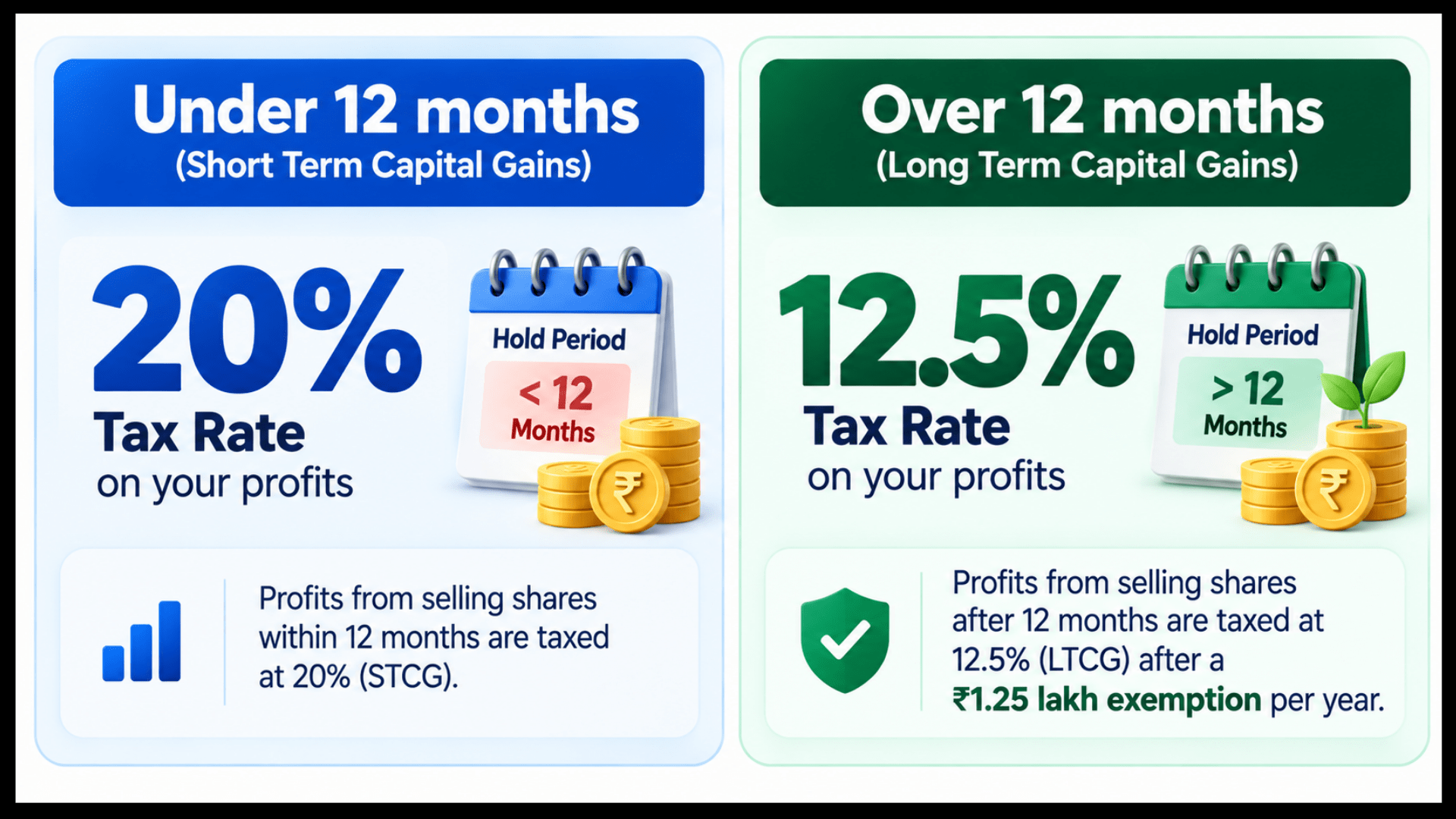
Gains on listed equity shares held for less than 12 months are short-term capital gains, taxed at a flat 20 percent.
This rate has applied since 23 July 2024.
Most positional trades close within a few months, so they usually fall under the 20 percent short-term rate.
When you exit often comes down to your signals, such as the momentum readings used in positional trading with MACD.
2. Holding Past 12 Months: Understanding Long-Term Delivery Tax
Gains on shares held for more than 12 months are long-term capital gains, taxed at 12.5 percent.
The first ₹1.25 lakh of long-term gains in a financial year is exempt.
A trend that keeps running past the one-year mark can shift into the lower long-term rate instead.
This is one more reason a proper stock screen matters.
Our guide on how to select stocks for positional trading helps you find trends strong enough to potentially run that long.
Calculating Your Returns: A Practical Positional Trade Example
These figures are illustrative and are not a recommendation.
You buy shares worth ₹2,00,000 and sell them four months later for ₹2,50,000.
That is a gain of ₹50,000, held for less than 12 months.
Since this falls under short-term capital gains, you owe 20 percent tax on the full gain.
That works out to ₹10,000, before cess.
If the same trade had instead run for fourteen months, it would qualify as long-term.
With no other long-term gains that year, the entire ₹50,000 would sit under the ₹1.25 lakh exemption, and you would owe nothing on it.
Why Does the Taxman Treat F&O Positional Trades as Business Income?
If you trade F&O to express a positional view, something we cover in our positional trading strategy guide, the tax treatment changes completely.
F&O income is treated as non-speculative business income, not capital gains.
Profits get added to your total income and taxed at your regular income tax slab rate, not at a flat capital gains rate.
Losses from F&O can be set off against other business income, and carried forward for up to eight years if not fully used.
Two numbers decide how closely your F&O activity gets checked: your turnover and your profit margin.
Keeping a close eye on these metrics forms a core pillar of positional trading risk management, helping you avoid unexpected tax audits and capital drawdowns.
Here is how each one works:
1. The Core Rule: Absolute Profit Method
Turnover for F&O trading is not your total contract value.
It is calculated using the absolute profit method, adding up every profit and every loss without netting them against each other.
A trader with ₹8 lakh in winning trades and ₹6 lakh in losing trades has a turnover of ₹14 lakh.
The net profit is only ₹2 lakh. This turnover figure decides whether a tax audit applies.
2. The ₹10 Crore Rule: Turnover Limits for Digital Traders
A tax audit becomes mandatory once turnover crosses ₹10 crore, provided most transactions are digital.
Below that, an audit may still apply if turnover is under ₹2 crore and your profit comes in under 6 percent of turnover.
That can trigger audit rules under the presumptive taxation scheme.
Most retail positional traders sit well below these thresholds.
Still, tracking your turnover through the year avoids a surprise close to filing season.
Traders weighing F&O against a faster style should also read our comparison of positional trading vs day trading.
Intraday and F&O positional trades sit in different tax categories entirely.
Which ITR Form Do Positional Traders Actually Need to File?
If you only traded delivery-based equity, capital gains are reported under Schedule CG, typically on ITR-2.
If you traded F&O at all, even alongside delivery trades, you generally need ITR-3, since F&O income falls under business income.
Filing the wrong form is one of the more common, avoidable mistakes among active traders.
If you log trades using tools covered in positional trading with AI, keep that trade record ready at filing time.
When to Exit a Trade: Should Tax Impact Your Decision?
Not the strategy itself, but it can shape your exit timing.
A trend close to crossing the 12-month mark, and still looking strong, is worth weighing against the tax difference.
That means comparing selling now versus selling a few weeks later.
This is also why the comparison in positional trading vs long term investing is worth reading.
The tax gap between the two styles is real, and it compounds over many trades a year.
Want to Learn the Trading Side With the Same Discipline?
Knowing the tax rules is one piece. Trading with a clear, disciplined process is the other.
Our best positional trading classes online teach exactly that, live, on real Indian stocks.
Conclusion
Positional trading tax in India comes down to one question: how did you trade?
Delivery-based equity falls under capital gains, with a 20 percent short-term rate and a 12.5 percent long-term rate above the ₹1.25 lakh exemption.
F&O positions are taxed as business income at your slab rate, with turnover deciding audit rules.
When retail participants evaluate how to grow their wealth over longer horizons, exploring the broader trade-offs covered in positional trading vs mutual fund investment can help clarify whether direct trading or collective schemes suit your financial goals.
File ITR-2 for delivery gains only and ITR-3 once F&O enters the picture.
Track holding periods and turnover through the year, and confirm anything unclear with a chartered accountant before you file.
Frequently Asked Questions
Before investing capital, invest your time in learning Stock Market.
Fill in the basic details below and a callback will be arranged for more information: