


If you have ever wondered about the option gamma meaning, you are looking at the option Greek that tends to confuse beginners the most—and catch traders off guard right before expiry.
Options gamma explained comes down to this. Gamma measures how fast delta itself changes.
If delta tells you how much an option moves, gamma tells you how quickly that sensitivity is shifting underneath you.
What is Option Gamma?
Gamma tells you how fast an option’s delta changes when the stock price moves by ₹1.
Delta shows how much the option price moves. Gamma shows how much delta itself moves.
To build a solid foundation before diving into advanced sensitivities, our guide on options greeks explained for beginners provides a comprehensive breakdown of how all these metrics interact.
Take an option with a delta of 0.50 and a gamma of 0.05.
To understand how other market sensitivities impact your positions, our guide on vega meaning in options trading examines how volatility expectations influence option pricing alongside delta and gamma.
If the stock rises by ₹1, the delta doesn’t stay at 0.50. It moves to roughly 0.55.
That might sound small. Over a big move, or close to expiry, it compounds fast.
Why Does Gamma Spike Near Options Expiry?
Gamma is highest for at-the-money options, and it grows sharply as expiry approaches.
Traders often call the final week before expiry “gamma week” for exactly this reason.
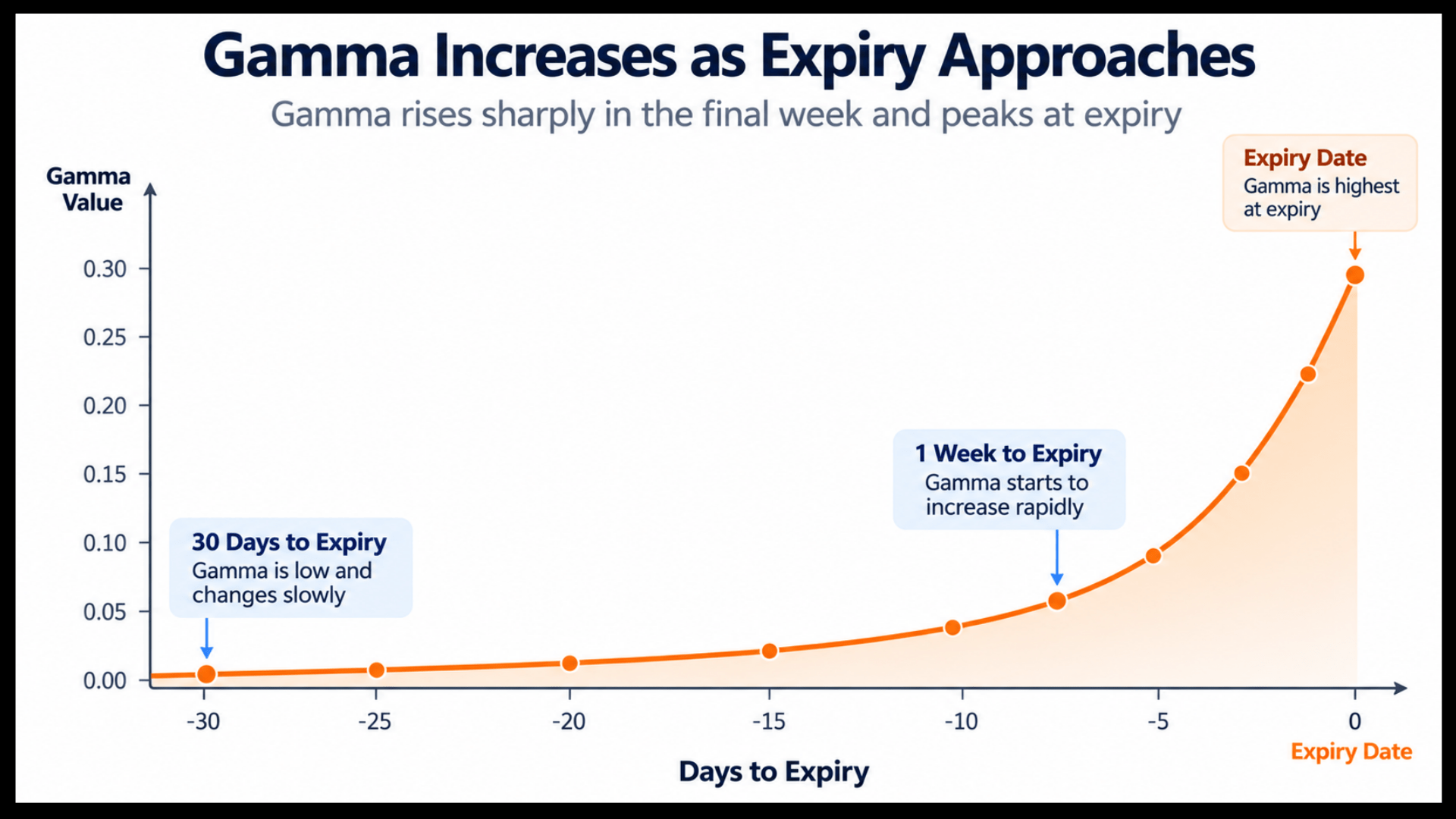
During this period, delta can swing wildly on even a modest stock move. An option that barely moved yesterday can suddenly behave like it has double the delta today.
This is a big part of why expiry day trading, something we cover in our guide on how to trade on expiry day, feels so different from trading earlier in the week.
Long Gamma vs Short Gamma: Who Wins, Buyers or Sellers?
Option buyers are generally long gamma. As the stock moves in their favour, delta increases in their favour too, which accelerates gains.
To understand how to leverage this sensitivity effectively before entering a trade, our guide on how to use delta for option buying breaks down the practical setups you need to watch.
Option sellers are generally short gamma. As the stock moves against them, delta works against them faster.
To learn how to manage these risks and maintain stable margins, our guide on how to use gamma for option selling provides practical frameworks for risk control.
That is exactly why option selling near expiry carries real, growing risk.
This asymmetry is one reason experienced sellers reduce size or exit positions as gamma risk builds.
Our post on how to use gamma for option selling covers that side of the decision in detail.
Gamma in Action: A Simple Call Option Example
Suppose you are holding a call option with a delta of 0.45 and a gamma of 0.08, three days before expiry.
The stock rises by ₹5. Your delta moves to roughly 0.85 after accounting for gamma across that move, far more sensitive than it was that morning.
A trader unaware of gamma might be surprised by how much the option’s price accelerated. A trader who understands gamma expects exactly this.
The Hidden Danger of Gamma: Why Options Risk Changes Fast?
Gamma is the reason “it was fine yesterday” is not a safe assumption in options trading.
A position’s risk profile can change meaningfully overnight, even without a large stock move, simply because gamma has grown as expiry approaches.
This matters most for anyone running strategies with multiple legs, where gamma on one leg can offset or compound gamma on another.
Traders who manage this actively are sometimes said to trade gamma itself, a technique known as gamma scalping.
ATM vs OTM: Which Strike Carries More Gamma?
Suppose you’re choosing between two call options on the same stock, both expiring in one week.
The first is at-the-money, with a delta of 0.50 and a gamma of 0.09. The second is deep out-of-the-money, with a delta of 0.12 and a gamma of 0.02.
A ₹20 move in the stock changes the at-the-money option’s delta far more than it changes the out-of-the-money option’s delta.
The at-the-money option is far more reactive, in both directions, because its gamma is so much higher.
Which strike suits you depends on your own answer to what the purpose of option trading is in your plan.
Does Gamma Hit Nifty and Bank Nifty Options the Same Way?
Gamma behaves the same way on index options like Nifty or Bank Nifty as it does on individual stocks. What changes is the scale and speed.
Index weekly expiries see extremely high trading volume in the final sessions, partly because gamma is pulling so many positions into rapid, visible repricing.
This is part of why weekly index options can feel so much more volatile in their last day or two than earlier in the week.
Sharp expiry-week losses also lead many traders to ask: can option trading loss be carried forward, a tax question worth settling early.
Under Indian tax laws, futures and options (F&O) trading is categorized as a non-speculative business income, meaning trading losses can be carried forward for up to 8 subsequent financial years to set off against future business profits, provided your income tax return is filed on time.
Want to See Gamma Behaviour on a Live Option Chain?
Gamma is easier to understand once you’ve watched it play out on a real chart, especially during expiry week.
Our best option trading classes cover exactly this, live, on real Indian stocks.
Conclusion
Gamma explains the acceleration behind delta, which is exactly why option prices can move so sharply close to expiry.
It is highest for at-the-money options and grows fastest in the final week, which helps buyers in a moving market and raises risk for sellers.
A position that looked calm yesterday can carry a very different risk profile today.
Understanding gamma won’t remove the risk. It will help you see it coming, instead of being surprised by it on expiry day.
Watch delta and gamma together before you size any trade.
Frequently Asked Questions
Before investing capital, invest your time in learning Stock Market.
Fill in the basic details below and a callback will be arranged for more information: