


Understanding the vega meaning in options trading is essential because the same option can trade at very different prices on two different days, even when the stock hasn’t moved.
Nothing about the strike or the stock price has changed. Only one thing has: the market’s expectation of future movement.
Vega meaning in options trading is simple at its core. Vega measures how much an option’s price changes when implied volatility changes by 1%.
Unlike delta and gamma, vega has nothing to do with the stock price moving. It’s entirely about expected movement.
A trade can be right on direction and still lose money if implied volatility falls after you buy.
Learning how to use delta for option buying handles the direction side, while vega handles the volatility side.
What Does Vega Measure in Options Trading?
Vega shows the rupee change in an option’s premium for every 1% move in implied volatility. The stock price stays fixed in this calculation.
Say an option has a vega of 2.
To understand how these individual sensitivities come together into a complete risk profile, our guide on options greeks explained for beginners provides a comprehensive overview of how delta, gamma, theta, and vega interact.
Implied volatility rises from 20% to 21%.
To help evaluate how these exposures translate into profit and loss over time, our guide on gamma scalping explained outlines how market-neutral portfolios capture returns from continuous price fluctuations.
The option’s price should rise by roughly ₹2. The stock itself hasn’t moved at all.
Implied volatility is the market’s expectation of future movement. Vega tells you how exposed your option is to that expectation changing.
That’s a separate question from the directional exposure covered in our post on delta meaning in options trading.
How Vega Impacts Option Premiums During Major Market Events?
Implied volatility tends to rise before scheduled events. Quarterly results, RBI policy announcements, and major elections all do this.
The market expects a bigger move than usual.
This means option premiums can rise into an event purely from vega. The stock price doesn’t need to move at all for this to happen.
What Is Volatility Crush, and Why Does It Hurt Option Buyers?
After the event passes, implied volatility often drops sharply. Traders call this volatility crush.
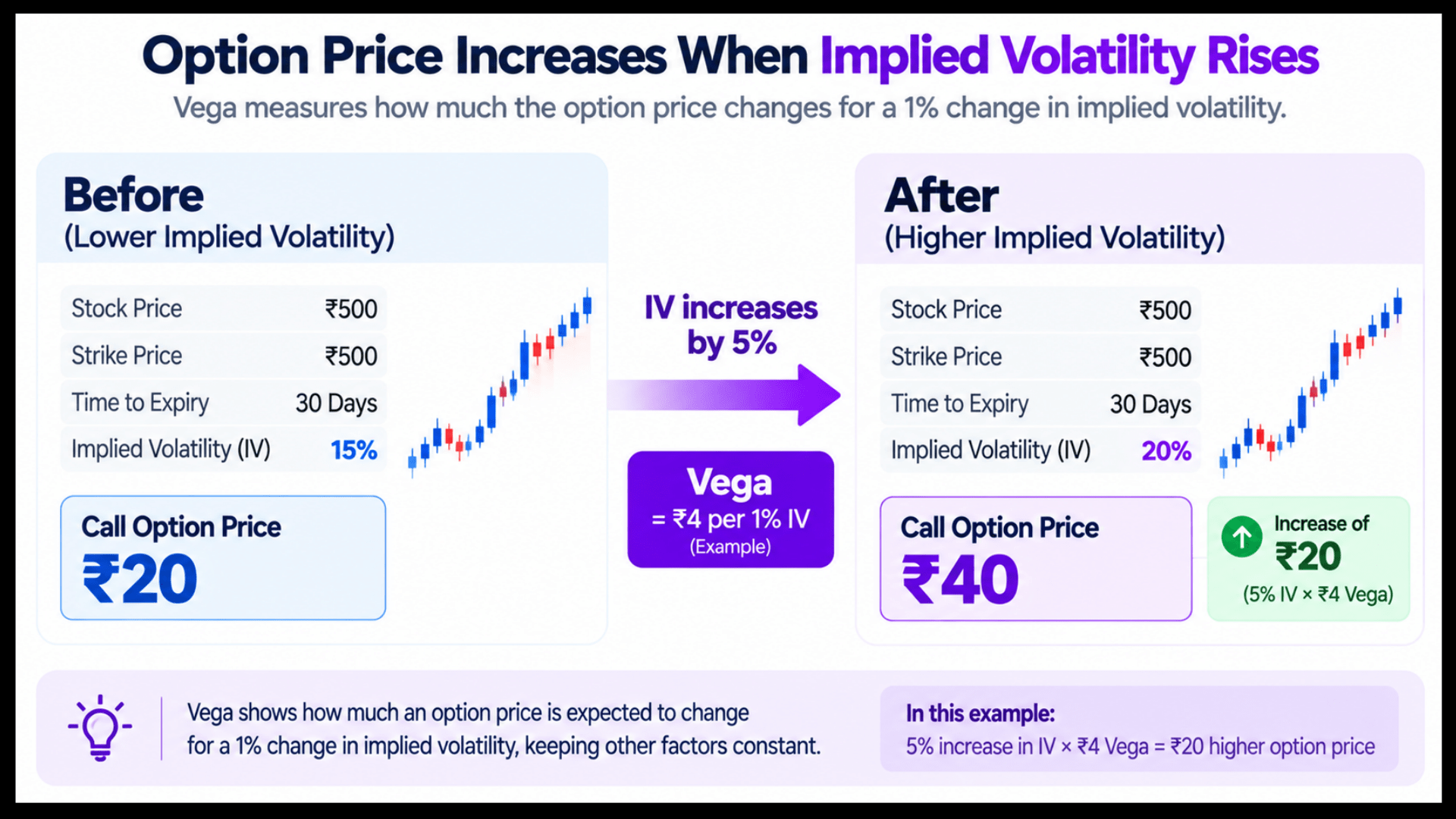
It can hurt option buyers even when they got the direction right.
Where Is Vega Highest? Strike and Expiry Rules in Options Trading
At-the-money options carry the highest vega. Deep in-the-money and deep out-of-the-money options carry less.
Longer-dated options also carry more vega than short-dated ones. There’s more time for volatility to matter over a longer period.
Strike and expiry choice affects your volatility exposure too, not just your directional view.
Our guide on how to choose strike price for options covers this decision in full.
Vega Example: Why Options Lose Value When the Stock Barely Moves?
A stock trades at ₹1,500 ahead of its quarterly results. An at-the-money call option has a vega of 3.
Implied volatility sits at 35% due to the upcoming announcement.
Results are announced. The stock barely moves.
Implied volatility collapses to 20%, a fall of 15 points. That alone can cost the option roughly ₹45 in value.
The stock itself did nothing wrong.
This is exactly the trap that catches traders who buy options purely expecting a big move around results.
Our post on quarterly results trading strategy covers this pattern in more detail.
How Is Vega Different From Gamma?
Gamma reacts to the stock price actually moving. Vega reacts to the market’s expectation of future movement changing.
The stock price doesn’t need to move for vega to matter.
To help you structure these risk parameters effectively, our guide on how to use gamma for option selling provides a detailed breakdown of how to manage changing portfolio sensitivities.
A position can be gamma-neutral and still carry significant vega risk. The reverse is true too.
Traders managing complex positions track both separately, a distinction explained fully in our post on options gamma meaning.
They represent genuinely different sources of risk.
Buying Options Before vs After an Event: How Vega Changes the Price?
Suppose two traders buy the identical option on the same stock. These figures are illustrative.
The first trader buys three days before quarterly results, paying a premium that includes a vega-driven volatility premium.
The second trader buys the same strike two days after results, once implied volatility has already collapsed.
The first trader paid more for the same directional exposure, purely because of vega.
If the stock doesn’t move sharply on results, that extra cost rarely gets recovered.
This is why some experienced traders prefer buying options after volatility crush rather than before it, when they still believe in the direction.
Vega in Options Trading: Checklist Before Trading Major Events
A few habits help you avoid the worst of volatility crush.
Navigating high-stakes announcements safely requires more than just a directional guess; it demands discipline.
Keeping a few core habits in mind helps you avoid the worst of volatility crush:
- Check current implied volatility against its recent average. Unusually high IV ahead of an event is a signal, not a coincidence.
- Ask whether your expected move is bigger than what’s already priced in. If not, you may be paying for movement that won’t materialise as profit.
- Consider waiting until after the event if your view isn’t tied to the specific announcement itself.
It also helps to step back and ask what is the purpose of option trading for you before you take an event trade.
None of this removes the risk entirely. It makes the decision a conscious one, rather than an accidental one.
Want to See Vega’s Effect Around a Real Event?
Reading about volatility crush is one thing. Watching an option’s price react to a live event is what actually makes vega click.
Our option trading classes in India cover this live, on real Indian stocks.
Conclusion
Grasping the meaning of vega in options trading helps you realize why vega is the Greek most beginners ignore, right up until an earnings season teaches them why it matters.
Once you can separate direction risk from volatility risk, a correct directional call stops being an automatic win. You start checking what you’re actually paying for.
Vega is highest in at-the-money and longer-dated options, and implied volatility tends to rise into events and drop after them.
Check IV before you buy, compare it with the move you expect, and treat every event trade as a conscious decision.
Frequently Asked Questions
Before investing capital, invest your time in learning Stock Market.
Fill in the basic details below and a callback will be arranged for more information: