

Most traders ask the same question early on: Is VWAP better than EMA? The truth is, choosing one blindly can quietly hurt your consistency.
VWAP shows where big money is active and where the price finds fair value. EMA reacts faster and helps you catch entries before the move runs away.
So the real edge is not choosing, but understanding how each behaves.
Intraday trading becomes clearer when you know what each tool is telling you. This is where most traders go wrong and miss high probability setups.
Let’s break it down simply so you can actually use it in live markets.
What Is VWAP And EMA?
Before comparing them, you need to understand how each one works. Both indicators help traders read price movement, but they work on completely different logic.
Understanding how each is calculated and how it behaves is what allows you to use them effectively in live markets.
VWAP Explained
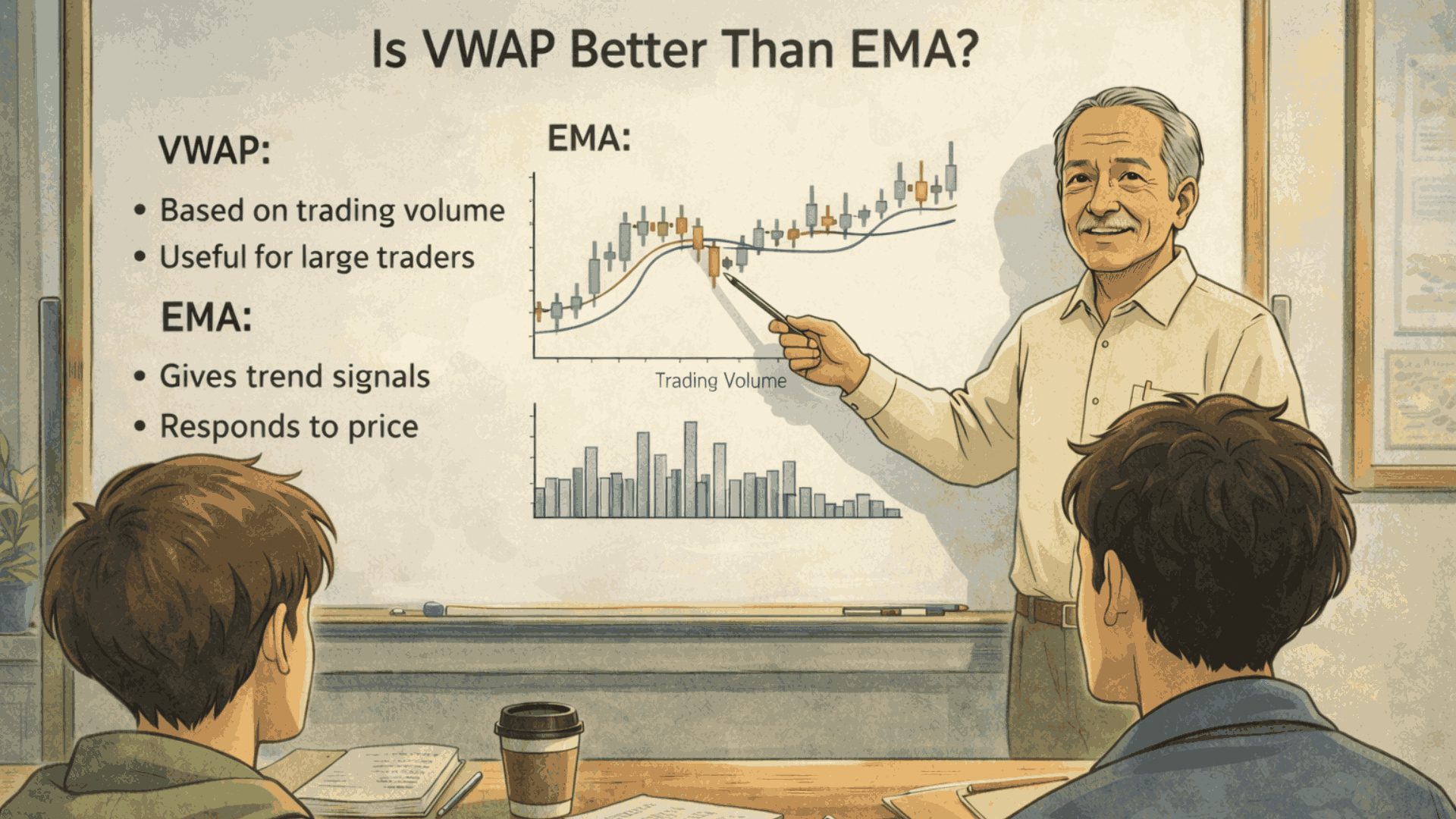
Volume Weighted Average Price is referred to as VWAP. It uses both price and volume to get the average price.
- Resets daily
- Shows fair value for intraday trading
- Used by institutions to execute large orders
Large operators, mutual funds, and FIIs need to buy or sell thousands of crores of a single stock without significantly moving the price.
They use VWAP as a benchmark, aiming to execute their full order at or near the VWAP price.
This is why VWAP often acts like a price magnet during the trading day. If the price is far below VWAP early in the day, institutional purchasers are probably still accumulating, which might cause the price to rise again.
Note: VWAP takes each trade that occurs during the day, multiplies the price by the volume at that price, adds them all together, and divides the result by the total volume.
To put it simply, the VWAP will be at ₹48,200 if most of today’s trading took place at ₹48,200 in Bank Nifty; this indicates where the majority of today’s money really changed hands.
Because of this, it refreshes daily, starting at 9:15 AM with a new computation.
EMA Explained
Exponential Moving Average is referred to as EMA. It is more sensitive than a straightforward moving average since it places greater emphasis on recent prices.
The specific moving average calculation used here reduces lag, allowing the indicator to hug the price action more closely than a simple average.
- Works across all timeframes
- Tracks trend direction
- Does not reset daily
Both of these signs are helpful. When each performs better is the true question.
Knowing their advantages and disadvantages in various market scenarios might be the difference between a profitable deal and a lost chance.
Difference Between EMA and VWAP
Let’s now discuss how VWAP and EMA vary from one another. Most of the confusion between the two starts here.
Understanding this distinction matters because it changes how you read price action and make trading decisions.
Key Differences:
|
Feature |
VWAP | EMA |
| Calculation | Price + Volume |
Price only |
|
Reset |
Daily | Continuous |
| Use Case | Intraday trading |
All timeframes |
|
Sensitivity |
Moderate | High |
| Works for Swing Trading? | No – resets daily |
Yes – continuous |
|
Volume Aware? |
Yes |
No |
VWAP has a magnet-like effect. During the day, the price frequently goes back to it. Conversely, during trends, EMA acts as a dynamic trend line that the price respects.
So when comparing VWAP and EMA, there is no better or worse, only context.
Limitations Of VWAP And EMA
EMA and VWAP are both effective methods, but neither is flawless. Knowing their limitations helps you trade more clearly and avoid being misled by false signals.
Key Limitations:
- VWAP responds slowly to abrupt movements: Sharp price surges might not show up right away since it depends on cumulative volume.
- At market open, VWAP is unreliable: VWAP is less accurate in the first ten to fifteen minutes due to insufficient data.
- VWAP has trouble in sideways markets: Confusion results from the price constantly fluctuating above and below VWAP.
- Swing trading is not a good application for VWAP: It is unable to track multi-day trends because it resets every day.
- Volume is ignored by EMA: The same appearance of price movements at low and high volume might deceive traders.
- In volatile markets, EMA provides erroneous indications: Unnecessary trades may result from frequent crossings.
- Fair value is not displayed by EMA: It does not determine if a price is high or low; it just monitors trends.
Understanding these weaknesses prevents blind reliance and makes you a more effective trader.
For trades with a greater likelihood, it also advises you to combine them with volume analysis and price movement.
VWAP Vs EMA For Intraday Trading
This is where the comparison gets genuinely useful. Is VWAP better than EMA for intraday trading? It is a question that many traders have.
The answer depends on your strategy, risk tolerance, and how you combine these tools with volume and price action.
Why VWAP Works Intraday:
- Shows institutional buying and selling zones
- Acts as intraday support and resistance
- Helps identify fair value
Why EMA Still Matters:
- Captures short-term trends quickly
- Helps in breakout and pullback trades
- Works well with fast-moving stocks
For example, a 9 EMA strategy is often used by scalpers to ride aggressive momentum without waiting for a deeper pullback to the VWAP.
Example Scenario:
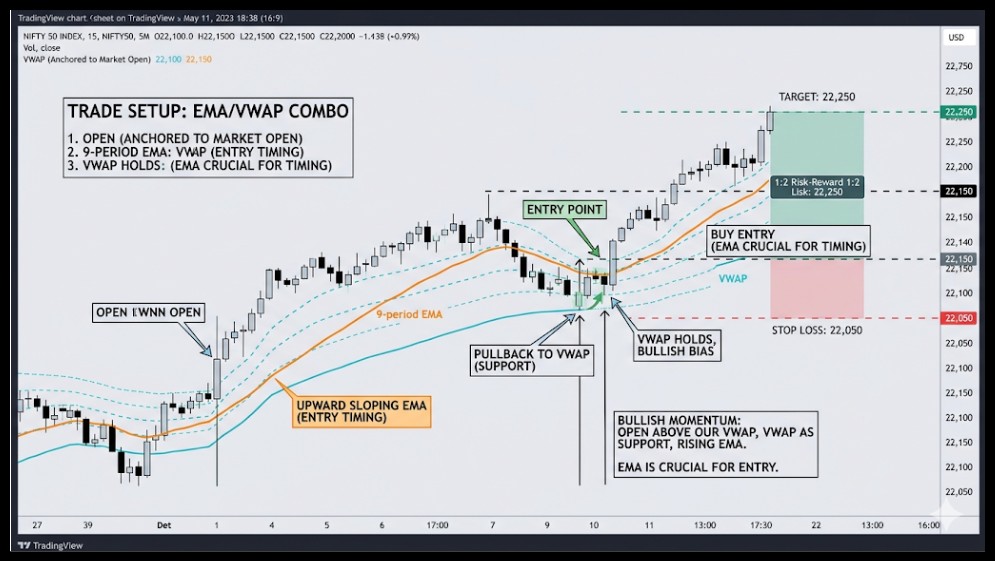
- Stock opens above VWAP
- Pulls back but holds above it
- EMA (like 9 or 20) shows an upward trend
Strong bullish momentum is indicated by this combo. Is VWAP better than? Yes, for intraday bias. EMA continues to be crucial for timing entry.
Is VWAP Better Than EMA or Not?
Traders often expect a clear winner when comparing VWAP and moving averages. However, the response is multifaceted.
Your trading style, time horizon, and whether you prefer intraday value signals or trend-following determine the answer.
VWAP Strength:
- Best for intraday context
- Reflects the real traded value
EMA Strength:
- Better for trend continuation
- Works in all market phases
There is a small paradox here. VWAP gives you clarity on where the price should be. EMA gives you timing for when to act. Most traders need both.
When you combine them, you can determine when to take action to maximize profit as well as where the price should be.
How To Use VWAP And EMA Together?
The practical portion is about to begin. Instead of choosing one over the other, experienced traders use both together.
This combination tells you both where the market finds fair value and when to enter.
Basic Setup:
- Use VWAP to define bias
- Use EMA to time entries
Simple Rules:
- Price above VWAP → look for buys
- Price below VWAP → look for sells
- Use EMA pullbacks for entry
For instance:
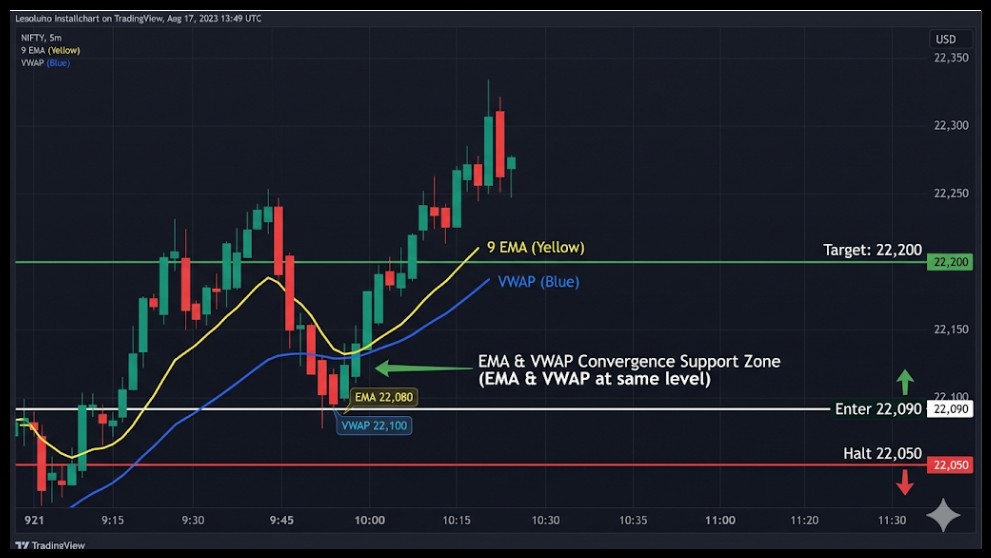
The Bank Nifty starts above VWAP at 48,100 at 9:45 AM, while the 9 EMA is trending upward at 48,080. The price returns to the 9 EMA.
In the same zone, VWAP and EMA are both providing help.
Two independent indicators corroborate the same support level, making this convergence (EMA and VWAP at the same level) a particularly high-probability entry.
Target at 48,200, halt below VWAP at 48,050, and enter at 48,090. The topic of how to successfully employ VWAP and EMA is addressed by this method.
VWAP and EMA Strategy
When applied properly, the VWAP EMA crossover approach is straightforward yet effective.
By integrating intraday value and short-term momentum signals, it assists traders in identifying high-probability entries.
Setup:
- Add VWAP and 9 EMA or 20 EMA
- Watch for price interaction
Entry Rules:
- Buy when EMA crosses above VWAP, and price holds
- Sell when the EMA crosses below the VWAP
Exit Rules: If the price falls below the VWAP on a long trade (the VWAP served as support and has now failed), you should exit the transaction.
If the price closes back above VWAP, short sellers should sell.
Avoid acting on VWAP-EMA crossovers in the last 30 minutes of the session, as VWAP becomes distorted near close due to erratic volume spikes.
Example:
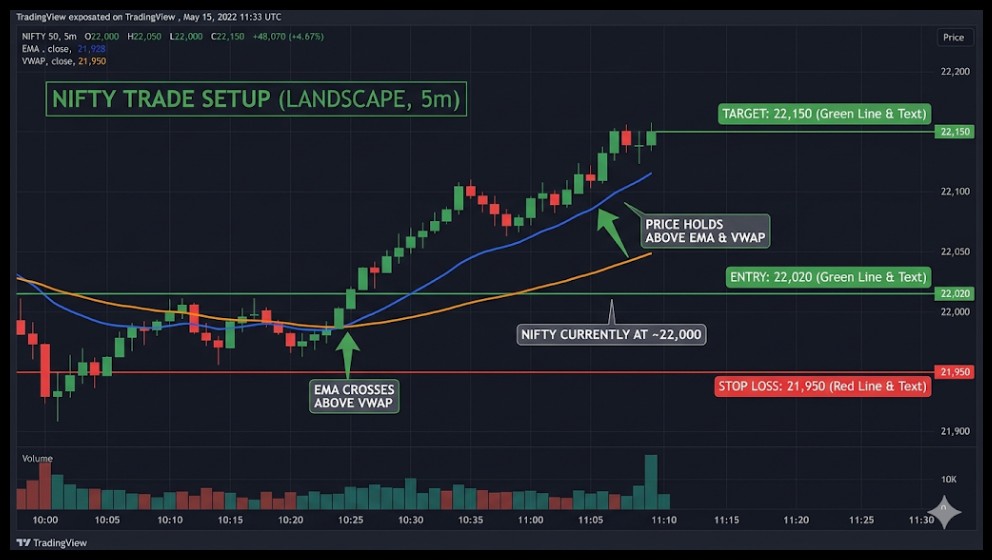
- Bank Nifty trading at 48,200
- EMA crosses above VWAP
- Price holds above both
Entry: 48,220
Stop: 48,150
Target: 48,350
During trending periods, this configuration performs well. Steer clear of sideways markets when crossovers don’t work.
Trade accuracy may be increased, and the strength of the trend can be further confirmed by combining volume analysis with the crossover.
VWAP And EMA Indicator TradingView Setup
The majority of traders blend indicators using tools such as TradingView. It’s easy to set up the VWAP and EMA indicator on TradingView.
For a quicker visual inspection, you may alter the colors and line thickness to easily distinguish between VWAP and EMA.
Setup Steps:
- Add VWAP from the indicators list
- Add EMA (9, 20, or 50 based on style)
- Adjust colors for clarity
What To Watch:
- Distance between price and VWAP
- EMA slope direction
- Volume confirmation
Generally speaking, a clear chart performs better than one that is crowded. Confusion results from too many signs.
By concentrating just on VWAP and EMA, you may swiftly identify important signals without hesitation.
Common Mistakes Traders Make
When used improperly, even powerful instruments might fail. Choosing the wrong settings or ignoring market context can turn a reliable signal into a losing trade.
Mistakes To Avoid:
- Using VWAP for swing trading
- Ignoring trend direction with EMA
- Trading every crossover blindly
- Overloading charts with indicators
- Overtrading VWAP touches
- Using VWAP for swing trades
Here is the reality. You are guided by indicators, but discipline determines the result. What sets great traders apart is their ability to consistently stick to their plan.
To avoid this, you must understand which time frame is best for VWAP. Since it is a session-specific tool, it yields the best results on shorter timeframes like 5 or 15 minutes rather than daily or weekly charts.”
Conclusion
The VWAP vs EMA debate usually misses the bigger point. The two indicators have distinct functions.
While EMA enables you to seamlessly ride trends, VWAP helps you understand where the market finds value throughout the day.
Combining them gives you the true advantage. Use EMA for execution, VWAP for guidance, and risk management for survival. This is how traders transform basic tools into reliable outcomes.
Discover which indicator fits your trading style. Join our technical analysis classes to learn how to use these tools effectively with real market examples.
FAQs
Q1: Is VWAP a Better Intraday Trading Option Than EMA?
Ans: For detecting intraday bias and fair value, VWAP works well. For timing entry inside that trend, EMA works well.
Q2: Is VWAP a Complete Replacement for EMA?
Ans: No, EMA and VWAP have separate functions. Combining the two improves accuracy and clarity.
Q3: Which VWAP EMA Combination Is the Best?
Ans: VWAP with 9 or 20 EMA is a typical configuration. It successfully strikes a balance between entry time and trend direction.
Before investing capital, invest your time in learning Stock Market.
Fill in the basic details below and a callback will be arranged for more information: