


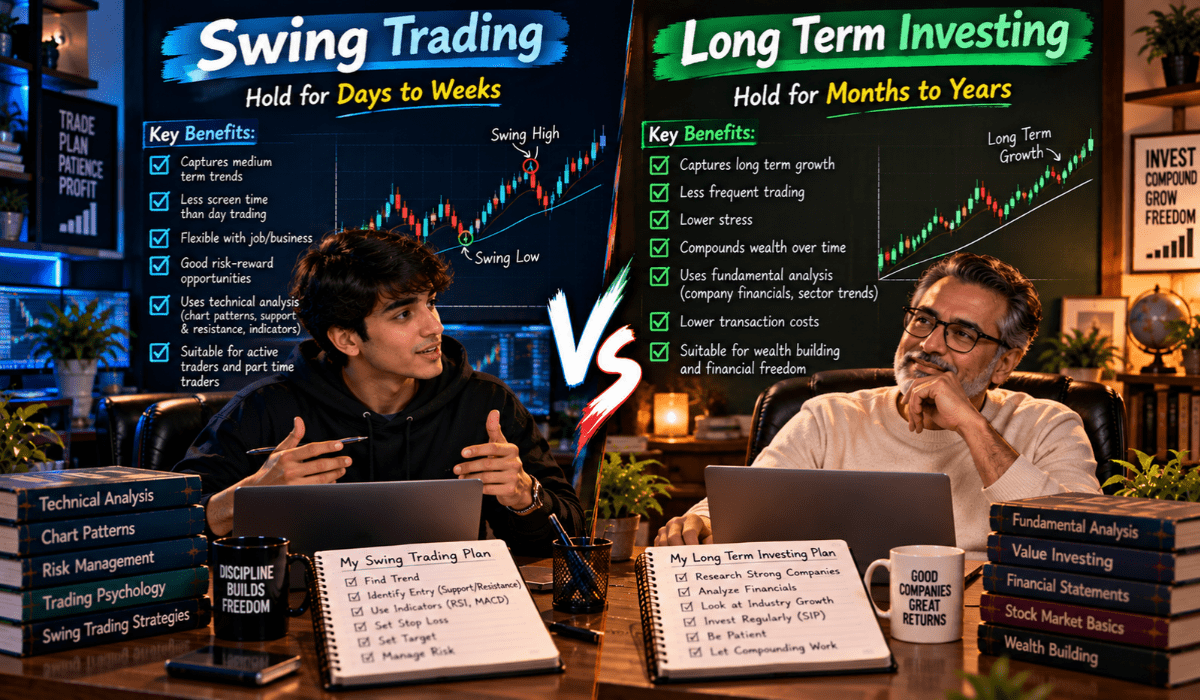
Swing trading vs long term investing is really a choice between two different relationships with the stock market.
It comes down to how actively you want to participate, or how passively you want your money to work.
The honest answer: both can build wealth, just through very different mechanisms.
Swing Trading vs Long Term Investing: Noise or Opportunity?
At the heart of this comparison is one basic disagreement: what short-term price movement actually means.
One approach treats it as noise to be ignored, while the other treats it as the very thing worth trading.
Once that difference is clear, every other distinction between the two becomes easier to understand.
Long Term Investing: Let the Business Do the Work
Long-term investing rests on a simple premise: buy quality businesses and hold them for years.
The company’s growth and compounding do the work. You largely ignore short-term price swings along the way.
Swing Trading: The Swings Are the Opportunity
Swing trading rests on the opposite premise. Short-term price swings are not noise; they are the actual opportunity.
The goal is to capture moves over days to weeks, not wait years for a growth story to play out.
Neither view is wrong. Each simply answers a different question about making money in markets.
How Much of Your Day Does Each Approach Demand?
Once you build a portfolio, long term investing needs very little ongoing time.
A periodic review, perhaps quarterly, is often enough. You simply check that each holding’s investment thesis still holds.
Swing trading needs a consistent daily or near-daily routine. You review charts, manage open positions and plan new entries.
By design, it is a far more active, hands-on relationship with the market.
This routine also marks where swing trading vs day trading differs most. Swing traders hold positions for days, while day traders close them within the session.
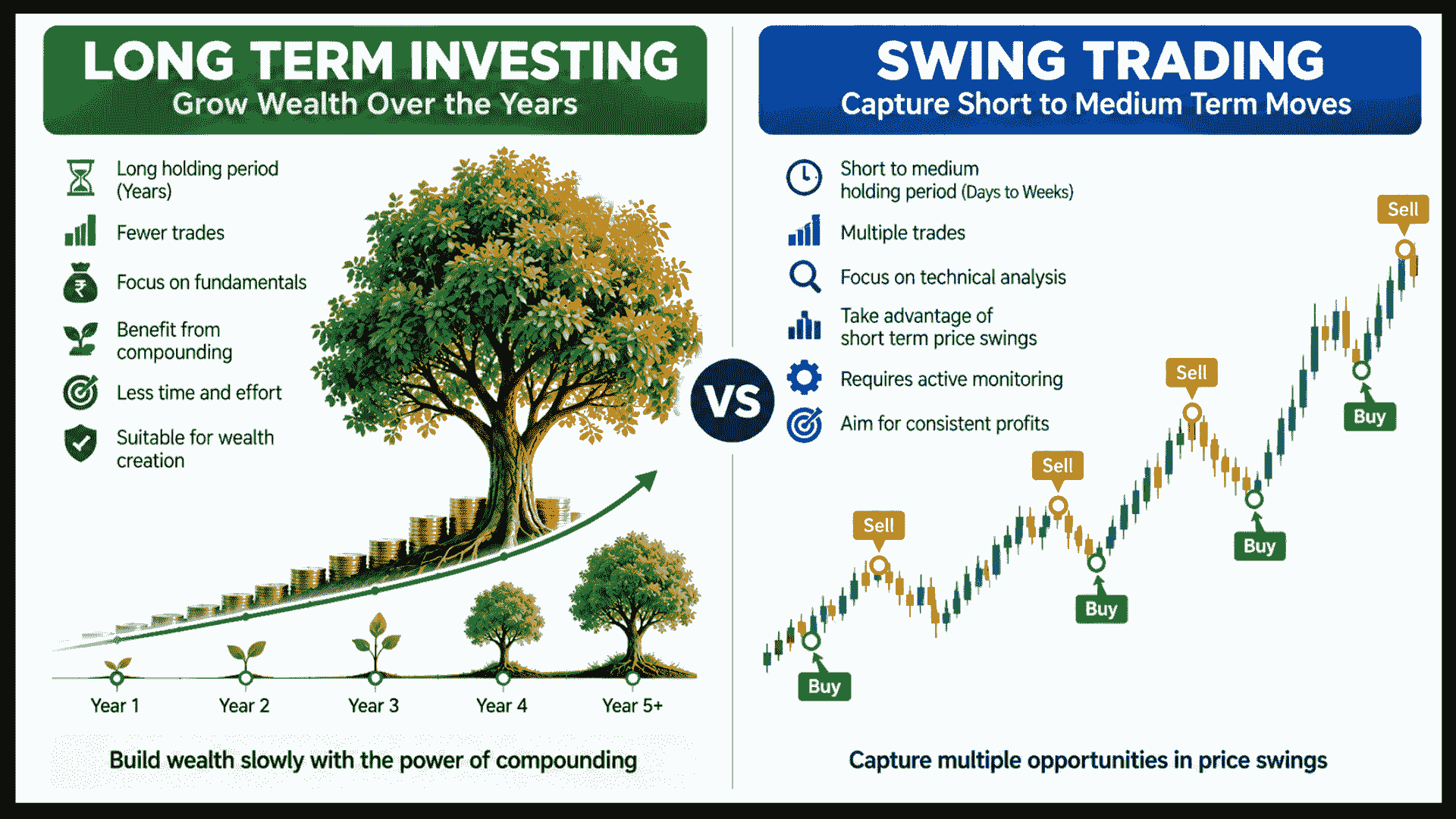
Balance Sheets or Price Charts? The Skills Each Style Needs
Long term investing leans on fundamental analysis. You read financial statements, study a business’s competitive position and judge management quality.
These skills develop over years of study, but they do not require daily chart-reading.
Swing trading leans on technical analysis. You read charts, indicators and patterns to time entries and exits.
It is a genuinely different skillset. It also takes real time and practice to develop, just a different kind.
Chart skills carry over at any pace. That is why swing trading vs positional trading comes down mostly to holding period, not skillset.
The Tax Gap You Cannot Afford to Ignore in India
This is a meaningful practical difference.
Swing traders usually exit within a year, so their gains generally count as short-term capital gains.
Equity held for over a year qualifies for long-term capital gains treatment. Current Indian tax rules tax it more favourably.
That does not automatically make long term investing “better.” The actual return you generate matters more than the tax rate.
Still, it is a real cost difference that any honest comparison should factor in.
What Returns Can You Realistically Expect?
Long Term Investing Returns
These returns generally track the broader market’s long-run growth, plus any extra return from good stock selection.
Indian equities have historically averaged low double-digit annual returns over long periods. Any single stretch of years can vary sharply.
Swing Trading Returns
Here, returns depend far more on the trader’s skill, discipline, and risk management. They vary enormously between traders.
A skilled, disciplined swing trader can meaningfully outperform a passive long-term return.
An undisciplined one can just as easily underperform or lose money. That is a far wider range of outcomes than long-term investing usually produces.
The gap widens further in a swing trading vs mutual fund investment comparison, where your own decisions replace those of a professional fund manager.
Patience or Discipline: Which Test Can You Pass?
Long term investing tests patience over a much longer horizon.
You need the discipline to hold through market corrections. You must not panic-sell a sound business during a temporary downturn.
Swing trading tests discipline on a faster, more frequent cycle.
You must follow predefined entry and exit rules on every trade. One loss or one big win should not change the next plan.
Structured swing trading classes can help you build that habit before you risk real capital.
Why Choose One When You Can Run Both?
Many people run both at once. They keep a core long-term portfolio for years, largely free from daily market noise.
Alongside it, they run a smaller, dedicated swing trading account for active, shorter-term opportunities.
Among people comfortable with both styles, this is arguably the most common approach. They do not treat the choice as either-or.
Same ₹4,00,000, Six Years, Two Very Different Journeys
The Long Term Investor’s Path
Suppose an investor puts ₹4,00,000 into a diversified equity portfolio and holds it for six years.
They add to it periodically but rarely trade. They ride out corrections with conviction in the underlying businesses.
Their outcome depends largely on how those businesses actually performed, plus whatever the broader market did.
The Swing Trader’s Path
A swing trader starts with the same ₹4,00,000 over the same six years. They might take fifty to a hundred or more trades.
Each trade is a self-contained decision with its own entry, exit and outcome.
Their final result is the sum of all those decisions. Their own skill and discipline shape it far more than any company’s long-run story.
Where Both Paths Can Lead
Both paths can end up in a similar place financially.
They simply take fundamentally different routes. One relies on patience and business conviction over years. The other relies on disciplined, repeated execution of shorter-term setups.
The Psychological Cost Most Comparisons Skip
A comparison of only time and tax misses something real.
Each approach feels psychologically different. That difference decides whether you can stick with your style long enough for it to work.
The Long Term Investor’s Struggle
Long term investing demands a specific patience: watching a position sit through a correction without acting.
Sometimes that correction hurts. You must trust the original thesis instead of reacting to short-term moves.
Some people find this genuinely hard. They check their portfolio daily and feel compelled to act on every dip.
The Swing Trader’s Struggle
Swing trading demands a different discipline: following the same predefined rules on every trade.
You must resist abandoning a losing trade’s stop loss out of hope. You must also avoid exiting a winner too early out of fear.
Some people struggle in the opposite direction. They want to constantly intervene instead of trusting the plan.
So be honest with yourself about which pattern fits you. That insight arguably helps more than comparing historical average returns.
Curious Whether Active Trading Fits Alongside Your Investments?
Swing trading does not have to replace long-term investing. It can genuinely complement it for the capital and time you want to manage actively.
Our Swing Trading Classes teach the complete approach. We design them to fit alongside your existing investments.
Conclusion: Choose the Style You Can Actually Stick With
Swing trading vs long term investing is not a contest with one winner. Long term investing rewards patience, business conviction and better tax treatment. Swing trading rewards daily discipline, sharp chart-reading and consistent execution.
Both can build wealth, but only if you stick with your style long enough. Start by honestly judging your time, temperament and the skills you are willing to build.
For many investors, the smartest answer is a core long-term portfolio with a smaller, rule-based swing trading account alongside it.
Frequently asked questions
Before investing capital, invest your time in learning Stock Market.
Fill in the basic details below and a callback will be arranged for more information: