

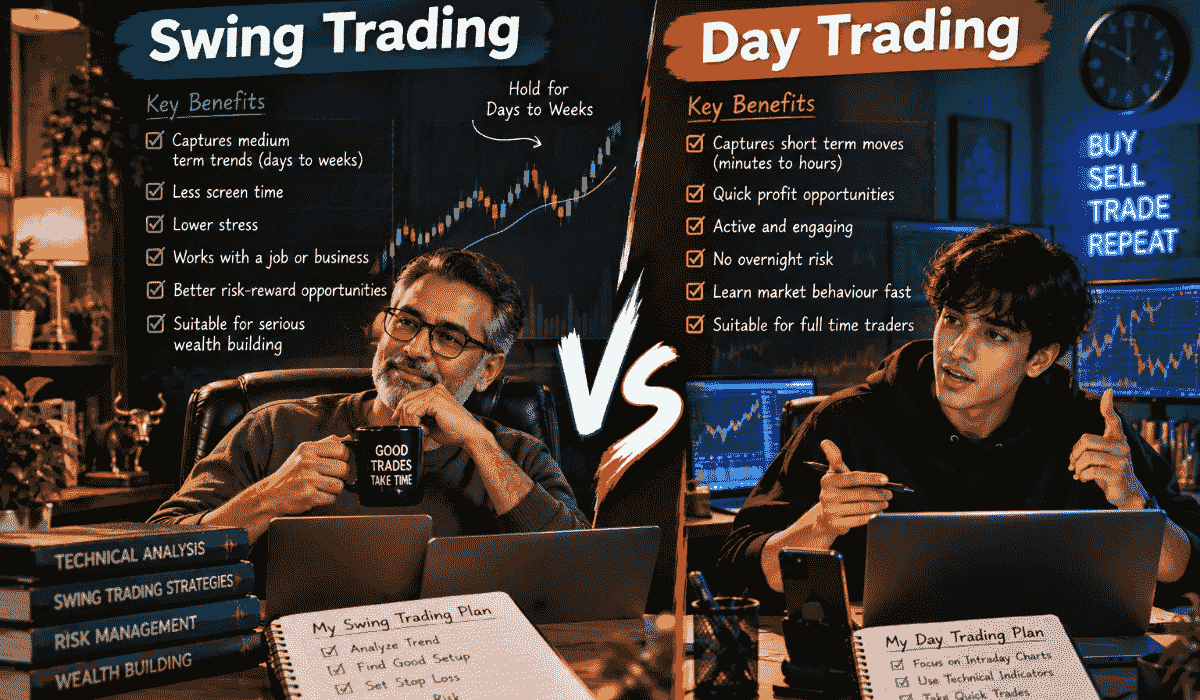
Swing trading vs day trading comparisons come up constantly, and for good reason.
Choosing between them (or intraday trading, as it is frequently called in India) is really a question about lifestyle and temperament as much as it is about strategy.
Get this choice wrong and even a technically sound approach will feel exhausting to actually stick with.
The Core Distinction: Holding Period Defines Everything
A day trader closes every position before the market shuts. Nothing is held overnight, ever, by definition.
Swing trading works the opposite way. It means holding a position for several days to a few weeks, deliberately carrying it through overnight sessions and weekends.
That extra time is the point: it gives a trade room to capture a larger price move than a single session could offer.
This one difference in holding period shapes almost every other distinction between day trading and swing trading, from capital and risk to how much screen time each demands.
Where the positional link goes: at the end of the holding-period section, not in the middle of it.
Hold even longer, from weeks into months, and swing trading starts to become positional trading. Our swing trading vs positional trading guide explains where that line falls.
That way the link continues the idea of stretching the holding period instead of breaking the day-vs-swing comparison.
If this is from the “what is swing trading” article rather than the day-trading one, paste the line before “Nothing is held overnight” and I’ll adjust the opening to fit it.
How Many Hours Does Each Style Actually Demand?
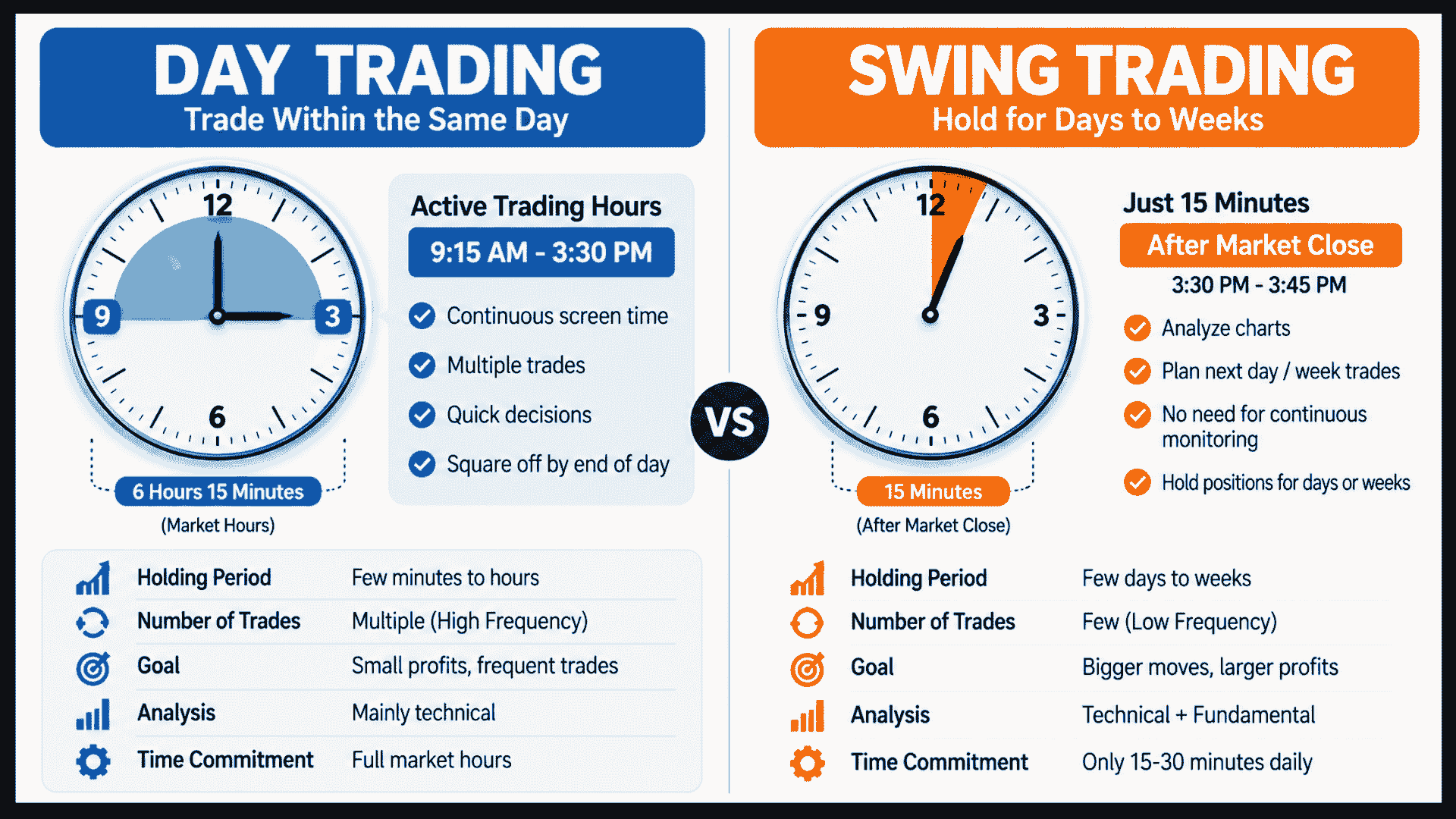
Day trading demands your full attention during market hours, roughly 9:15 am to 3:30 pm on Indian exchanges.
It means watching charts continuously and reacting within minutes or even seconds.
Swing trading requires far less daily time. The core analysis typically happens once a day, after market close, reviewing charts and planning the next session’s orders.
This is the single biggest reason people with a full-time job or fixed daytime schedule gravitate toward swing trading rather than day trading.
Multiplier Effect: Why Leverage Changes the Game
Day trading in the cash segment typically uses higher intraday leverage offered by brokers.
Since positions are squared off the same day, they carry no overnight exposure risk from the broker’s perspective. This magnifies both gains and losses within a single session.
Swing trading generally uses less leverage, or delivery-based positions without leverage at all.
Carrying a leveraged position overnight is considerably riskier than carrying one intraday.
This is also why traders asking what the advantages of option trading are often point to leverage first, though the same caution about overnight exposure applies there too.
Capital requirements per trade tend to be comparable, but the leverage difference meaningfully changes the risk profile.
Where Does the Real Risk Hide in Each Style?
Day trading risk is concentrated into a single session.
A bad day can be a genuinely bad day, but it ends when the market closes, with no overnight exposure to worry about.
Swing trading risk is spread across a longer window but includes something day trading does not: overnight and weekend gap risk.
News, global market moves, or company announcements while the market is closed can cause a stock to open sharply higher or lower than where it closed, a risk day traders simply do not carry.
What Skills Does Each Style Truly Demand?
Day trading rewards extremely fast decision-making, strong emotional control under rapid-fire pressure, and the ability to read short-term price action in real time.
It is genuinely difficult to do well and sustainably, and the failure rate among aspiring day traders is well documented to be high.
Swing trading rewards patience and the discipline to wait for a setup to actually confirm rather than acting on impulse.
It also needs the ability to read charts on a slightly longer timeframe, and it is more forgiving of a slower decision-making style.
Still, it demands real discipline around stop losses and position sizing, two of the most important swing trading rules to follow.
Swing Trading vs Scalping: Where Does the Fastest Style Fit?
Scalping is worth mentioning separately, since it is often confused with day trading but is actually more extreme.
Scalping means holding a position for seconds to a few minutes, aiming to capture very small price movements repeatedly, often dozens of times a day.
If day trading demands full attention during market hours, scalping demands complete, uninterrupted focus for the entire session.
Reaction times are measured in seconds rather than minutes, making it the fastest-paced style on this spectrum, sitting even further from swing trading than standard day trading does.
Time to Decide: Are You Built for Day Trading or Swing Trading?
Ask yourself honestly: can you watch the market continuously during trading hours on most days, and do you genuinely enjoy fast, high-pressure decision-making?
If yes, day trading (or scalping, at the end) may suit your temperament.
If your schedule does not allow continuous screen time, or you prefer analysing charts calmly after market hours, swing trading is very likely the better fit.
Neither answer is right or wrong. They are genuinely different skill sets.
Forcing the wrong one onto your actual schedule and temperament is a common, avoidable reason people struggle with trading in general.And if you would rather not track charts at all, comparing swing trading vs mutual fund investment can help you decide whether a more passive route suits you better
Can You Really Run Both at the Same Time?
Some experienced traders eventually run both a swing trading portfolio and a smaller day trading account side by side.
But this is generally something to grow into once one style is genuinely working, not a starting point.
Trying to learn both simultaneously as a beginner usually means neither gets the focused attention it needs to actually develop.Many traders also keep their swing trades separate from long-term holdings, which is why it helps to understand swing trading vs long term investing before mixing the two.
Swing Trading vs Intraday Trading vs Scalping at a Glance
| Factor | Day Trading / Intraday | Swing Trading | Scalping |
|---|---|---|---|
| Holding period | Minutes to hours, same day | Days to weeks | Seconds to minutes |
| Daily attention needed | Continuous during market hours | ~15-20 min, after close | Continuous, intense focus |
| Overnight risk | None | Yes, gap risk | None |
| Typical leverage | Higher (intraday margin) | Lower or none | Higher (intraday margin) |
| Best suited for | Full-time availability during market hours | Working professionals, students | Extremely fast decision-makers |
What Does a Realistic Week Look Like for Each Style?
A day trader’s week involves being present and focused for the entire market session, five days a week.
Decisions are made and completed within each session, with very little “after hours” work, since every position is already closed when the market shuts.
The Swing Trader’s Week
A swing trader’s week looks different: brief daily check-ins after market close, perhaps fifteen to twenty minutes.
Add a slightly longer weekly review to reassess the watchlist and broader market context.
The actual number of trades in a given week might be one, two, or sometimes zero, depending on how many genuine setups appeared.
The Scalper’s Week
A scalper’s week resembles a day trader’s but compressed further, often requiring specialised, faster order execution tools.
It also needs a workspace built for rapid-fire decision-making, since the entire edge in scalping depends on speed and precision that a casual setup cannot reliably support.
Style First, Strategy Second: Why Does the Order Matter?
A common mistake is picking a specific strategy or indicator first, then trying to force it into whichever trading style sounds appealing.
It works better the other way around. Decide honestly which pace, day trading, swing trading, or scalping, actually fits your available time and temperament first.
Then look for strategies built specifically for that style.
Trying to swing trade with a day trader’s impatience, checking charts every hour and second-guessing a position that has not moved yet, tends to produce exactly the frustration that leads people to abandon a perfectly sound strategy too early.
Not Sure Which Style Actually Fits Your Schedule?‘
If your days are already full with work, study, or other commitments, swing trading is built to work around that rather than compete with it.
Our Online swing trading classes India teach a complete, structured approach designed for exactly this kind of schedule.
Conclusion: Pick the Pace That Fits Your Life
The swing trading vs day trading decision is less about which style is better and more about which one matches your schedule and temperament.
Day trading and scalping reward speed, constant screen time, and emotional control under pressure.
Swing trading rewards patience, calm end-of-day analysis, and disciplined risk management, which makes it far easier to fit around a job or studies.
Choose your pace honestly first, then pick strategies built for it. Master one style fully before adding another, and you give yourself a far better chance of trading consistently over the long run.
Frequently Asked Questions
Before investing capital, invest your time in learning Stock Market.
Fill in the basic details below and a callback will be arranged for more information: