


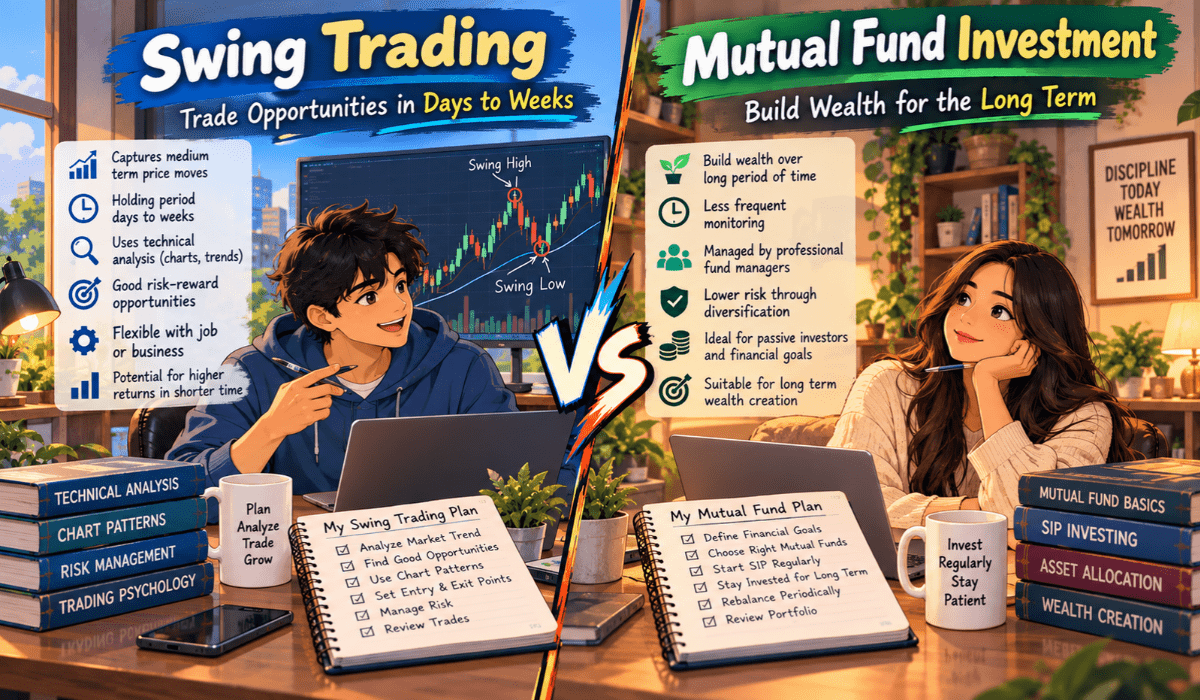
Comparing swing trading vs mutual fund investment is a bit like driving a car yourself versus hiring a driver.
Both get you somewhere, but the level of control, effort, and involvement required is completely different.
It is really a choice between actively managing your own trades and handing that decision-making to a professional fund manager instead.
Who Is Really Calling the Shots With Your Money?
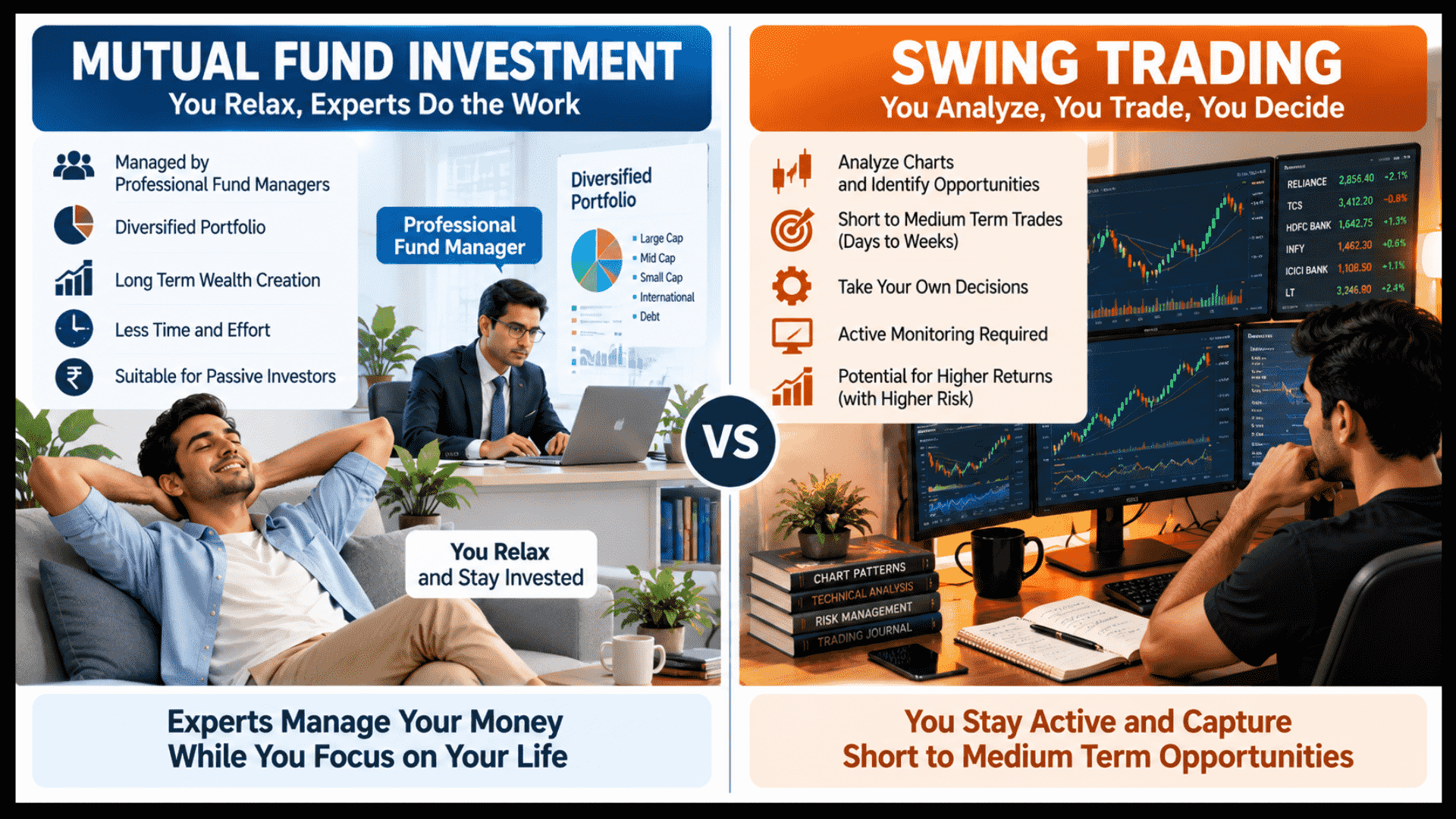
In mutual fund investing, a professional fund manager and their research team decide which stocks to buy, when to buy them, and when to sell, within the fund’s stated strategy.
You are investing in their expertise and process, not making individual stock decisions yourself.
In swing trading, you are making every single decision. What to buy, when to enter, where to place your stop loss, when to exit.
There is no professional layer between you and the outcome of each trade.
How Much of Your Time Does Each One Really Demand?
Mutual fund investing, particularly through a systematic investment plan (SIP), can be genuinely close to hands-off.
Set up the SIP, and the ongoing effort required from you is minimal, an occasional review of the fund’s performance and whether it still fits your goals.
Swing trading requires real, ongoing effort: daily or near-daily chart review, active position management, and continuous learning to stay sharp.
This is lighter than the intraday involvement you see in the swing trading vs day trading comparison, but there is no version of swing trading that works well on autopilot.
Swing Trading vs Mutual Fund Investment: What Are You Actually Paying For?
Mutual funds charge an expense ratio, an annual fee taken from the fund’s assets regardless of performance.
It varies by fund type but is a recurring cost either way.
Swing trading costs are transactional: brokerage, securities transaction tax, and other charges on every trade you place, rather than one annual percentage fee.
Depending on how frequently you trade, these transactional costs can add up meaningfully, which is part of why the earlier point about avoiding overtrading matters for cost reasons too, not just risk reasons.
Holding period plays a part here as well, which is why the swing trading vs positional trading choice also affects how often these charges hit your account.
Diversification Risk: How Many Stocks Should You Hold?
Even a single equity mutual fund typically holds twenty to sixty or more stocks, giving instant diversification across sectors and companies with a single investment.
A swing trading portfolio, especially for an individual managing three to six open positions at a time as a sensible risk limit, is inherently far less diversified.
This is not automatically a flaw, since a swing trader is not trying to replicate market-wide diversification.
But it does mean individual position risk carries more weight than it would inside a mutual fund.
Full Control vs Hands-Off Management: Who DecidesYour Trades?
Mutual fund investors have essentially no control over individual stock decisions within the fund.
Your outcome is entirely tied to the fund manager’s choices and the fund’s stated strategy.
Swing traders have complete control over every decision, for better and for worse.
This appeals strongly to people who want to actively apply their own market view, and feels like a real drawback to people who would rather not be involved in individual stock decisions at all.
Swing Trading vs Mutual Fund Investment: What Results Can You Really Expect?
Mutual funds, particularly index funds and well-managed active funds, have a long track record of producing broadly market-linked returns over long periods.
There is genuine variance between fund managers and fund types, but generally within a more contained range than individual trading outcomes.
Swing trading outcomes vary far more widely from person to person.
They depend directly on individual skill, discipline, and risk management, rather than a professional process applied consistently across all investors in the fund.
Can You Swing Trade and Invest in Mutual Funds Together?
Not necessarily. A genuinely common approach is treating mutual fund investing (often through SIPs) as the core, long-term foundation of a portfolio, handled largely passively.
Alongside it, a smaller, clearly defined portion of capital is allocated specifically for active swing trading.
This way, the bulk of long-term wealth building does not depend on trading skill, while the swing trading portion offers a way to actively participate in the market with capital you can afford to actively manage.
This is also different from the swing trading vs long term investing debate, which compares two ways of picking stocks yourself rather than active versus professionally managed money.
Comparing Returns: ₹5 Lakh in Swing Trading vs Mutual Funds
Here is how swing trading vs mutual fund investment plays out with the same starting amount.
Suppose an investor puts ₹5,00,000 into a diversified large-cap fund and simply holds it for five years, checking in occasionally but making no active decisions along the way.
Their return is tied to the fund’s overall performance, the underlying market’s growth, and the fund manager’s stock selection, all outside the investor’s direct control.
Now suppose a swing trader starts with the same ₹5,00,000, but actively manages fifteen to twenty trades over the same period, each based on their own chart analysis and risk rules.
Their outcome depends heavily on their own skill and discipline across those individual decisions, for better or worse, in a way the mutual fund investor’s outcome simply does not.
Neither path is guaranteed to outperform the other. The mutual fund investor accepted less control in exchange for professional management and minimal effort.
The swing trader accepted full responsibility for the outcome in exchange for full control over every decision.
Does Your Own Skill Change the Game Over Time?
One meaningful difference worth naming honestly: a mutual fund investor’s stock-picking skill generally does not need to improve for the investment to work, since that responsibility sits with the fund manager.
A swing trader’s outcomes, by contrast, tend to improve as their chart-reading, risk management, and discipline genuinely develop through practice and experience.
This means a swing trader’s early results, in the first several months of learning, are not necessarily representative of what a more experienced version of the same trader might achieve later.
That is worth keeping in mind before drawing firm conclusions about whether this active approach suits you, based only on early results.
Ready to Take the Active Side of This Comparison?
If your long-term investing is already on autopilot through mutual funds, and you want to actively engage with the market using a separate, clearly defined portion of your capital, our swing trading classes teach that active approach from the ground up.
Conclusion: Control or Convenience, Which One Fits You Better?
Swing trading vs mutual fund investment is not really about which one wins. It is about who makes the decisions and how much effort you want to put in.
Mutual funds offer professional management, instant diversification and minimal effort, in exchange for giving up control. Swing trading offers full control over every trade, but asks for skill, discipline and consistent time.
For many investors, the smartest route is using both, with SIPs as the long-term foundation and a smaller, clearly defined portion for active trading. Choose based on your time, temperament and goals.
Frequently Asked Questions
Before investing capital, invest your time in learning Stock Market.
Fill in the basic details below and a callback will be arranged for more information: