



You have studied delta, gamma and vega. Then a fifth Greek shows up on the screen.
What is rho in options, and does it really matter for your trades? In short, rho shows how an option’s price changes when interest rates change.
If the Greeks feel heavy, you are not alone. So, take them one at a time, and rho turns out to be the gentlest of them.
For most short-term traders it is the quietest Greek, and you will see why.
Here, all numbers are hypothetical, computed with code and shown for illustration only.
Rho in Options Meaning in Simple Words
First, let us settle the definition. In fact, everything else on this page rests on it.
Rho measures the expected change in an option’s price for a 1 percentage point move in the risk-free interest rate.
The other inputs are assumed to stay the same.
For example, say a call has a rho of 30. Its price is expected to rise by about 30 points if the rate rises by 1 percentage point.
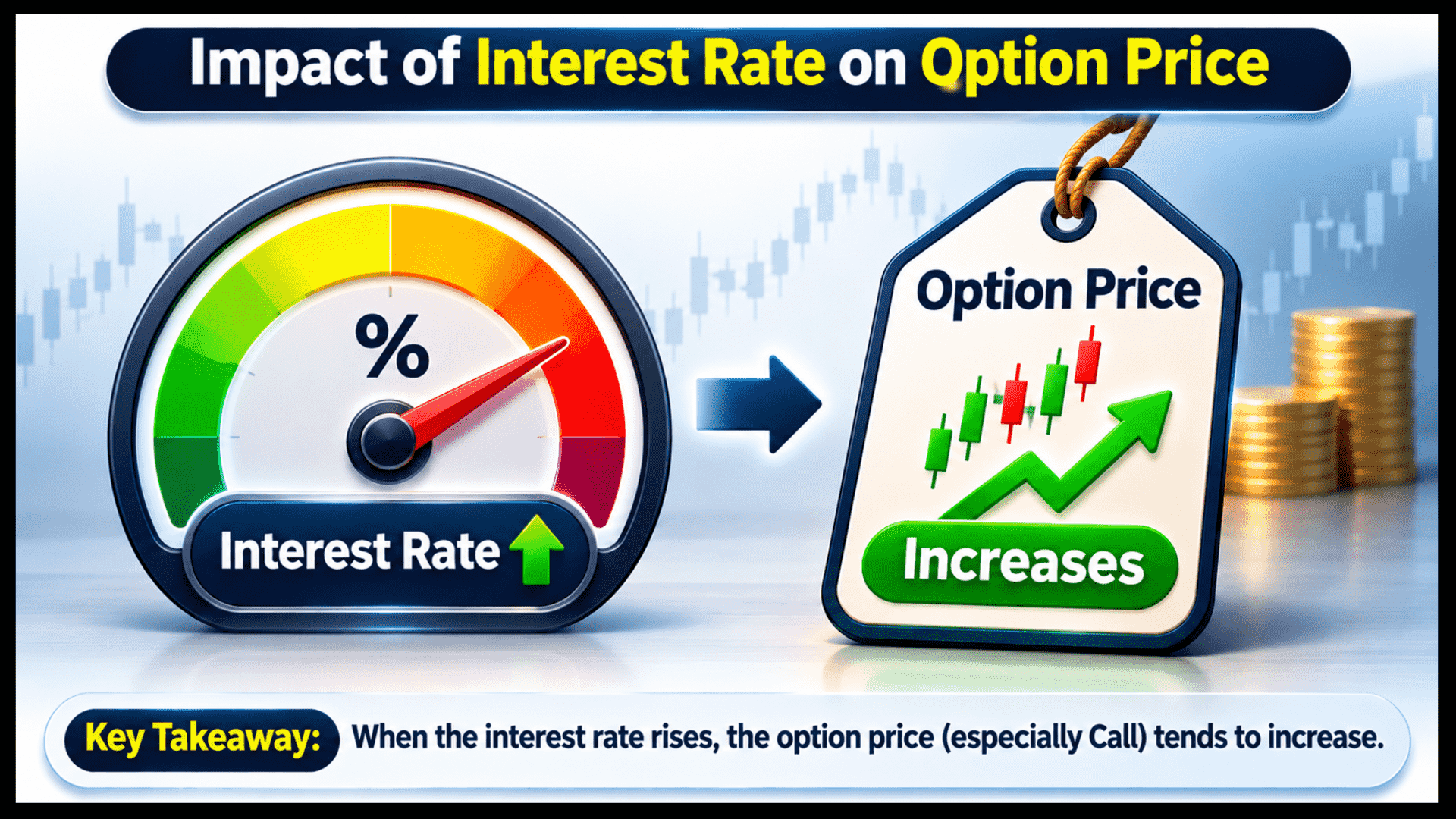
However, rates rarely move that much at once, so real changes are far smaller.
Rho belongs to the family of Greeks. Also, each Greek isolates the effect of one input on the option price.
The most used of them is delta, which we explain in delta in options trading.
Why Do Interest Rates Affect Option Prices?
Next comes the why. It helps to see the logic once, because the sign of rho follows from it.
An option is a right to buy or sell later at a fixed strike. Paying the strike price later, instead of today, has a time value of money.
For example, a buyer of a call keeps their money in hand until expiry. At a higher interest rate, that money earns more, so the call becomes slightly more valuable.
A put works the other way round, because a put holder receives the strike price later.
Thus, this is why standard pricing models such as Black-Scholes include an interest rate as an input.
Interest rates in India change through central bank policy decisions, so it helps to know this link in general. Verify current rates from official sources.
This effect sits inside the time value part of the price, not the intrinsic part. If that split is unclear, revisit the intrinsic value of options.
Is Call Rho Positive or Negative? Understanding Call vs. Put Rho
Now for the sign. It is easy to remember once you see it.
Call rho is positive. When rates rise, call prices tend to rise, all else equal.
Put rho is negative. When rates rise, put prices tend to fall.
Likewise, the reverse is also true. If rates fall, calls lose a little value and puts gain a little.
Instead, think of it as a quiet background push. It does not decide whether a trade works, but it is part of the full picture.
Let us look at how big the push actually is.
The Black-Scholes Rho Formula in Options Trading & Its Assumptions
First, a quick look at the shape of the formula. You will not need it by hand, but it explains where rho is large.
Under Black-Scholes, rho for a European option without dividends is:
- Call rho = K x T x e^(-rT) x N(d2), divided by 100 for a 1% move
- Put rho = -K x T x e^(-rT) x N(-d2), divided by 100 for a 1% move
Here K is the strike, T is time to expiry in years and r is the interest rate. Also, N is the normal distribution function.
You never need to calculate this by hand, because trading platforms show rho.
Still, what matters is the shape of the formula. Rho grows with time to expiry (T) and with the strike (K).
As a result, you can tell where it is large and where it is tiny.
Everything below uses these assumptions, for illustration only: index level 22,000, volatility 15%, interest rate 6.5%, no dividends.
Prices and rho are in index points per unit.
Rho in Options Example
Now let us see rho with real-looking numbers. In fact, expiry is the biggest driver of rho.
The table below prices an at-the-money (ATM) call and put at five expiries. These numbers are computed with Black-Scholes at 0 dividends and are hypothetical.
| Days to expiry | Call price | Call rho | Put price | Put rho |
|---|---|---|---|---|
| 7 | 196.23 | 2.19 | 168.82 | -2.02 |
| 30 | 437.91 | 9.73 | 320.69 | -8.26 |
| 90 | 838.23 | 30.46 | 488.43 | -22.92 |
| 180 | 1298.27 | 62.97 | 604.25 | -42.10 |
| 365 | 2083.64 | 131.93 | 699.13 | -74.23 |
First, a 7-day ATM call has a rho of only 2.19. A full 1 percentage point rate change would move its price by about 2 points.
Besides, the price itself is about 196.
However, for a 365-day option, the same rate change moves the price by about 132 points. Longer expiry means larger rho.
This is why rho matters mostly for long-dated options such as LEAPS-style contracts, where available.
Index option weekly and monthly contracts are short-dated, so rho is usually the least important Greek for them.
Does a Small Interest Rate Change Really Move the Option Price?
Rates move in small steps, so this is a fair question. Let us test it on the 90-day ATM call.
At a 6.0% rate the price is 823.07, at 6.5% it is 838.23 and at 7.0% it is 853.53.
So a 0.5 point rise in the rate adds about 15.3 points. This matches rho, since 30.46 x 0.5 is about 15.2.
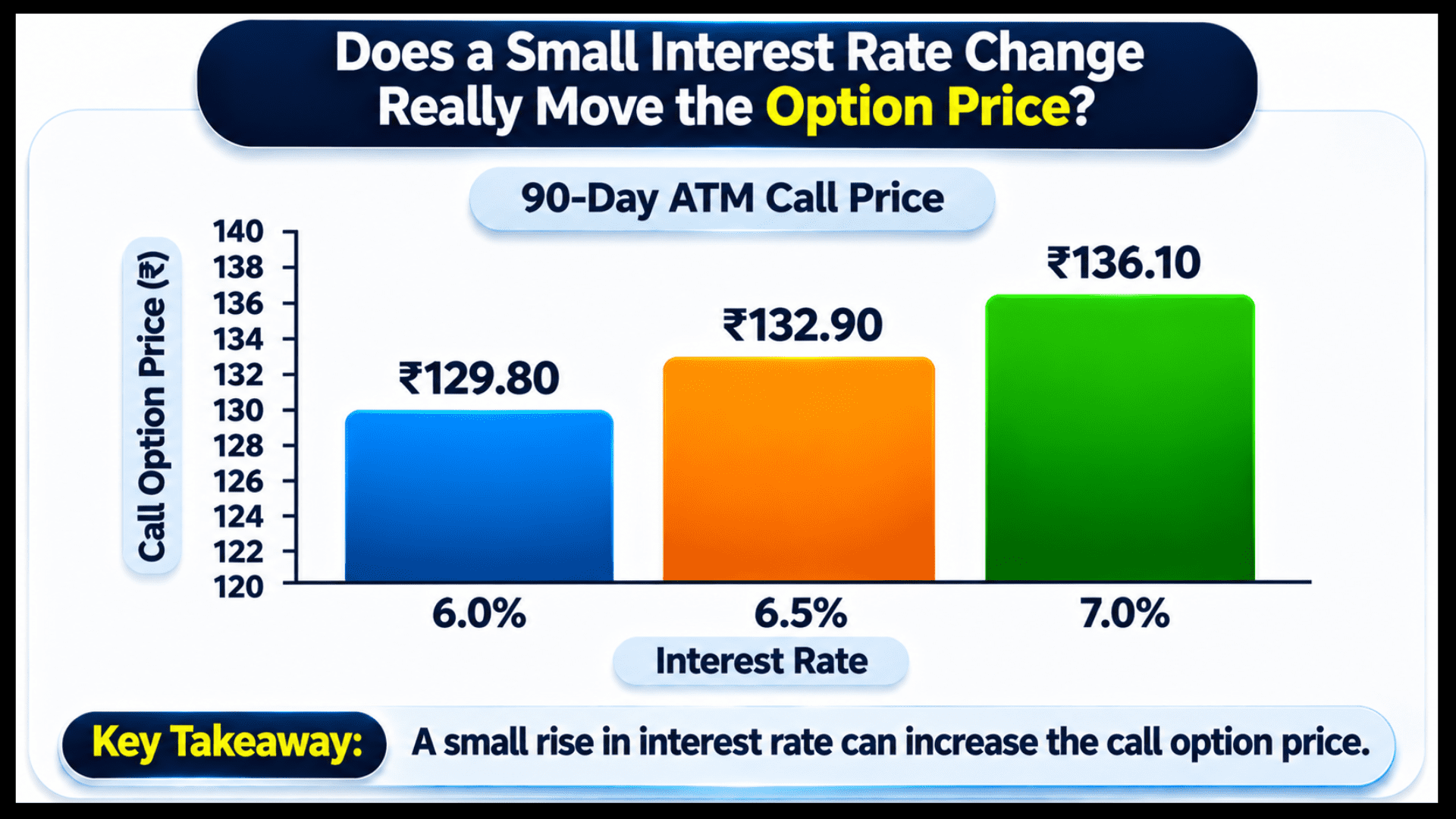
Central banks usually change policy rates in steps of 0.25 percentage points. A 0.25 move would shift this call by roughly 7.6 points, or under 1% of its price.
Over a few days, the effect of time decay and price moves is far larger.
Does Moneyness Affect Rho?
Expiry is one driver. Meanwhile, the strike matters too.
Rho also depends on how far the strike is from the index. Calls deep in the money (ITM) have higher rho than far out-of-the-money (OTM) calls.
They behave more like a position that will be exercised.
Puts show the mirror image: OTM puts have small negative rho, and ITM puts have larger negative rho.
The next table uses the same assumptions.
| Strike | Days | Call rho | Put rho |
|---|---|---|---|
| 21,000 (ITM call) | 30 | 15.14 | -2.03 |
| 22,000 (ATM) | 30 | 9.73 | -8.26 |
| 23,000 (OTM call) | 30 | 3.31 | -15.50 |
| 21,000 (ITM call) | 180 | 75.82 | -24.48 |
| 22,000 (ATM) | 180 | 62.97 | -42.10 |
| 23,000 (OTM call) | 180 | 47.49 | -62.35 |
Still, time dominates. A 180-day OTM call has a larger rho than a 30-day ITM call in this example.
For illustration, take a lot of 50 units. The 90-day ATM call then has a rho of about 1,523 rupees per 1 percentage point.
Also, real lot sizes are revised by the exchange, so verify them before using any number.
Comparing Option Greeks: Where Does Rho Stand Against Delta & Vega?
Rho is one of five common Greeks, and it helps to see its size next to the others.
The comparison below uses the 90-day ATM option from above.
| Greek | What it measures | Typical importance for short-term traders |
|---|---|---|
| Delta | Price change for a move in the index | High |
| Gamma | Change in delta as the index moves | High near expiry |
| Theta | Daily time decay | High for sellers and buyers |
| Vega | Price change for 1% change in volatility | Medium to high |
| Rho | Price change for 1 percentage point rate change | Low for short-dated options |
For the same 90-day ATM option, vega is about 42.22 per 1 volatility point. Rho is about 30.46 per 1 rate point.
In contrast, volatility can jump several points in a day, but rates move slowly.
If vega is new to you, start with vega in options. It explains why volatility usually matters more than rates.
How Do Traders Use Rho in Practice?
Most traders just check that rho is not a surprise. Here is a simple routine.
- Look at the days to expiry. Under a month, rho is nearly negligible.
- Check if a rate decision is due. Longer-dated positions feel it more.
- Compare rho with vega and theta before worrying about it.
Rho matters more for long-dated options, large positions and portfolio-level risk management. A desk holding thousands of long-dated contracts watches total rho.
Protection planning of this kind is covered in our options hedging strategy page.
On the other hand, a retail trader buying weekly options rarely needs it.
Common Mistakes With Rho in Options
Most rho errors come from habit, not from maths. So, watch for these four.
- Ignoring expiry. A rho figure of 30 sounds big. But it applies to a full 1 percentage point change in rates, which is rare.
- Blaming a loss on rates. When a short-dated option loses money, the cause is almost always the index move. Time decay or a fall in implied volatility can also be the cause.
- Mixing up signs. Remember it simply: calls up with rates, puts down with rates.
- Thinking rho explains losses. Some beginners believe rho is the reason option buyers lose.
The real reasons are explained in our page on why option buyers lose money.
Limits of Rho: What It Cannot Tell You
Rho is a model output. It assumes a flat, known interest rate, no dividends and a European-style option.
Real index options are affected by expected dividends, and the actual rate used by a pricing model may differ. Different platforms may show slightly different rho for the same option.
Moreover, rho is also a snapshot. It changes as the index moves and as expiry approaches, just like option gamma and the other Greeks.
Even so, none of this makes rho useless. It simply means rho is a context number, not a signal to enter or exit a trade.
How to Learn the Greeks Safely
If the Greeks still feel heavy, learn them one at a time. Begin with delta, then theta, then vega, and treat rho as the last piece.
Next, practise reading all of them on a virtual account before using real money. Our overview of how to learn options trading gives a clear learning order.
Besides, selling options carries margin requirements and risk that can be much larger than the premium received. Understand them fully before you try selling.
Once the Greeks are clear, you can see how they combine inside different setups in the option strategies learning path.
Delta, gamma, theta, vega, rho: do the Greeks still feel like alphabet soup?
Reading about them is easy, but real option chains and a mentor’s answers make them click.
Join our live classes from your mobile, ask your doubts and learn step by step.
Conclusion
So, rho shows how an option’s price changes for a 1 percentage point move in interest rates. Call rho is positive, and put rho is negative.
In short, rho grows with time to expiry, so it matters most for long-dated options. As a result, it is usually the quietest Greek for weekly and monthly traders.
Finally, treat rho as a context number, not a trade signal. Remember, this is learning, not a buy or sell call.
Disclaimer: This page is for education only. All numbers are hypothetical and computed for illustration, and a lot of 50 units is only an example.
It is not investment advice. Also, options trading involves risk of loss. Verify rates, lot sizes and rules on official sources.
Frequently Asked Questions
Before investing capital, invest your time in learning Stock Market.
Fill in the basic details below and a callback will be arranged for more information: