


The big move is usually preceded by a silent narrative in price charts. The descending triangle pattern Elliott wave structure is ranked among the patterns closely monitored by traders studying the Elliott wave triangle pattern.
It seems easy on the surface, but when you think of it, there is a lot of depth behind it in terms of crowd psychology and market pressure.
As the price continues to create lower highs and the price is at a flat level, something significant is occurring. The sellers are increasingly taking over.
This triangle in Elliott Wave trading often takes place during the correction time, especially in Wave 4 or Wave B.
To learn more about how this pattern works, what traders say about it, and how the pattern fits into the Elliott Wave, let’s break it down.
What is Descending Triangle Pattern?
The descending triangle pattern is a bearish chart formation. It occurs when the price keeps on testing a horizontal support level as the highs keep on decreasing.
The structure creates a triangle shape that gradually tightens before a breakout.
Key Characteristics Of The Pattern:
| Feature | Explanation |
| Flat Support | Price repeatedly touches the same support level |
| Lower Highs | Each bounce upward forms a lower peak |
| Volume Pattern | Volume usually decreases during formation |
| Breakout Direction | Often breaks below support |
In simple terms, buyers defend a price level, but sellers keep pushing prices lower each time the market rallies.
Eventually, the support breaks, and when it breaks, the move can be sharp.
A Simple Example:
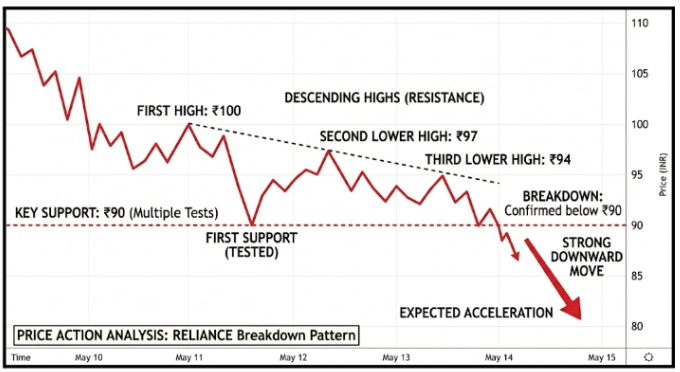
RELIANCE trades like this:
| Price Move | Value |
| First high | ₹100 |
| First support | ₹90 |
| Second high | ₹97 |
| Third high | ₹94 |
The highs keep falling, but support remains around ₹90.
When the price finally breaks ₹90, traders expect a strong downward move.
Descending Triangle Elliott Wave Structure
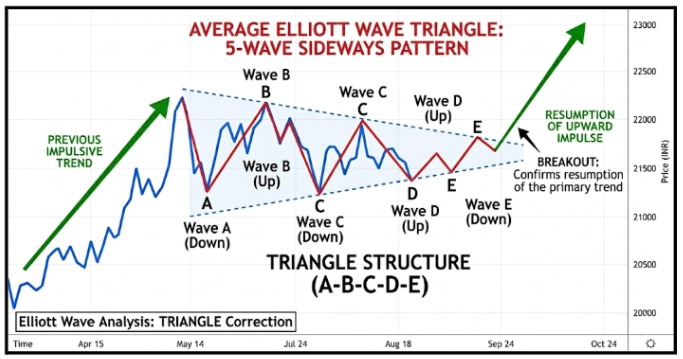
Triangles in the context of Elliott Wave theory are not impulsive moves; they belong to the corrective wave types.
One of the variations is the descending triangle, which differs from formations such as the Elliott wave expanding triangle.
An average Elliott Wave triangle has 5 waves inside it, which are marked:
A B C D E
These waves move sideways rather than trending strongly.
Typical Triangle Wave Structure:
| Wave | Direction |
| Wave A | Down |
| Wave B | Up |
| Wave C | Down |
| Wave D | Up |
| Wave E | Down |
Elliott Wave Rule: In a descending triangle, all five waves (A, B, C, D, E) each subdivide into 3 sub-waves, making the full structure a 3-3-3-3-3 pattern.
None of the five waves is impulsive. This is what separates an Elliott Wave triangle from a standard technical analysis triangle.
The Thrust After Wave E
After Wave E completes in a descending triangle, the market often makes a fast directional move known as the thrust. This move typically breaks out of the triangle and continues the prior trend.
Key points traders watch:
- The thrust usually forms Wave 5 when the triangle appears in Wave 4.
- It moves quickly with strong momentum.
- The target often equals the widest part of the triangle.
Spotting Wave E early can lead to a clean, high-probability trade setup.
Where Does the Descending Triangle Appear in Elliott Wave?
Triangles appear in specific positions within the wave cycle.
Most Common Locations:
| Wave Position | Description |
| Wave 4 | Consolidation before final Wave 5 |
| Wave B | Correction within a larger trend |
| Wave X/Y | Final wave within a complex corrective combination (double or triple combination) |
For example:
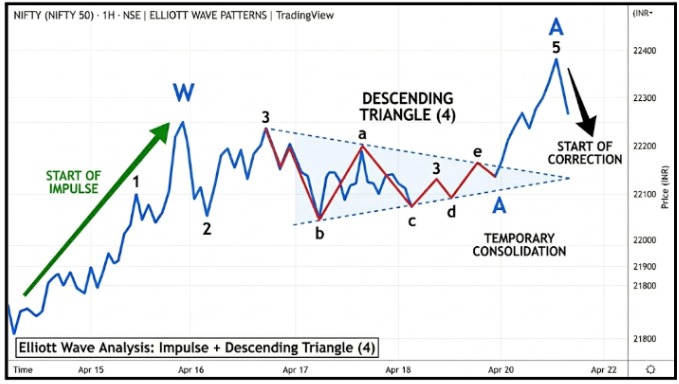
- Wave 1 strong uptrend
- Wave 2 pullback
- Wave 3 strong rally
- Wave 4 descending triangle consolidation
- Wave 5 final push
In this case, the triangle shows temporary consolidation rather than full trend reversal.
This nuance matters.
A descending triangle inside Wave 4 can still lead to higher prices afterward.
Context is everything when you do Elliott wave analysis on live charts.
Descending Triangle In A Bull Market: Not Always Bearish
A descending triangle is often labeled as a bearish pattern. But with Elliott Wave analysis, it has a different meaning depending on its location within the wave structure.
A descending triangle is typical in a bull market, where Wave 4 is characterized by consolidation that sets the stage to take off on a final thrust in Wave 5.
Important things that traders ought to keep in mind:
- In Wave 4 of an uptrend, the triangle signals consolidation before Wave 5 continuation upward.
- In Wave B of a zigzag during a downtrend, the breakout tends to be bearish.
- The pattern’s meaning depends on wave position, not just shape.
Simple rule: A descending triangle is bearish in a downtrend but bullish in Wave 4 of an uptrend.
Rules Of The Descending Triangle In Elliott Wave
A descending triangle is a consolidation pattern that forms before a strong move in the direction of the larger trend.
In Elliott Wave analysis, it appears during corrective phases where the market contracts before the final actionary wave. Recognizing its rules helps traders avoid confusion with other triangle patterns.
Key Rules To Identify A Descending Triangle:
- Rule 1: The bottom must be a level horizontal support line, and several waves bottom out at the same price point.
- Rule 2: The top line is shaped like a down-sloping trendline, which joins a successive row of low highs.
- Rule 3: There are five waves in the pattern marked A-B-C-D-E.
- Rule 4: In each wave, three internal sub-waves form a 3-3-3-3-3 structure.
- Rule 5: The triangle appears before the last actionary wave, often Wave 4, Wave B, or Wave X, which is always the last; it cannot be Wave 2.
Descending Triangle Pattern Elliott Wave Formula
There is no strict mathematical formula, but traders use measurement guidelines.
Common Measurement Rule:
| Calculation Step | Example |
| Measure triangle height | ₹100 to ₹90 = ₹10 |
| Identify breakout level | ₹90 support |
| Project target | ₹90 − ₹10 = ₹80 |
This is commonly referred to as the descending triangle pattern Elliott wave formula used for estimating potential price targets.
However, experienced traders treat this as a guideline rather than certainty.
Markets rarely follow perfect geometry.
Real Trading Perspective: How Traders Use This Pattern?
Professional traders rarely rely on patterns alone. They combine structure, volume, and confirmation signals.
A typical workflow might look like this.
Step-by-Step Trading Approach:
- Identify lower highs forming against flat support.
- Confirm decreasing volatility within the triangle.
- Wait for a breakout candle below support.
- Look for volume expansion on the break.
- Enter short trade after confirmation.
Practical Risk Management
| Element | Approach |
| Entry | Break below support |
| Stop loss | Above last lower high |
| Target | Height of the triangle |
Risk management matters more than prediction.
Triangles fail sometimes. Markets surprise traders more often than charts suggest.
A Chart Scenario of Descending Triangle Pattern in Elliott Wave
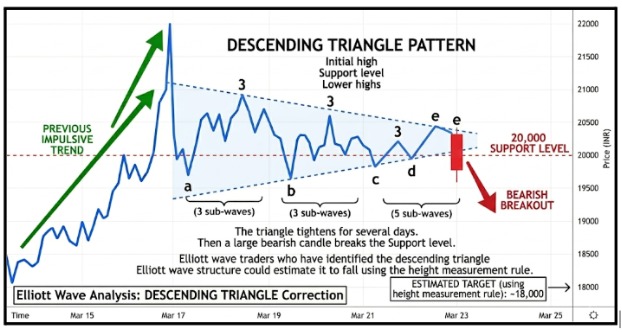
Consider a cryptocurrency chart.
| Stage | Price |
| Initial high | $42,000 |
| Support level | $38,000 |
| Lower highs | $41k, $40k, $39k |
The triangle tightens for several days.
Then a large bearish candle breaks $38,000.
Elliott wave traders who have identified the descending triangle Elliott wave structure could estimate it to fall to a point of $34,000 using the height measurement rule.
Still, experienced traders also follow macro news, the level of liquidity, and market sentiment. Patterns guide decisions. They do not ensure results.
Common Mistakes Made in Descending Triangle Pattern
Even simple patterns can mislead inexperienced traders.
Frequent errors:
- Entering before the breakout.
- Ignoring volume confirmation.
- Forgetting the broader trend direction.
- Placing stop losses too tightly.
The triangle can stretch longer than expected. Price may fake a breakout before the real move.
Conclusion
The descending triangle is not just geometry. It reveals pressure building under the surface. Each lower high shows sellers stepping in earlier.
Buyers still defend support, but their strength weakens. Eventually, the market tips.
That final break often feels sudden, yet the warning signs were present all along.
Ready to turn chart patterns into real profits?
Join our stock market classes and learn how traders use patterns like the descending triangle to make smarter trading decisions.
FAQs
Q1: Is A Descending Triangle Pattern Bullish Or Bearish?
Ans: The descending triangle pattern is usually a bearish trend since sellers decrease prices and can even increase further, whilst the support becomes weaker.
When the market hits below the support, it is usually discounted even further.
Q2: What Is The Triangle Rule In Elliott Wave?
Ans: In the Elliott Wave theory, triangles comprise 5 waves, namely A B C D E, and are present in periods of correcting, i.e., Wave 4 or Wave B.
The market tends to continue in the movement of Wave E.
Q3: What Is The Success Rate Of Descending Triangles?
Ans: Analysis of chart patterns indicates that descending triangles are nearly always followed by approximately 60 to 70%, especially when validated by volume and a distinct breakout.
The necessity of risk management is not disappearing as false breaks continue to take place.
Before investing capital, invest your time in learning Stock Market.
Fill in the basic details below and a callback will be arranged for more information: