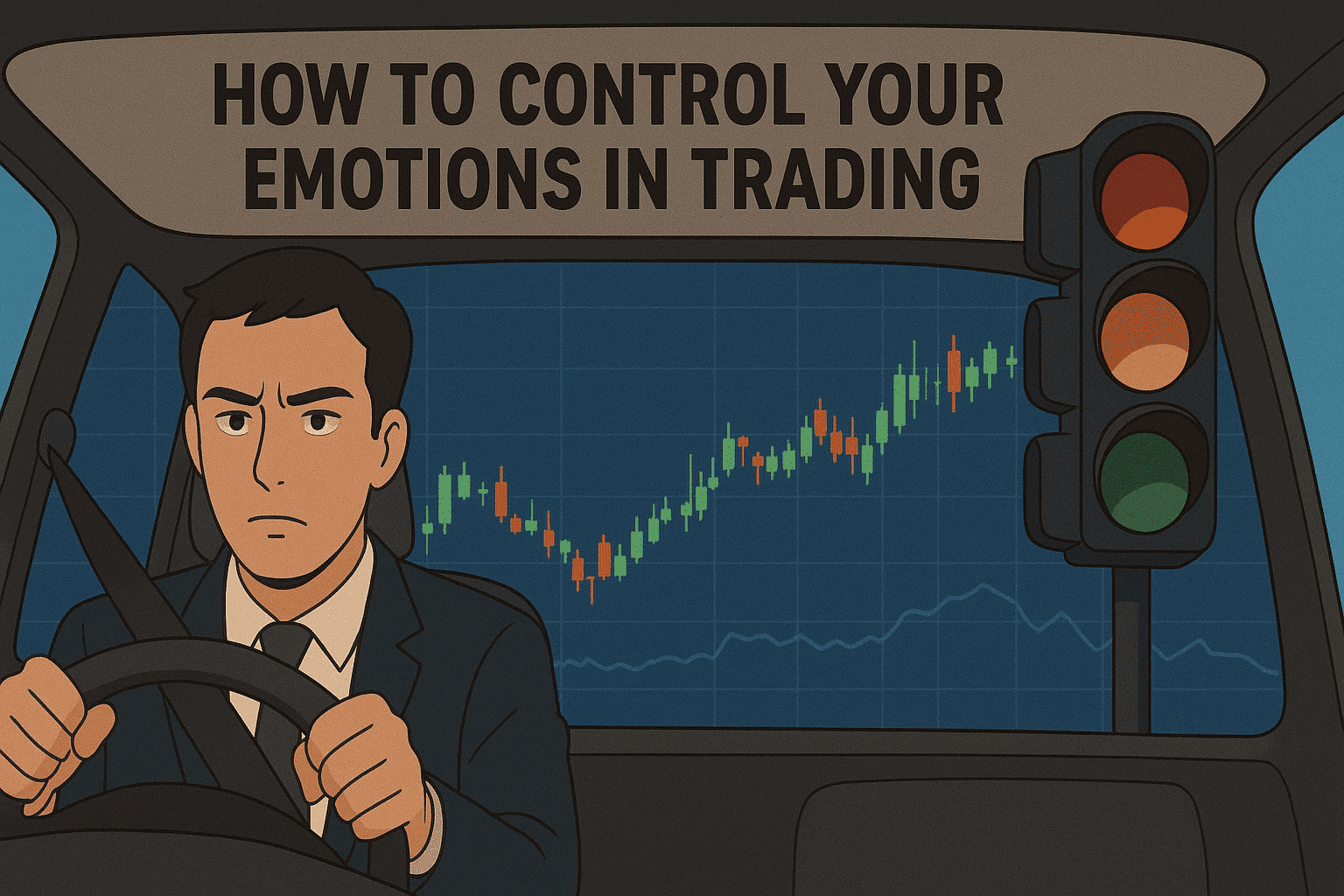



Put these two side by side and something feels odd. They use the same charts, the same stocks, sometimes the same broker screen.
Yet the day-to-day experience of doing them barely overlaps at all.
Positional trading vs day trading, also called intraday trading in India, is really a question about how you want to spend your day.
It is not just about which strategy performs better.
Pick the wrong one for your schedule, and even a sound strategy starts to feel like a fight you cannot win.
The One Rule That Separates Day Trading From Positional Trading
Day trading has a hard rule built in. Every position closes the same day, no exceptions.
Nothing carries overnight.
Positional trading works the other way. You are meant to hold through the ups and downs, sometimes for months.
If you are still wondering what positional trading is, this is the simplest answer: you wait for a bigger trend to play out instead of exiting by the close.
That one rule about overnight holding shapes everything else in this comparison. Keep it in mind as we go through the rest.
Positional Trading vs Day Trading Compared at a Glance
Before we go through each point in detail, here is the full comparison in one place.
Use it as a quick reference, then read on for the reasoning behind each row.
| Factor | Day trading (intraday) | Positional trading |
|---|---|---|
| Holding period | Same day, closed before market close | Weeks to a few months |
| Attention needed | Continuous, during market hours | A few hours a week, mostly outside market hours |
| Overnight risk | None | Yes, gap risk from news and events |
| Typical leverage | Higher, since no overnight risk to the broker | Lower, or none on pure delivery trades |
| Best suited for | Full-time availability during market hours | Working professionals and anyone with a fixed schedule |
| Chart timeframe used | 5 minute or 15 minute charts | Daily and weekly charts |
Where Positional Trading vs Day Trading Actually Differ?
The table gives you the headline differences. But each row hides a practical trade-off worth understanding.
Below, we break down time, capital, risk and indicators one by one, starting with the factor that decides it for most people.
How Much Time Does Positional Trading vs Day Trading Take?
This is usually the deciding factor for most people, more than any strategy detail.
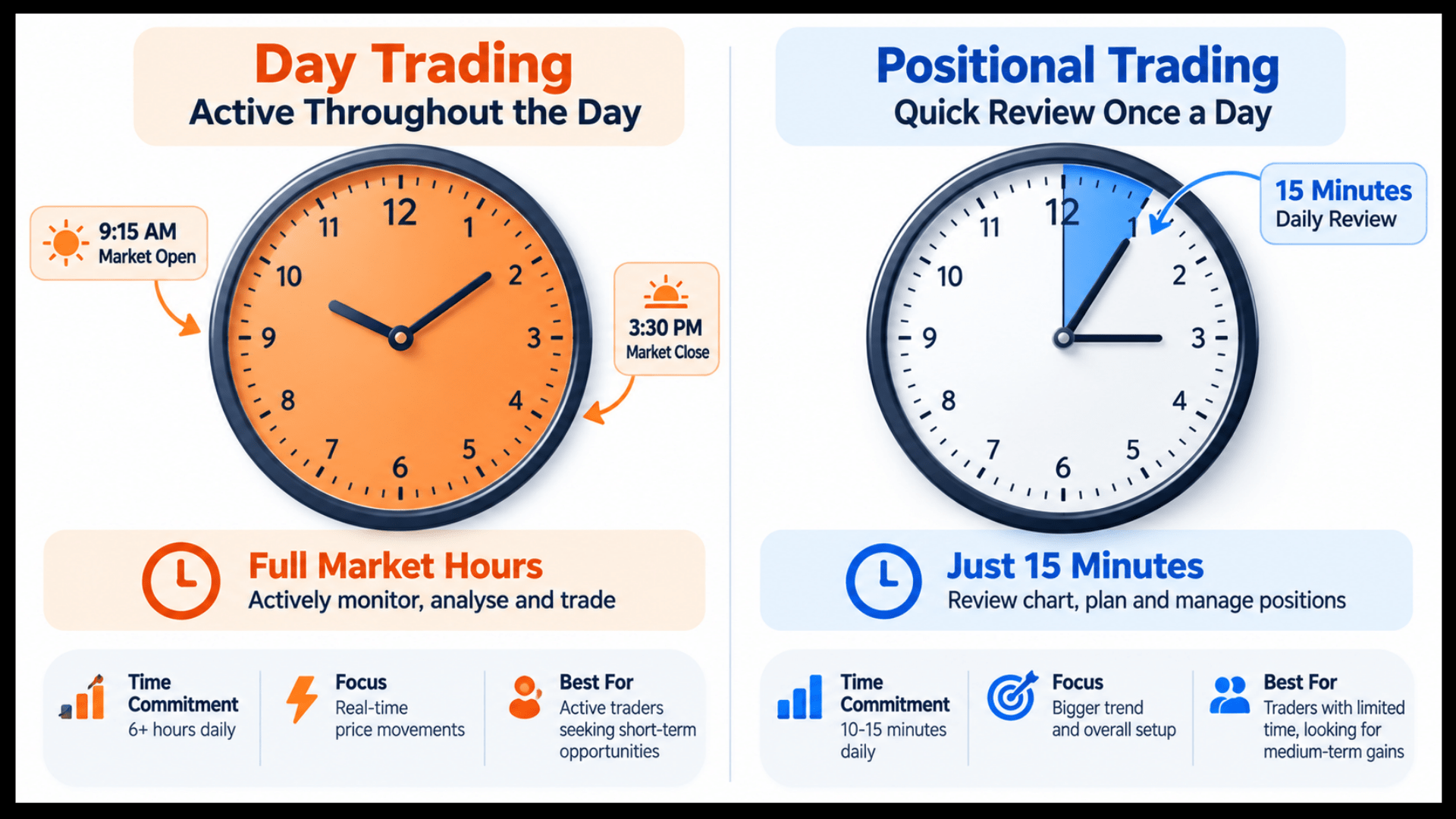
Day trading asks for your full attention while the market is open. Roughly six and a half hours on Indian exchanges.
You watch price move in real time and react fast.
Positional trading asks for a fraction of that. You check your weekly and daily charts.
You review open positions using rules like the ones in our positional trading strategy.
Does Positional Trading or Day Trading Require More Capital?
Not necessarily more capital. But definitely different capital behaviour.
Day trading usually comes with higher intraday leverage from your broker. Nothing carries overnight risk on their side, so they allow it.
That leverage cuts both ways. Bigger gains, and bigger losses, within the same session.
Positional trading generally uses less leverage, or none at all if you trade pure delivery equity.
Holding a leveraged position through weeks of news is a very different risk than holding it for six hours.
Which Strategy Actually Carries More Risk?
Neither one wins this outright. They just carry risk in different shapes.
A day trader’s risk lives entirely inside market hours. Once the session ends, so does the exposure for that day.
Nothing can gap against you while you sleep.
A positional trader’s risk stretches across every night and weekend the trade stays open.
A surprise announcement or a global market move can hit the price while the market is shut. You can do nothing until it reopens.
How Indicators Work Differently in Positional vs. Day Trading?
Day trading rewards someone who thinks fast and does not flinch under pressure.
Traders in this style genuinely enjoy quick decisions made and reversed within minutes.
Meanwhile, positional trading rewards someone who can pick a stock through a careful process, like the one in our guide on how to select stocks for positional trading.
Such individuals can sit on their hands through a pullback without touching anything.
Why Your Daily Routine and Mindset Matter Most?
Time, capital, and risk are only half the picture. The other half is you.
Choosing a trading style isn’t just about crunching numbers or analyzing charts—it’s about matching your daily habits, stress tolerance, and work schedule to the demands of the market.
Let’s look at how your routine shapes your success in each style:
These next two points look closely at the kind of person each style rewards and whether it fits into a normal job schedule.
1. What Kind of Person Tends to Do Well at Each?
This is worth being honest with yourself about. Forcing the wrong temperament onto the wrong style rarely ends well.
Day trading rewards someone who thinks fast and does not flinch under pressure.
They genuinely enjoy quick decisions made and reversed within minutes.
Positional trading rewards someone who can pick a stock through a careful process, like the one in our guide on how to select stocks for positional trading.
Then sit on their hands through a pullback, without touching anything.
2. Can a Working Professional Realistically Do Either?
Honestly, one of these fits a normal job far better than the other.
Day trading needs you glued to a screen during market hours.
That is close to impossible with a nine-to-five job that is not trading itself.
Positional trading was practically built for this situation.
Many traders now use the approach covered in our post on positional trading with AI to speed up their evening research.
Most of the actual work happens before the market opens or after it closes.
3. Is It Possible to Trade Both Styles at the Same Time?
Some experienced traders eventually run a day trading account and a positional trading account side by side.
This usually comes later, though. Not at the start.
If speed matters less to you than holding period, our comparison of positional trading vs long term investing covers a different version of this decision.
Trying to learn both styles at once as a beginner tends to mean neither one gets the attention it needs.
Which Style Should You Choose?
Ask yourself one simple question. Can you watch a screen continuously during market hours, most days?
If yes, day trading might suit your schedule and your temperament.
If your days are already full with other commitments, positional trading was built for exactly that gap.
Neither answer is wrong. They are just built for different lives.
Real-World Example For Positional Trading vs Intraday Trading
Suppose two traders each start with ₹3,00,000. These figures are illustrative and not a recommendation.
The first trades intraday. They open and close five to eight positions a day, every day the market is open.
They watch charts continuously from 9:15 am to 3:30 pm.
The second trades positionally. They review weekly charts on Sunday evening and place two or three orders for the week.
They check in briefly each evening after their day job ends.
Both can end the month profitable. Both can end it with a loss.
The difference is not the outcome. It is how many hours of their week the strategy actually demanded.
Not Sure Which Pace Actually Fits Your Life?
If your days are already full with work or other commitments, positional trading is built to work around that. Not compete with it.
Our best positional trading classes teach this approach live, so you can see exactly how it fits your schedule.
Conclusion
Positional trading vs day trading is not a contest with one winner. Day trading suits someone who can watch the screen through market hours and make fast calls under pressure.
Positional trading suits someone with a full schedule who prefers daily and weekly charts and a slower rhythm of decisions.
Both carry real risk, just in different shapes, from intraday leverage to overnight gaps.
Before choosing, be honest about the hours you actually have and the pace you can sustain. The right style is the one you can follow consistently without burning out.
Frequently Asked Question
Before investing capital, invest your time in learning Stock Market.
Fill in the basic details below and a callback will be arranged for more information: