



What is positional trading? It is a style of trading where you hold a stock for several weeks to a few months.
You aim to capture a large part of a trend, not a single day’s move.
That is the core positional trading meaning. Everything else in this guide builds on it.
You sit between two extremes. You are slower than an intraday trader and faster than a long-term investor.
The Blueprint for Capturing Multi-Week Trends With Confidence
Think of a stock in a strong uptrend. It rises for a few weeks, pauses, then rises again.
Over four months, it climbs 30%.
A positional trader tries to buy near the start of that climb. They then hold through the pauses and sell when the trend loses strength.
Daily wiggles do not matter to them. They care about the direction of the trend.
How Long Do Positional Trades Last?
There is no fixed rule. Most positional trades last from about two weeks to six months, depending on how long the trend runs.
The trend sets the exit, not the calendar.
A strong trend can carry a trade for a year.
A weak trend ends the trade in weeks.
Real-World Positional Trade Example: Riding a 3-Month Trend
These figures are illustrative.
A capital goods stock trades at ₹2,000 after a long base. It breaks out on strong volume, and you buy at ₹2,040 with a stop at ₹1,950.
Over the next three months, the stock climbs to ₹2,500 with a few small pullbacks.
You hold through each one because the stop never triggers.
Then a weekly candle closes below the trend line. You sell near ₹2,430.
One trade took three months and gained ₹390 per share on ₹90 of risk.
Best Segments for Positional Trades in India?
In India, most positional trading happens in the equity delivery segment. You buy shares, and they stay in your demat account while you hold.
Traders also use stock or index futures and options to express a positional view.
That adds leverage and time decay, so it carries a different risk profile.
Positional trading in India works on NSE and BSE stocks, mostly in liquid large and mid-cap names.
Comparing Trading Styles: Intraday vs. Swing vs. Positional vs. Investing
The difference is mostly holding time.
That one factor changes your screen time, your capital tie-up and your risk.
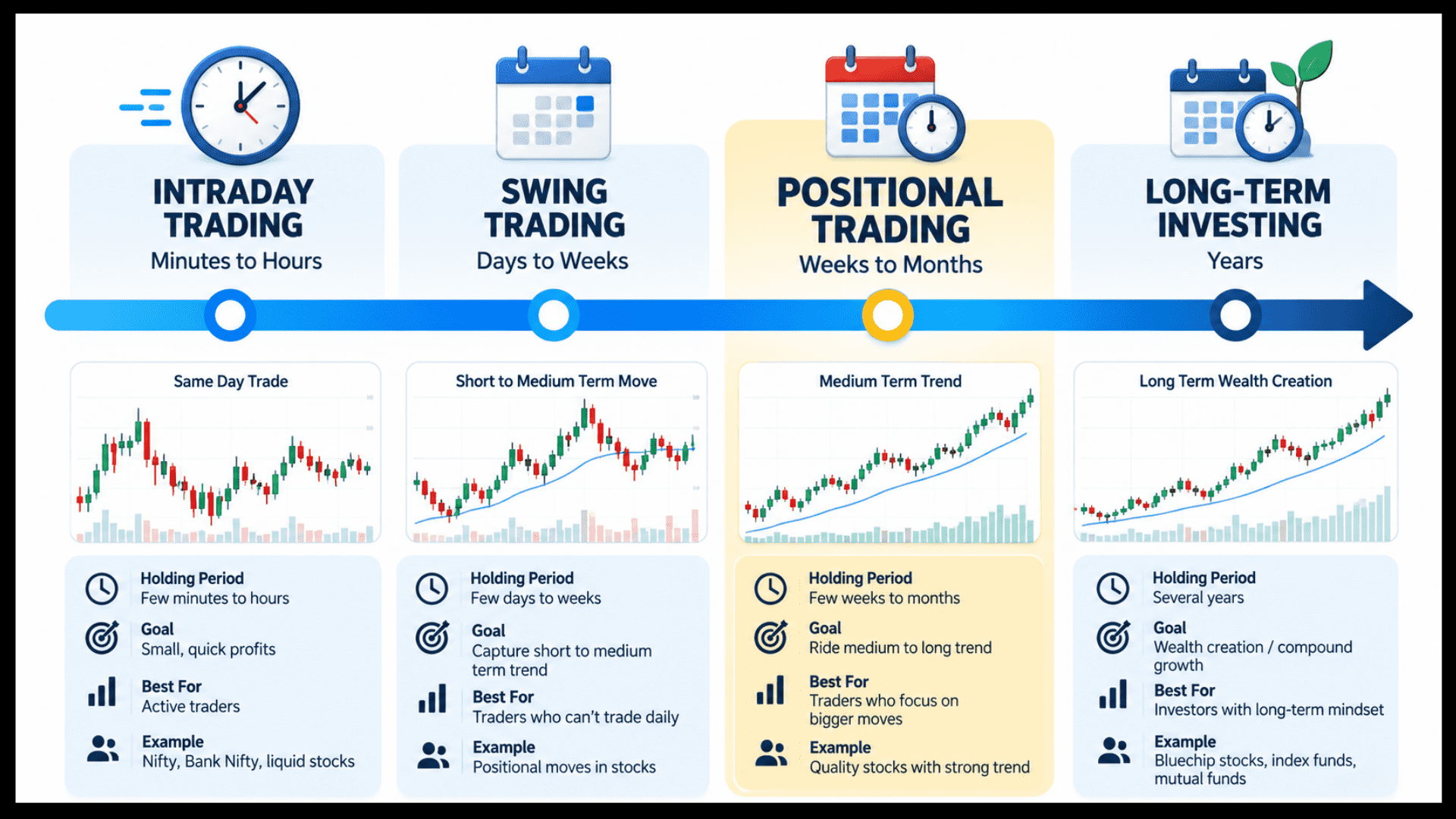
To see how positional trading stacks up against other approaches, here is how each style compares across timeframes:
- Intraday trading: you close every position the same day. You carry no overnight risk, but you need constant attention.
- Swing trading: you hold for days to a few weeks. You use daily charts and need less time on the screen.
- Positional trading: you hold for weeks to months. You use weekly charts and accept wider stops.
- Long-term investing: you hold for years. Business quality matters more than the chart.
How Does Positional Trading Work Step by Step?
The method is simple to describe. It is harder to follow with discipline.
You confirm that the market and sector trend up. Next, pick a stock with a clean weekly uptrend.
You enter on a pullback or a breakout, set a stop loss, and trail your exit as the trend develops.
Each step has its own detail. Our guide to a positional trading strategy walks through the full plan with worked examples.
Essential Tools for Positional Trading to Keep Your Charts Clutter-Free
Positional traders keep their toolkit small. Most rely on a handful of simple tools.
To keep your analysis clean and free of clutter, here are the five core components every positional trader needs:
- Weekly and daily charts to read the trend
- 50-day and 200-day moving averages to judge trend strength
- Volume to confirm breakouts
- Support and resistance to place stops
- One momentum indicator such as weekly MACD
Many traders prefer weekly MACD because it keeps them on the right side of the main trend.To add it to your setup, learn how to use positional trading with MACD
Why Stock Selection Matters More for Positional Trading Success?
Stock choice matters more here than in short-term styles, because you hold longer.
A weak choice stays on your books for weeks.
Traders usually screen for liquid stocks in strong sectors with rising earnings and a clean weekly uptrend.
Learning how to select stocks for positional trading is one of the first skills worth building.
Our guide on how to select stocks for positional trading lays out a six-step screen.
Pros and Cons of Positional Trading
Every trading style comes with trade-offs. Positional trading gives you time and bigger moves, but asks for patience in return.
The next two sections cover the advantages first, then the risks you must plan for.
Why Traders Choose This Style
Positional trading has real strengths, especially for people with limited screen time.
To see why many traders prefer this approach over short-term strategies, here are the core benefits you gain:
- Less screen time. You check charts a few times a week, not all day.
- Lower costs. You make fewer trades, so brokerage and charges add up less.
- Larger moves. You aim to capture 15% to 50% or more from a strong trend.
- Less noise. Weekly charts filter out most daily random moves.
Risks You Must Plan For
No style is free of risk. Positional trading has its own.
To ensure you are fully prepared for the challenges of multi-week holding periods, here are the key risks to keep in mind:
- Gap risk. News can move a stock sharply overnight or over a weekend, past your stop.
- Capital lock-in. Money stays tied up for weeks while a trade develops.
- Patience. Sitting through a pullback without reacting is harder than it sounds.
- Event risk. Results and policy announcements can hit a position you hold.
Position sizing and a stop loss on every trade manage most of these risks. They do not remove them.
Positional Trading Best For?
Positional trading suits people who cannot watch the market all day.
Working professionals, business owners and students often prefer it.
It also suits people who prefer fewer, more considered decisions.
If constant action stresses you, this pace may feel calmer.
Evaluating positional trading vs day trading highlights how different styles demand varying levels of screen time and emotional discipline.
It does not suit someone who needs quick results. Trends take time, and some trades go nowhere for weeks.
Inside a Positional Trader’s Week
A positional trader does not sit at a screen. The work happens in short blocks.
On the weekend, they review weekly charts and update stop losses.
Some traders use AI tools for positional trading to screen sector trends and shortlist charts faster.
During the week, they check open positions briefly and place orders only for confirmed setups.
That adds up to a few hours a week, which is why the style suits people with jobs and businesses.
Why Do Market Trends Last Long Enough to Trade?
Large moves in a stock rarely happen in one day.
Institutions build positions over weeks, and news and earnings feed into prices gradually.
That slow build creates trends. A positional trader tries to join a trend after it shows itself, and stays until it fades.
Trends do not always persist. Many fail, which is exactly why the stop loss matters.
How Much Can You Earn From Positional Trading?
Nobody can promise a return, and anyone who does deserves suspicion.
Results depend on your skill, your discipline, and the market.
What you can control is your risk. You choose how much to lose on each trade, and you choose to cut losers early.
A common goal is to keep losses small and let a few winners run. Over many trades, that asymmetry drives results.
Can You Do Positional Trading With a Full-Time Job?
Yes, and many people do. The style needs no intraday attention, because you read weekly and daily charts outside market hours.
You need a weekend review, a few evening checks, and pre-set stop orders.
You can place stop orders in advance, so market hours do not force your hand.
Start small. Learn the routine on a few positions before you scale up.
What Should Beginners Learn First?
Before you build a full positional trading strategy, start with trend reading. Every other tool depends on it.
Then learn support and resistance, volume, and one moving average.
Add a stop loss and position sizing rule before you place a real trade.
Do not add ten indicators. They slow you down and rarely add an edge.
Top Myths About Positional Trading You Should Stop Believing
“It is just long-term investing.” It is not. You use technical entries and exits, and you leave when the trend breaks.
An investor may hold through the break.
When evaluating positional trading vs long-term investing, remember that technical trendlines dictate your exits rather than long-term business fundamentals.
You can ignore the position once you buy.” Not true. You still need to trail stops and watch for events.
“Positional trading is low risk.” It is different, not lower.
You trade fewer times, but each position carries more overnight exposure.
Positional Trading for Beginners: How to Plan Your First Month
Start with the basics, and keep your first month low-stakes. You are learning a process, not chasing a return.
Open a demat and trading account if you do not have one.
Learn to read a weekly chart, and mark trends, supports and resistances on five or six stocks.
Then paper trade for a few weeks. Write down each entry, stop and exit as if the trade were real.
When you place your first live trade, keep the size small. Your goal is to follow your rules under real pressure.
Positional Trading Risk Management: Handling News and Leverage
Holding for weeks means your position lives through nights, weekends and news cycles.
The next two sections explain how to plan for overnight news and why borrowed money needs extra caution.
How Do Positional Traders Handle Overnight News?
You cannot avoid overnight news, but you can plan for it.
Know the dates of results and policy announcements before you enter.
Reduce your position size ahead of a major event, or stay out until it passes.
Use stop orders, but remember that a gap can open beyond your stop price.
That gap is the price of holding for weeks. Small position sizes keep it affordable.
Should You Trade Positions With Borrowed Money?
Avoid leverage while you learn. Borrowed money magnifies both gains and losses.
A long holding period gives losses time to grow.
Use your own capital that you can afford to risk.
Add derivatives only after you understand the risks of time decay and margin.
Leverage is a tool for experienced traders with strict rules. It is not a shortcut.
Want to Learn Positional Trading With Live Guidance?
Understanding the meaning is the first step.
Applying it on a moving chart, with real money at stake, is the second.
Our positional trading classes for beginners take you from these basics to live setups on Indian stocks.
Conclusion
Positional trading means holding a stock for weeks to months to ride a trend, not a single day’s move.
It sits between intraday trading and long-term investing, and it suits people with limited screen time.
The method rests on a few habits: read the weekly trend, pick liquid stocks in strong sectors, enter with a stop loss and trail your exit.
Returns are never guaranteed, but risk is always yours to control.
Start small, paper trade first and let discipline, not excitement, decide every trade.
Frequently Asked Questions
Before investing capital, invest your time in learning Stock Market.
Fill in the basic details below and a callback will be arranged for more information: