


When comparing positional trading vs. long-term investing, both approaches involve holding a stock for longer than a day.
However, that is often where the similarities end.
Deciding between them really comes down to one thing: how long are you willing to stay in a position?
Get this right, and you pick the approach that fits your time and your money. Not just the one that sounds better on paper.
Positional Trading vs Long Term Investing: How Long Should You Hold?
This one number decides almost everything else in this comparison.
If you are still working out what positional trading is, the holding period is the easiest place to start.
If you are still working out what positional trading is, the holding period is the easiest place to start.
A positional trade usually runs from a couple of weeks to a few months. Sometimes it stretches close to a year, if the trend keeps going.
Unlike the constant, screen-glued pressure of intraday sessions, exploring positional trading vs day trading reveals a much calmer alternative—letting you capture market moves without giving up your day job or staring at charts all day.
A long-term investment is measured in years. Often five, ten, or longer.
There is no plan to exit just because the price wobbles for a week.
That gap changes how each side reacts to a bad week in the market. A positional trader watches a stop loss. A long-term investor checks the business instead.
Some traders also rely on positional trading with MACD, a slower signal, to judge when a trend is fading.
A long-term investor has no equivalent signal to watch, since price movement alone rarely changes their view.
Key Differences Between Positional Trading And Long-Term Investing
Reading through the details above helps. But a quick side-by-side view often makes the choice clearer.
Both styles involve buying stocks and holding them, but they differ in how long you stay invested, why you exit, and how you’re taxed.
The table below compares them across six practical factors.
| Factor | Positional trading | Long-term investing |
|---|---|---|
| Typical holding period | A few weeks to a few months | Several years or more |
| What triggers an exit | A technical signal or stop loss | A change in the business itself |
| Time needed per week | A few hours, mostly on weekends | Very little, checked quarterly or yearly |
| Tax treatment in India | Usually short-term capital gains | Long-term capital gains after one year |
| Main skill needed | Chart reading and discipline | Business judgement and patience |
| Risk exposure | Overnight and weekend gaps, capped by a stop | No stop loss, risk tied to the business itself |
How to Choose Between Positional Trading and Long-Term Investing?
The table gives you the summary. Now let’s unpack each difference one by one.
We start with how you exit, then move to time, tax, skill and risk. Each one pulls you towards a different side.
Every strategy demands a different reason to sell.
Here is how active chart exits compare to waiting out business shifts.
1. The Exit Trigger: Chart Signal or Business Change?
This is where the two approaches think in completely different ways.
A positional trader exits on a technical signal. A broken trend line. A close below a moving average. A stop loss getting hit.
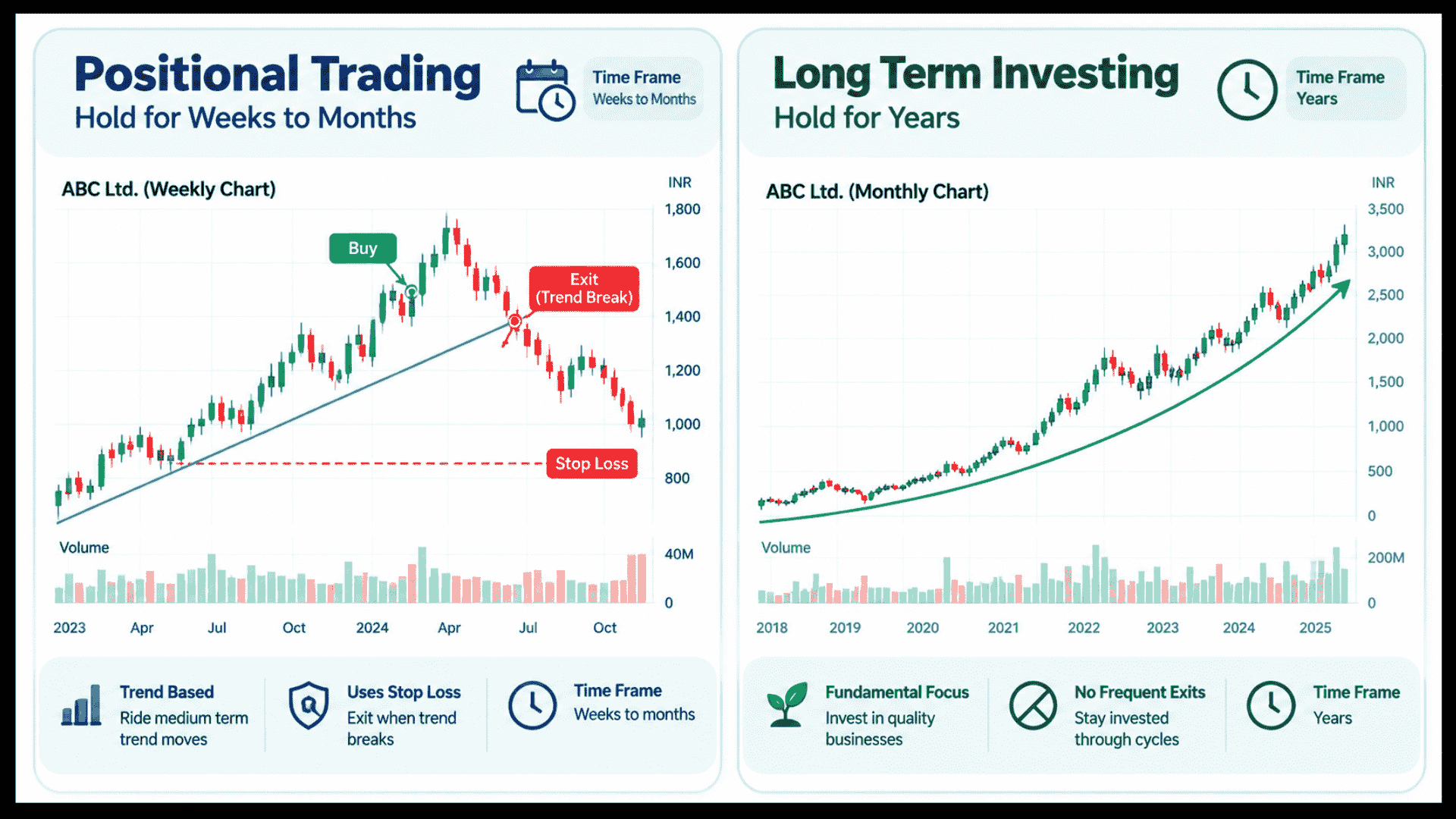
The chart makes the call.
A long term investor exits when the business itself has changed for the worse. Not because the stock had a rough month.
Price alone rarely triggers the decision.
2. How Much of Your Week Does Each One Actually Take?
Neither one needs your full attention during market hours. But they are not equally hands-off either.
Positional trading needs a real weekly habit. You review charts. You check stop losses.
You rebuild your watchlist now and then, using a process like the one in our guide on how to select stocks for positional trading.
Long term investing needs far less. A check every quarter, or even once a year, is usually enough.
Mostly reading results. Mostly confirming the business still looks the way you expected.
3. Does the Taxman Treat Them Differently?
This is one of the more concrete differences. Worth knowing before you assume the two are financially similar.
In India, gains on equity held under a year are taxed as short-term capital gains. Most positional trades fall into this bucket.
Long-term investments, held for more than a year, get long-term capital gains treatment. That currently carries a lower tax rate.
This one detail can change your actual take-home return, even when the raw gain on paper looks the same.
4. Chart Skill vs Business Skill: Which One Do You Have?
Both need skill. Just different kinds. It helps to be honest about which one you are actually good at.
Positional trading leans on reading charts well. It leans on following the rules in our positional trading strategy.
It rewards discipline under a moving price, and not second-guessing a stop loss the moment it gets hit.
Long-term investing leans on reading a business well. It rewards patience through a correction, more than quick reaction to a falling price.
5. Which Is Safer?
Not really comparable. Calling one simply “safer” than the other misses the point.
A positional trade carries overnight and weekend gap risk on every position.
News can move a stock while the market is shut. You can do nothing about it until it reopens.
But each loss is usually capped, since you set a stop loss in advance.
A long term investment does not use a stop loss at all.
A genuinely bad business decision can sit uncorrected for a long time before anyone notices. The risk just shows up differently.
Positional Trading Actually Safer Than Long-Term Investing?
In practice, most people don’t choose only one. This is probably the most useful takeaway from this whole comparison.
Many traders run a long-term portfolio quietly in the background. Built through SIPs or direct equity. Left mostly alone.
Alongside it, they keep a smaller amount of capital for active positional trades.
Some even use positional trading with AI to speed up research on that active side.
This split matters for one reason. Your financial future should not depend entirely on your trading skill improving quickly.
Which Style Fits You Better: Trading or Investing?
Ask yourself one question first. Do you want to actively manage a position, or would you rather set it and mostly forget it?
If you enjoy following a chart and reacting to it, positional trading rewards that instinct.
If you would rather judge a business once and hold through the noise, long term investing suits you better.
Most people are not purely one or the other. Knowing which pull is stronger in you is a good starting point.
A Worked Example For Positional Trading vs. Long-Term Investing
Suppose two people each put ₹2,00,000 into the market on the same day. These figures are illustrative and not a recommendation.
The first buys a stock after a clean weekly breakout, sets a stop-loss, and treats it as a positional trade.
Over four months the stock climbs 22%, then breaks its trend line. They exit, book the gain, and pay short-term capital gains tax on it.
The second buys shares in the same company as part of a long-term portfolio.
They ignore the same 22% rise entirely, since their plan was always to hold for years.
They do not check the chart weekly. They check the annual report once a year instead.
Both approaches can work. They simply ask something different of the person doing it.
Not Sure Where Your Capital Should Actually Go?
Reading about the difference is easy. Deciding what fits your own goals takes a bit more thought, and some practice.
Our positional trading classes teach the active side of this comparison. Live, so you can see if it is genuinely for you.
Conclusion
Positional trading and long-term investing both ask you to hold through some discomfort, just on very different timelines.
A positional trader reads the chart, sets a stop loss and exits on a technical signal.
A long-term investor judges the business once and holds for years, paying lower tax on gains held over a year.
Neither is the better choice.
Pick the one that matches how you want to spend your time, or run both side by side, with a steady long-term portfolio and a smaller active account.
Frequently Asked Question
Before investing capital, invest your time in learning Stock Market.
Fill in the basic details below and a callback will be arranged for more information: