


More traders now open ChatGPT or Claude before they even open their charts because positional trading with ai has become a real habit today. It is not a gimmick.
This post will not tell you AI can pick your next winning stock. It cannot do that.
What it can do is save you time on the reading and thinking part of positional trading.
It cannot help with the part that needs a live price on your screen.
How Positional Trading with AI Fits Into a Trader’s Routine?
Anyone who has asked what positional trading is knows it moves at a slower pace than day trading.’
For anyone wondering how execution speeds differ when deciding between positional trading vs day trading, this slower tempo changes the entire analytical approach.
You check charts a few times a week, not every hour.
That slower pace is exactly where AI tools fit.
You have time to ask a question and read the answer properly.
This pace is also why some traders run a positional account alongside a quiet, buy-and-hold approach.
Our post on positional trading vs long term investing covers that trade-off in full.
Both styles leave room for this kind of thinking time.
Treat AI as a second pair of eyes on your homework. Do not treat it as a trading terminal.
Practical Ways Positional Trading with AI Saves You Time
A few tasks come up again and again for positional traders.
These are the ones worth handing to an AI assistant.
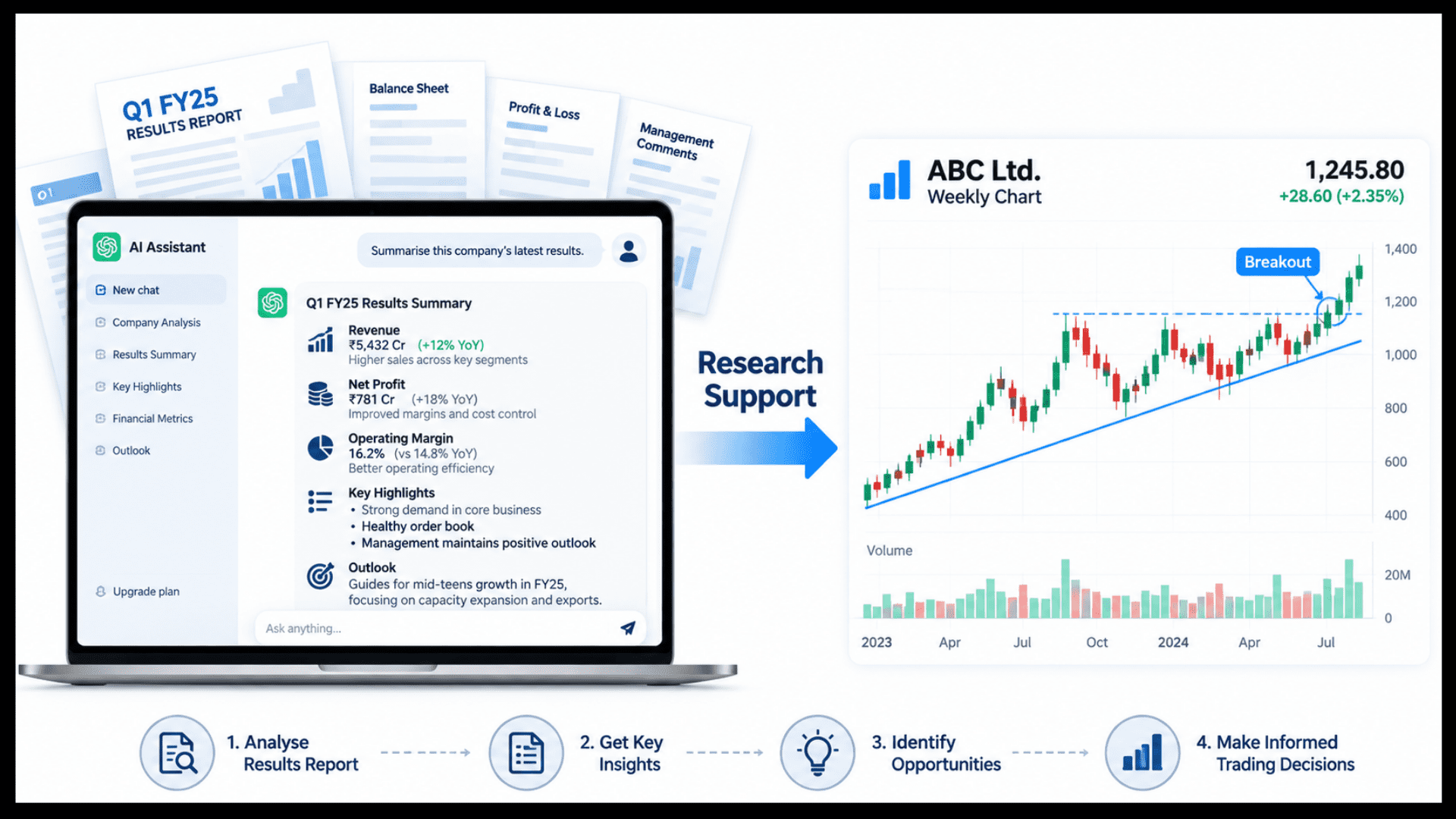
Instead of spending an hour digging through balance sheets and management commentary, here is how you can streamline your fundamental research in minutes:”
How Positional Trading with AI Simplifies Reading Quarterly Results
Positional trades often run through an earnings date.
That is exactly why checking the event calendar matters, a step we cover in our guide on how to select stocks for positional trading.
Paste the results commentary into Claude or ChatGPT. Ask what changed from last quarter.
You save real reading time.
Breaking Down a Setup You’re Unsure About
Say you are not sure why a golden cross matters.
Or how the setup in our post on positional trading with MACD actually forms.
Ask an AI assistant to explain it in plain words first.
Then go check it on a live chart yourself.
Organizing Your Watchlist and Trading Journal with Positional Trading with AI
You can ask for a simple template to log entries and exits against your own positional trading strategy.
Structuring ten stocks worth of notes is exactly the kind of task AI handles well.
Summarising a Busy Week of Sector News
A sector you follow had a busy week. Paste in the headlines.
Where AI Falls Short in Positional Trading
This is the part most articles on this topic skip.
It matters more for positional trades than for almost any other style.
While AI speeds up your research, it completely misses the live pulse of the market,
which brings us to our first major limitation:
It Usually Has No Live Chart Data
Unless the tool is connected to a market feed, it cannot see today’s price.
It cannot tell you where a moving average sits right now. Always check that yourself.
It Cannot Judge Your Specific Chart
You can describe a setup in words. The AI is not looking at your candles or your volume bars.
It only works from what you type.
Is Not a SEBI Registered Adviser
Nothing it says should be treated as personal investment advice.
That is not a small print detail. It is simply true.
Its Training Has a Cutoff Date
Fresh news, a new RBI move, or last week’s results are not automatically known to it.
You need to paste that in yourself, or use a tool with live search.
How to Approach Positional Trading with AI Safely?
The traders getting real value from this treat AI as one small step. Not the whole process.
Your charting platform still does the actual chart reading.
Your own positional trading strategy still decides the entry, the stop and the exit.
AI sits beside all of that. It explains, summarises and organises. It does not decide for you.
Even people who build AI tools for a living stay cautious here. Bridgewater’s co-CIO Greg Jensen has said as much publicly.
His own firm invests heavily in AI.
He has called relying on a chatbot alone for stock picks a “hopeless path.”
His reason is simple. A chatbot cannot reliably see a major market turn coming.
That is a fair warning from someone who uses these tools every day.
Real Scenarios Where Positional Trading with AI Works Best
Knowing what AI can and cannot do is only half the battle.
Here is how these boundaries look in practice during a normal trading week
Scenario 1: Holding a Stock Through Quarterly Results
Say you are holding a stock through its quarterly results.
This happens often in positional trading, since your holding period usually runs past an earnings date.
That is unlike the same-day exits covered in our post on positional trading vs day trading.
After pasting the results commentary into Claude, ask it what changed in margins and guidance since last quarter.
Within a minute, you will have a clear summary. From there, open your own chart to see how the stock actually reacted.
Finally, decide whether to hold or exit using your own stop loss rule.
AI did the reading. You did the trading.
Scenario 2: Building a Pre-Buy Research Checklist
Suppose you want a consistent way to review each stock before you buy, a core part of how to select stocks for positional trading.
You ask an AI assistant to help draft a checklist.
It might suggest checking the trend, the sector, the volume, and one momentum signal, like the crossover used in positional trading with MACD.
That is a reasonable starting list.
You then apply that checklist to real, current charts yourself.
The AI helped you organise the thinking. It did not do the analysis for you.
Scenario 3: Learning From Your Own Trading Mistakes
Keeping a trading journal is good practice.
Reading it back and actually learning from it is where most traders fall short.
You can paste in a few months of trade notes and ask an AI assistant to spot patterns.
Maybe you keep exiting winners too early. Maybe you keep ignoring the sector trend before you enter.
An AI assistant reading plain text can surface a pattern faster than you scrolling through old notes.
It cannot fix the habit for you. Only repetition and discipline do that.
Want Guidance That Actually Looks at Real Charts With You?
AI is a decent research companion.
It does not watch a live chart with you, and it will not catch a setup forming in real time.
Our positional trading classes for beginners do exactly that. Live, on real Indian stocks.
Conclusion
Positional trading with ai works best when you keep the roles clear.
AI can speed up the reading and thinking side of your process, from explaining a setup and summarising quarterly results to organising your trading journal.
What it cannot do is watch your chart, know today’s price, or make the final call for you.
Use it as a research assistant that sits beside your own process, not one that replaces it.
The charts, the rules, the stop loss and the final decision still belong to you, and that is exactly how it should stay.
Frequently Asked Question
Before investing capital, invest your time in learning Stock Market.
Fill in the basic details below and a callback will be arranged for more information: