



You open a company’s numbers and see a minus sign next to free cash flow. Naturally, you ask: what does it mean when free cash flow is negative, and should you worry?
The short answer: the business spent more cash on its assets than its operations brought in that year. However, that can be healthy or worrying, depending on why.
Negative Free Cash Flow Meaning
Free cash flow (FCF) is operating cash flow minus capital expenditure (capex). So, if capex is bigger than operating cash flow, FCF turns negative.
We will not rebuild the basics here. If you need them first, read what free cash flow means and come back.
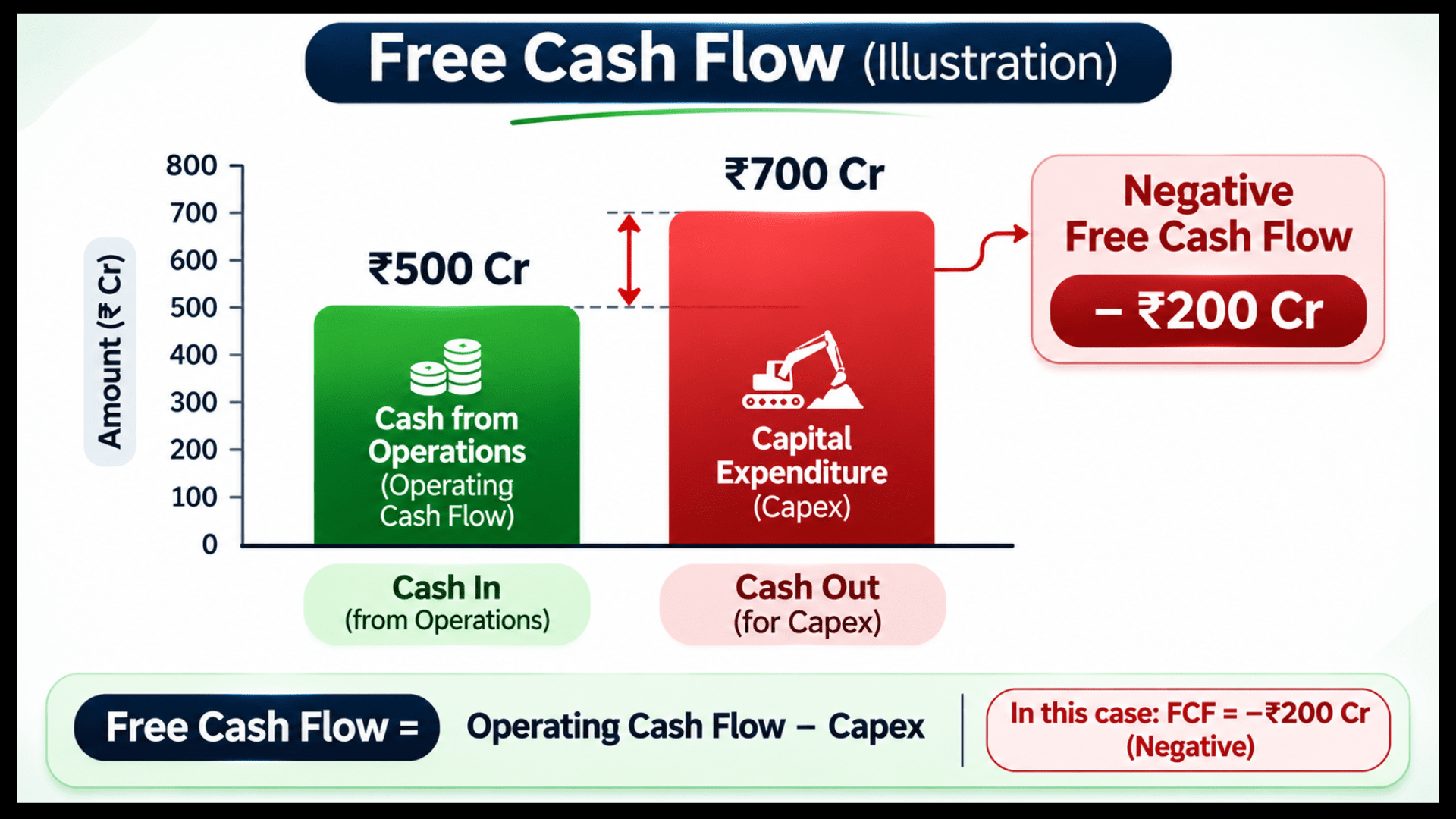
Negative FCF is a question, not a verdict. Therefore, the useful part is finding which story sits behind the number.
Why Does Free Cash Flow Turn Negative?
There are four common reasons. Each looks the same in the final figure, yet each means something very different.
- Heavy capex for growth. The company is building a plant, opening outlets or buying machines.
- Weak operations. The core business itself is not generating enough cash.
- Working capital build-up. Cash is stuck in unsold inventory or unpaid customer bills.
- A one-off event. A large single purchase or a delayed collection hits one year.
Heavy Capex for Growth
A growing business often spends today to earn tomorrow. As a result, the cash leaves now, while the extra sales arrive in later years.
Here, operating cash flow can be perfectly healthy. Only capex is large.
Weak Operations
Sometimes even small capex pushes FCF below zero, because operating cash flow is itself negative or thin. This is the pattern that needs closer attention.
In this case, the business is paying its bills from borrowed money or old savings.
Working Capital Build-Up
A company can report a good profit and still run short of cash. For example, if customers pay late or inventory piles up, cash gets locked in the balance sheet.
For the profit side of this story, see how free cash flow differs from profit.
One-Off Events That Distort a Single Year
A single large land purchase can distort one year. Likewise, a big customer payment arriving a week after year end can do the same.
Fortunately, one-offs fade when you look at several years together.
Why Growing Companies Have Negative Free Cash Flow
When growth capex is behind the minus sign, negative FCF can simply be the price of expansion. Still, the key is whether operating cash flow is healthy and rising.
Look at the illustration below. All numbers are hypothetical, for illustration only, in Rs crore.
The formula used: FCF = operating cash flow (OCF) minus capex.
| Company | Operating cash flow | Capex | Free cash flow | Likely story |
|---|---|---|---|---|
| Company A | 120 | 200 | -80 | Growth capex, healthy operations |
| Company B | -30 | 40 | -70 | Weak operations |
| Company C | 20 | 30 | -10 | Cash locked in working capital |
All three show negative FCF. Yet Company A is investing from a position of strength, and Company B is burning cash.
Meanwhile, Company C has a collection or inventory issue.
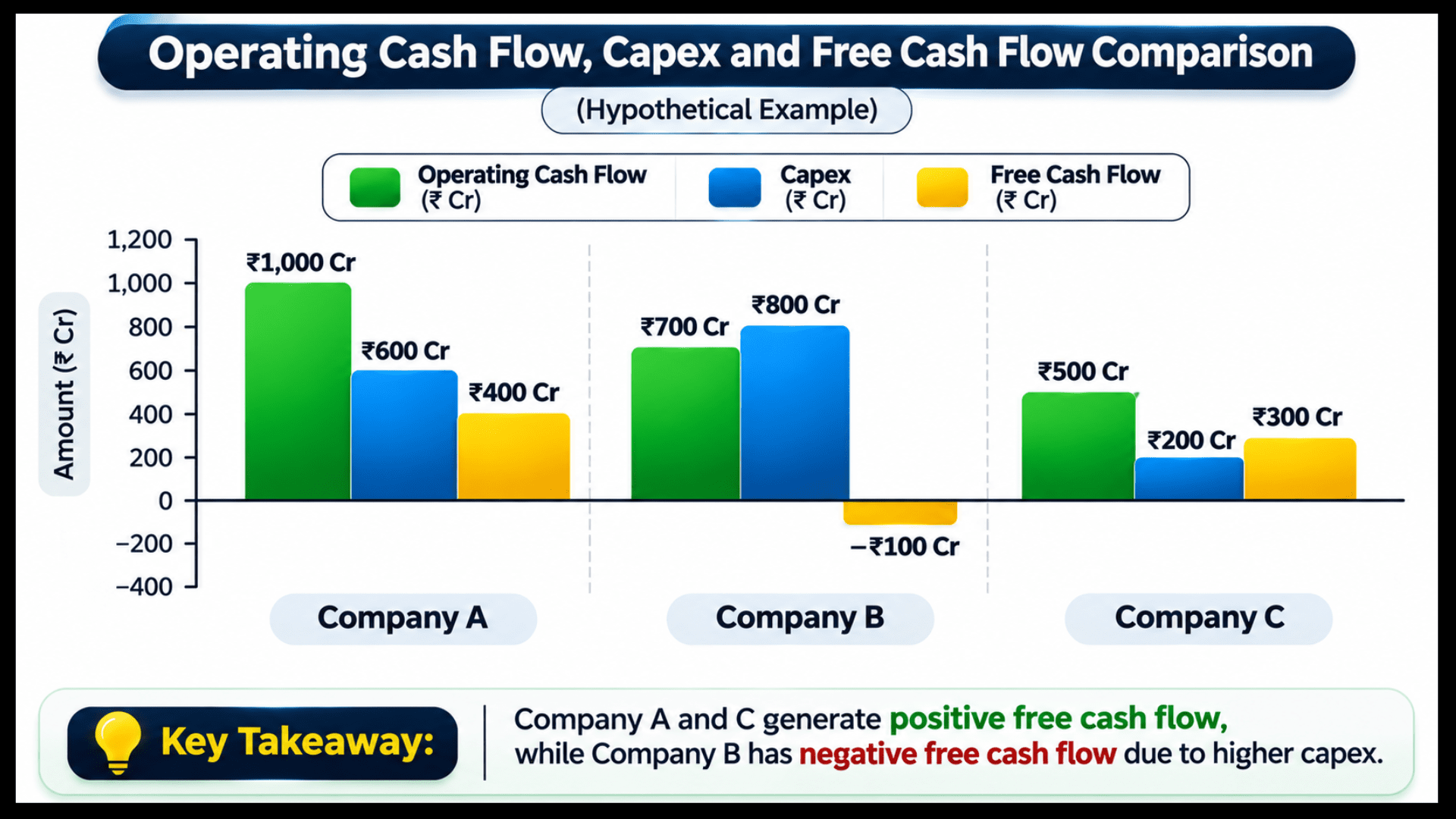
The size of the negative number alone tells you very little. In contrast, the reason behind it tells you a lot.
Is Negative FCF Good or Bad?
A single negative year is rarely enough to judge anything. Instead, the pattern over several years matters far more.
Patterns that are often read as more comfortable:
- Operating cash flow positive and growing while capex is high.
- FCF improving year after year as new capacity starts earning.
- Capex that is clearly linked to a stated expansion plan.
Patterns that usually deserve more questions:
- Operating cash flow negative or shrinking for several years.
- FCF negative every year with no sign of improvement.
- Profit rising steadily while operating cash flow stays flat.
This is a general reading guide, not a rule. After all, every business and sector has its own rhythm.
Besides, the same minus sign reads differently once you know the Free Cash Flow Meaning and its formula.
When Free Cash Flow Stays Negative Is Good Growth or a Red Flag?
A longer run of negative FCF changes the question. One year of heavy capex is a phase, but many years without improvement is a pattern.
See how a hypothetical Company A moves over three years.
| Year | Operating cash flow | Capex | Free cash flow |
|---|---|---|---|
| Year 1 | 80 | 200 | -120 |
| Year 2 | 120 | 200 | -80 |
| Year 3 | 170 | 150 | 20 |
All figures are in Rs crore, for illustration only. Here, operating cash flow rises each year, capex falls in Year 3, and FCF turns positive.
However, if operating cash flow had stayed near 80 while capex stayed at 200, the minus sign would repeat.
That would be a different story.
Quarterly numbers can also swing a lot, so avoid reading too much into one quarter. In fact, the impact of quarterly results on share price shows why short-term numbers can mislead.
What to Check When Free Cash Flow Turns Negative
A red number can make anyone nervous, so stay calm and check the story behind it. A few follow-up checks usually give you the answer.
- Operating cash flow trend. Is it rising, flat or falling across three to five years?
- Capex purpose. Is the spending for expansion, or only to keep old assets running?
- Debt and interest. Is the gap being filled by borrowing, and can the company afford the interest?
- Funding source. Did it come from fresh equity, loans or its own cash balance?
- Capex plan. Does the company expect spending to slow down, and is that believable?
- Working capital. Are receivables and inventory growing faster than sales?
Debt matters especially. After all, a company funding capex with heavy borrowing carries more risk than one funding it from healthy operations.
Next, compare debt with owners’ money, because tools like the DuPont approach help you see the role of leverage. Here, DuPont analysis shows how.
Is Negative Free Cash Flow Bad?
Not by default. In fact, many businesses that later became strong ran negative FCF in their building years.
Negative FCF turns concerning when:
- It continues with no improving trend.
- Operating cash flow is the weak part.
- The gap is covered mainly by new debt.
- Management gives no clear capex plan.
Borrowing also gets costlier when rates rise. Therefore, the impact of interest rate on the stock market is worth knowing for debt-funded companies.
The same minus sign can be a sign of ambition or a sign of strain. Context decides.
Company C in our table shows another angle. Suppose its net profit is 90, yet its operating cash flow is only 20.
The reason: 70 got locked in receivables and inventory.
As a result, the profit looks fine, but the cash tells the real story. Remember that a business does not run on profit alone. It runs on cash.
Common Mistakes When Reading Negative FCF
Beginners often draw quick conclusions from one number. Here are the usual traps.
- “Negative means the company is failing.” Not always. Growth capex can cause it.
- “Positive means the company is safe.” Not always. FCF can be positive because a company cut capex and is starving its future growth.
- Looking at one year. One year can be a one-off, so check at least three to five years.
- Ignoring the definition. Some sources adjust FCF for interest or lease payments, so two sites may show different figures for the same company.
- Comparing across sectors. Capex-heavy sectors will often show lower FCF than asset-light ones.
A full-picture read also pairs cash flow with the other statements. If you want a structured way to do that, you can learn fundamental analysis step by step.
How Negative FCF Fits Into Your Overall Stock Analysis
FCF is one input. Besides, it sits next to profit, debt, returns on capital, management quality and valuation.
Value-minded investors, for instance, often like to see whether a business can eventually turn its investments into cash. Similarly, the ideas behind value investing vs growth investing explain why cash generation over time matters.
Also remember that this is not a buy or sell signal. Estimates can be wrong, and past improvement does not guarantee future improvement.
Comparing Free Cash Flow and Operating Cash Flow
Negative FCF with strong operating cash flow is a very different thing from negative FCF with weak operating cash flow. Unfortunately, many readers mix the two.
If you want the side-by-side view, our comparison of free cash flow vs. operating cash flow helps.
It lays out the exact difference with a table.
Questions to Ask When You See Negative FCF
Ask three questions each time you meet a minus sign:
- Why is it negative: growth, weak business, working capital or a one-off?
- For how long has it been negative: one year or many?
- How is it funded: from operations, cash balance, equity or debt?
If the answers are clear and reasonable, a negative year may be nothing to fear. Otherwise, dig deeper before forming a view.
Reading about FCF is easy, but real statements and a mentor’s answers are what build confidence.
Join our live classes from your mobile, ask your doubts and learn step by step.
Conclusion
So, a negative FCF is not automatically bad. It simply means a company spent more cash than it generated, and the reason decides everything.
In short, check the cause, the trend and the funding. As a result, you can tell a growing business from a struggling one.
Also, never judge a company on one year or one number. Instead, read FCF alongside profit, debt and operating cash flow.
Finally, practise on real statements, because that habit turns this knowledge into confidence. Remember, this is learning, not a buy or sell signal.
Disclaimer: This article is for education only. All numbers are hypothetical and for illustration only.
It is not investment advice or a recommendation to buy, sell or hold any security. So, please do your own research or consult a SEBI-registered adviser.
Frequently Asked Questions
Before investing capital, invest your time in learning Stock Market.
Fill in the basic details below and a callback will be arranged for more information: