



The 5 8 13 EMA Crossover Strategy was built for traders who are tired of entering late.
Imagine watching a stock rally 4% and realizing you saw the signal but hesitated; that hesitation costs traders more money than any bad trade ever does.
Three exponential moving averages work together to catch momentum early and clearly.
The chart stays simple, the signals stay sharp, and the rules stay consistent. It works for intraday traders, scalpers, and anyone who trades short-term momentum.
You don’t need ten indicators to trade well, but you need the right three.
Let’s break down this strategy completely.
What is a 5 8 13 EMA Strategy?
Markets hardly follow straight lines. They beat, rest, and beat again. The 5 8 13 EMA Crossover Strategy is constructed in such a way that they capture those short bursts of momentum at an earlier stage.
It uses three exponential moving averages:
- 5 EMA for fast price reaction
- 8 EMA for short-term balance
- 13 EMA for trend confirmation
Many traders first encounter a standalone 5 EMA strategy for catching quick reversals, but combining it with the 8 and 13 EMAs provides a layer of trend confirmation that a single line lacks.
Unlike a simple moving average, the moving average calculation for an EMA gives more weight to recent price data, which is why this specific setup is popular, because it shows momentum shifts clearly.
When all three lines align, the trend often gains strength.
So, what is a 5 8 13 EMA strategy in simple terms? It is a high-frequency system that assists traders in getting in during a trend early on but keeps the risk narrow.
Why 5, 8, and 13? The Fibonacci Connection
The 5, 8 and 13 are numbers from the Fibonacci sequence (1, 1, 2, 3, 5, 8, 13, 21, 34…).
These numbers naturally appear in markets because a large number of traders and institutions recognize and react to them.
It’s not about prediction, it’s about participation. When many traders react to the same levels, those levels start to matter more in real price action.
Why This 5 8 13 Moving Average Crossover Strategy Works?
Before jumping into rules, it helps to understand why this setup works so well. The logic is simple, but effective. Short EMAs react quickly.
When three of them align, it signals strong directional intent.
The core idea behind this strategy is:
- 5 EMA crosses first, showing early momentum
- 8 EMA confirms the move
- 13 EMA validates the trend
Such an arrangement is not only an indication of a trend, but a long-lasting movement where one can comfortably remain in a position or even accumulate in terms of trading.
The gain starts to pick up, and the price tends to tread along.
This has a little contradiction. The quicker the signal, the earlier the entry, the more there are false signals as well. That’s why filtering matters.
Reading The 5 8 13 EMA Crossover Setup
A 5 8 13 ema crossover strategy chart looks clean but carries strong signals. You don’t need many indicators here.
In fact, fewer indicators often lead to clearer decisions and better execution.
Bullish Crossover:
- 5 EMA crosses above 8 EMA
- 8 EMA crosses above 13 EMA
- Price starts holding above all three
Bearish Crossover:
- 5 EMA crosses below 8 EMA
- 8 EMA crosses below 13 EMA
- Price stays below all three
These crossovers help traders identify the start of a strong trend early. Watching all three EMAs align provides a clearer signal and reduces the chances of entering false moves.
“Full Sail”: When The Signal Is Strongest:
The “Full Sail” condition is where this strategy shows its true strength. It arises in instances when all three EMAs coincide in their position (5 > 8 > 13), with it being in an upward trade as it is positioned above all the EMAs, demonstrating strong bullish momentum.
The trend still stands even when price returns to the 13 EMA, though it holds, providing a high-probability continuation entry.
Such an arrangement is not only an indication of a trend, but a long-lasting movement where one can comfortably remain in a position or even accumulate in terms of trading.
Simple Example:
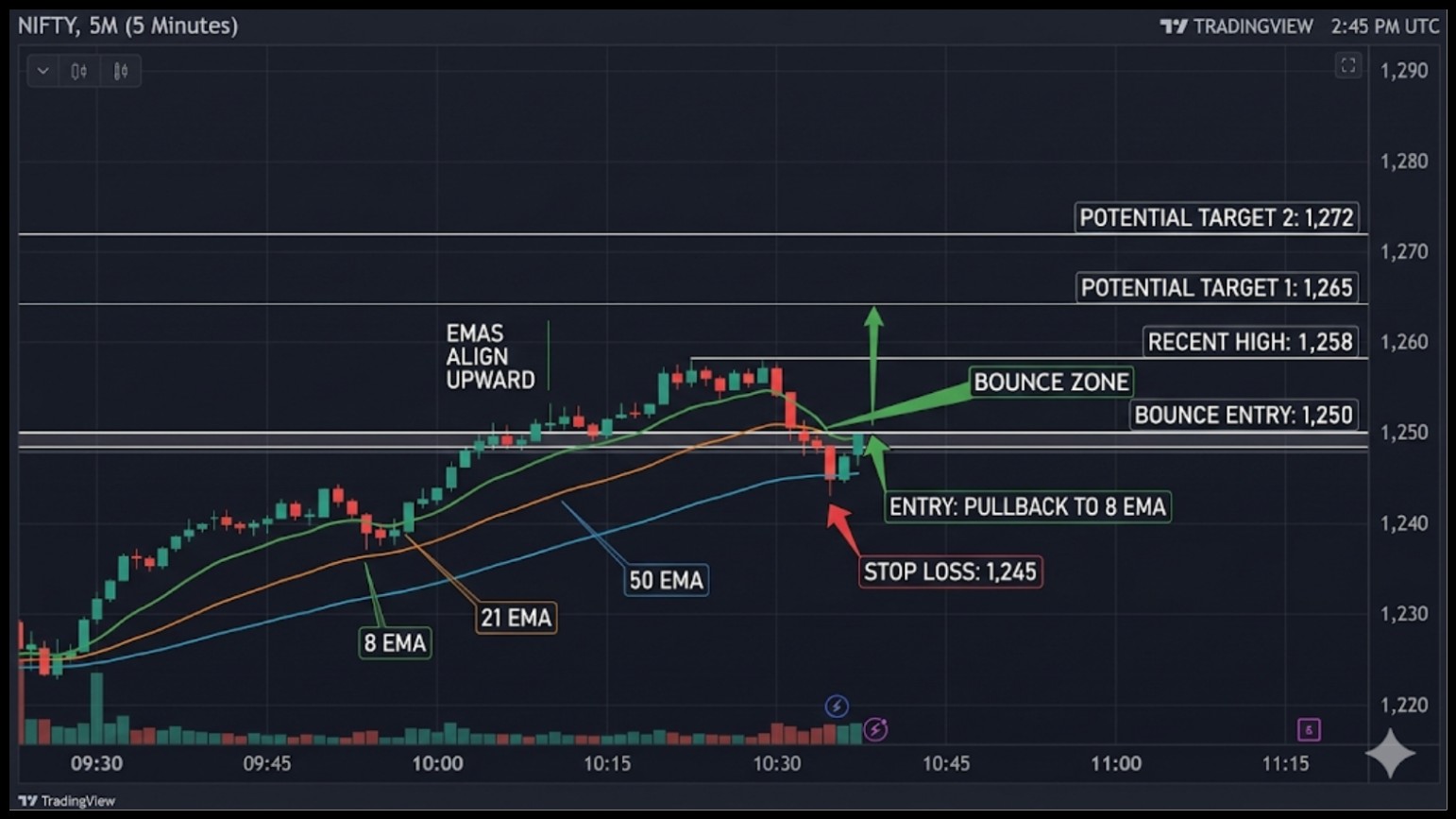
- Stock trades at 1,250
- EMAs align upward
- Price pulls back to the 8 EMA and bounces
That bounce becomes a potential entry. The structure is simple, but timing matters. Properly timing the entry can turn a small pullback into a profitable move, while mistiming may lead to early exits or false signals.
5 8 13 EMA Crossover Strategy Rules
Rules keep emotions in check. Without them, even a good system fails. Following clear rules ensures you enter and exit trades consistently, turning a simple setup into a disciplined strategy.
Entry Rules:
- Enter buy when 5 > 8 > 13 and price pulls back
- Enter sell when 5 < 8 < 13 and price rallies
- Wait for a confirmation candle
Exit Rules:
- Aggressive exit: When the 5 EMA crosses back below the 8 EMA (in a buy trade), this signals early momentum loss
- Conservative exit: when the 8 EMA crosses below the 13 EMA, this confirms the trend has fully reversed
Note: A full signal requires all three EMAs to be stacked in the same direction (5 > 8 > 13 for buys).
If only the 5 EMA has crossed the 8 EMA but the 8 EMA has not yet crossed the 13 EMA, this is a partial signal; wait for confirmation before entering, or skip the trade entirely.
Risk Management Table
| Rule | Explanation |
| Risk per trade | 1 to 2 percent |
| Stop loss | Below the recent swing |
| Reward ratio | Minimum 1:1.5 |
Following these 5 8 13 ema crossover strategy rules helps avoid impulsive trades. Consistency grows from repetition.
1. 5 8 13 EMA Crossover strategy For Short-Term Trades
This strategy shines in fast markets. The 5 8 13 EMA Crossover for Short-Term Trades is widely used in intraday setups.
Because the reaction time is so quick, using an EMA crossover for intraday trading allows traders to catch early momentum shifts and enter trades before the broader market moves, giving a potential edge in quick sessions.
Best Timeframes:
- 1-minute for scalping
- 5 minutes for intraday
- 15 minutes for smoother trades
Why It Works Short-Term:
- Quick reaction to price
- Early trend detection
- Clear entry zones
But here’s the catch. Lower timeframes bring noise. Not every crossover deserves a trade.
Practical Tip: Use a higher timeframe trend as a filter. If the 15-minute trend is bullish, focus only on buy setups in the 5-minute chart.
2. Opening Range Breakout + 5 8 13 EMA
The first 15 to 30 minutes of the session often set the tone for the day. In this phase, price forms an opening range, and a breakout from this range can trigger strong moves.
When this breakout aligns with the 5 8 13 EMA in full sail position (5 > 8 > 13 for buy), it creates a high-probability entry.
Traders typically enter on the breakout candle and place a stop below the range low.
This setup works especially well in Nifty and Bank Nifty during high-volume openings.
Real Trade Example
Let’s bring clarity with a real-style scenario using this 5 8 13 EMA strategy timeframe on a 5-minute chart.
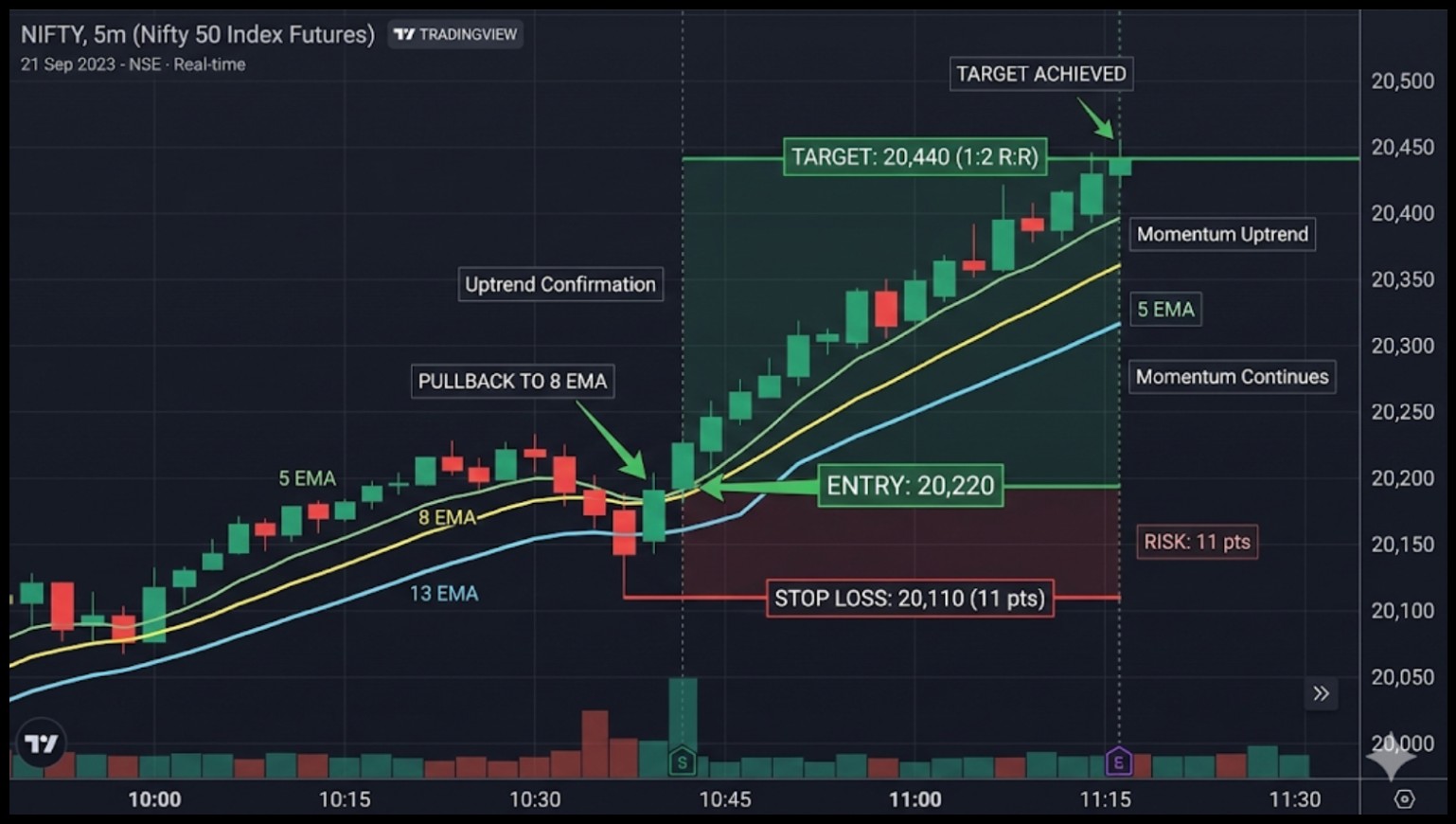
Trade Setup:
- Stock: HDFC Bank
- Price: 1,520
- 5 EMA: 1,518
- 8 EMA: 1,515
- 13 EMA: 1,510
Entry Conditions:
- EMAs aligned upward (5 > 8 > 13)
- Price pulls back to the 8 EMA
- Entry at: 1,522
Stop And Target:
- Stop loss: 1,512
- Risk: 10 points
- Target: 1,542 (1:2 ratio)
Outcome:
- Price resumes uptrend
- Hits the target within the next few candles
This is how traders apply the system in real markets. Clear setup, defined risk, no guesswork.
Consistently following these rules helps turn a simple strategy into a repeatable edge over time.
5-8-13 vs Other Triple EMA Combinations
Not all triple EMA setups behave the same. The fastest popular combination is the 5 8 13 EMA Crossover Strategy, and other approaches, such as 8-13-21 and 9-21-55, provide a smoother yet slower signal.
The decision on which one to choose is based on the speed at which you would like the signals, as well as the amount of noise that you can tolerate.
While many use the 5-8-13 for scalping, applying an EMA crossover for swing trading usually requires these slower combinations on daily or weekly charts to filter out market noise.
Let’s compare some of the popular triple EMA setups with the help of a table:
| EMA Setup | Speed | Best Timeframe | Use Case |
| 5-8-13 | Fastest | 1 to 5 min | Scalping, quick momentum trades |
| 8-13-21 | Moderate | 15 min to 1 hour | Intraday trend trading |
| 9-21-55 | Slow | 1 hour daily | Swing trading, strong trend filtering |
The faster the setup, the earlier the signal, but the higher the noise. Slower setups give fewer trades, but often cleaner trends and better stability.
5 8 13 EMA Strategy Success Rate
Let’s talk numbers. The 5 8 13 ema strategy success rate depends on market conditions and discipline.
Typical Performance:
- Win rate: 50% to 65%
- Higher in trending markets
- Lower in sideways phases
What Improves Accuracy:
- Trading with a higher timeframe trend
- Avoiding low-volume sessions
- Sticking to stop loss
A 55% win rate can still be profitable if your winners are larger than your losses. That’s the real edge. Consistently applying proper risk-reward ratios ensures that even a moderate win rate grows your account over time.
5 8 13 EMA Crossover Screener And Tools
Finding setups manually can be tiring. That’s where a 5 8 13 EMA crossover screener helps. These screeners automatically highlight stocks or indices where the 5, 8, and 13 EMAs are aligning, saving you hours of chart scanning.
They also help filter out weak or sideways setups, so you can focus only on high-probability trades.
Popular Tools Traders Use:
- TradingView screeners
- Chartink for Indian stocks
- Broker platforms like Zerodha Kite
What To Scan For:
- EMA alignment (5 > 8 > 13 or reverse)
- Volume spikes
- Price near support or resistance
Screeners save time, but they don’t replace judgment. You still need to validate each setup. Always double-check price action and EMA alignment before entering a trade to avoid false signals.
Common Mistakes Made in 5 8 13 EMA Crossover Strategy
Even a simple system like this can go wrong. Mistakes are usually small, but repeated often. Overconfidence and ignoring market context are often what turn a good setup into a loss.
Here are some mistakes to avoid:
- Trading in sideways markets: The 5 8 13 EMA works best in trending conditions; flat markets produce false crossovers that lead nowhere.
- Entering late after big moves: Chasing a candle that has already moved significantly increases your risk and reduces your reward.
- Ignoring stop loss: Skipping your stop loss turns a small,
- manageable loss into a trade that damages your entire account.
- Overtrading every crossover: Not every EMA crossover is a valid signal; quality setups always matter more than quantity.
The system is simple, but execution takes discipline. Small errors repeated daily quietly destroy what good trades build.
Conclusion
The 5 8 13 EMA Crossover Strategy is one of the cleanest momentum tools available. It gives early signals, keeps risk defined, and works across multiple timeframes.
But no strategy works without discipline behind it. Stick to the rules, trade with the trend, and always respect your stop loss.
The real edge comes from consistency, not from catching every single move.
Use a screener to find setups faster and filter out the noise. Over time, this approach builds a trading habit that is structured and repeatable.
Start simple, stay patient, and let the EMAs guide your decisions.
Master the 5-8-13 EMA Crossover Strategy and elevate your trading. Download the Stock Pathshala app now for a comprehensive, deep-dive session!
FAQs
Q1: Which Timeframe Is Best For 5 8 13 EMA Strategy?
Ans: 5-minute and 15-minute charts work well for intraday trading. Scalpers may prefer 1-minute charts for quick moves.
Q2: Is the 5 8 13 EMA Strategy Good For Beginners?
Ans: Yes, it’s simple and easy to follow. Beginners should focus on risk management and avoid irregular choppy markets.
Q3: Can I Use The 5 8 13 EMA Strategy For Swing Trading?
Ans: Yes, but it performs better on shorter timeframes. For swing trading, use it on 15-minute or hourly charts along with a higher timeframe trend filter.
Before investing capital, invest your time in learning Stock Market.
Fill in the basic details below and a callback will be arranged for more information: