


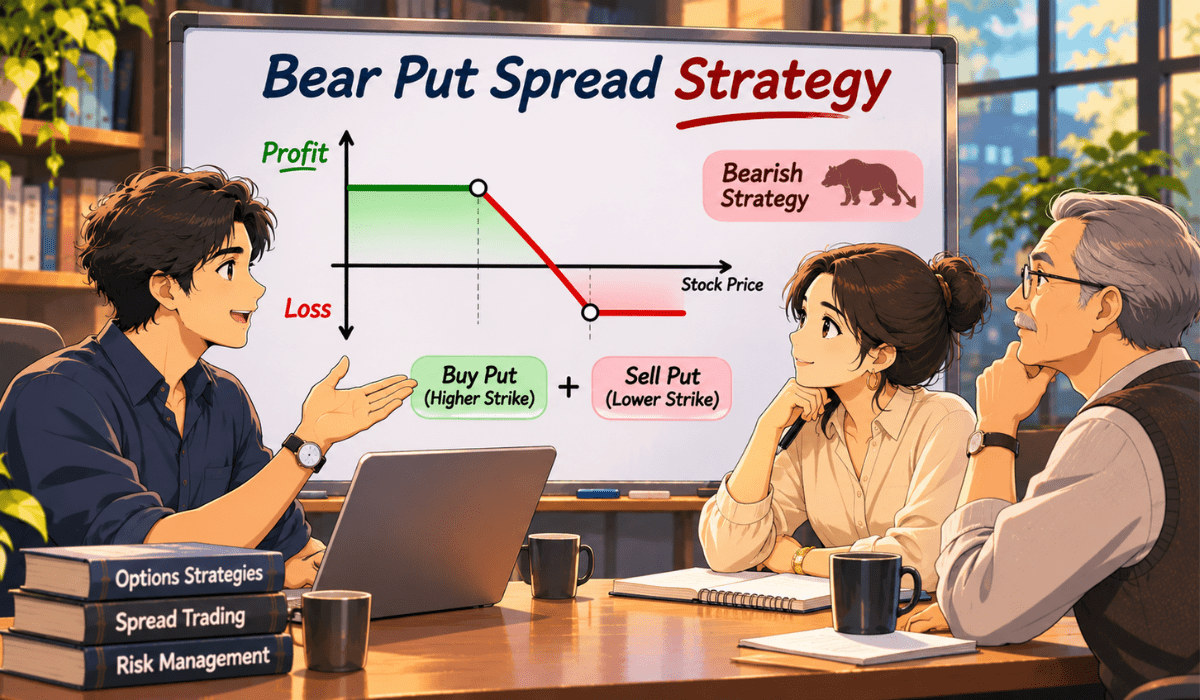
Worried that the market may slip, but not ready to bet big on a fall? The bear put spread strategy is one way to express a moderately bearish view.
Both the cost and the maximum loss are known upfront. This page covers the legs, payoff, formulas and risks with one hypothetical example, for learning only.
What Is a Bear Put Spread Strategy?
First, let us settle the meaning. In fact, every number later on this page rests on it.
A bear put spread is a two-leg options strategy. You buy a put at a higher strike and sell a put at a lower strike. Both use the same underlying and expiry.
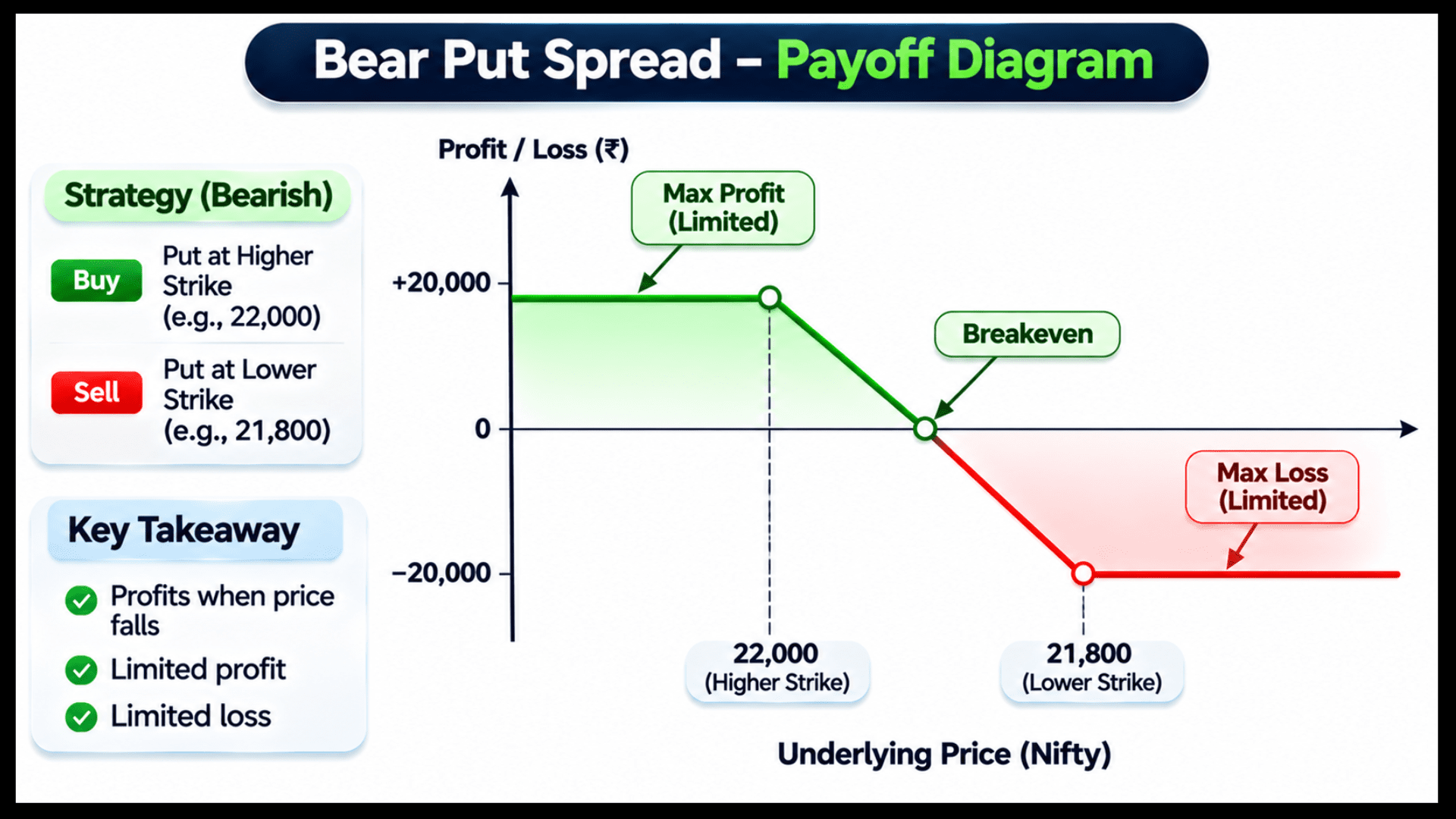
You pay more for the bought put than you receive for the sold put. So, the strategy starts with a net debit, which is also the most you can lose.
New to this? Start with option strategies for beginners to see the wider picture first.
Bear Put Spread Example
Next, let us build an example. The numbers are for illustration only, not live prices and not a suggestion to trade.
Assume an index at 22,000 with 30 days to expiry. We use Black-Scholes with 15% volatility and a 0% interest rate, rounded to whole points.
Also, we assume 1 lot = 50 units. Real lot sizes are revised by the exchange, so verify the current one.
The table below shows the two legs and their model premiums.
| Leg | Action | Option | Strike | Premium (points) |
|---|---|---|---|---|
| 1 | Buy | Put | 22,000 | 377 |
| 2 | Sell | Put | 21,800 | 284 |
The long put costs 377 points, and the short put brings in 284 points. Net debit = 377 – 284 = 93 points.
For one lot of 50 units, that is 93 x 50 = Rs 4,650, before any charges. The gap between the two strikes is 200 points, called the width of the spread.
Bear Put Spread Payoff at Expiry: Formula and Table
Now, let us see what happens at expiry. Only intrinsic value remains, and for a put it is the strike minus the index level, or zero.
If that idea is new, read about the intrinsic value of options in plain words.
The net result per unit is the long put payoff, minus the short put payoff, minus the 93-point debit.
Bear Put Spread Payoff Table at Expiry
Next, the table applies that formula at different expiry levels. The last column multiplies by 50 units.
| Index at expiry | Long 22,000 put payoff | Short 21,800 put payoff | Net P/L (points) | Net P/L per lot (Rs) |
|---|---|---|---|---|
| 22,400 | 0 | 0 | -93 | -4,650 |
| 22,200 | 0 | 0 | -93 | -4,650 |
| 22,000 | 0 | 0 | -93 | -4,650 |
| 21,900 | 100 | 0 | 7 | 350 |
| 21,800 | 200 | 0 | 107 | 5,350 |
| 21,700 | 300 | -100 | 107 | 5,350 |
| 21,600 | 400 | -200 | 107 | 5,350 |
| 21,400 | 600 | -400 | 107 | 5,350 |
Look at the pattern. Above 22,000 you lose the whole debit, and between 22,000 and 21,800 the result improves point by point.
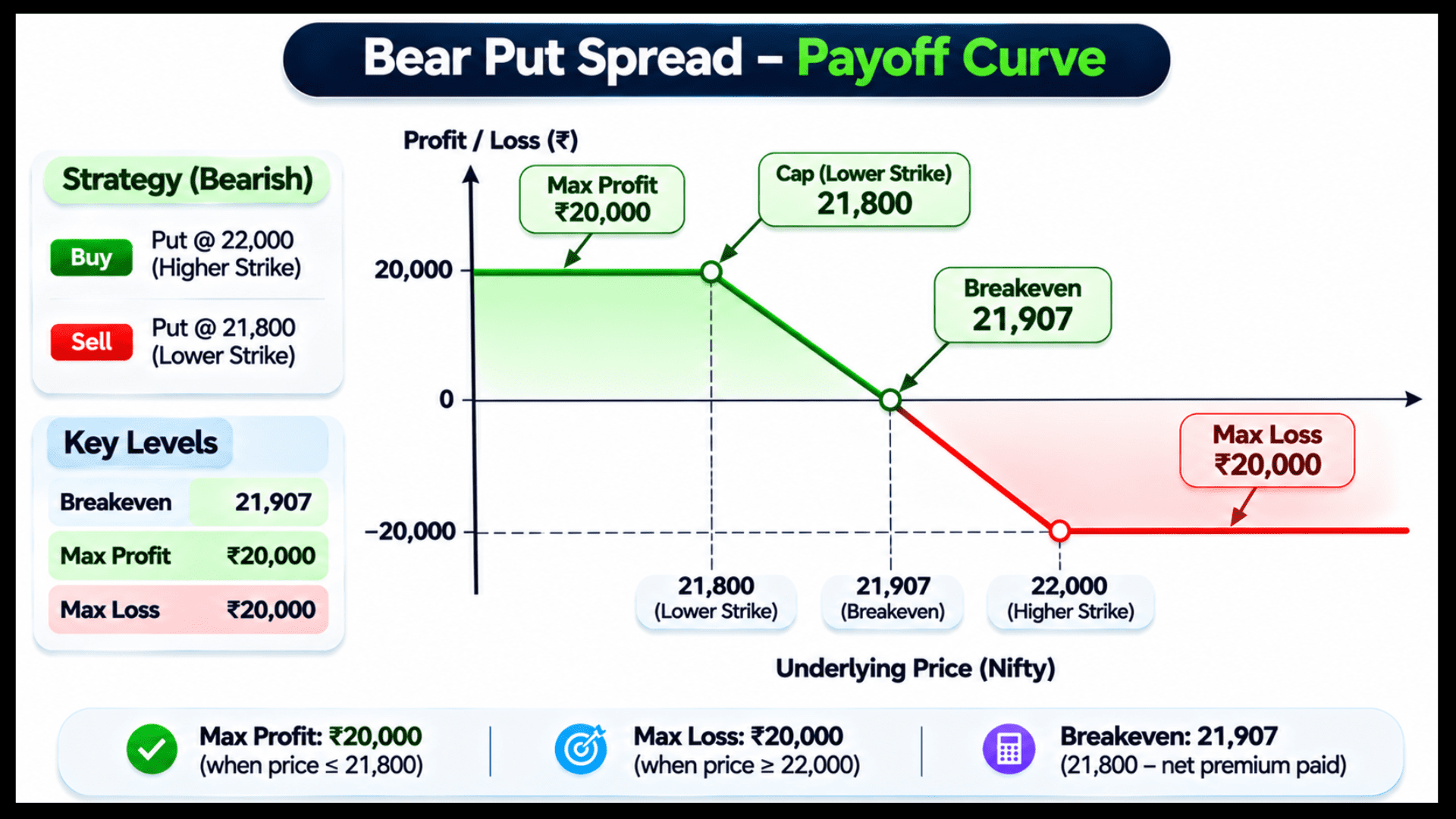
Below 21,800, the result is flat at the maximum. The short put gives back every extra point the long put earns.
Bear Put Spread Max Profit, Max Loss and Breakeven Formulas
These three numbers are fixed the moment you open the trade. That is the main reason traders look at spreads.
- Maximum loss = net debit
- Maximum profit = width of spread – net debit
- Breakeven = higher strike – net debit
Using our example, the figures are below.
- Maximum loss: 93 points, or Rs 4,650 per lot
- Maximum profit: 200 – 93 = 107 points, or Rs 5,350 per lot
- Breakeven at expiry: 22,000 – 93 = 21,907
Notice that profit is capped at 107 points. If the index crashes to 21,000, you still earn only 107 points.
That is the price you pay for a lower upfront cost. Charges, taxes and slippage are not included, so check your own contract note.
When to Use a Bear Put Spread?
Before any trade, match the strategy with your view. Here we see who might consider a bear put spread.
The strategy suits a moderately bearish view.
The trader expects the index to fall, but only to a certain zone and over a limited time. If you expect no real move at all, a Butterfly Spread fits that view better than any directional spread.
Compare this with a single put. A long put costs 377 points here, with breakeven at 21,623. The spread costs 93 points, with breakeven at 21,907.
So, the spread is cheaper and breaks even sooner, but it stops paying beyond 21,800.
Still building your base? Learn how to learn options trading in the right order, one concept at a time.
Bear Put Spread Time Decay and Volatility: What Changes Before Expiry
The payoff table shows expiry only. Before expiry, the spread behaves differently because both puts still hold time value.
Here we reuse the same model with 15 days left and 15% volatility. The spread is valued as the 22,000 put minus the 21,800 put.
With the index at 22,100, the spread is worth about 78 points, a loss of 15 against the 93 debit. At 21,900 it is worth about 101 points, a gain of 8.
At 21,700 it is worth about 125 points, a gain of 32. Even then, it is far below the 200-point width, so gains build slowly as expiry nears.
Because you hold one long and one short option, the effect of time and volatility is partly offset. That is why a spread is usually less sensitive than a single option.
To see why, read about vega in options trading and how volatility moves premiums.
Bear Put Spread Margin, Costs and Risks
Because one leg is sold, the position carries margin requirements. Exchanges and brokers set these rules and they change, so verify before trading.
In many setups, holding the long put reduces the margin on the short put. However, the exact benefit varies.
Here are the main risks to keep in mind.
- Capped profit: a big fall beyond the lower strike adds nothing.
- Full debit loss: if the index stays above the higher strike at expiry, the whole premium is lost.
- Assignment and settlement: the short put can be exercised if it ends in the money, so know the rules.
- Costs add up: two legs mean two sets of charges on entry and again on exit.
- Liquidity: a wide bid-ask gap on either leg can eat a large part of a small spread.
Selling a leg carries more risk than only buying options. Beginners should read why option buyers lose money before putting real money in.
How to Exit or Adjust a Bear Put Spread?
You do not have to hold a spread until expiry. Some traders close both legs together once a planned profit or loss level is reached.
Closing early also avoids last-day surprises. A few general ideas people use are below, and none of them is a rule.
- Set exit levels for profit and loss before entering.
- Close both legs together, not one by one, so the position does not turn into a naked short put.
- Review the trade if your view changes or the expected event has passed.
Moving strikes or rolling to a later expiry is possible. However, each change adds cost and complexity.
Common Bear Put Spread Mistakes to Avoid
Most errors come from the setup, not from the idea itself. Watch for these five.
- Choosing strikes far from the market: both puts are cheap, but the chance of profit is small.
- Ignoring expiry timing: a fall that arrives after expiry earns nothing.
- Closing only one leg: this leaves a lone short put or long put with a different risk.
- Skipping the cost math: a small spread can lose much of its edge to charges.
- Using too large a size: even a defined loss hurts when it repeats many times.
A simple habit helps. Write down the debit, maximum loss and breakeven before you click anything.
The habit matters even more once you move to four-leg setups like the Iron Condor Strategy, where one wrong leg changes the whole risk.
When the Bear Put Spread Strategy Fails?
The strategy fails when the view or the timing is wrong. If the index rises or stays flat, the debit is lost in full.
It also underperforms when the fall is much bigger than expected. A plain long put would have earned more, while the spread stays capped. And if you expect a big move but cannot call the direction, a Long Strangle Strategy is the setup built for that doubt.
A sharp fall that quickly reverses before expiry can leave the spread with little value. Nothing here is a promise of results.
Before using any new setup with real money, test it on past data. Here, backtesting options trading strategies shows how to do that with care.
Bear Put Spread vs Long Put vs Bull Call Spread
The bear put spread has close relatives. The table below compares them in general terms, using the same example where possible.
| Feature | Bear put spread | Long put | Bull call spread |
|---|---|---|---|
| View | Moderately bearish | Strongly bearish | Moderately bullish |
| Legs | Buy higher put, sell lower put | Buy one put | Buy lower call, sell higher call |
| Upfront cost | Net debit (93 in example) | Full premium (377 in example) | Net debit |
| Maximum loss | Net debit | Premium paid | Net debit |
| Maximum profit | Capped | Large, up to index at zero | Capped |
A bear put spread is the mirror of the bullish version. To see that side, compare it with the bull call spread strategy and check both payoffs.
How to Practise the Bear Put Spread Before Real Money?
Do not start with real money. Use virtual or paper trading to place both legs, and watch how premiums move and how charges change the result.
Keep a small journal with your view, strikes, debit and exit reason. Review it after a few weeks to spot repeat mistakes.
Reading about spreads helps, but live option chains and a mentor’s answers make the two legs click.
Join our live classes from your mobile, ask your doubts and learn step by step.
Conclusion
In short, a bear put spread buys a higher-strike put and sells a lower-strike put. It suits a moderately bearish view and caps both profit and loss.
However, a flat or rising market costs you the full debit. Finally, practise virtually first, and remember that this is learning, not a buy or sell call.
Disclaimer: This page is for education only and is not investment advice. All prices, strikes, premiums and lot sizes are hypothetical.
Options trading involves risk of loss, and selling options carries higher risk. Verify lot sizes, margins and charges with the exchange and your broker.
Frequently Asked Questions
Before investing capital, invest your time in learning Stock Market.
Fill in the basic details below and a callback will be arranged for more information: