


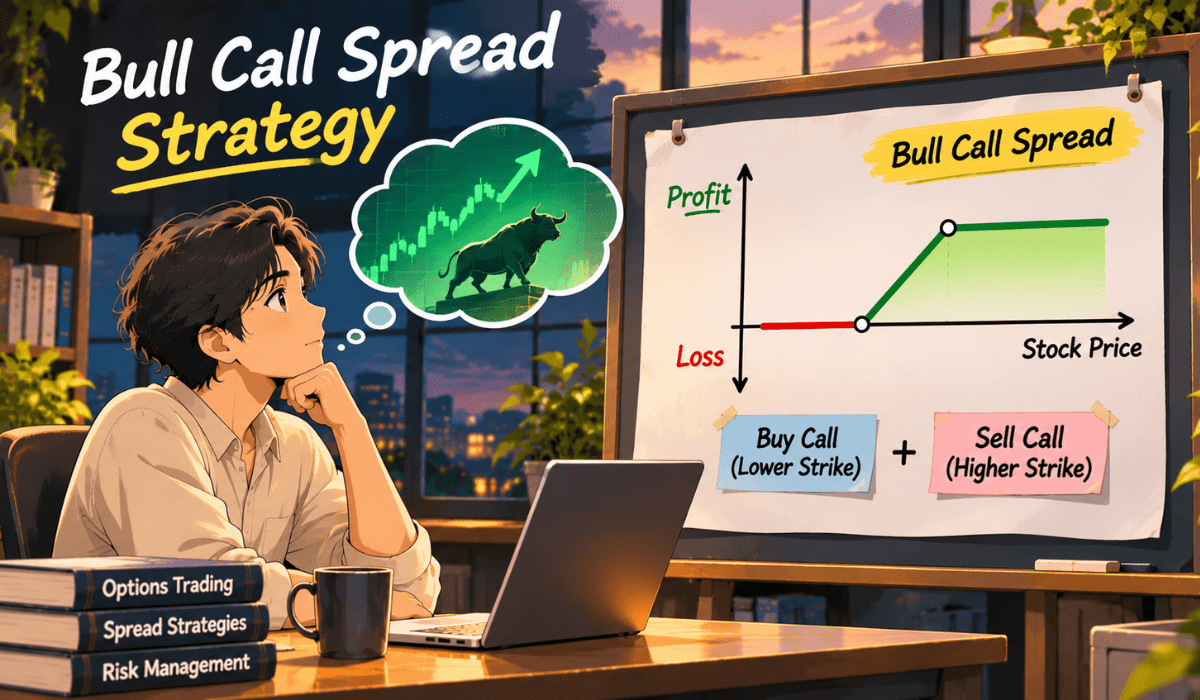
The bull call spread strategy lets you take a moderately bullish view with a fixed, known risk. You buy one call and sell another call at a higher strike. So, both your cost and your maximum profit are capped.
If a plain call option feels expensive or nerve-racking, this is one of the first strategies people study. Let us go through it step by step, with numbers.
What Is a Bull Call Spread Strategy?
First, let us settle the meaning. In fact, every number later on this page rests on it.
A bull call spread is a two-leg options strategy. You buy a call at a lower strike and sell a call at a higher strike. Both use the same underlying and the same expiry.
The call you sell brings in premium. That premium reduces your net cost, but it also puts a ceiling on your profit.
Because you pay more than you receive, the strategy is called a debit spread. The net debit is the most you can lose.
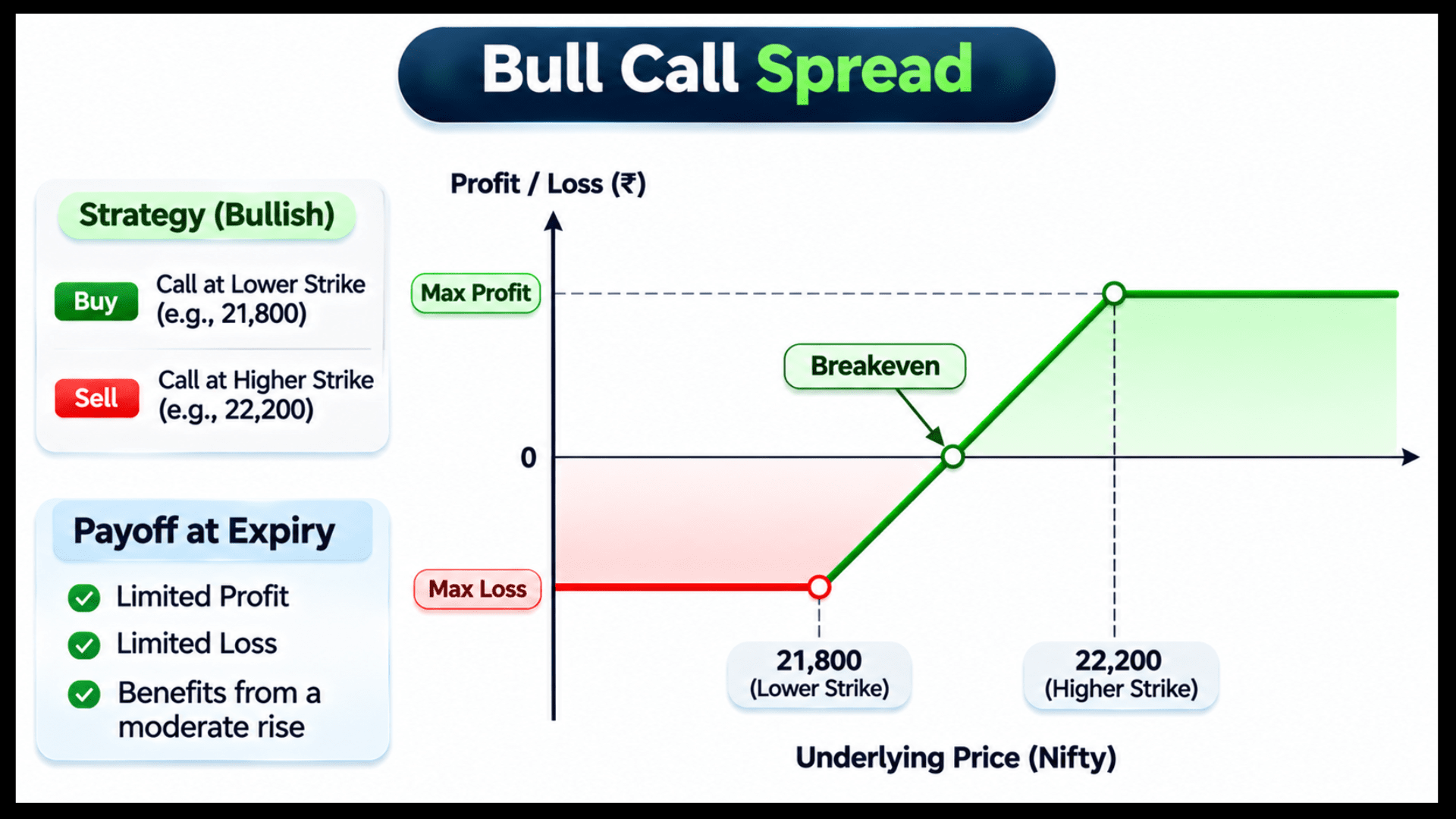
It suits a trader who expects the price to rise moderately, not to explode upwards. If your view is a huge rally, a plain long call keeps more upside, but at a higher cost.
If you expect almost no movement, a Butterfly Spread is built for that view instead.
Everything below is hypothetical and for illustration only. The price levels, premiums and lot size are not live market data.
Building a Bull Call Spread: Key Legs, Strikes & Net Debit
Next, let us look at the structure. It has only two legs, and the strike relationship never changes.
The long call strike is always lower than the short call strike. Here is the setup we will use throughout, for illustration only.
The lot size of 50 units is an assumption, because real lot sizes are revised by the exchange. So, always verify the current one.
| Leg | Action | Option | Strike | Premium (per unit) |
|---|---|---|---|---|
| Leg 1 | Buy | Call | 22,000 | 377 |
| Leg 2 | Sell | Call | 22,400 | 214 |
| Net | Pay (debit) | – | – | 163 |
The index is assumed at 22,000 with 30 days to expiry. Premiums come from the Black-Scholes model with 15% volatility and a 0% interest rate, rounded to whole numbers.
Real option chains will differ.
Calculating the Bull Call Spread Net Debit And Total Cost
Now, work out what you pay to enter. The sold call pays back part of the bought call.
Net debit = 377 – 214 = 163 points. For 1 lot of 50 units, that is 163 x 50 = Rs 8,150.
How to Calculate Bull Call Spread Payoff at Expiry?
Now, let us see what each leg is worth on expiry day. At expiry, each call is worth only its intrinsic value.
If you are new to that idea, read about the intrinsic value of options in plain words.
The formula for profit per unit at expiry is below.
Profit = max(S – 22,000, 0) – max(S – 22,400, 0) – 163.
Here S is the index price at expiry.
Bull Call Spread Payoff Table at Expiry
Next, apply the formula at different expiry prices. The table below ignores brokerage, taxes and other charges.
| Index at expiry | Long call value | Short call value | Profit/loss per unit | Profit/loss per lot (50) |
|---|---|---|---|---|
| 21,600 | 0 | 0 | -163 | -8,150 |
| 21,800 | 0 | 0 | -163 | -8,150 |
| 22,000 | 0 | 0 | -163 | -8,150 |
| 22,163 | 163 | 0 | 0 | 0 |
| 22,200 | 200 | 0 | 37 | 1,850 |
| 22,400 | 400 | 0 | 237 | 11,850 |
| 22,600 | 600 | -200 | 237 | 11,850 |
| 22,800 | 800 | -400 | 237 | 11,850 |
Notice that the result stops changing at both ends. Below 22,000 you lose the same 163 points, and above 22,400 you earn the same 237 points.
Bull Call Spread Payoff Formulas: Max Profit, Loss & Breakeven
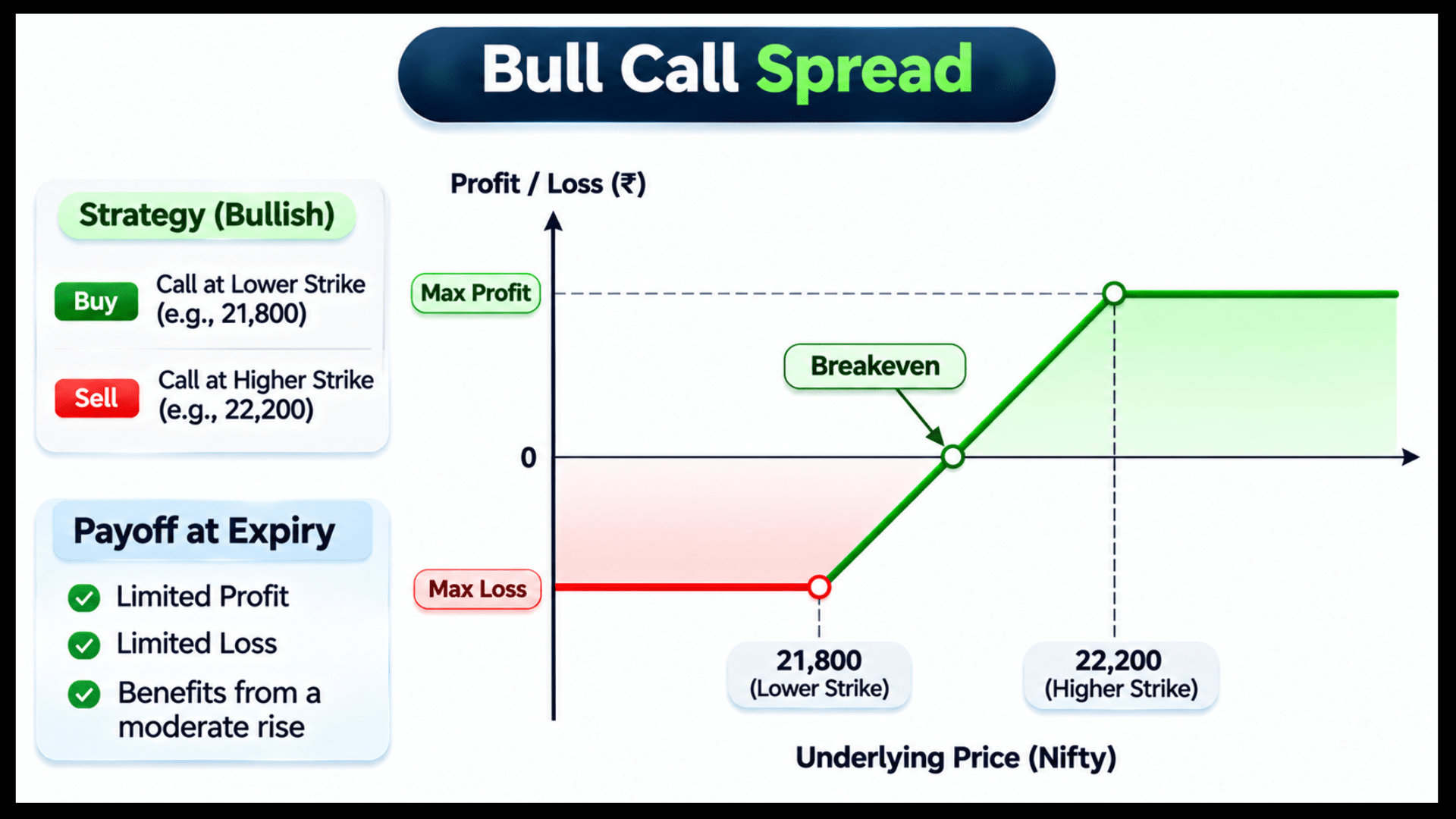
All three numbers are known the moment you place the trade. That is the main appeal of the bull call spread strategy.
- Maximum loss = net debit = 163 points (Rs 8,150 per lot).
- Maximum profit = strike gap – net debit = 400 – 163 = 237 points (Rs 11,850 per lot).
- Breakeven = lower strike + net debit = 22,000 + 163 = 22,163.
The maximum loss happens if the index closes at or below the lower strike. In contrast, the maximum profit happens if it closes at or above the higher strike.
This is a limited profit, limited loss structure.
Nothing here is a promise of profit, and the chance of landing in any zone is never guaranteed. The same capped logic, applied to a call spread and a put spread together, is what builds an Iron Condor Strategy.
Bull Call Spread Margin and Costs: What to Expect
Both risk and reward are capped. So, many brokers ask for less margin than for a naked short call.
The exact rule depends on your broker and the exchange, so verify before you trade. Learn how option trading margin is calculated before you size a trade.
The short call is still a selling leg. Selling legs can carry margin requirements and larger risk if one leg is closed alone.
Beginners should understand this before going live. You also pay brokerage, exchange charges and taxes on both legs, at entry and again at exit.
On a small expected profit, these costs matter. To see why costs and timing hurt so many buyers, read about why option buyers lose money.
Options Strategy Comparison: Bull Call Spread vs. Long Call vs. Bear Put Spread
A spread is easier to judge when you place it next to its neighbours. The table below compares the same example with a plain long call at the 22,000 strike.
| Feature | Bull call spread | Long call (22,000) |
|---|---|---|
| Cost | 163 points | 377 points |
| Max loss | 163 points | 377 points |
| Max profit | 237 points (capped) | Unlimited |
| Breakeven | 22,163 | 22,377 |
| Best for | Moderate rise | Strong rise |
Both strategies are bullish. The spread trades away unlimited upside to get a lower cost and a lower breakeven.
The mirror image on the bearish side is the Bear Put Spread Strategy. It uses puts for a moderately falling view, with the same capped logic.
Bull Call Spread Greeks: Delta, Time and Volatility
A spread reacts less to each Greek than a single option does, because the two legs partly cancel each other. Here is how the main ones behave.
Bull Call Spread Delta
Our example is mildly positive in delta, since the long call has a higher delta than the short call.
To build that intuition, read about delta in options trading as a good next step.
Bull Call Spread Time Decay and Volatility
In general, time works against the spread when the index sits near or below the long strike. It tends to help once the index is well above the short strike.
Volatility has a smaller effect than on a plain call.
How to Manage Bull Call Spread Risks and Early Exits?
The biggest risk is simple: the index does not rise enough. Then the whole 163 points can go.
Here are a few general ways traders think about managing it. These are ideas, not instructions:
- Decide the exit rule before entering, such as a maximum loss you accept.
- Consider closing both legs together instead of leaving one leg alone.
- Review the trade as expiry nears, since the last days move fast.
- Avoid sizing so large that a full loss hurts your peace of mind.
Some traders close early once a good part of the maximum profit is reached. The last few points are often slow to arrive.
Others roll the spread to a later expiry. Each choice has costs and trade-offs.
Common Bull Call Spread Mistakes to Avoid
Many beginners make the same few errors. Knowing them early saves money.
- Choosing strikes too far apart, so the breakeven is hard to reach.
- Choosing strikes too close, so the profit is tiny after charges.
- Ignoring brokerage on four orders (two to enter, two to exit).
- Closing only one leg in panic and leaving a naked position.
- Expecting a big rally and using a spread that caps the gain.
- Holding to the last day without a plan.
Testing an idea on past data helps you spot these early. This note on backtesting options trading strategies shows the general approach.
When the Bull Call Spread Strategy Fails?
The strategy struggles in three situations. First, the market falls or stays flat.
Second, a sharp rise happens after you exit, or the rise is much larger than you planned for. Third, charges and slippage eat a narrow profit.
In the first case you lose up to the net debit. In the second, you only earn the capped profit.
This is why the bull call spread suits a moderately bullish view, not every bullish view. A fall in implied volatility can also hurt the spread, and vega in options explains the idea behind it.
Treat every example here as a learning tool.
How to Practise the Bull Call Spread Before Going Live?
Spreads involve a selling leg and two orders, so mistakes in order entry are common. It is wise to practise on virtual money first.
Track your results honestly and only then think about real capital. To see where this strategy sits among others, browse option strategies for beginners.
Reading about spreads helps, but live option chains and a mentor’s answers make the two legs click.
Join our live classes from your mobile, ask your doubts and learn step by step.
Conclusion
In short, a bull call spread suits a moderately bullish view and caps both profit and loss. The maximum loss is the net debit, and the breakeven sits just above the lower strike.
However, the capped profit means a huge rally leaves you behind. Finally, practise on virtual money first, and remember that this is learning, not a buy or sell call.
Disclaimer: This page is for education only. All prices, premiums, strikes and the lot size are hypothetical, and they are not trade recommendations or advice.
Options carry risk and you can lose your entire premium. Lot sizes, margins and charges change, so verify them with your broker and the exchange.
Frequently Asked Questions
Before investing capital, invest your time in learning Stock Market.
Fill in the basic details below and a callback will be arranged for more information: