


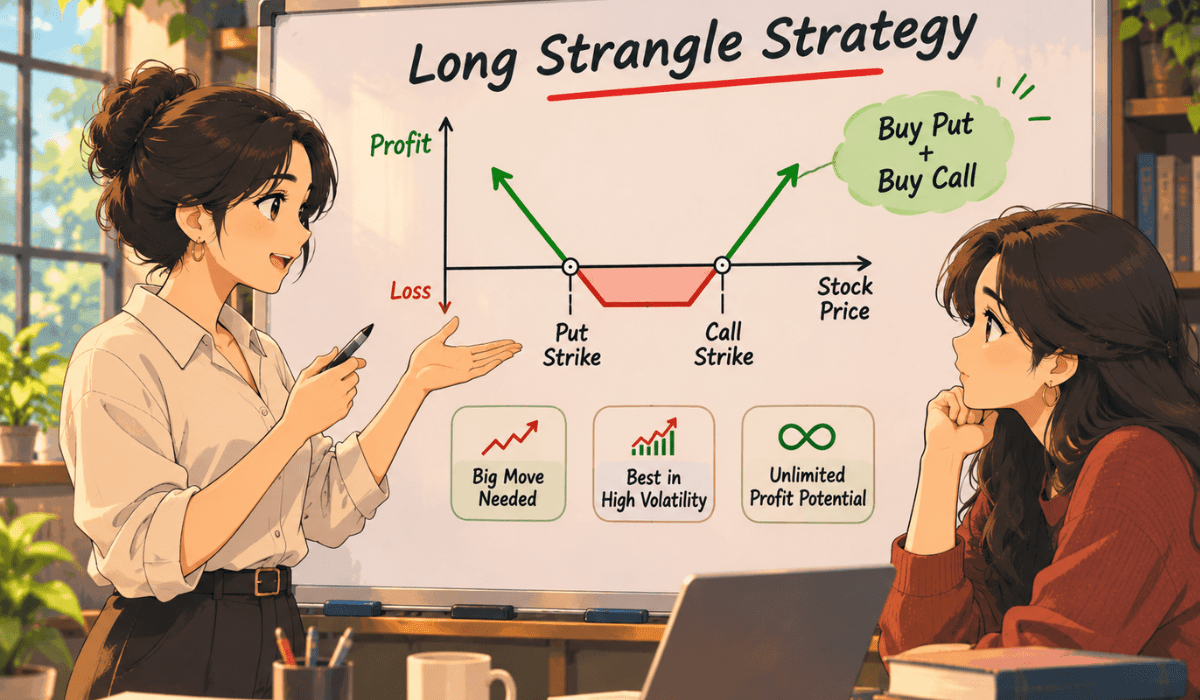
A big move is coming, you feel. But which way? In fact, that one doubt stops many traders from taking any position at all. The long strangle strategy is built for exactly that doubt.
You buy an out-of-the-money call and an out-of-the-money put, and you need the market to move far in either direction.
What Is a Long Strangle Strategy?
First, let us settle the meaning. In fact, every number later on this page rests on it.
A long strangle is an option strategy with two bought legs. You buy one out-of-the-money (OTM) call and one OTM put on the same underlying and the same expiry.
The call strike is above the current price. Meanwhile, the put strike is below it.
You pay a premium for both legs, so the strategy starts with a net debit. Also, that debit is the most you can lose.
In simple words, you are paying for a large move, not for a direction. Overall, everything on this page is hypothetical and for illustration only.
In short, it is education, not a trade suggestion.
How a Long Strangle Works?
If options feel like a maze of legs and strikes, you are not alone. However, this one is simpler than it looks.
It is just two bought options held to the same expiry, one call and one put. Because both legs are bought, nobody can force you to add margin later.
As a result, your loss is capped at the premium paid. Next, we turn this into real numbers.
Meanwhile, if you are still mapping the bigger picture, see how to learn option strategies and where this one sits.
Long Strangle Option Strategy Example with Worked Calculations
Now let us put numbers on it. All figures are for illustration only.
The lot size of 1 lot = 50 units is also an assumption, because exchanges revise real lot sizes. So, please verify the current lot size.
Assumptions: index at 22,000, expiry in 7 days, volatility 16%, interest rate 0%. Also, the premiums come from the Black-Scholes model, rounded to whole points.
- Buy OTM call at 22,200: premium 111 points.
- Buy OTM put at 21,800: premium 110 points.
Thus, the total debit is 111 + 110 = 221 points. For one lot, that is 221 x 50 = 11,050, before brokerage and taxes.
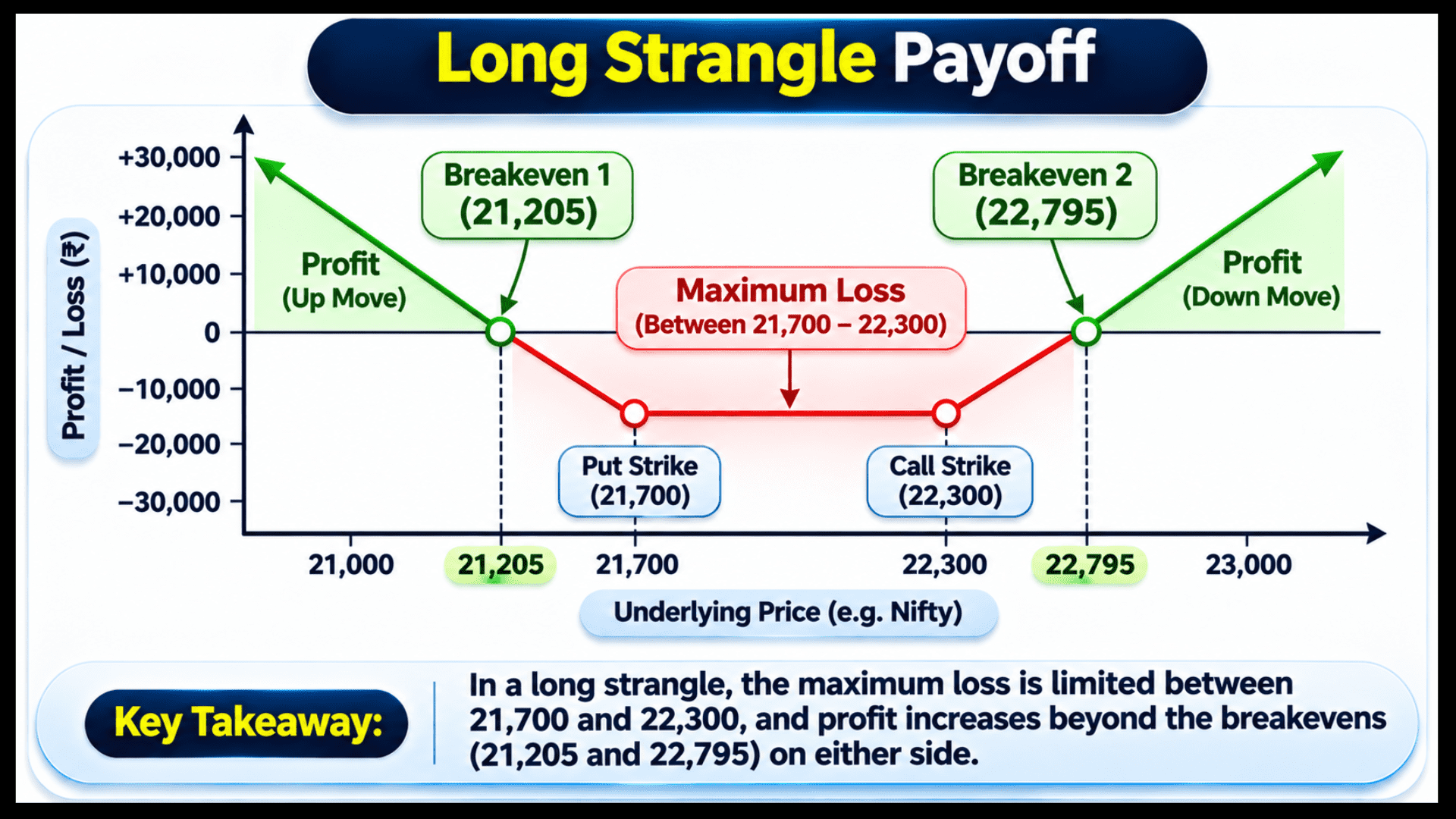
At expiry, an option is worth only its intrinsic value, so we ignore time value in the payoff below. If that term is new, read about the intrinsic value of options first.
Long Strangle Option Strategy Payoff Table at Expiry
The next table applies one rule. Call value = max(index – 22,200, 0). Put value = max(21,800 – index, 0). Net = call value + put value – 221.
| Index at expiry | Call value | Put value | Net profit or loss per unit | Per lot (50 units) |
|---|---|---|---|---|
| 21,000 | 0 | 800 | 579 | 28,950 |
| 21,400 | 0 | 400 | 179 | 8,950 |
| 21,579 | 0 | 221 | 0 | 0 |
| 21,800 | 0 | 0 | -221 | -11,050 |
| 22,000 | 0 | 0 | -221 | -11,050 |
| 22,200 | 0 | 0 | -221 | -11,050 |
| 22,421 | 221 | 0 | 0 | 0 |
| 22,600 | 400 | 0 | 179 | 8,950 |
| 23,000 | 800 | 0 | 579 | 28,950 |
Now, look at the middle rows. Between 21,800 and 22,200, both legs expire worthless and you lose the full 221 points.
In fact, the two breakeven rows show the gap you must cross before profit begins. That gap is wider than many beginners expect.
Long Strangle Max Profit, Max Loss and Breakeven Formulas
These formulas hold at expiry, using intrinsic values only.
- Maximum loss = total premium paid. Here it is 221 points, or 11,050 per lot.
- Upper breakeven = call strike + total premium = 22,200 + 221 = 22,421.
- Lower breakeven = put strike – total premium = 21,800 – 221 = 21,579.
- Maximum profit on the upside = unlimited in theory, because the call keeps gaining as the index rises.
- Maximum profit on the downside = put strike – total premium, because an index cannot fall below zero. It is large but finite.
So, the index must move more than 221 points beyond a strike just to break even. In other words, that is 421 points up or 421 points down from 22,000.
When to Use a Long Strangle?
It suits a volatility view. In other words, you expect a large move but cannot call the direction.
Once you can call it, a one-sided structure like the Bear Put Spread Strategy is the cheaper choice for a falling view.
For example, typical situations are event days, results, policy announcements or a long tight range that looks ready to break. However, it is not a neutral strategy, and a quiet market hurts it.
Besides, the pricing of such events matters too. Indeed, options often become expensive before a known event.
The vega of an option shows how much a change in implied volatility moves the premium.
Still, there is no promise here that any event will produce a big move. Instead, markets can stay still, and the premium is lost.
How Theta and IV Crush Impact a Long Strangle Strategy?
Even with a big move ahead, timing decides the result. In fact, each day closer to expiry, the premium shrinks if nothing happens.
As theta eats away at your capital day by day, a sudden drop in implied volatility can deal an even faster blow to your position.
Long Strangle Value Table: Days Left vs IV
The table below shows the model value of the same strangle with the index unchanged at 22,000. It uses the Black-Scholes model with a 0% rate.
| Days left | IV 12% | IV 16% | IV 20% |
|---|---|---|---|
| 7 | 134.3 | 221.2 | 312.1 |
| 4 | 75.9 | 136.3 | 201.6 |
| 1 | 9.1 | 26.0 | 49.0 |
With IV at 16%, the strangle bought at about 221 is worth about 136 after three quiet days. Overall, that is a paper loss of roughly 85 points, or about 4,250 per lot.
Here is a second check at 4 days left and IV 16%. If the index falls 300 points to 21,700, the model value is about 215.5.
Surprisingly, the strangle is still slightly below its cost of 221, even after a 300-point move. Why? Because the put is still out of the money and time has passed.
The gamma of an option explains why such moves help only gradually. It also shows why a late, sharp move helps far more.
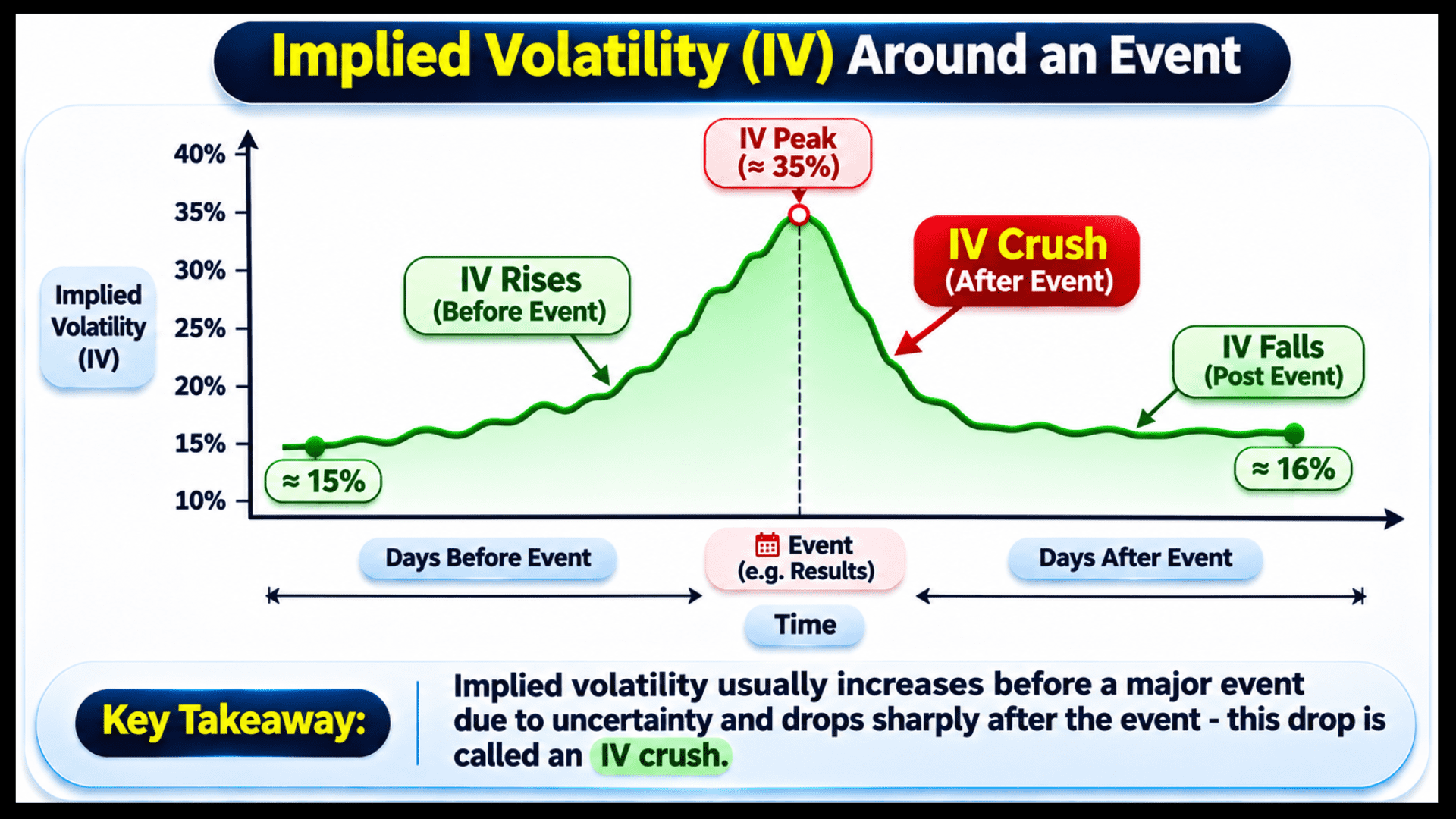
Also note the IV column. If implied volatility falls after you buy, you can lose money even when the index moves.
This is often called an IV crush.
Difference Between a Long Strangle and Long Straddle
First, a quick difference. A straddle buys the call and put at the same strike, usually at the money.
In contrast, a strangle uses two different strikes, so it is cheaper but needs a bigger move. With the same assumptions, the at-the-money straddle costs 194.5 + 194.5 = 389 points, or 19,450 per lot.
Long Strangle vs Straddle Comparison Table
The table below puts both side by side.
| Feature | Long strangle | Long straddle |
|---|---|---|
| Strikes | Different (OTM call and OTM put) | Same (ATM call and ATM put) |
| Cost in this example | 221 points | 389 points |
| Maximum loss | 11,050 per lot | 19,450 per lot |
| Breakevens | 21,579 and 22,421 | 21,611 and 22,389 |
| Loss zone | Wide (between strikes) | A single point at the strike |
In short, the strangle loses less but has a wide dead zone.
If you want the full build, see how to create a long straddle and compare the two side by side.
Long Strangle Cost, Margin, and Brokerage Charges Explained
Both legs are bought, so the cost is the premium. First, brokers usually collect that amount upfront.
Generally, no extra margin is blocked for buying options. However, brokerage, exchange charges and taxes apply to each leg, and they reduce your result.
Rules differ by broker and change over time, so verify them in your contract note.
In contrast, strategies that sell options need margin and carry a much larger risk. Therefore, beginners should be careful there.
If you are new, practise a long strangle in a virtual account first. Besides, watching how the premium decays costs nothing and teaches a lot.
Common Long Strangle Mistakes to Avoid in Option Trading
Most mistakes come from treating a cheap premium as a cheap trade. A low premium also means a low chance of finishing in profit.
- Buying too close to expiry, when time decay is fastest.
- Ignoring that implied volatility is already high before the event.
- Choosing strikes only because the premium looks small.
- Holding to expiry hoping for a late rescue.
- Sizing too large because the loss is “limited”.
Still, limited loss is a loss, and repeating it adds up. These habits are also why option buyers lose money so often.
How to Exit or Adjust a Long Strangle?
Overall, there is no single correct exit. These are common ideas that traders discuss.
- Set a time limit. If the move does not come in a few days, many traders close.
- Book one leg when it has gained, and keep the other with a clear rule.
- Decide a maximum loss in advance, such as a fraction of the premium.
- Avoid adding fresh legs without understanding the new risk.
Meanwhile, many traders test their exit rules on past data first. Learning backtesting options trading strategies helps you do that without risking real money.
Whatever you choose, write the rule down before entering. After all, a rule made in panic is rarely a good one.
When the Long Strangle Fails
It fails in four common situations:
- The market stays inside the strikes until expiry.
- The move happens, but too late.
- Implied volatility drops after you buy.
- The move is real but smaller than the combined premium.
In all four cases, you lose some or all of the premium. That is the price of the strategy, and it should be accepted before the trade, not after.
Long Strangle Alternatives: Related Option Strategies to Consider
The opposite idea is to expect a quiet market. For example, a short strangle does that, but with unlimited risk and heavy margin. A Butterfly Spread plays the same quiet view with a capped loss, which is why beginners usually meet it first.
Therefore, be clear on the purpose of option trading for you before choosing a view.
A different view needs a different tool, so do not mix them up. If your view is a moderate rise rather than a big swing, the Bull Call Spread Strategy costs far less than buying two legs.
Do you also read about strangles and still freeze before placing a real trade?
Reading alone doesn’t build that confidence; practice on a live option chain and a mentor’s answers do.
Join our live classes from your mobile, ask your doubts and learn step by step.
Conclusion
In short, a long strangle buys an OTM call and an OTM put. The aim is to profit from a big move in either direction.
The loss is capped at the premium paid, but the index must cross a wide gap to reach breakeven. However, time decay and a fall in IV work against you every day.
Finally, practise virtually first, and remember that this is learning, not a buy or sell call.
Disclaimer: This page is for education only. All numbers are hypothetical, and lot sizes are assumed.
It is not investment advice, and options carry risk, so verify rules and charges with your broker and the exchange.
Frequently Asked Questions
Before investing capital, invest your time in learning Stock Market.
Fill in the basic details below and a callback will be arranged for more information: