



Learning how to select stocks for positional trading is crucial because picking the wrong stock costs you more than in almost any other style.
You will hold it for weeks or months, so a weak choice stays on your books.
This guide shows you a six-step screen that takes you from thousands of listed stocks down to a short, tradeable watchlist.
It takes you from thousands of listed stocks down to a short, tradeable watchlist.
How to Identify Stocks Worth Holding for Weeks?
A good positional candidate has three things: a steady trend, strong trading volume, and a sector that is in favour.
Once you understand what positional trading is, it becomes clear why these three qualities matter more than short-term price moves.
This is where swing trading vs positional trading differs in stock selection. A swing trade only needs a few good days, but a positional pick has to hold up for weeks.
Erratic price movements will only waste your precious time.
Illiquid shares that prevent clean exits put your capital at risk.
Understanding the structural boundaries of positional trading vs day trading highlights why shorter holding limits demand quick exits whereas weeks-long horizons require deeper liquidity safeguards.
Furthermore, equities stuck in weak sectors struggle to move.
Every step below tests one of these three qualities.
Screening Process to Find Positional Trading Stocks
Before diving into individual equities, your screening process needs a top-down approach to filter out background market noise.
This 6-step framework walks you through assessing broad market health, sector rotation, liquidity, trend structure, and risk factors before you place a trade.
Step 1: Read the Market Before You Read the Stock
Mastering how to select stocks for positional trading always begins by looking at the broad market index before evaluating individual equities.
Start with Nifty, not with the stock. A strong stock in a falling market still struggles to hold its gains.
Look at the weekly chart. Is the index above its 50-day and 200-day averages?
Are its highs and lows rising?
If yes, you can be selective and aggressive. If no, shrink your position sizes or wait.
Step 2: Follow the Sectors Where Money Is Flowing
Sectors rotate. Money moves into banks, then IT, then capital goods, and back again.
Compare each sector index against Nifty over the past three months. Focus on the two or three that have outperformed.
Stocks in leading sectors have a tailwind. Stocks in lagging sectors fight it.
Step 3: Make Sure You Can Exit Cleanly
Positional trades need liquidity for a clean exit, even if you hold for months.
Thin stocks can gap sharply against you.
Set a minimum average daily traded value that suits your position size.
Many traders start with large and mid-cap stocks for this reason.
Skip stocks under circuit filters, or with frequent freezes.
Step 4: How to Select Stocks for Positional Trading With a Clear Weekly Uptrend
Now look at the chart of each shortlisted stock. You want an uptrend on the weekly chart.
Check for these signs:
- Price trades above the 50-day and 200-day moving averages
- The 50-day average sits above the 200-day average
- Highs and lows keep rising on the weekly chart
- Pullbacks stay shallow and hold above the last swing low
A stock that fails two of these is not ready.
While some traders prefer to add a momentum check using positional trading with MACD before pulling the trigger, establishing a clean trend structure always comes first.
Step 5: Screen Out Hidden Fundamental Risks
You are not valuing the company. You are screening out obvious risks that can wipe out a technical setup overnight.
Look for growing sales and profit over recent quarters.
Check debt levels, and check whether promoters have pledged a large share of their holding.
Step 6: Never Get Caught Off Guard by a Results Date
Results, policy dates and index rebalancing can cause overnight gaps.
Positional traders carry positions through all of them.
Check when the next quarterly results are due.
Decide beforehand whether you will hold through the announcement, cut the size, or wait.
Never discover a results date after you have entered.
How to Build a Positional Trading Stock Screener?
Manually scanning thousands of stocks every weekend is slow, tiring and easy to get wrong.
A dedicated stock screener built around your positional trading strategy bridges the gap between strategy and execution, filtering out the noise and surfacing high-potential setups automatically.
Leveraging advanced technology like positional trading with ai allows traders to automate deep multi-factor screenings and spot high-probability setups much faster.
1. A Simple Starting Screen
When setting up your automated scans, these five core criteria filter out the market noise to surface high-potential setups.
Together, they ensure you only focus on liquid, fundamentally sound leaders that are already in a strong structural uptrend.
- Price above the 200-day moving average
- 50-day average above the 200-day average
- Average daily volume above your minimum
- Quarterly sales and profit growth positive
- Price within 10% of its 52-week high
The screen gives you candidates, not trades. You still read each chart before you act.
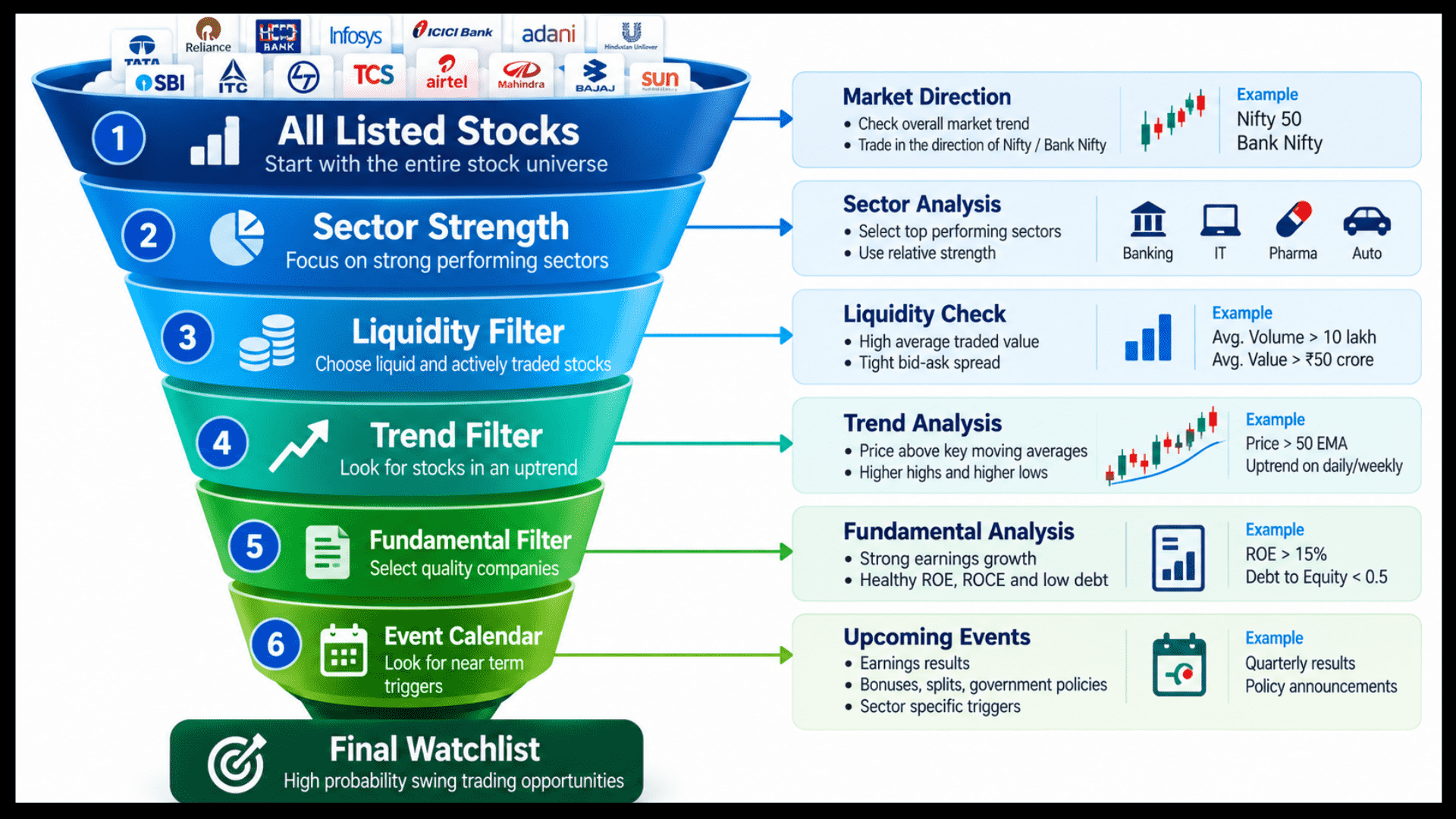
2. The Stock Screener in Action: Narrowing 500 Stocks to a Watchlist
The figures below are illustrative.
Suppose you start with the top 500 stocks by traded value.
The market filter passes, because Nifty trades above both averages.
Sector strength leaves you with three sectors. The liquidity filter cuts the list to about 120 stocks.
The trend filter leaves 30. The fundamental check leaves 12.
The calendar check removes 3 that report results this week.
You end with 9 stocks.
You then study each weekly chart and pick the two or three with the cleanest structure.
What Are the Best Stocks for Positional Trading?
There is no fixed list, and any fixed list goes stale.
The best stocks for positional trading are the ones that pass the screen this month.
In practice, they tend to be liquid large and mid-cap names, in sectors that are leading, with rising earnings and an intact weekly uptrend.
Transitioning from multi-week holding periods to wealth accumulation across several quarters often requires understanding the operational differences highlighted in positional trading vs long Term investing.
Rebuild your list every few weeks. Leaders change.
How to Check If Your Stock Is Outperforming Nifty?
Relative strength shows which stocks lead the market. It is one of the most useful checks on this list.
Compare the stock’s return over the past three and six months with Nifty’s return over the same period.
A stock that beats the index is showing strength.
You can also chart the stock divided by Nifty. A rising line means the stock is outperforming.
A falling line means it is lagging, even if its price is climbing.
Prefer stocks that lead their sector and the index together.
How to Monitor and Manage Your Positional Picks After the Screen?
Screening for candidates is only half the battle; managing them through changing market
conditions dictates your ultimate success.
The following section covers how to adapt your strategy and protect your capital when the broader trend shifts.
What to Do When the Market Stops Trending in Positional Trading?
Screens work best when the market trends up.
In a sideways market, fewer stocks pass, and that is fine.
Do not loosen your filters to find more trades. A short list is a signal that conditions are poor.
In a falling market, keep your position sizes small or stay in cash.
Positional trades against the index have lower odds.
How Often Should You Review Your Positional Trading Portfolio?
Once you own a stock, you still check the same filters. A stock that passed last month can fail today.
Review each position weekly.
Ask whether it is still above its key averages and whether its sector is still leading.
If the answer turns to no, tighten your stop or exit.
Do not wait for a news event to force the decision.
Mistakes to Avoid When Selecting Positional Stocks
The first mistake is chasing a stock after a sharp rally.
A stock that has already run 40% in a month has little margin for error.
The second is ignoring the sector. A good chart inside a weak sector often fails.
The third is holding too many names. Five to eight positions are plenty to manage properly.
Ready to Build a Positional Watchlist With Live Guidance?
Running the filters is simple. Judging which chart is really clean takes practice.
Our best positional trading classes show you how to build and refine a watchlist live, on current Indian charts.
Conclusion
Selecting stocks for positional trading is a process of elimination, not prediction.
Start with the market, move to leading sectors, then filter for liquidity, a clean weekly uptrend, sound fundamentals and a clear event calendar.
What remains is a short watchlist worth your attention.
Keep reviewing each holding weekly, because a stock that passed last month can fail today.
When conditions are poor, a short list is the right answer, not a reason to loosen your filters.
Stay selective, stay patient and let the screen do the heavy lifting.
Frequently Asked Question
Before investing capital, invest your time in learning Stock Market.
Fill in the basic details below and a callback will be arranged for more information: