


If you want to understand delta meaning in options trading, you first need to look at an option chain, where you will spot a column called Delta.
Most beginners skip right past it, which is a major mistake because delta tells you exactly how much an option’s price moves when the underlying stock shifts by one rupee.
Once you understand that, half of options trading starts making sense.
What Does Delta Actually Measure in Options Trading?
Delta is a number between 0 and 1 for call options, and between 0 and -1 for put options.
It shows you the expected price change in the option for every one rupee move in the stock.
Say a call option has a delta of 0.50. If the stock moves up by ₹10, that option’s price moves up by roughly ₹5.
To understand the broader foundations of these metrics, our guide on options greeks explained for beginners provides a clear walkthrough of all core sensitivity measures.
To help traders evaluate how these sensitivity measures shift across complex portfolios..
our guide on gamma scalping explained outlines methods for keeping net exposure balanced.
A put option works the other way. A delta of -0.40 means the option gains about ₹4 in value for every ₹10 fall in the stock.
If you’re still wondering what the purpose of option trading is in the first place, that’s worth understanding before going deeper into the Greeks.
The Hidden Probability Signal Inside Delta
Delta also tells you the rough odds of an option expiring in the money.
A delta of 0.50 suggests roughly a 50% chance. A delta of 0.20 suggests a lower chance, closer to 20%.
This is not an exact probability. It is a useful approximation traders use constantly.
How Does Delta Change as a Stock Moves?
Delta is never a static number throughout the lifecycle of an options contract.
Depending on where the strike price is set relative to the current stock price, delta behaves very differently.
Here is how it changes across the spectrum:
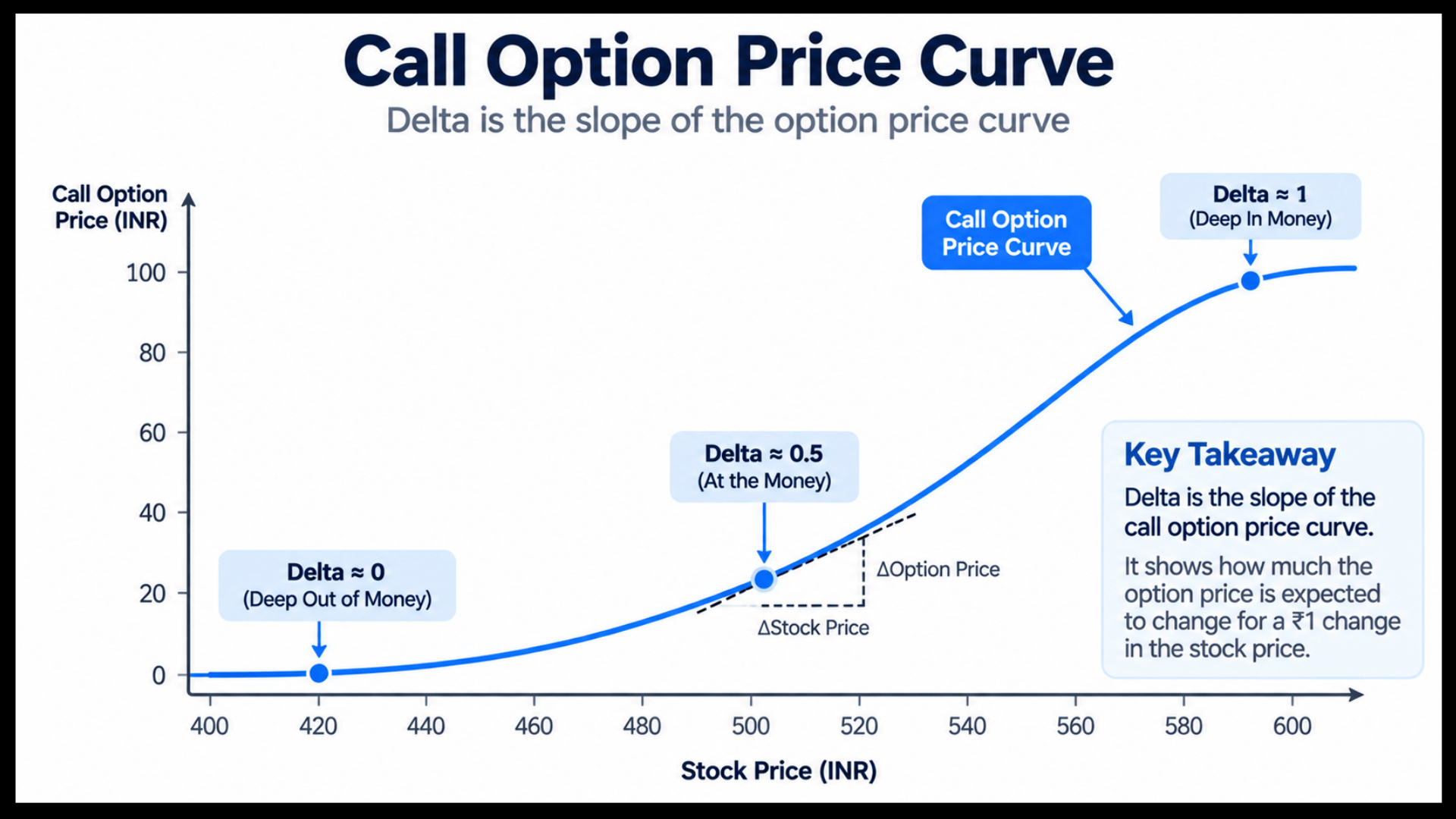
- A deep in-the-money call option has a delta close to 1. It moves almost rupee for rupee with the stock.
- A deep out-of-the-money call option has a delta close to 0. It barely reacts to the stock moving.
- An at-the-money option usually sits near 0.50. This is where delta changes fastest.
That’s exactly why strike selection matters so much. Our guide on how to choose strike price for options covers this relationship in more depth.
ITM, ATM and OTM: Three Labels, One Story
These three terms and delta are really describing the same thing from different angles.
In-the-money options carry higher delta. Out-of-the-money options carry lower delta.
At-the-money sits in the middle, close to 0.50. If this distinction is still new to you, our post on ITM vs OTM breaks it down clearly.
Delta in Action: A Call Option Example
Suppose Reliance Industries trades at ₹2,800. You buy a call option with a strike of ₹2,800, and its delta shows 0.52.
The stock rises to ₹2,830, a move of ₹30. Your option’s price should rise by roughly ₹15.60, based on that 0.52 delta.
If the stock had fallen by ₹30 instead, the option’s value would drop by a similar amount. Delta works both ways.
Why Delta in Options Trading Acts as Your Real Risk Meter?
Delta tells you how much real exposure you are carrying, which matters more than the premium amount alone.
Two options worth the same premium can carry very different delta, and therefore very different risk.
A high delta option behaves almost like owning the stock directly. A low delta option barely reacts to normal price moves.
Knowing your position’s total delta helps you judge how exposed you actually are.
We cover this further in our guide on how to use delta for option buying.
Even with good risk control, some trades will go against you.
That’s when many traders ask, can option trading loss be carried forward?
Under Indian tax laws, futures and options (F&O) trading is legally classified as a non-speculative business income, meaning you can carry forward your net trading losses for up to 8 consecutive years to offset against future business profits—provided you file your Income Tax Return (ITR-3) on time.
Why Delta Changes: The Role of Gamma and Time Decay
Delta rarely works alone. It interacts with gamma, the Greek that measures how fast delta itself changes.
To understand these secondary interactions, our guide on options gamma meaning breaks down how your risk profile scales as the underlying price shifts.
That’s covered in our post on options gamma explained simply.
To master how these second-order derivatives impact your risk parameters during volatile market conditions, our guide on how to use gamma for option selling provides practical strategies for managing open positions.
How Does Delta Work on a Put Option?
Suppose a stock trades at ₹900. You buy a put option with a strike of ₹900, and its delta shows -0.48.
The stock falls to ₹870, a drop of ₹30. Your put option’s value should rise by roughly ₹14.40, based on that -0.48 delta.
If the stock had risen by ₹30 instead, the put would lose a similar amount of value.
The negative sign simply tells you the direction runs opposite to the stock.
Can Delta Move Even When the Stock Doesn’t?
Delta doesn’t only react to price. It also drifts slightly as each day passes, purely from the passage of time.
For an at-the-money option, this drift is usually small.
For an option already in the money, delta tends to creep toward 1 as expiry nears, assuming the stock stays above the strike.
an option out of the money, delta creeps toward 0 over the same period.
This is one more reason a position’s risk profile keeps shifting, even on a quiet day with no major price movement.
Want to See Delta Applied on Live Option Chains?
Reading about delta is one thing. Watching how it shifts on a real option chain, during a live session, is what actually makes it click.
Our option trading classes cover this live, on real Indian stocks.
Conclusion
Delta is the first Greek worth learning properly, since it answers the most basic question in options trading: how much will this option actually move?
It also hints at the odds of expiring in the money and shows the real exposure behind every premium you pay.
Once you can read delta on an option chain, strike selection and position sizing both get easier, because you finally know what you’re holding.
To master the complete risk profile of your trades, our guide on vega meaning in options trading explores how implied volatility impacts your option premium.
From here, it’s worth learning how volatility affects your premium too. Our post on vega meaning in options trading covers that side of the picture.
Frequently Asked Questions
Before investing capital, invest your time in learning Stock Market.
Fill in the basic details below and a callback will be arranged for more information: