



Wondering how to use gamma for option selling? Option sellers often collect steady premium for weeks, then watch a position turn against them fast in the final few days before expiry.
Gamma is usually why.
Understanding this dynamic really means one thing: respect how gamma risk builds as expiry gets closer, and size your position accordingly.
Sellers who ignore this tend to learn it the expensive way.
Why Option Sellers Face Higher Gamma Risk Than Buyers?
Option sellers are structurally short gamma.
Being short gamma means every move against you adds to the loss faster than the one before it.
As the stock moves against a sold position, delta shifts against the seller faster than it would have earlier in the expiry cycle.
This means losses on a short option position can accelerate, not just grow steadily. The same move that cost little early on can cost far more near expiry.
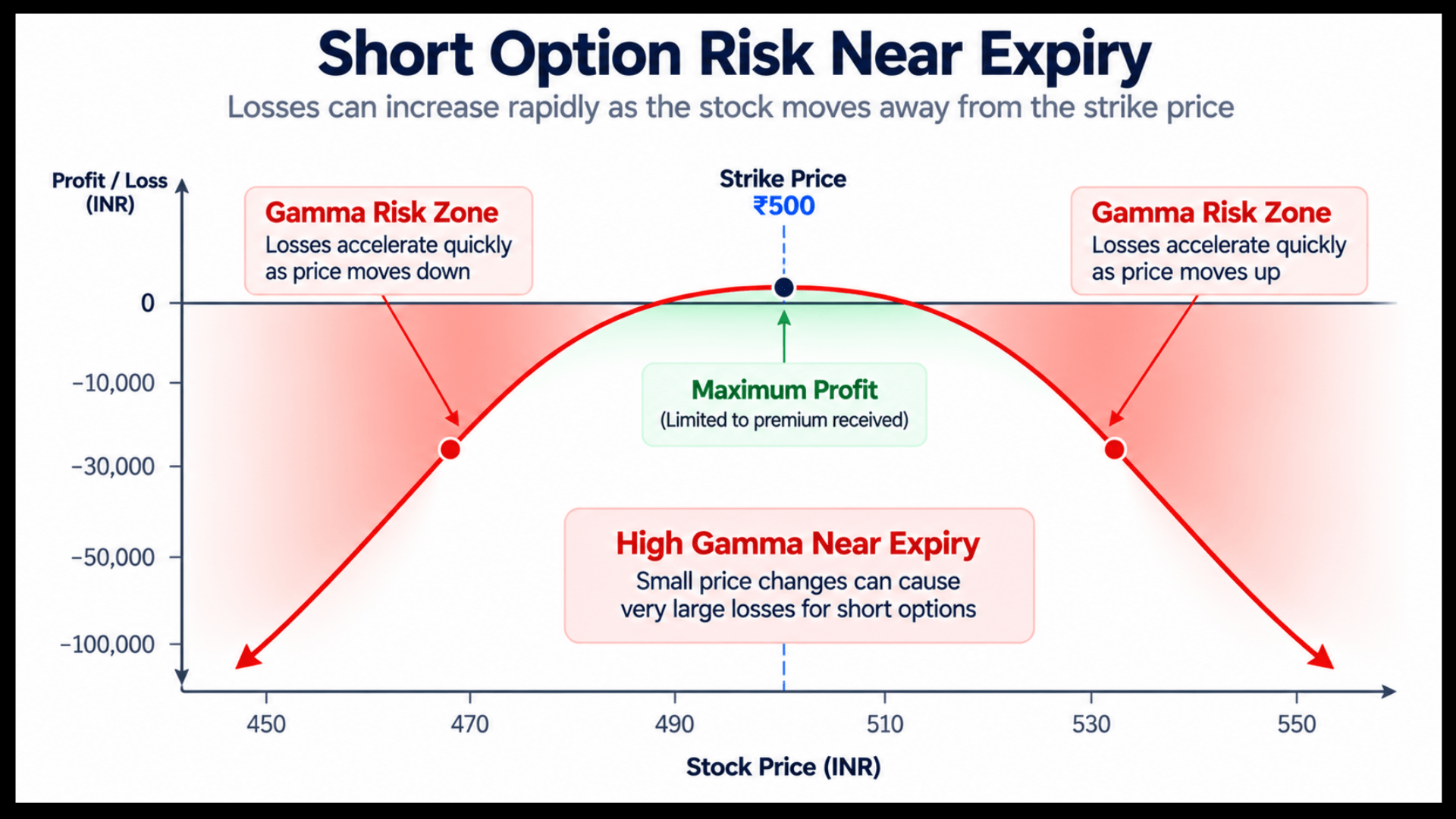
A move that would have been manageable three weeks ago can do real damage in the final few days.
Buyers benefit from this same acceleration. Sellers are on the wrong side of it.
When Do Option Sellers Face Peak Gamma Risk Before Expiry?
Gamma is highest for at-the-money strikes, and it grows sharply in the final week before expiry. Our post on option gamma meaning explains why it peaks near the strike.
This is exactly why many experienced sellers reduce position size, or exit entirely, as their sold strike gets closer to the current stock price near expiry.
Margin requirements often reflect this too.
How to Manage Gamma Risk as an Option Seller?
Here’s a simple set of habits that keep gamma risk from catching you off guard.
Managing gamma risk doesn’t require complex calculations-it comes down to building disciplined routines.
To master these tactical adjustments and learn advanced execution methods, our guide on gamma scalping provides a detailed breakdown of how to trade volatility directly rather than just defending against it.
Incorporate these core habits into your trading workflow to keep accelerating risk from catching you off guard:
- Track how close your sold strike is to the current price, not just the premium collected.
- Reduce size as expiry approaches, especially if your strike is near the money.
- Set a clear exit rule for when the stock moves close to your strike, rather than deciding in the moment.
- Avoid holding large short positions through the final two trading sessions unless you have a specific, tested reason to.
None of this eliminates risk. It keeps you from being surprised by how fast it can grow.
Gamma Risk in Action: A Worked Example
Suppose you sell a call option two weeks before expiry, with the stock trading comfortably below your strike. Gamma is low, and the position behaves predictably day to day.
With three days left, the stock rallies and gets close to your strike.
Gamma has grown significantly by now, and the same size move that barely affected your position last week now moves it sharply.
If that shift feels unclear, our guide on delta meaning in options trading shows how delta drives a position’s daily change.
A seller who sized the position assuming week-one behaviour can be caught out. Without adjusting for rising gamma, they end up holding far more risk than planned.
How Strike Selection Impacts Gamma Risk for Option Sellers?
Selling further from the current price generally means lower gamma risk. The option is less likely to move into the at-the-money zone where gamma peaks.
This is part of a broader decision that also involves delta and premium.
Our post on how to choose strike price for options covers how these factors fit together when you’re deciding where to sell.
Two Sellers, Same Trade: Why Did Only One Lose Big?
Suppose two traders each sell a call option at the same strike, three weeks before expiry. These figures are illustrative.
The first trader checks the position daily and notices the stock drifting closer to the strike in the final week.
They reduce their position size as gamma rises, accepting a smaller profit in exchange for lower risk.
The second trader leaves the position unchanged, assuming it will behave the way it did in week one.
A sharp move in the final two days, driven partly by rising gamma, causes a loss far larger than the premium they originally collected.
A jump in volatility can add to that damage, which our post on vega meaning in options trading explains.
Same trade, same strike. Very different outcomes, purely from how each trader managed growing gamma risk.
Why Gamma Risk Hits Nifty and Bank Nifty Options Harder?
Yes, and often more visibly. Weekly index options on Nifty and Bank Nifty see gamma build quickly in their final one or two sessions.
The entire market is watching the same strikes near the current price.
Sellers who write weekly index options close to the money should expect this acceleration as a routine part of the trade, not an unusual event.
Before writing weekly contracts, be clear on what is the purpose of option trading in your own plan, whether income or hedging.
Want to Learn Option Selling With Proper Risk Controls?
Managing gamma risk as a seller takes real discipline, built through practice, not just theory.
Our best option trading classes cover this live, on real Indian stocks.
Conclusion
Gamma is the reason a comfortable option-selling position can turn uncomfortable fast, usually in the final stretch before expiry.
Understanding this doesn’t mean avoiding option selling. It means sizing and managing positions with this acceleration in mind, instead of discovering it the hard way.
Track your strike’s distance from the price, cut size as expiry nears, and set exit rules in advance.
Buyers sit on the other side of this acceleration, which our post on how to use delta for option buying covers in detail.
Frequently Asked Questions
Before investing capital, invest your time in learning Stock Market.
Fill in the basic details below and a callback will be arranged for more information: